中英对照 · IEEE TPAMI 44(7), 2022, 3523–3542 · DOI 10.1109/TPAMI.2021.3059968
英文底本: Image Segmentation Using Deep Learning: A Survey
阅读文件: 中文 PDF · 术语和原文异文说明 · 源映射
按节跳转: 1 引言 · 2 深度神经网络架构 · 3 基于深度学习的图像分割模型 · 4 数据集 · 5 深度学习分割模型的性能 · 6 挑战与机遇 · 7 结论 · 参考文献 · 作者简介
按原文 PDF 页码跳转: p.1 · p.2 · p.3 · p.4 · p.5 · p.6 · p.7 · p.8 · p.9 · p.10 · p.11 · p.12 · p.13 · p.14 · p.15 · p.16 · p.17 · p.18 · p.19 · p.20
Source: p.1 S001
ENImage Segmentation Using Deep Learning: A Survey
Source: p.1 S002
ENShervin Minaee, Member, IEEE, Yuri Boykov, Member, IEEE, Fatih Porikli, Fellow, IEEE, Antonio Plaza, Fellow, IEEE, Nasser Kehtarnavaz, Fellow, IEEE, and Demetri Terzopoulos, Fellow, IEEE
中Shervin Minaee(IEEE 会员)、Yuri Boykov(IEEE 会员)、Fatih Porikli(IEEE 会士)、Antonio Plaza(IEEE 会士)、Nasser Kehtarnavaz(IEEE 会士)和 Demetri Terzopoulos(IEEE 会士)
ORCID: https://orcid.org/0000-0001-6689-9221 · https://orcid.org/0000-0001-6374-1736 · https://orcid.org/0000-0002-1520-4466 · https://orcid.org/0000-0002-9613-1659 · https://orcid.org/0000-0001-5183-6359
摘要
Source: p.1 S003
ENAbstract—Image segmentation is a key task in computer vision and image processing with important applications such as scene understanding, medical image analysis, robotic perception, video surveillance, augmented reality, and image compression, among others, and numerous segmentation algorithms are found in the literature. Against this backdrop, the broad success of deep learning (DL) has prompted the development of new image segmentation approaches leveraging DL models. We provide a comprehensive review of this recent literature, covering the spectrum of pioneering efforts in semantic and instance segmentation, including convolutional pixel-labeling networks, encoder-decoder architectures, multiscale and pyramid-based approaches, recurrent networks, visual attention models, and generative models in adversarial settings. We investigate the relationships, strengths, and challenges of these DL-based segmentation models, examine the widely used datasets, compare performances, and discuss promising research directions.
中摘要 图像分割是计算机视觉和图像处理中的一项关键任务,在场景理解、医学图像分析、机器人感知、视频监控、增强现实和图像压缩等方面有重要应用。现有文献已提出大量分割算法。在此背景下,深度学习(DL)的广泛成功推动了新的图像分割方法的发展,这些方法利用深度学习模型完成分割。本文全面回顾这一时期的文献,涵盖语义分割和实例分割中的各类开创性工作,包括基于卷积的像素标注网络、编码器-解码器架构、多尺度与金字塔方法、循环网络、视觉注意力模型,以及在对抗框架下使用生成模型的方法。我们考察这些深度学习分割模型之间的关系、各自优势及所面临的挑战,介绍广泛使用的数据集,对比模型性能,并讨论有前景的研究方向。
Source: p.1 S004
ENIndex Terms—Image segmentation, deep learning, convolutional neural networks, encoder-decoder models, recurrent models, generative models, semantic segmentation, instance segmentation, panoptic segmentation, medical image segmentation
中索引词 图像分割、深度学习、卷积神经网络、编码器-解码器模型、循环模型、生成模型、语义分割、实例分割、全景分割、医学图像分割
1 引言
Source: p.1 S005
Source: p.1 S006
ENIMAGE segmentation has been a fundamental problem in computer vision since the early days of the field [1] (Chapter 8). An essential component of many visual understanding systems, it involves partitioning images (or video frames) into multiple segments and objects [2] (Chapter 5) and plays a central role in a broad range of applications [3] (Part VI), including medical image analysis (e.g., tumor boundary extraction and measurement of tissue volumes), autonomous vehicles (e.g., navigable surface and pedestrian detection), video surveillance, and augmented reality to name a few.
中从计算机视觉学科的早期发展起,图像分割就是其中的一个基本问题[1](第8章)。它把图像(或视频帧)划分为多个区域和对象[2](第5章),是许多视觉理解系统的重要组成部分,在多种应用中起核心作用[3](第VI部分),例如医学图像分析(提取肿瘤边界和测量组织体积)、自动驾驶车辆(检测可通行表面和行人)、视频监控及增强现实。
Source: p.1 S007
ENImage segmentation can be formulated as the problem of classifying pixels with semantic labels (semantic segmentation), or partitioning of individual objects (instance segmentation), or both (panoptic segmentation). Semantic segmentation performs pixel-level labeling with a set of object categories (e.g., human, car, tree, sky) for all image pixels; thus, it is generally a more demanding undertaking than whole-image classification, which predicts a single label for the entire image. Instance segmentation extends the scope of semantic segmentation by detecting and delineating each object of interest in the image (e.g., individual people).
中图像分割可以表述为对像素赋予语义类别(语义分割)、把不同对象实例分开(实例分割),或同时完成两者(全景分割)。语义分割从一组对象类别中(如人、汽车、树、天空)为图像中的每个像素赋予标签;因此,它通常比仅为整幅图像预测一个标签的图像分类更难。实例分割进一步扩展了语义分割的范围,要求检测并勾画图像中每个感兴趣对象(例如把每个人分别找出来)。
Source: p.1 S008
ENNumerous image segmentation algorithms have been developed in the literature, from the earliest methods, such as thresholding [4], histogram-based bundling, region-growing [5], k-means clustering [6], watershed methods [7], to more advanced algorithms such as active contours [8], graph cuts [9], conditional and Markov random fields [10], and sparsity-based [11], [12] methods. In recent years, however, deep learning (DL) models have yielded a new generation of image segmentation models with remarkable performance improvements, often achieving the highest accuracy rates on popular benchmarks (e.g.,
Fig. 1). This has caused a paradigm shift in the field.
中文献中已有大量图像分割算法。从最早的阈值法[4]、基于直方图的分组、区域生长[5]、k 均值聚类[6]和分水岭法[7],发展到主动轮廓[8]、图割[9]、条件随机场和马尔可夫随机场[10]以及基于稀疏性的方法[11]、[12]。近年来,深度学习(DL)模型催生了新一代图像分割模型,其性能显著提升,常在常用基准上取得最高准确率(例如
图1)。这使该领域的研究范式发生转变。
图1
Placed near: p.1 S008
Source: p.2 F001 / C001

ENFig. 1. Segmentation results of DeepLabV3 [13] on sample images.
中图1 DeepLabV3[13]在示例图像上的分割结果。
Source: p.1 S009
ENThis survey, a revised version of [14], covers the recent literature in deep-learning-based image segmentation, including more than 100 such segmentation methods proposed to date. It provides a comprehensive review with insights into different aspects of these methods, including the training data, the choice of network architectures, loss functions, training strategies, and their key contributions. The target literature is organized into the following categories:
中本文是文献[14]的修订版,回顾了基于深度学习的图像分割近期研究,涵盖截至撰稿时提出的100多种分割方法。我们从训练数据、网络架构选择、损失函数、训练策略和主要贡献等方面进行全面评述。所综述的文献分为以下几类:
Source: p.1 S010
EN1) Fully convolutional networks
Source: p.1 S011
EN2) Convolutional models with graphical models
Source: p.1 S012
EN3) Encoder-decoder based models
Source: p.1 S013
EN4) Multiscale and pyramid network based models
Source: p.1 S014
EN5) R-CNN based models (for instance segmentation)
Source: p.1 S015
EN6) Dilated convolutional models and DeepLab family
Source: p.1 S016
EN7) Recurrent neural network based models
Source: p.2 S017
EN8) Attention-based models
Source: p.2 S018
EN9) Generative models and adversarial training
Source: p.2 S019
EN10) Convolutional models with active contour models
Source: p.2 S020
Source: p.2 S021
Source: p.2 S022
ENwe provide a comprehensive review and analysis of deep-learning-based image segmentation algorithms;
Source: p.2 S023
ENwe overview popular image segmentation datasets, grouped into 2D and 2.5D (RGB-D) images;
中介绍常用图像分割数据集,分为二维图像和2.5维(RGB-D)图像;
Source: p.2 S024
ENwe summarize the performances of the reviewed segmentation methods on popular benchmarks;
Source: p.2 S025
ENwe discuss several challenges and future research directions for deep-learning-based image segmentation.
中讨论基于深度学习的图像分割面临的若干挑战和未来研究方向。
Source: p.2 S026
ENThe remainder of this survey is organized as follows: Section 2 overviews popular Deep Neural Network (DNN) architectures that serve as the backbones of many modern segmentation algorithms. Section 3 reviews the most significant state-of-the-art deep learning based segmentation models. Section 4 overviews some of the most popular image segmentation datasets and their characteristics. Section 5 lists popular metrics for evaluating deep-learning-based segmentation models and tabulates model performances. Section 6 discusses the main challenges and opportunities of deep learning-based segmentation methods. Section 7 presents our conclusions.
中本文其余部分安排如下:第2节概述许多现代分割算法用作骨干网络的常用深度神经网络(DNN)架构。第3节回顾最具代表性的先进深度学习分割模型。第4节介绍若干最常用的图像分割数据集及其特点。第5节列出用于评估深度学习分割模型的常用指标,并以表格汇总模型性能。第6节讨论深度学习分割方法的主要挑战与机会。第7节给出结论。
2 深度神经网络架构
Source: p.2 S027
EN2 DEEP NEURAL NETWORK ARCHITECTURES
Source: p.2 S028
ENThis section provides an overview of prominent DNN architectures used by the computer vision community, including convolutional neural networks, recurrent neural networks and long short-term memory, encoder-decoder and autoencoder models, and generative adversarial networks. Due to space limitations, several other DNN architectures that have been proposed, among them transformers, capsule networks, gated recurrent units, and spatial transformer networks, will not be covered.
中本节概述计算机视觉研究中常用的几种深度神经网络架构:卷积神经网络、循环神经网络与长短期记忆网络、编码器-解码器与自编码器模型,以及生成对抗网络。限于篇幅,本文不讨论已提出的若干其他架构,包括 Transformer、胶囊网络、门控循环单元和空间变换网络。
2.1 卷积神经网络(CNN)
Source: p.2 S029
EN2.1 Convolutional Neural Networks (CNNs)
Source: p.2 S030
ENCNNs are among the most successful and widely used architectures in the deep learning community, especially for computer vision tasks. CNNs were initially proposed by Fukushima [16] in his seminal paper on the “Neocognitron”, which was based on Hubel and Wiesel’s hierarchical receptive field model of the visual cortex. Subsequently, Waibel et al. [17] introduced CNNs with weights shared among temporal receptive fields and backpropagation training for phoneme recognition, and LeCun et al. [15] developed a practical CNN architecture for document recognition (
Fig. 2). CNNs usually include three types of layers: i) convolutional layers, where a kernel (or filter) of weights is convolved to extract features; ii) nonlinear layers, which apply (usually element-wise) an activation function to feature maps, thus enabling the network to model nonlinear functions; and iii) pooling layers, which reduce spatial resolution by replacing small neighborhoods in a feature map with some statistical information about those neighborhoods (mean, max, etc.). The neuronal units in layers are locally connected; that is, each unit receives weighted inputs from a small neighborhood, known as the receptive field, of units in the previous layer. By stacking layers to form multi-resolution pyramids, the higher-level layers learn features from increasingly wider receptive fields. The main computational advantage of CNNs is that all the receptive fields in a layer share weights, resulting in a significantly smaller number of parameters than fully-connected neural networks. Some of the most well known CNN architectures include AlexNet [18], VGGNet [19], and ResNet [20].
中CNN 是深度学习领域最成功、应用最广的架构之一,尤其适用于计算机视觉任务。Fukushima[16]最早在关于“新认知机”(Neocognitron)的奠基性论文中提出 CNN,其依据是 Hubel 和 Wiesel 关于视觉皮层分层感受野的模型。随后,Waibel 等[17]引入在时间感受野之间共享权重、用反向传播训练的 CNN,用于音素识别;LeCun 等[15]面向文档识别开发了一种实用的 CNN 架构(
图2)。CNN 通常包含三类层:i)卷积层,用一组权重构成的核(或滤波器)做卷积以提取特征;ii)非线性层,对特征图施加激活函数(通常逐元素运算),使网络能够对非线性函数建模;iii)池化层,通过以统计量(均值、最大值等)代替特征图中的局部邻域来降低空间分辨率。不同层的神经元之间局部连接,即每个神经元仅接收前一层一个小邻域(即感受野)内神经元的加权输入。把多层堆叠成多分辨率金字塔后,层级越高,学习特征所用的感受野就越大。CNN 在计算上的主要优势是同一层的所有感受野都共享权重,因此参数数量显著少于全连接神经网络。最著名的 CNN 架构包括 AlexNet[18]、VGGNet[19]和 ResNet[20]。
图2
Placed near: p.2 S030
Source: p.2 F002 / C002

ENFig. 2. Architecture of CNNs. From [15].
中图2 卷积神经网络(CNN)的架构。引自[15]。
图表词汇: Input:输入;Convolution:卷积;Pooling:池化;Fully-connected:全连接;Output:输出。
2.2 循环神经网络(RNN)与长短期记忆网络(LSTM)
Source: p.2 S031
EN2.2 Recurrent Neural Networks (RNNs) and the LSTM
中2.2 循环神经网络(RNN)与长短期记忆网络(LSTM)
Source: p.2 S032
ENRNNs [22] are commonly used to process sequential data, such as speech, text, videos, and time-series. Referring to
Fig. 3, at each time step t the model collects the input xₜ and the hidden state hₜ₋₁ from the previous step, and outputs a target value oₜ and the next hidden state hₜ₊₁. RNNs are typically problematic for long sequences as they cannot capture long-term dependencies in many real-world applications and often suffer from gradient vanishing or exploding problems. However, a type of RNN known as the Long Short-Term Memory (LSTM) [23] is designed to avoid these issues. The LSTM architecture (
Fig. 4) includes three gates (input gate, output gate, and forget gate) that regulate the flow of information into and out of a memory cell that stores values over arbitrary time intervals.
中RNN[22]常用来处理语音、文本、视频和时间序列等序列数据。如
图3所示,在每个时间步 t,模型接收当前输入 xₜ 和前一步的隐藏状态 hₜ₋₁,输出目标值 oₜ 及下一隐藏状态 hₜ₊₁。RNN 处理长序列时往往会遇到困难:在许多实际应用中难以捕捉长期依赖关系,也常出现梯度消失或梯度爆炸。长短期记忆网络(LSTM)[23]是为避免这些问题而设计的一类 RNN。LSTM 架构(
图4)包含输入门、输出门和遗忘门,用于调节信息进出记忆单元;该单元可在任意长的时间间隔内保存数值。
图3
Placed near: p.2 S032
Source: p.2 F003 / C003

ENFig. 3. Architecture of a simple RNN. Courtesy of Christopher Olah [21].
中图3 简单循环神经网络(RNN)的架构。Christopher Olah 提供[21]。
图表词汇: Unfold:按时间展开;x、h、o 分别表示输入、隐藏状态和输出。
图4
Placed near: p.2 S032
Source: p.3 F004 / C004

ENFig. 4. Architecture of a standard LSTM module. Courtesy of Olah [21].
中图4 标准 LSTM 模块的架构。Olah 提供[21]。
2.3 编码器-解码器与自编码器模型
Source: p.2 S033
EN2.3 Encoder-Decoder and Auto-Encoder Models
Source: pp.2–3 S034
ENEncoder-decoders [24], [25] are a family of models that learn to map data-points from an input domain to an output domain via a two-stage network (
Fig. 5): The encoder, performing an encoding function z = g(x), compresses the input x into a latent-space representation z, while the decoder y = f(z) predicts the output y from z. The latent, or feature (vector), representation captures the semantic information of the input useful in predicting the output. Such models are popular for sequence-to-sequence modeling in Natural Language Processing (NLP) applications as well as in image-to-image translation, where the output could be an enhanced version of the image (such as in image deblurring, or super-resolution) or a segmentation map. Autoencoders are a special case of encoder-decoder models in which the input and output are the same.
中编码器-解码器[24]、[25]是一类用两阶段网络学习从输入域到输出域映射的模型(
图5)。编码器用编码函数 z = g(x) 把输入 x 压缩成潜在空间表示 z;解码器则用 y = f(z) 根据 z 预测输出 y。潜在表示,也称特征(向量)表示,保留了输入中有助于预测输出的语义信息。这类模型常用于自然语言处理(NLP)的序列到序列建模,也用于图像到图像的转换;在后者中,输出可以是增强后的图像(例如去模糊或超分辨率结果),也可以是分割图。自编码器是编码器-解码器模型的一种特殊情况,其输入和输出相同。
图5
Placed near: pp.2–3 S034
Source: p.3 F005 / C005

ENFig. 5. Architecture of a simple encoder-decoder model.
图表词汇: 从左到右:输入图像、编码器、潜在表示、解码器、输出图。
2.4 生成对抗网络(GAN)
Source: p.3 S035
EN2.4 Generative Adversarial Networks (GANs)
Source: p.3 S036
ENGANs [26] are a newer family of deep learning models. They consist of two networks—a generator and a discriminator (
Fig. 6). In the conventional GAN, the generator network G learns a mapping from noise z (with a prior distribution) to a target distribution y, which is similar to the “real” samples. The discriminator network D attempts to distinguish the generated “fake” samples from the real ones. The GAN may be characterized as a minimax game between G and D, where D tries to minimize its classification error in distinguishing fake samples from real ones, hence maximizing a loss function, and G tries to maximize the discriminator network’s error, hence minimizing the loss function. GAN variants include Convolutional-GANs [27], conditional-GANs [28], and Wasserstein-GANs [29].
中GAN[26]是一类相对较新的深度学习模型,由生成器和判别器两个网络组成(
图6)。在传统 GAN 中,生成器网络 G 学习把具有先验分布的噪声 z 映射到接近真实样本分布的目标分布 y。判别器网络 D 尝试区分生成的“假”样本与真实样本。GAN 可以看作 G 和 D 之间的一场极小极大博弈:D 试图降低辨别真假样本时的分类误差,从而最大化损失函数;G 则试图让判别器的误差最大化,从而最小化该损失函数。GAN 的变体包括卷积 GAN[27]、条件 GAN[28]和 Wasserstein GAN[29]。
图6
Placed near: p.3 S036
Source: p.3 F006 / C006
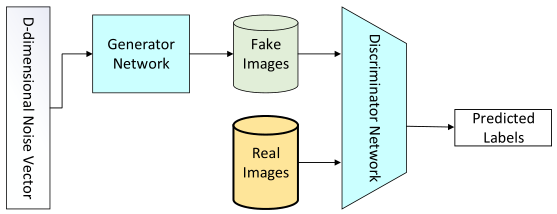
ENFig. 6. Architecture of a GAN. Courtesy of Ian Goodfellow.
中图6 生成对抗网络(GAN)的架构。Ian Goodfellow 提供。
图表词汇: 噪声向量经生成器产生假图像,判别器接收假图像和真图像,输出预测标签。
3 基于深度学习的图像分割模型
Source: p.3 S037
EN3 DL-BASED IMAGE SEGMENTATION MODELS
Source: p.3 S038
ENThis section is a survey of numerous learning-based segmentation methods, grouped into 10 categories based on their model architectures. Several architectural features are common among many of these methods, such as encoders and decoders, skip-connections, multiscale architectures, and more recently the use of dilated convolutions. It is convenient to group models based on their architectural contributions over prior models.
中本节回顾多种基于学习的分割方法,按模型架构归为10类。许多方法共享若干架构特征,如编码器和解码器、跳跃连接、多尺度架构,以及较晚出现的空洞卷积。根据各模型相对于既有模型的架构贡献对其归类,是一种方便的组织方式。
3.1 全卷积模型
Source: p.3 S039
EN3.1 Fully Convolutional Models
Source: p.3 S040
ENLong et al. [30] proposed Fully Convolutional Networks (FCNs), a milestone in DL-based semantic image segmentation models. An FCN (
Fig. 7) includes only convolutional layers, which enables it to output a segmentation map whose size is the same as that of the input image. To handle arbitrarily-sized images, the authors modified existing CNN architectures, such as VGG16 and GoogLeNet, by removing all fully-connected layers such that the model outputs a spatial segmentation map instead of classification scores.
中Long 等[30]提出的全卷积网络(FCN)是深度学习语义图像分割模型的一座里程碑。FCN(
图7)只包含卷积层,可以输出与输入图像尺寸相同的分割图。为了处理任意尺寸的图像,作者修改了 VGG16、GoogLeNet 等现有 CNN 架构,删去所有全连接层,使模型输出空间分割图而不是分类得分。
图7
Placed near: p.3 S040
Source: p.3 F007 / C007

ENFig. 7. The FCN learns to make pixel-accurate predictions. From [30].
中图7 全卷积网络(FCN)学习进行精确的逐像素预测。引自[30]。
图表词汇: Forward/inference:前向/推理;Backward/learning:反向/学习;Pixelwise prediction:逐像素预测。
Source: p.3 S041
ENThrough the use of skip connections (
Fig. 8) in which feature maps from the final layers of the model are up-sampled and fused with feature maps of earlier layers, the model combines semantic information (from deep, coarse layers) and appearance information (from shallow, fine layers) in order to produce accurate and detailed segmentations. Tested on PASCAL VOC, NYUDv2, and SIFT Flow, the model achieved state-of-the-art segmentation performance.
中FCN 利用跳跃连接(
图8),将模型末端层的特征图上采样,并与前面层的特征图融合。这样就能结合来自深层、低分辨率层的语义信息与来自浅层、高分辨率层的外观信息,从而获得准确且细致的分割结果。在 PASCAL VOC、NYUDv2 和 SIFT Flow 上测试时,该模型达到了当时最先进的分割性能。
图8
Placed near: p.3 S041
Source: p.3 F008 / C008

ENFig. 8. Skip connections combine coarse and fine information. From [30].
中图8 跳跃连接融合粗粒度和细粒度信息。引自[30]。
Source: pp.3–4 S042
ENFCNs have been applied to a variety of segmentation problems, such as brain tumor segmentation [31], instance-aware semantic segmentation [32], skin lesion segmentation [33], and iris segmentation [34]. While demonstrating that DNNs can be trained to perform semantic segmentation in an end-to-end manner on variable-sized images, the conventional FCN model has some limitations—it is too computationally expensive for real-time inference, it does not account for global context information in an efficient manner, and it is not easily generalizable to 3D images. Several researchers have attempted to overcome some of the limitations of the FCN. For example, Liu et al. [35] proposed ParseNet (
Fig. 9), which adds global context to FCNs by using the average feature for a layer to augment the features at each location. The feature map for a layer is pooled over the whole image, resulting in a context vector. The context vector is normalized and unpooled to produce new feature maps of the same size as the initial ones, which are then concatenated, which amounts to an FCN whose convolutional layers are replaced by the described module (
Fig. 9e).
中FCN 已用于多种分割问题,例如脑肿瘤分割[31]、实例感知语义分割[32]、皮肤病灶分割[33]和虹膜分割[34]。它表明,深度神经网络可以通过端到端训练对不同尺寸的图像进行语义分割。不过,传统 FCN 有一些局限:计算开销太大,难以用于实时推理;无法有效纳入全局上下文信息;也不易推广到三维图像。一些研究尝试克服这些局限。例如,Liu 等[35]提出 ParseNet(
图9),利用某层的平均特征增强各位置处的特征,把全局上下文引入 FCN。做法是对该层的特征图在整幅图像上池化,得到一个上下文向量,再把该向量归一化并反池化,生成与原特征图同样大小的新特征图。随后将新、旧特征图拼接;这相当于用所述模块替代 FCN 的卷积层(
图9e)。
图9
Placed near: pp.3–4 S042
Source: p.4 F009 / C009

ENFig. 9. The ParseNet (e) uses extra global context to produce a segmentation (d) smoother than that of an FCN (c). From [35].
中图9 ParseNet 的结构见 (e)。它引入额外的全局上下文,得到的分割结果 (d) 比 FCN 的结果 (c) 更平滑。引自[35]。
图表词汇: 图中 Image:原图;Truth:真值;Global Average Pooling:全局平均池化;L2 Norm:L2 归一化;UnPool:反池化。
3.2 结合图模型的 CNN
Source: p.4 S043
EN3.2 CNNs With Graphical Models
Source: p.4 S044
ENAs discussed, the FCN ignores potentially useful scene-level semantic context. To exploit more context, several approaches incorporate into DL architectures probabilistic graphical models, such as Conditional Random Fields (CRFs) and Markov Random Fields (MRFs).
中如前所述,FCN 忽略了可能有用的场景级语义上下文。为了利用更多上下文,一些方法把条件随机场(CRF)和马尔可夫随机场(MRF)等概率图模型纳入深度学习架构。
Source: p.4 S045
ENDue to the invariance properties that make CNNs good for high level tasks such as classification, responses from the later layers of deep CNNs are not sufficiently well localized for accurate object segmentation. To address this drawback, Chen et al. [36] proposed a semantic segmentation algorithm that combines CNNs and fully-connected CRFs (
Fig. 10). They showed that their model can localize segment boundaries with higher accuracy than was possible with previous methods.
中不变性使 CNN 擅长分类等高层任务,却也意味着深层 CNN 后部各层的响应定位不够精确,因而不利于准确分割对象。为弥补这一不足,Chen 等[36]提出将 CNN 与全连接 CRF 相结合的语义分割算法(
图10)。结果表明,该模型定位分割边界的准确率高于此前的方法。
图10
Placed near: p.4 S045
Source: p.4 F010 / C010

ENFig. 10. A CNN+CRF model. From [36].
中图10 结合 CNN 与 CRF 的模型。引自[36]。
图表词汇: Coarse Score Map:粗分辨率得分图;Bi-linear Interpolation:双线性插值;Fully Connected CRF:全连接 CRF。
Source: p.4 S046
ENSchwing and Urtasun [37] proposed a fully-connected deep structured network for image segmentation. They jointly trained CNNs and fully-connected CRFs for semantic image segmentation, and achieved encouraging results on the challenging PASCAL VOC 2012 dataset. Zheng et al. [38] proposed a similar semantic segmentation approach. In related work, Lin et al. [39] proposed an efficient semantic segmentation model based on contextual deep CRFs. They explored “patch-patch” context (between image regions) and “patch-background” context to improve semantic segmentation through the use of contextual information.
中Schwing 和 Urtasun[37]提出一种用于图像分割的全连接深度结构化网络。他们联合训练 CNN 和全连接 CRF 来做图像语义分割,并在颇具挑战性的 PASCAL VOC 2012 数据集上取得了令人鼓舞的结果。Zheng 等[38]提出了类似的语义分割方法。在相关工作中,Lin 等[39]提出了一种基于上下文深度 CRF 的高效语义分割模型。他们研究了图像区域之间的“区域-区域”上下文和“区域-背景”上下文,用这些上下文信息改进语义分割。
Source: p.4 S047
ENLiu et al. [40] proposed a semantic segmentation algorithm that incorporates rich information into MRFs, including high-order relations and mixture of label contexts. Unlike previous efforts that optimized MRFs using iterative algorithms, they proposed a CNN model, namely a Parsing Network, which enables deterministic end-to-end computation in one pass.
中Liu 等[40]提出一种语义分割算法,把高阶关系和多种标签上下文的混合等丰富信息纳入 MRF。以往方法通常用迭代算法优化 MRF;他们则提出一种名为解析网络(Parsing Network)的 CNN 模型,可在一次前向过程中完成确定性的端到端计算。
3.3 基于编码器-解码器的模型
Source: p.4 S048
EN3.3 Encoder-Decoder Based Models
Source: p.4 S049
ENMost of the popular DL-based segmentation models use some kind of encoder-decoder architecture. We group these models into two categories: those for general image segmentation, and those for medical image segmentation.
中大多数常用的深度学习分割模型都采用某种形式的编码器-解码器架构。我们将这类模型按用途分为通用图像分割和医学图像分割两类。
3.3.1 通用图像分割
Source: p.4 S050
EN3.3.1 General Image Segmentation
Source: p.4 S051
ENNoh et al. [41] introduced semantic segmentation based on deconvolution (a.k.a. transposed convolution). Their model, DeConvNet (
Fig. 11), consists of two parts, an encoder using convolutional layers adopted from the VGG 16-layer network and a multilayer deconvolutional network that inputs the feature vector and generates a map of pixel-accurate class probabilities. The latter comprises deconvolution and unpooling layers, which identify pixel-wise class labels and predict segmentation masks.
中Noh 等[41]引入了基于反卷积(也称转置卷积)的语义分割。其模型 DeConvNet(
图11)由两部分组成:采用16层 VGG 网络卷积层的编码器,以及接收特征向量并生成逐像素类别概率图的多层反卷积网络。后者包含反卷积层和反池化层,用来识别逐像素类别标签并预测分割掩膜。
图11
Placed near: p.4 S051
Source: p.4 F011 / C011

ENFig. 11. Deconvolutional semantic segmentation. From [41].
Source: p.4 S052
ENBadrinarayanan et al. [25] proposed SegNet, a fully convolutional encoder-decoder architecture for image segmentation (
Fig. 12). Similar to the deconvolution network, the core trainable segmentation engine of SegNet consists of an encoder network, which is topologically identical to the 13 convolutional layers of the VGG16 network, and a corresponding decoder network followed by a pixel-wise classification layer. The main novelty of SegNet is in the way the decoder upsamples its lower-resolution input feature map(s); specifically, using pooling indices computed in the maxpooling step of the corresponding encoder to perform non-linear up-sampling.
中Badrinarayanan 等[25]提出用于图像分割的全卷积编码器-解码器架构 SegNet(
图12)。与上述反卷积网络类似,SegNet 可训练的核心分割模块由编码器、对应的解码器以及其后的逐像素分类层组成;编码器的拓扑结构和 VGG16 的13个卷积层相同。SegNet 的主要创新在于解码器如何对低分辨率的输入特征图执行上采样:它利用对应编码器在最大池化步骤中得到的池化索引进行非线性上采样。
图12
Placed near: p.4 S052
Source: p.4 F012 / C012

ENFig. 12. The SegNet model. From [25].
图表词汇: Pooling Indices:池化索引;绿色为池化,红色为上采样,黄色为 Softmax。
Source: pp.4–5 S053
ENA limitation of encoder-decoder based models is the loss of fine-grained image information, due to the loss of resolution through the encoding process. HRNet [42] (
Fig. 13) addresses this shortcoming. Other than recovering high-resolution representations as is done in DeConvNet, SegNet, and other models, HRNet maintains high-resolution representations through the encoding process by connecting the high-to-low resolution convolution streams in parallel and repeatedly exchanging the information across resolutions. There are four stages: the 1st stage consists of high-resolution convolutions, while the 2nd/3rd/4th stage repeats 2-resolution/ 3-resolution/4-resolution blocks. Several recent semantic segmentation models use HRNet as a backbone.
中基于编码器-解码器的模型有一个局限:编码会降低分辨率,致使图像的细粒度信息丢失。HRNet[42](
图13)解决了这一问题。不同于 DeConvNet、SegNet 等模型靠恢复来获得高分辨率表示,HRNet 把从高分辨率到低分辨率的不同卷积分支并联,并让各分辨率分支反复交换信息,从而在整个编码过程中维持高分辨率表示。HRNet 有四个阶段:第1阶段采用高分辨率卷积,第2/3/4阶段分别重复使用含2/3/4种分辨率的模块。近年有多种语义分割模型以 HRNet 为骨干网络。
图13
Placed near: pp.4–5 S053
Source: p.4 F013 / C013

ENFig. 13. The HRNet architecture. From [42].
图表词汇: channel maps:通道图;conv. unit:卷积单元;strided conv.:带步幅卷积;upsample:上采样。
Source: p.5 S054
ENSeveral other works adopt transposed convolutions, or encoder-decoders for image segmentation, such as Stacked Deconvolutional Network (SDN) [43], Linknet [44], W-Net [45], and locality-sensitive deconvolution networks for RGB-D segmentation [46].
中还有一些工作采用转置卷积或编码器-解码器进行图像分割,如堆叠式反卷积网络(SDN)[43]、LinkNet[44]、W-Net[45],以及用于 RGB-D 分割的局部敏感反卷积网络[46]。
3.3.2 医学与生物医学图像分割
Source: p.5 S055
EN3.3.2 Medical and Biomedical Image Segmentation
Source: p.5 S056
ENSeveral models inspired by FCNs and encoder-decoder networks were initially developed for medical/biomedical image segmentation, but are now also being used outside the medical domain.
中受 FCN 与编码器-解码器网络启发,一些模型起初是为医学或生物医学图像分割开发的,目前也用于医学之外的领域。
Source: p.5 S057
ENRonneberger et al. [47] proposed the U-Net (
Fig. 14) for efficiently segmenting biological microscopy images. The U-Net architecture comprises two parts, a contracting path to capture context, and a symmetric expanding path that enables precise localization. The U-Net training strategy relies on the use of data augmentation to learn effectively from very few annotated images. It was trained on 30 transmitted light microscopy images, and it won the ISBI cell tracking challenge 2015 by a large margin.
中Ronneberger 等[47]提出 U-Net(
图14),用于高效分割生物显微图像。U-Net 由两部分组成:用于捕捉上下文的收缩路径,以及结构对称、用于精确定位的扩张路径。U-Net 的训练策略通过数据增强使模型能够从极少量带标注的图像中有效学习。该模型用30幅透射光显微图像进行训练,并以较大优势赢得了2015年 ISBI 细胞跟踪挑战赛。
图14
Placed near: p.5 S057
Source: p.5 F014 / C014

ENFig. 14. The U-Net model. From [47].
图表词汇: copy and crop:复制并裁剪;max pool:最大池化;up-conv:上卷积。
Source: p.5 S058
ENVarious extensions of U-Net have been developed for different kinds of images and problem domains; for example, Zhou et al. [48] developed a nested U-Net architecture, Zhang et al. [49] developed a road segmentation algorithm based on U-Net, and Cicek et al. [50] proposed a U-Net architecture for 3D images.
中针对不同类型的图像和问题领域,研究人员提出了多种 U-Net 扩展。例如,Zhou 等[48]开发了嵌套式 U-Net 架构,Zhang 等[49]开发了基于 U-Net 的道路分割算法,Çiçek 等[50]则提出了适用于三维图像的 U-Net 架构。
Source: p.5 S059
ENV-Net (
Fig. 15), proposed by Milletari et al. [51] for 3D medical image segmentation, is another well known FCN-based model. The authors introduced a new loss function based on the Dice coefficient, enabling the model to deal with situations in which there is a strong imbalance between the number of voxels in the foreground and background. The network was trained end-to-end on MRI images of the prostate and learns to predict segmentation for the whole volume at once. Some of the other relevant works on medical image segmentation includes Progressive Dense V-Net et al. for automatic segmentation of pulmonary lobes from chest CT images, and the 3D-CNN encoder for lesion segmentation [52].
中Milletari 等[51]提出的 V-Net(
图15)是另一种著名的 FCN 模型,用于三维医学图像分割。作者引入基于 Dice 系数的新损失函数,使模型能处理前景与背景体素数量严重不均衡的情况。该网络在前列腺磁共振(MRI)图像上以端到端的方式训练,可一次预测整个体数据的分割结果。相关的医学图像分割工作还包括使用 Progressive Dense V-Net 等方法从胸部 CT 图像自动分割肺叶,以及用于病灶分割的 3D-CNN 编码器[52]。
图15
Placed near: p.5 S059
Source: p.5 F015 / C015

ENFig. 15. The V-Net model for 3D image segmentation. From [51].
中图15 用于三维图像分割的 V-Net 模型。引自[51]。
3.4 基于多尺度与金字塔网络的模型
Source: p.5 S060
EN3.4 Multiscale and Pyramid Network Based Models
Source: p.5 S061
ENMultiscale analysis, a well established idea in image processing, has been deployed in various neural network architectures. One of the most prominent models of this sort is the Feature Pyramid Network (FPN) proposed by Lin et al. [53], which was developed for object detection but was also applied to segmentation. The inherent multiscale, pyramidal hierarchy of deep CNNs was used to construct feature pyramids with marginal extra cost. To merge low and high resolution features, the FPN is composed of a bottom-up pathway, a top-down pathway and lateral connections. The concatenated feature maps are then processed by a 3 × 3 convolution to produce the output of each stage. Finally, each stage of the top-down pathway generates a prediction to detect an object. For image segmentation, the authors use two multilayer perceptrons (MLPs) to generate the masks.
中多尺度分析是图像处理中的成熟方法,已被用于多种神经网络架构。其中最具代表性的模型之一是 Lin 等[53]提出的特征金字塔网络(FPN)。它最初为目标检测开发,也应用于分割。FPN 利用深层 CNN 固有的多尺度金字塔层级结构构建特征金字塔,只增加很少的开销。为融合低分辨率和高分辨率特征,FPN 由自底向上路径、自顶向下路径和横向连接组成。拼接后的特征图经过 3 × 3 卷积,得到每个阶段的输出。最后,自顶向下路径的每一阶段都会生成用于目标检测的预测。在图像分割中,作者使用两个多层感知机(MLP)生成掩膜。
Source: p.5 S062
ENZhao et al. [54] developed the Pyramid Scene Parsing Network (PSPN), a multiscale network to better learn the global context representation of a scene (
Fig. 16). Multiple patterns are extracted from the input image using a residual network (ResNet) as a feature extractor, with a dilated network. These feature maps are then fed into a pyramid pooling module to distinguish patterns of different scales. They are pooled at four different scales, each one corresponding to a pyramid level, and processed by a 1 × 1 convolutional layer to reduce their dimensions. The outputs of the pyramid levels are up-sampled and concatenated with the initial feature maps to capture both local and global context information. Finally, a convolutional layer is used to generate the pixel-wise predictions.
中Zhao 等[54]提出金字塔场景解析网络(PSPN),用多尺度结构改善对场景全局上下文表示的学习(
图16)。它使用残差网络(ResNet)作为特征提取器,结合空洞卷积网络,从输入图像中提取多种模式。随后将特征图送入金字塔池化模块,以区分不同尺度的模式。特征图在4种尺度上池化,每种尺度对应金字塔的一级;再经 1 × 1 卷积层降维。各金字塔层级的输出上采样后与初始特征图拼接,同时捕捉局部与全局上下文信息。最后由卷积层输出逐像素预测。
图16
Placed near: p.5 S062
Source: p.5 F016 / C016

ENFig. 16. The PSPN architecture. From [54].
中图16 金字塔场景解析网络(PSPN)的架构。引自[54]。
图表词汇: 从左到右:输入图像、特征图、金字塔池化模块、最终预测。
Source: pp.5–6 S063
ENGhiasi and Fowlkes [55] developed a multiresolution reconstruction architecture based on a Laplacian pyramid that uses skip connections from higher resolution feature maps and multiplicative gating to successively refine segment boundaries reconstructed from lower-resolution maps. They showed that while the apparent spatial resolution of convolutional feature maps is low, the high-dimensional feature representation contains significant sub-pixel localization information.
中Ghiasi 和 Fowlkes[55]基于拉普拉斯金字塔开发了多分辨率重建架构。它利用来自较高分辨率特征图的跳跃连接和乘法门控,逐步细化从较低分辨率特征图重建的分割边界。作者表明,尽管卷积特征图的表观空间分辨率较低,高维特征表示仍包含大量亚像素定位信息。
Source: p.6 S064
ENOther models use multiscale analysis for segmentation, among them Dynamic Multiscale Filters Network (DM-Net) [56], Context Contrasted Network and gated multiscale aggregation (CCN) [57], Adaptive Pyramid Context Network (APC-Net) [58], MultiScale Context Intertwining (MSCI) [59], and salient object segmentation [60].
中其他使用多尺度分析进行分割的模型和方法包括动态多尺度滤波器网络(DM-Net)[56]、上下文对比网络与门控多尺度聚合(CCN)[57]、自适应金字塔上下文网络(APC-Net)[58]、多尺度上下文交织(MSCI)[59],以及显著对象分割[60]。
3.5 基于 R-CNN 的模型
Source: p.6 S065
Source: p.6 S066
ENThe Regional CNN (R-CNN) and its extensions have proven successful in object detection applications. In particular, the Faster R-CNN [61] architecture (
Fig. 17) uses a region proposal network (RPN) that proposes bounding box candidates. The RPN extracts a Region of Interest (RoI), and an RoIPool layer computes features from these proposals to infer the bounding box coordinates and class of the object. Some extensions of R-CNN have been used to address the instance segmentation problem; i.e., the task of simultaneously performing object detection and semantic segmentation.
中基于区域的 CNN(R-CNN)及其扩展在目标检测中取得了成功。其中,Faster R-CNN[61]架构(
图17)引入区域提议网络(RPN),用来给出候选边界框。RPN 提取感兴趣区域(RoI),RoIPool 层再从这些候选区域计算特征,用于推断对象的边界框坐标和类别。R-CNN 的一些扩展被用来处理实例分割,即同时执行目标检测和语义分割的任务。
图17
Placed near: p.6 S066
Source: p.6 F017 / C017

ENFig. 17. Faster R-CNN architecture. Each image is processed by convolutional layers and its features are extracted, a sliding window is used in RPN for each location over the feature map, for each location, k (k = 9) anchor boxes are used (3 scales of 128, 256 and 512, and 3 aspect ratios of 1:1, 1:2, 2:1) to generate a region proposal; A cls layer outputs 2k scores whether there or not there is an object for k boxes; A reg layer outputs 4k for the coordinates (box center coordinates, width, and height) of k boxes. From [61].
中图17 Faster R-CNN 架构。卷积层处理每幅图像并提取其特征。区域提议网络(RPN)在特征图的每个位置使用滑窗;每个位置采用 k 个锚框(k = 9),即128、256、512三种尺度和 1:1、1:2、2:1 三种宽高比的组合,以生成区域提议。分类层(cls)针对 k 个框是否含对象输出 2k 个得分;回归层(reg)为 k 个框输出 4k 个坐标参数,即框的中心坐标、宽和高。引自[61]。
图表词汇: Region Proposal Network:区域提议网络;RoI pooling:感兴趣区域池化;classifier:分类器。
Source: p.6 S067
ENHe et al. [62] proposed Mask R-CNN (
Fig. 18), which outperformed previous benchmarks on many COCO object instance segmentation challenges (
Fig. 19), efficiently detecting objects in an image while simultaneously generating a high-quality segmentation mask for each instance. Essentially, it is a Faster R-CNN with 3 output branches—the first computes the bounding box coordinates, the second computes the associated classes, and the third computes the binary mask to segment the object. The Mask R-CNN loss function combines the losses of the bounding box coordinates, the predicted class, and the segmentation mask, and trains all of them jointly.
中He 等[62]提出 Mask R-CNN(
图18)。它在多项 COCO 对象实例分割挑战中超过此前的基准表现(
图19),能高效检测图像中的对象,同时为每个实例生成高质量分割掩膜。其本质是一个有3个输出分支的 Faster R-CNN:第一个分支计算边界框坐标,第二个分支计算对应类别,第三个分支计算用于分割对象的二值掩膜。Mask R-CNN 的损失函数结合边界框坐标、预测类别和分割掩膜的损失,并对三个分支进行联合训练。
图18
Placed near: p.6 S067
Source: p.6 F018 / C018

ENFig. 18. Mask R-CNN architecture. From [62].
中图18 Mask R-CNN 架构。引自[62]。
图表词汇: RoIAlign:感兴趣区域对齐;class、box、mask 分别对应类别、边界框及掩膜输出。
图19
Placed near: p.6 S067
Source: p.6 F019 / C019

ENFig. 19. Mask R-CNN instance segmentation results. From [62].
中图19 Mask R-CNN 的实例分割结果。引自[62]。
Source: p.6 S068
ENThe Path Aggregation Network (PANet) proposed by Liu et al. [63] is based on the Mask R-CNN and FPN models (
Fig. 20). The feature extractor of the network uses an FPN backbone with a new augmented bottom-up pathway improving the propagation of lower-layer features. Each stage of this third pathway takes as input the feature maps of the previous stage and processes them with a 3 × 3 convolutional layer. A lateral connection adds the output to the same-stage feature maps of the top-down pathway and these feed the next stage.
中Liu 等[63]提出路径聚合网络(PANet),以 Mask R-CNN 和 FPN 为基础(
图20)。该网络的特征提取器以 FPN 为骨干网络,增加一条自底向上的增强路径,以改善低层特征的传播。这条第三路径的每个阶段都以前一阶段的特征图为输入,用 3 × 3 卷积层处理。横向连接把该输出加到自顶向下路径同一阶段的特征图上,叠加后的特征图再输入下一阶段。
图20
Placed near: p.6 S068
Source: p.6 F020 / C020

ENFig. 20. The Path Aggregation Network. (a) FPN backbone. (b) Bottom-up path augmentation. (c) Adaptive feature pooling. (d) Box branch. (e) Fully-connected fusion. From [63].
中图20 路径聚合网络。(a)FPN 骨干网络;(b)自底向上的路径增强;(c)自适应特征池化;(d)边界框分支;(e)全连接融合。引自[63]。
Source: p.6 S069
ENDai et al. [64] developed a multitask network for instance-aware semantic segmentation that consists of three networks for differentiating instances, estimating masks, and categorizing objects. These networks form a cascaded structure and are designed to share their convolutional features. Hu et al. [65] proposed a new partially-supervised training paradigm together with a novel weight transfer function, which enables training instance segmentation models on a large set of categories, all of which have box annotations, but only a small fraction of which have mask annotations.
中Dai 等[64]开发了面向实例感知语义分割的多任务网络,由三个网络分别区分实例、估计掩膜和对对象分类。这三个网络构成级联结构,并共享卷积特征。Hu 等[65]提出一种新的部分监督训练范式及权重迁移函数。这使实例分割模型能够在大量类别上训练:这些类别均有边界框标注,但只有很小一部分有掩膜标注。
Source: pp.6–7 S070
ENChen et al. [66] developed an instance segmentation model, MaskLab, by refining object detection with semantic and direction features based on Faster R-CNN. This model produces three outputs (
Fig. 21), box detection, semantic segmentation logits for pixel-wise classification, and direction prediction logits for predicting each pixel’s direction toward its instance center. Building on the Faster R-CNN object detector, the predicted boxes provide accurate localization of object instances. Within each region of interest, MaskLab performs foreground/background segmentation by combining semantic and direction prediction.
中Chen 等[66]在 Faster R-CNN 的基础上,用语义特征和方向特征改善目标检测,由此开发了实例分割模型 MaskLab。模型有三种输出(
图21):边界框检测结果、用于逐像素分类的语义分割 logits,以及用于预测每个像素朝向其所属实例中心的方向 logits。借助 Faster R-CNN 检测器,预测的边界框可以准确定位对象实例。在每个感兴趣区域内,MaskLab 结合语义预测和方向预测进行前景与背景分割。
图21
Placed near: pp.6–7 S070
Source: p.6 F021 / C021

ENFig. 21. The MaskLab model. From [66].
图表词汇: 三个分支依次是边界框检测、语义分割 logits、方向预测 logits;模型在感兴趣区域内融合分割信号。
Source: p.7 S071
ENTensormask, proposed by Chen et al. [67], is based on dense sliding window instance segmentation. The authors treat dense instance segmentation as a prediction task over 4D tensors and present a general framework that enables novel operators on 4D tensors. They demonstrate that the tensor approach yields large gains over baselines, with results comparable to Mask R-CNN.
中Chen 等[67]提出的 TensorMask 基于密集滑窗做实例分割。作者把密集实例分割视作四维张量上的预测任务,给出一个通用框架,可以在四维张量上实现新型算子。他们证明,张量方法相较基线取得了较大提升,结果与 Mask R-CNN 相当。
Source: p.7 S072
ENOther instance segmentation models have been developed based on R-CNN, such as those developed for mask proposals, including R-FCN [68], DeepMask [69], PolarMask [70], boundary-aware instance segmentation [71], and CenterMask [72]. Another promising approach is to tackle the instance segmentation problem by learning grouping cues for bottom-up segmentation, such as deep watershed transform [73], real-time instance segmentation [74], and semantic instance segmentation via deep metric learning [75].
中其他基于 R-CNN 的实例分割模型包括面向掩膜提议开发的 R-FCN[68]、DeepMask[69]、PolarMask[70]、边界感知实例分割[71]和 CenterMask[72]。另一条有前景的路线是学习自底向上分割所需的分组线索来处理实例分割,例如深度分水岭变换[73]、实时实例分割[74],以及基于深度度量学习的语义实例分割[75]。
3.6 空洞卷积模型
Source: p.7 S073
EN3.6 Dilated Convolutional Models
Source: p.7 S074
ENDilated (a.k.a. “atrous”) convolution introduces to convolutional layers another parameter, the dilation rate. For example, a 3 × 3 kernel (
Fig. 22) with a dilation rate of 2 will have the same size receptive field as a 5 × 5 kernel while using only 9 parameters, thus enlarging the receptive field with no increase in computational cost.
中空洞卷积(dilated convolution,也称 atrous convolution)为卷积层增加了一个参数:膨胀率。例如,膨胀率为2的 3 × 3 卷积核(
图22)与 5 × 5 卷积核有同样大的感受野,却只使用9个参数,因此可以在不增加计算成本的情况下扩大感受野。
图22
Placed near: p.7 S074
Source: p.7 F022 / C022
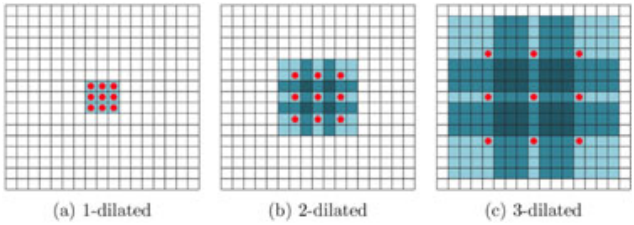
ENFig. 22. Dilated convolution. A 3 × 3 kernel at different dilation rates.
中图22 空洞卷积:3 × 3 卷积核在不同膨胀率下的采样位置。
Source: p.7 S075
ENDilated convolutions have been popular in the field of real-time segmentation, and many recent publications report the use of this technique. Some of the most important include the DeepLab family [76], multiscale context aggregation [77], Dense Upsampling Convolution and Hybrid Dilated Convolution (DUC-HDC) [78], densely connected Atrous Spatial Pyramid Pooling (DenseASPP) [79], and the Efficient Network (ENet) [80].
中空洞卷积广泛用于实时分割,许多近期论文都报告使用了这一技术。具有代表性的有 DeepLab 系列[76]、多尺度上下文聚合[77]、密集上采样卷积与混合空洞卷积(DUC-HDC)[78]、密集连接的空洞空间金字塔池化(DenseASPP)[79]和高效网络(ENet)[80]。
Source: p.7 S076
ENDeepLabv1 [36] and DeepLabv2 [76], developed by Chen et al., are among the most popular image segmentation models. The latter has three key features (
Fig. 23). First is the use of dilated convolution to address the decreasing resolution in the network caused by max-pooling and striding.
中Chen 等提出的 DeepLabv1[36]与 DeepLabv2[76]属于最常用的图像分割模型。后者有三个关键特征(
图23)。第一,采用空洞卷积来解决最大池化和带步幅运算导致的网络分辨率下降。
图23
Placed near: p.7 S076
Source: p.7 F023 / C023

ENFig. 23. The DeepLab model. From [76].
Source: p.7 S077
ENSecond is Atrous Spatial Pyramid Pooling (ASPP), which probes an incoming convolutional feature layer with filters at multiple sampling rates, thus capturing objects as well as multiscale image context to robustly segment objects at multiple scales. Third is improved localization of object boundaries by combining methods from deep CNNs, such as fully convolutional VGG-16 or ResNet 101, and probabilistic graphical models, specifically fully-connected CRFs.
中第二,采用空洞空间金字塔池化(ASPP),使用不同采样率的滤波器探测输入的卷积特征层,同时捕捉对象和多尺度图像上下文,从而稳健地分割不同尺度的对象。第三,把全卷积 VGG-16 或 ResNet-101 等深层 CNN 方法和全连接 CRF 等概率图模型结合起来,提高对象边界的定位精度。
Source: p.7 S078
ENSubsequently, Chen et al. [13] proposed DeepLabv3, which combines cascaded and parallel modules of dilated convolutions. The parallel convolution modules are grouped in the ASPP. A 1 × 1 convolution and batch normalization are added in the ASPP. All the outputs are concatenated and processed by another 1 × 1 convolution to create the final output with logits for each pixel. Next, Chen et al. [81] released Deeplabv3+ (
Fig. 24), which uses an encoder-decoder architecture including dilated separable convolution composed of a depthwise convolution (spatial convolution for each channel of the input) and pointwise convolution (1 × 1 convolution with the depthwise convolution as input). They used the DeepLabv3 framework as the encoder. The most relevant model has a modified Xception backbone with more layers, dilated depthwise separable convolutions instead of max pooling and batch normalization.
中随后,Chen 等[13]提出 DeepLabv3,把级联和并行的空洞卷积模块结合起来。并行卷积模块编入 ASPP,其中还加入了 1 × 1 卷积和批归一化。把各路输出拼接后,再经另一个 1 × 1 卷积,得到每个像素的 logits。Chen 等[81]接着发布了 DeepLabv3+(
图24),采用编码器-解码器架构,其中的空洞可分离卷积由逐通道卷积(对输入的每个通道分别进行空间卷积)和逐点卷积(以逐通道卷积的输出为输入的 1 × 1 卷积)组成。作者用 DeepLabv3 框架作为编码器。文中着重介绍的版本采用经改造的 Xception 骨干网络,层数更多,并采用空洞深度可分离卷积来替代最大池化,同时使用批归一化。
图24
Placed near: p.7 S078
Source: p.7 F024 / C024

ENFig. 24. The DeepLab-v3+ model. From [81].
中图24 DeepLabv3+ 模型。引自[81]。
图表词汇: Encoder:编码器;Decoder:解码器;Concat:拼接;Upsample by 4:上采样至 4 倍尺寸。
3.7 基于 RNN 的模型
Source: p.7 S079
Source: p.7 S080
ENWhile CNNs are a natural fit for computer vision problems, they are not the only possibility. RNNs are useful in modeling the short/long term dependencies among pixels to (potentially) improve the estimation of the segmentation map. Using RNNs, pixels may be linked together and processed sequentially to model global contexts and improve semantic segmentation. However the natural 2D structure of images poses a challenge.
中CNN 很适合计算机视觉问题,但不是唯一选择。RNN 可以对像素间的短期、长期依赖关系建模,有望改善分割图的估计。采用 RNN 时,可把像素相连后按序处理,以对全局上下文建模,改进语义分割。然而,图像天然具有二维结构,这给 RNN 带来了挑战。
Source: pp.7–8 S081
ENVisin et al. [82] proposed an RNN-based model for semantic segmentation called ReSeg (
Fig. 25). This model is mainly based on ReNet [83], which was developed for image classification. Each ReNet layer is composed of four RNNs that sweep the image horizontally and vertically in both directions, encoding patches/activations, and providing relevant global information. To perform image segmentation with the ReSeg model, ReNet layers are stacked atop pre-trained VGG-16 convolutional layers, which extract generic local features, and are then followed by up-sampling layers to recover the original image resolution in the final predictions.
中Visin 等[82]提出名为 ReSeg 的 RNN 语义分割模型(
图25),主要以为图像分类开发的 ReNet[83]为基础。每个 ReNet 层由四个 RNN 组成,在水平和垂直方向上分别对图像做双向扫描,对图像块或激活值编码,提供相应的全局信息。将 ReNet 层堆叠在预训练的 VGG-16 卷积层上,由这些卷积层提取通用的局部特征;其后接上采样层,使最终分割预测恢复到原始图像分辨率。
图25
Placed near: pp.7–8 S081
Source: p.7 F025 / C025

ENFig. 25. The ReSeg model (without the pre-trained VGG-16 feature extractor). From [82].
中图25 ReSeg 模型(未画出预训练的 VGG-16 特征提取器)。引自[82]。
Source: p.8 S082
ENByeon et al. [84] performed per-pixel segmentation and classification of images of natural scenes using 2D LSTM networks, which learn textures and the complex spatial dependencies of labels in a single model that carries out classification, segmentation, and context integration.
中Byeon 等[84]使用二维 LSTM 网络对自然场景图像逐像素分割和分类。该网络在同一个模型中学习纹理及标签间复杂的空间依赖关系,同时完成分类、分割与上下文整合。
Source: p.8 S083
ENLiang et al. [85] proposed a semantic segmentation model based on a graph-LSTM network (
Fig. 26) in which convolutional layers are augmented by graph-LSTM layers built on super-pixel maps, which provide a more global structural context. These layers generalize the LSTM for uniform, array-structured data (i.e., row, grid, or diagonal LSTMs) to nonuniform, graph-structured data, where arbitrary-shaped superpixels are semantically consistent nodes and the adjacency relations between superpixels correspond to edges, thus forming an undirected graph (
Fig. 27).
中Liang 等[85]提出基于图 LSTM 网络的语义分割模型(
图26),在卷积层之外加入以超像素图为基础的图 LSTM 层,引入更全局的结构上下文。这样就把用于规则阵列数据的 LSTM(按行、按网格或沿对角线处理)推广到了不规则的图结构数据:形状不规则但语义一致的超像素作为节点,超像素之间的相邻关系作为边,共同构成无向图(
图27)。
图26
Placed near: p.8 S083
Source: p.8 F026 / C026

ENFig. 26. The graph-LSTM model for semantic segmentation. From [85].
中图26 用于语义分割的图 LSTM 模型。引自[85]。
图27
Placed near: p.8 S083
Source: p.8 F027 / C027

ENFig. 27. Comparison of conventional RNN models and the graph-LSTM. From [85].
中图27 常规 RNN 模型与图 LSTM 的比较。引自[85]。
图表词汇: 图中分别比较按行的 LSTM、沿对角线的双向 LSTM、局部-全局 LSTM,以及按超像素邻接关系运行的图 LSTM。
Source: p.8 S084
ENXiang and Fox [86] proposed Data Associated Recurrent Neural Networks (DA-RNNs) for joint 3D scene mapping and semantic labeling. DA-RNNs use a new recurrent neural network architecture for semantic labeling on RGB-D videos. The output of the network is integrated with mapping techniques such as Kinect-Fusion in order to inject semantic information into the reconstructed 3D scene.
中Xiang 和 Fox[86]提出数据关联循环神经网络(DA-RNN),联合进行三维场景建图和语义标注。DA-RNN 采用新的循环神经网络架构对 RGB-D 视频做语义标注,并将网络输出与 Kinect-Fusion 等建图技术结合,把语义信息注入重建的三维场景。
Source: p.8 S085
ENHu et al. [87] developed a semantic segmentation algorithm that combines a CNN to encode the image and an LSTM to encode its linguistic description. To produce pixel-wise image segmentations from language inputs, they propose an end-to-end trainable recurrent and convolutional model that jointly learns to process visual and linguistic information (
Fig. 28). This differs from traditional semantic segmentation over a predefined set of semantic classes; i.e., the phrase “two men sitting on the right bench” requires segmenting only the two people on the right bench and no others sitting on another bench or standing.
Fig. 29 shows an example segmentation result by the model.
中Hu 等[87]提出一种语义分割算法,结合 CNN 对图像编码、LSTM 对该图像的语言描述编码。为根据语言输入得到逐像素的图像分割,他们提出一个可端到端训练的循环-卷积模型,联合学习对视觉和语言信息的处理(
图28)。这不同于在一组预先定义的语义类别上进行的传统语义分割;例如,给出“坐在右边长椅上的两名男子”,只应分割出坐在右边长椅上的这两个人,不分割坐在另一张长椅上或站立的其他人。
图29给出该模型的一个分割示例。
图28
Placed near: p.8 S085
Source: p.8 F028 / C028

ENFig. 28. The CNN+LSTM architecture for semantic segmentation from natural language expressions. From [87].
中图28 根据自然语言表达式进行语义分割的 CNN+LSTM 架构。引自[87]。
图表词汇: 上方为自然语言表达式输入及其词嵌入、LSTM 编码,下方为图像和 CNN 特征;联合得到分割结果。
图29
Placed near: p.8 S085
Source: p.8 F029 / C029

ENFig. 29. CNN+LSTM segmentation masks generated for the query “people in blue coat”. From [87].
中图29 CNN+LSTM 根据“穿蓝色外套的人”这一查询生成的分割掩膜。引自[87]。
图表词汇: (a) 输入;(b) 人物类别分割;(c) 人物实例分割;(d) 按语言表达式分割。
Source: p.8 S086
ENA drawback of RNN-based models is that they will generally be slower than their CNN counterparts as their sequential nature is not amenable to parallelization.
中基于 RNN 的模型有一个缺点:它们的序列式处理不易并行化,因此通常比对应的 CNN 模型慢。
3.8 基于注意力的模型
Source: p.8 S087
EN3.8 Attention-Based Models
Source: p.8 S088
ENAttention mechanisms have been persistently explored in computer vision over the years, and it is not surprising to find publications that apply them to semantic segmentation.
中多年来,计算机视觉领域一直在研究注意力机制,也已有论文将其用于语义分割。
Source: p.8 S089
ENChen et al. [88] proposed an attention mechanism that learns to softly weight multiscale features at each pixel location. They adapt a powerful semantic segmentation model and jointly train it with multiscale images and the attention model In
Fig. 30, the model assigns large weights to the person (green dashed circle) in the background for features from scale 1.0 as well as on the large child (magenta dashed circle) for features from scale 0.5. The attention mechanism enables the model to assess the importance of features at different positions and scales, and it outperforms average and max pooling.
中Chen 等[88]提出一种注意力机制,学习对每个像素位置的多尺度特征进行软加权。他们改造了一个性能较强的语义分割模型,使用多尺度图像对它和注意力模型进行联合训练。如
图30所示,对1.0尺度的特征,模型给背景中的人物(绿色虚线圈)分配较高权重;对0.5尺度的特征,则给画面上较大的儿童(品红色虚线圈)分配较高权重。注意力机制让模型能判断不同位置、不同尺度的特征有多重要,效果优于平均池化和最大池化。
图30
Placed near: p.8 S089
Source: p.8 F030 / C030

ENFig. 30. Attention-based semantic segmentation model. From [88].
中图30 基于注意力的语义分割模型。引自[88]。
图表词汇: Score Map:得分图;Attention Model:注意力模型;Result:融合结果。
Source: pp.8–9 S090
ENUnlike approaches in which convolutional classifiers are trained to learn the representative semantic features of labeled objects, Huang et al. [89] proposed a Reverse Attention Network (RAN) architecture (
Fig. 31) for semantic segmentation that also applies reverse attention mechanisms, thereby training the model to capture the opposite concept—features that are not associated with a target class. The RAN network performs the direct and reverse-attention learning processes simultaneously.
中以往方法训练卷积分类器来学习带标注对象的代表性语义特征。与之不同,Huang 等[89]为语义分割提出反向注意力网络(RAN)架构(
图31),同时运用反向注意力机制,使模型也能捕捉相反的概念,即哪些特征与目标类别无关。RAN 同时进行正向和反向注意力学习。
图31
Placed near: pp.8–9 S090
Source: p.9 F031 / C031

ENFig. 31. The RAN architecture. From [89].
中图31 反向注意力网络(RAN)的架构。引自[89]。
图表词汇: 上下两支分别学习“不是猫/狗”和“是猫/狗”的特征。
Source: p.9 S091
ENLi et al. [90] developed a Pyramid Attention Network for semantic segmentation, which exploits global contextual information for semantic segmentation. Eschewing complicated dilated convolutions and decoder networks, they combined attention mechanisms and spatial pyramids to extract precise dense features for pixel labeling. Fu et al. [91] proposed a dual attention network for scene segmentation that can capture rich contextual dependencies based on the self-attention mechanism. Specifically, they append two types of attention modules on top of a dilated FCN that models the semantic inter-dependencies in spatial and channel dimensions, respectively. The position attention module selectively aggregates the features at each position via weighted sums.
中Li 等[90]为语义分割开发了金字塔注意力网络,利用全局上下文信息进行分割。他们不采用复杂的空洞卷积和解码器网络,而是结合注意力机制与空间金字塔来提取可用于像素标注的精确稠密特征。Fu 等[91]提出用于场景分割的双重注意力网络,可借助自注意力机制捕捉丰富的上下文依赖关系。具体而言,他们在空洞 FCN 之上接入两种注意力模块,分别对空间维度和通道维度上的语义依赖关系建模。其中,位置注意力模块通过加权求和有选择地汇聚各位置的特征。
Source: p.9 S092
ENOther applications of attention mechanisms to semantic segmentation include OCNet [92], which employs an object context pooling inspired by self-attention mechanism, ResNeSt: Split-Attention Networks [93], Height-driven Attention Networks [94], Expectation-Maximization Attention (EMANet) [95], Criss-Cross Attention Network (CCNet) [96], end-to-end instance segmentation with recurrent attention [97], a point-wise spatial attention network for scene parsing [98], and Discriminative Feature Network (DFN) [99].
中注意力机制在语义分割中的其他应用包括:受自注意力启发、使用对象上下文池化的 OCNet[92],ResNeSt 分组注意力网络[93],高度驱动注意力网络[94],期望最大化注意力网络(EMANet)[95],十字交叉注意力网络(CCNet)[96],基于循环注意力的端到端实例分割[97],用于场景解析的逐点空间注意力网络[98],以及判别特征网络(DFN)[99]。
3.9 生成模型与对抗训练
Source: p.9 S093
EN3.9 Generative Models and Adversarial Training
Source: p.9 S094
ENGANs have been applied to a wide range of tasks in computer vision, not excluding image segmentation.
中GAN 已应用于计算机视觉的多种任务,图像分割也在其中。
Source: p.9 S095
ENLuc et al. [100] proposed an adversarial training approach for semantic segmentation in which they trained a convolutional semantic segmentation network (
Fig. 32), along with an adversarial network that discriminates between ground-truth segmentation maps and those generated by the segmentation network. They showed that the adversarial training approach yields improved accuracy on the Stanford Background and PASCAL VOC 2012 datasets.
中Luc 等[100]提出语义分割的对抗训练方法:在训练卷积语义分割网络的同时(
图32),训练一个对抗网络来区分真值分割图与分割网络生成的图。他们的结果表明,对抗训练提高了模型在 Stanford Background 和 PASCAL VOC 2012 数据集上的准确率。
图32
Placed near: p.9 S095
Source: p.9 F032 / C032

ENFig. 32. The GAN for semantic segmentation. From [100].
中图32 用于语义分割的生成对抗网络。引自[100]。
图表词汇: Segmentor:分割网络;Adversarial network:对抗网络;Ground truth:真值。
Source: p.9 S096
ENSouly et al. [101] proposed semi-weakly supervised semantic segmentation using GANs. Their model consists of a generator network providing extra training examples to a multiclass classifier, acting as discriminator in the GAN framework, that assigns sample a label from the possible label classes or marks it as a fake sample (extra class).
中Souly 等[101]提出使用 GAN 的半弱监督语义分割方法。该模型中,生成器为一个多类分类器提供额外的训练样本,该分类器在 GAN 中担任判别器:要么为样本分配已有类别中的标签,要么把它标记为假样本(额外类别)。
Source: p.9 S097
ENHung et al. [102] developed a framework for semi-supervised semantic segmentation using an adversarial network. They designed an FCN discriminator to differentiate the predicted probability maps from the ground truth segmentation distribution, considering the spatial resolution. The loss function of this model has three terms: cross-entropy loss on the segmentation ground truth, adversarial loss of the discriminator network, and semi-supervised loss based on the confidence map output of the discriminator.
中Hung 等[102]用对抗网络构建了半监督语义分割框架。他们设计了一个 FCN 判别器,在兼顾空间分辨率的同时,区分预测的概率图和真值分割分布。模型的损失函数由三项组成:以分割真值计算的交叉熵损失、判别网络的对抗损失,以及根据判别器输出的置信图计算的半监督损失。
Source: p.9 S098
ENXue et al. [103] proposed an adversarial network with multiscale L1 Loss for medical image segmentation. They used an FCN as the segmentor to generate segmentation label maps, and proposed a novel adversarial critic network with a multi-scale L1 loss function to force the critic and segmentor to learn both global and local features that capture long and short range spatial relationships between pixels.
中Xue 等[103]提出用于医学图像分割的多尺度 L1 损失对抗网络。他们用 FCN 作为分割网络,生成分割标签图;并提出一个使用多尺度 L1 损失函数的新对抗评判网络,以促使评判网络与分割网络都学习全局和局部特征,捕捉像素间长距离和短距离的空间关系。
Source: p.9 S099
ENOther approaches based on adversarial training include cell image segmentation using GANs [104], and segmentation and generation of the invisible parts of objects [105].
中基于对抗训练的其他方法包括使用 GAN 分割细胞图像[104],以及分割并生成对象中不可见的部分[105]。
3.10 结合主动轮廓模型的 CNN
Source: p.9 S100
EN3.10 CNN Models With Active Contour Models
Source: p.9 S101
ENThe exploration of synergies between FCNs and Active Contour Models (ACMs) [8] has recently attracted research interest.
中近来,研究人员开始关注全卷积网络(FCN)和主动轮廓模型(ACM)[8]如何相互补充。
Source: p.9 S102
ENOne approach is to formulate new loss functions that are inspired by ACM principles. For example, inspired by the global energy formulation of [106], Chen et al. [107] proposed a supervised loss layer that incorporated area and size information of the predicted masks during training of an FCN and tackled the problem of ventricle segmentation in cardiac MRI. Similarly, Gur et al. [108] presented an unsupervised loss function based on morphological active contours without edges [109] for microvascular image segmentation.
中一种做法是根据 ACM 的原理构造新的损失函数。例如,受文献[106]全局能量表达式启发,Chen 等[107]提出一个有监督的损失层,在训练 FCN 时纳入预测掩膜的面积和大小信息,并用它处理心脏 MRI 中的心室分割。类似地,Gur 等[108]利用无边缘的形态学主动轮廓[109]构造无监督损失函数,用于微血管图像分割。
Source: p.9 S103
ENA different approach initially sought to utilize the ACM merely as a post-processor of the output of an FCN and several efforts attempted modest co-learning by pre-training the FCN. One example of an ACM post-processor for the task of semantic segmentation of natural images is the work by Le et al. [110] in which level-set ACMs are implemented as RNNs. Deep Active Contours by Rupprecht et al. [111], is another example. For medical image segmentation, Hatamizadeh et al. [112] proposed an integrated Deep Active Lesion Segmentation (DALS) model that trains the FCN backbone to predict the parameter functions of a novel, locally-parameterized level-set energy functional. In another relevant effort, Marcos et al. [113] proposed Deep Structured Active Contours (DSAC), which combines ACMs and pre-trained FCNs in a structured prediction framework for building instance segmentation (albeit with manual initialization) in aerial images. For the same application, Cheng et al. [114] proposed the Deep Active Ray Network (DarNet), which is similar to DSAC, but with a different explicit ACM formulation based on polar coordinates to prevent contour self-intersection.
中另一种做法起初只把 ACM 用于 FCN 输出的后处理,也有一些工作尝试通过预训练 FCN 实现有限程度的联合学习。在自然图像语义分割中,一个采用 ACM 后处理的例子是 Le 等[110]的工作,他们以 RNN 实现水平集 ACM。Rupprecht 等的深度主动轮廓[111]是另一个例子。对于医学图像分割,Hatamizadeh 等[112]提出集成式深度主动病灶分割(DALS)模型,训练 FCN 骨干网络来预测一种新的局部参数化水平集能量泛函的参数函数。在另一项相关工作中,Marcos 等[113]提出深度结构化主动轮廓(DSAC),用结构化预测框架结合 ACM 与预训练的 FCN,对航拍图像中的建筑物做实例分割,不过需要人工初始化。针对同一应用,Cheng 等[114]提出深度主动射线网络(DarNet),其思路与 DSAC 类似,但采用了基于极坐标的另一种显式 ACM 形式,以避免轮廓自相交。
Source: pp.9–10 S104
ENA truly end-to-end backpropagation trainable, fully-integrated FCN-ACM combination was recently introduced by Hatamizadeh et al. [115], dubbed Trainable Deep Active Contours (TDAC). Going beyond [112], they implemented the locally-parameterized level-set ACM in the form of additional convolutional layers following the layers of the backbone FCN, exploiting Tensorflow’s automatic differentiation mechanism to backpropagate training error gradients throughout the entire DCAC framework. The fully-automated model requires no intervention either during training or segmentation, can naturally segment multiple instances of objects of interest, and deal with arbitrary object shape including sharp corners.
中Hatamizadeh 等[115]近期提出可训练的深度主动轮廓(TDAC),真正做到了把 FCN 和 ACM 完全集成,并用反向传播端到端训练。在文献[112]基础上,他们把局部参数化的水平集 ACM 实现为 FCN 骨干网络之后的若干附加卷积层,并借助 TensorFlow 的自动微分机制,让训练误差的梯度在整个 DCAC 框架中反向传播。这个全自动模型在训练或分割时均不需要人工干预,可以直接分割多个感兴趣对象实例,并能处理任意形状的对象,包括具有尖角的对象。
3.11 其他模型
Source: p.10 S105
Source: p.10 S106
ENOther popular DL architectures for image segmentation include the following:
中用于图像分割的其他常用深度学习架构包括下列模型。
Source: p.10 S107
ENContext Encoding Network (EncNet) [116] uses a basic feature extractor and feeds the feature maps into a context encoding module. RefineNet [117] is a multipath refinement network that explicitly exploits all the information available along the down-sampling process to enable high-resolution prediction using long-range residual connections. Seednet [118] introduced an automatic seed generation technique with deep reinforcement learning that learns to solve the interactive segmentation problem. Object-Contextual Representations (OCR) [42] learns object regions and the relation between each pixel and each object region, augmenting the representation pixels with the object-contextual representation. Additional models and methods include BoxSup [119], Graph Convolutional Networks (GCN) [120], Wide ResNet [121], Exfuse [122] (enhancing low-level and high-level features fusion), Feedforward-Net [123], saliency-aware models for geodesic video segmentation [124], Dual Image Segmentation (DIS) [125], FoveaNet [126] (perspective-aware scene parsing), Ladder DenseNet [127], Bilateral Segmentation Network (BiSeNet) [128], Semantic Prediction Guidance for Scene Parsing (SPGNet) [129], gated shape CNNs [130], Adaptive Context Network (AC-Net) [131], Dynamic-Structured Semantic Propagation Network (DSSPN) [132], Symbolic Graph Reasoning (SGR) [133], CascadeNet [134], Scale-Adaptive Convolutions (SAC) [135], Unified Perceptual parsing Network (UperNet) [136], segmentation by re-training and self-training [137], densely connected neural architecture search [138], hierarchical multiscale attention [139], Efficient RGB-D Semantic Segmentation (ESA-Net) [140], Iterative Pyramid Contexts [141], and Learning Dynamic Routing for Semantic Segmentation [142].
中上下文编码网络(EncNet)[116]通过基础特征提取器得到特征图,再把它们输入上下文编码模块。RefineNet[117]是多路径细化网络,它显式利用下采样过程中可用的所有信息,并通过长距离残差连接实现高分辨率预测。SeedNet[118]提出基于深度强化学习的自动种子生成技术,学习解决交互式分割问题。对象上下文表示(OCR)[42]学习对象区域以及每个像素与每个对象区域之间的关系,用对象上下文表示增强像素的表示。其他模型和方法包括 BoxSup[119]、图卷积网络(GCN)[120]、Wide ResNet[121]、Exfuse[122](增强低层与高层特征的融合)、Feedforward-Net[123]、用于测地视频分割的显著性感知模型[124]、双重图像分割(DIS)[125]、FoveaNet[126](透视感知场景解析)、Ladder DenseNet[127]、双边分割网络(BiSeNet)[128]、用于场景解析的语义预测引导网络(SPGNet)[129]、门控形状 CNN[130]、自适应上下文网络(AC-Net)[131]、动态结构语义传播网络(DSSPN)[132]、符号图推理(SGR)[133]、CascadeNet[134]、尺度自适应卷积(SAC)[135]、统一感知解析网络(UPerNet)[136]、基于重新训练和自训练的分割[137]、密集连接神经架构搜索[138]、分层多尺度注意力[139]、高效 RGB-D 语义分割(ESA-Net)[140]、迭代金字塔上下文[141],以及为语义分割学习动态路由[142]。
Source: p.10 S108
ENPanoptic segmentation [143] is growing in popularity. Efforts in this direction include Panoptic Feature Pyramid Network (PFPN) [144], attention-guided network for panoptic segmentation [145], seamless scene segmentation [146], panoptic Deeplab [147], unified panoptic segmentation network [148], and efficient panoptic segmentation [149].
中全景分割[143]正受到越来越多关注。相关工作包括全景特征金字塔网络(PFPN)[144]、注意力引导的全景分割网络[145]、无缝场景分割[146]、Panoptic DeepLab[147]、统一全景分割网络[148]和高效全景分割[149]。
Source: p.10 S109
ENFig. 33 provides a timeline of some of the most representative DL image segmentation models since 2014.
中图33按时间列出了自2014年以来部分最具代表性的深度学习图像分割模型。
图33
Placed near: p.10 S109
Source: p.10 F033 / C033
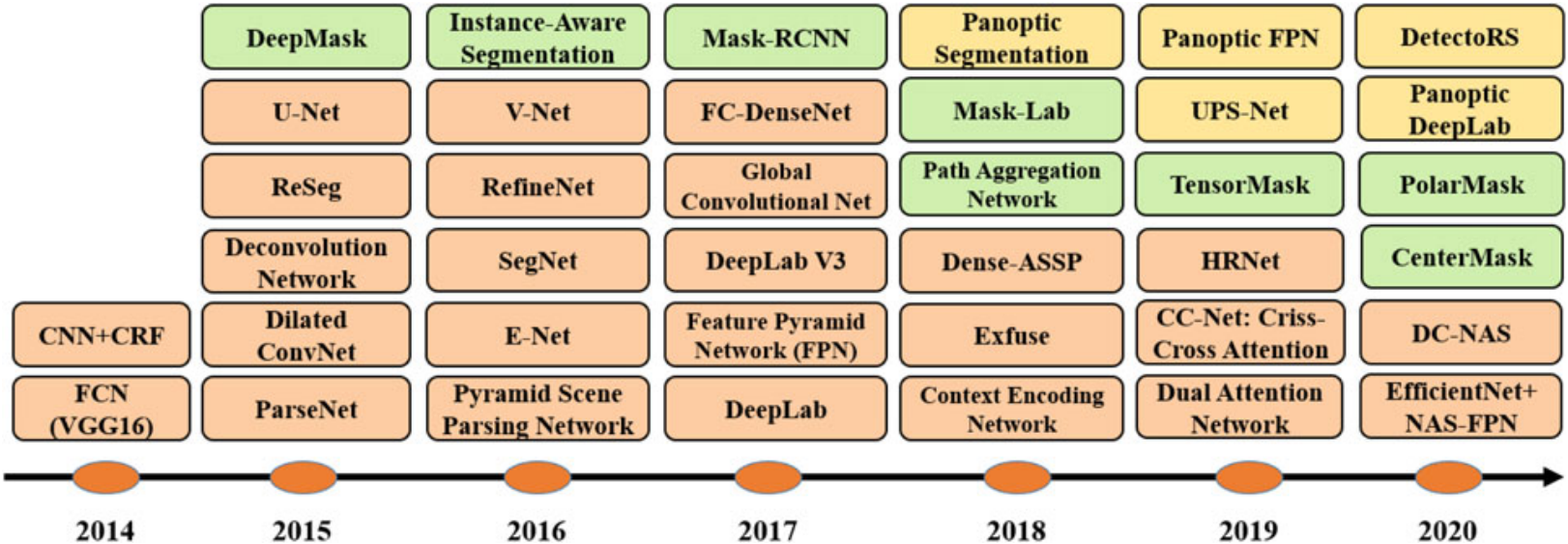
ENFig. 33. Timeline of representative DL-based image segmentation algorithms. Orange, green, and yellow blocks indicate semantic, instance, and panoptic segmentation algorithms, respectively.
中图33 代表性深度学习图像分割算法的时间线。橙色、绿色、黄色分别表示语义分割、实例分割和全景分割。
4 数据集
Source: p.10 S110
Source: p.10 S111
ENIn this section we survey the image datasets most commonly used to train and test DL image segmentation models, grouping them into 3 categories—2D (pixel) images, 2.5D RGB-D (color+depth) images, and 3D (voxel) images— and provide details about the characteristics of each dataset.
中本节回顾训练和测试深度学习图像分割模型时最常用的图像数据集,按二维图像(像素)、2.5维 RGB-D 图像(彩色+深度)和三维图像(体素)分为3类,并具体介绍各数据集的特点。
Source: p.10 S112
ENData augmentation is often used to increase the number of labeled samples, especially for small datasets such as those in the medical imaging domain, thus improving the performance of DL segmentation models. A set of transformations is applied either in the data space, or feature space, or both (i.e., both the image and the segmentation map). Typical transformations include translation, reflection, rotation, warping, scaling, color space shifting, cropping, and projections onto principal components. Data augmentation can also benefit by yielding faster convergence, decreasing the chance of over-fitting, and enhancing generalization. For some small datasets, data augmentation has been shown to boost model performance by more than 20 percent.
中数据增强常用来增加带标注的样本数量,尤其适用于医学影像等领域的小型数据集,从而提高深度学习分割模型的性能。可在数据空间或特征空间实施一系列变换,也可以同时进行(即同时变换图像和分割图)。常见变换包括平移、镜像、旋转、几何形变、缩放、颜色空间偏移、裁剪和向主成分投影。数据增强还有助于加快收敛、降低过拟合风险并提高泛化能力。在某些小型数据集上,数据增强已被证明可以让模型性能提升超过20%。
4.1 二维图像数据集
Source: p.10 H041
Source: p.10 S113
ENThe bulk of image segmentation research has focused on 2D images; therefore, many 2D image segmentation datasets are available. The following are some of the most popular:
中图像分割研究大多集中在二维图像上,因此已有许多二维图像分割数据集。下面介绍其中最常用的一些。
Source: pp.10–11 S114
ENPASCAL Visual Object Classes (VOC) [150] is a highly popular dataset in computer vision, with annotated images available for 5 tasks—classification, segmentation, detection, action recognition, and person layout. For the segmentation task, there are 21 labeled object classes and pixels are labeled as background if they do not belong to any of these classes. The dataset is divided into two sets, training and validation, with 1,464 and 1,449 images, respectively, and a private test set for the actual challenge.
Fig. 34 shows an example image and its pixel-wise label.
中PASCAL Visual Object Classes(VOC)[150]是计算机视觉中十分常用的数据集,为5种任务提供带标注的图像:分类、分割、检测、动作识别和人体结构布局。对于分割任务,有21个带标注的对象类别;不属于这些类别的像素被标为背景。数据集分为训练集和验证集,分别包含1,464幅和1,449幅图像,另有不公开的测试集用于正式挑战赛。
图34展示一幅示例图像与它的逐像素标签。
图34
Placed near: pp.10–11 S114
Source: p.11 F034 / C034

ENFig. 34. An example image from the PASCAL VOC dataset. From [151].
中图34 PASCAL VOC 数据集中的图像示例。引自[151]。
图表词汇: 左至右:原图、实例标注、语义类别标注。
Source: p.11 S115
ENPASCAL Context [152] is an extension of the PASCAL VOC 2010 detection challenge. It includes pixel-wise labels for all the training images. It contains more than 400 classes (including the original 20 classes plus backgrounds from PASCAL VOC segmentation), in three categories (objects, stuff, and hybrids). Many of the object categories of this dataset are too sparse and; therefore, a subset of 59 classes is usually selected for use.
中PASCAL Context[152]扩展了 PASCAL VOC 2010 检测挑战赛的数据,为所有训练图像提供逐像素标签。它包含400多个类别(包括 PASCAL VOC 分割的原有20个类别和背景),归为三组:可数对象(things)、不可数区域(stuff)和混合类别。许多类别的样本过于稀少,因此一般选用包含59个类别的子集。
Source: p.11 S116
ENMicrosoft Common Objects in Context (MS COCO) [153] is a large-scale object detection, segmentation, and captioning dataset. COCO includes images of complex everyday scenes, containing common objects in their natural contexts. This dataset contains photos of 91 object types, with a total of 2.5 million labeled instances in 328K images.
Fig. 35 compares MS-COCO labels with those of previous datasets for a sample image.
中微软 Common Objects in Context(MS COCO)[153]是一个面向目标检测、分割和图像描述的大规模数据集。COCO 的图像来自复杂的日常场景,呈现常见对象在自然环境中的样子。数据集含91类对象的照片,328K 幅图像中共标注了250万个实例。
图35以一幅图像为例,将 MS COCO 的标签与此前数据集的标签进行对比。
图35
Placed near: p.11 S116
Source: p.11 F035 / C035

ENFig. 35. A sample image and segmentation map in COCO. From [153].
中图35 COCO 中的样本图像和分割图。引自[153]。
图表词汇: (a) 图像分类;(b) 对象定位;(c) 语义分割;(d) MS COCO 的实例级分割标注。
Source: p.11 S117
ENCityscapes [154] is a large database with a focus on semantic understanding of urban street scenes. It contains a diverse set of stereo video sequences recorded in street scenes from 50 cities, with high quality pixel-level annotation of 5K frames, in addition to a set of 20K weakly annotated frames. It includes semantic and dense pixel annotations of 30 classes, grouped into 8 categories—flat surfaces, humans, vehicles, constructions, objects, nature, sky, and void.
Fig. 36 shows sample segmentation maps from this dataset.
中Cityscapes[154]是以城市街景语义理解为重点的大型数据库。它包含在50座城市的街景中采集的多样化双目视频序列,其中5K帧具有高质量的像素级标注,另有20K帧带弱标注。数据集对30个类别提供稠密的像素级语义标注,分为8组:平坦表面、人、车辆、建筑构筑物、物品、自然、天空和空类(void)。
图36展示了该数据集中的分割图示例。
图36
Placed near: p.11 S117
Source: p.11 F036 / C036

ENFig. 36. Segmentation maps from the Cityscapes dataset. From [154].
中图36 Cityscapes 数据集中的分割图。引自[154]。
Source: p.11 S118
ENADE20K / MIT Scene Parsing (SceneParse150) offers a training and evaluation platform for scene parsing algorithms. The data for this benchmark comes from the ADE20K dataset [134], which contains more than 20K scene-centric images exhaustively annotated with objects and object parts. The benchmark is divided into 20K images for training, 2K images for validation, and another batch of images for testing. There are 150 semantic categories in this dataset.
中ADE20K / MIT Scene Parsing(SceneParse150)为场景解析算法提供训练和评估平台。该基准基于 ADE20K 数据集[134],后者包含20K多幅以场景为中心的图像,对其中的对象及其组成部分都有详尽标注。该基准用20K幅图像训练,以2K幅做验证,并另外留出一批测试图像。数据集共有150个语义类别。
Source: p.11 S119
ENSiftFlow [155] includes 2,688 annotated images, from a subset of the LabelMe database, of 8 different outdoor scenes, among them streets, mountains, fields, beaches, and buildings, and in one of 33 semantic classes.
中SiftFlow[155]来自 LabelMe 数据库的一个子集,包含2,688幅带标注图像,涵盖街道、山地、田野、海滩和建筑等8种室外场景,使用33个语义类别之一进行标注。
Source: p.11 S120
ENStanford Background [156] comprises outdoor images of scenes from existing datasets, such as LabelMe, MSRC, and PASCAL VOC. It includes 715 images with at least one foreground object. The dataset is pixel-wise annotated, and can be used for semantic scene understanding.
中Stanford Background[156]汇集 LabelMe、MSRC 和 PASCAL VOC 等现有数据集的室外场景图像,包含715幅至少有一个前景对象的图像。这些图像有逐像素标注,可用于语义场景理解。
Source: p.11 S121
ENBerkeley Segmentation Dataset (BSD) [157] contains 12,000 hand-labeled segmentations of 1,000 Corel dataset images from 30 human subjects. It aims to provide an empirical basis for research on image segmentation and boundary detection. Half of the segmentations were obtained from presenting the subject a color image and the other half from presenting a grayscale image. The public benchmark based on this data consists of all of the grayscale and color segmentations for 300 images. The images are divided into a training set of 200 images and a test set of 100 images.
中伯克利分割数据集(BSD)[157]包含30名受试者为 Corel 数据集的1,000幅图像给出的12,000份人工分割标注,旨在为图像分割和边界检测研究提供经验依据。半数标注是在给受试者呈现彩色图像时获得的,另一半对应灰度图像。基于这些数据的公开基准收录了300幅图像的全部灰度和彩色分割标注,其中200幅用于训练、100幅用于测试。
Source: p.11 S122
ENYoutube-Objects [158] contains videos collected from YouTube, which include objects from ten PASCAL VOC classes (aeroplane, bird, boat, car, cat, cow, dog, horse, motorbike, and train). The original dataset did not contain pixel-wise annotations (as it was originally developed for object detection, with weak annotations). However, Jain et al. [159] manually annotated a subset of 126 sequences, and then extracted a subset of frames to further generate semantic labels. In total, there are about 10,167 annotated 480x360 pixel frames available in this dataset.
中YouTube-Objects[158]包含从 YouTube 收集的视频,涉及 PASCAL VOC 的10个类别:飞机、鸟、船、汽车、猫、牛、狗、马、摩托车和火车。该数据集最初为目标检测开发,只带弱标注,没有逐像素标注。Jain 等[159]随后人工标注了其中126个序列,再抽取部分帧生成语义标签。该数据集共提供约10,167帧带标注图像,分辨率为 480 × 360 像素。
Source: p.11 S123
ENCamVid: is another scene understanding database (with a focus on road/driving scenes) which was originally captured as five video sequences via camera mounted on the dashboard of a car. A total of 701 frames were provided by sampling from the sequences. These frames were manually annotated into 32 classes.
中CamVid 是另一个场景理解数据库,侧重道路和驾驶场景。最初使用安装在汽车仪表台上的相机录制了5段视频,从中采样出701帧,并以32个类别对这些视频帧做了人工标注。
Source: p.11 S124
ENKITTI [160] is one of the most popular datasets for autonomous driving, containing videos of traffic scenarios, recorded with a variety of sensor modalities (including high-resolution RGB, grayscale stereo cameras, and a 3D laser scanners). The original dataset does not contain ground truth for semantic segmentation, but researchers have manually annotated parts of the dataset; e.g., Alvarez et al. [161] generated ground truth for 323 images from the road detection challenge with 3 classes—road, vertical, and sky.
中KITTI[160]是最常用的自动驾驶数据集之一,包含以多种传感器模态录制的交通场景视频,例如高分辨率 RGB 相机、灰度双目相机和三维激光扫描仪。原始数据集没有语义分割真值,研究人员对其中一部分做了人工标注。例如,Alvarez 等[161]为道路检测挑战赛的323幅图像制作了3类真值:道路、竖直区域和天空。
Source: p.11 S125
ENOther datasets for image segmentation purposes include Semantic Boundaries Dataset (SBD) [162], PASCAL Part [163], SYNTHIA [164], and Adobe’s Portrait Segmentation [165].
中其他用于图像分割的数据集包括 Semantic Boundaries Dataset(SBD)[162]、PASCAL Part[163]、SYNTHIA[164]和 Adobe 的人像分割数据集[165]。
4.2 2.5维数据集
Source: p.11 H042
Source: p.11 S126
ENWith the availability of affordable range scanners, RGB-D images have became increasingly widespread. The following RGB-D datasets are among the most popular:
中随着价格可负担的测距扫描仪日益普及,RGB-D 图像的使用越来越广泛。以下是部分最常用的 RGB-D 数据集。
Source: pp.11–12 S127
ENNYU-Depth V2 [166] consists of video sequences from a variety of indoor scenes, recorded by the RGB and depth cameras of the Microsoft Kinect. It includes 1,449 densely labeled RGB and depth image pairs of more than 450 scenes taken from 3 cities. Each object is labeled with a class and instance number (e.g., cup1, cup2, cup3, etc.). It also contains 407,024 unlabeled frames.
Fig. 37 shows an RGB-D sample and its label map.
中NYU-Depth V2[166]由微软 Kinect 的 RGB 相机和深度相机在多种室内场景中录制的视频序列组成。它收录来自3座城市、450多个场景的1,449对带稠密标注的 RGB 图像和深度图像。每个对象都有类别和实例编号,例如 cup1、cup2、cup3 等;数据集另外包含407,024帧无标注图像。
图37展示一个 RGB-D 样本及其标签图。
图37
Placed near: pp.11–12 S127
Source: p.12 F037 / C037

ENFig. 37. A sample from the NYU V2 dataset. From left: RGB image, preprocessed depth image, class labels map. From [166].
中图37 NYU V2 数据集的一个样本。从左到右依次为 RGB 图像、预处理后的深度图像、类别标签图。引自[166]。
Source: p.12 S128
ENSUN-3D [167] is a large RGB-D video dataset that contains 415 sequences captured from 254 different spaces in 41 different buildings; 8 sequences are annotated and more will be annotated in the future. Each annotated frame provides the semantic segmentation of the objects in the scene as well as information about the camera pose.
中SUN-3D[167]是大型 RGB-D 视频数据集,包含从41栋不同建筑内的254处空间采集的415个序列。其中8个序列已经标注,之后还将标注更多序列。每个带标注的帧提供场景中对象的语义分割结果和相机位姿信息。
Source: p.12 S129
ENSUN RGB-D [168] provides an RGB-D benchmark for advancing the state-of-the-art of all major scene understanding tasks. It is captured by four different sensors and contains 10,000 RGB-D images at a scale similar to PASCAL VOC.
中SUN RGB-D[168]提供 RGB-D 基准,以推动各项主要场景理解任务的性能上限。数据由四种不同的传感器采集,包含10,000幅 RGB-D 图像,规模与 PASCAL VOC 相当。
Source: p.12 S130
ENScanNet [169] is an RGB-D video dataset containing 2.5 million views in more than 1,500 scans, annotated with 3D camera poses, surface reconstructions, and instance-level semantic segmentations. To collect these data, an easy-to-use and scalable RGB-D capture system was designed that includes automated surface reconstruction, and the semantic annotation was crowd-sourced. Using this data helped achieve state-of-the-art performance on several 3D scene understanding tasks, including 3D object classification, semantic voxel labeling, and CAD model retrieval.
中ScanNet[169]是 RGB-D 视频数据集,包含1,500多次扫描中的250万个视图,标注包括三维相机位姿、表面重建和实例级语义分割结果。研究者为此设计了易用、可扩展的 RGB-D 采集系统,能自动重建表面,并通过众包获得语义标注。使用这些数据有助于在若干三维场景理解任务上达到当时的先进水平,包括三维对象分类、语义体素标注和 CAD 模型检索。
Source: p.12 S131
ENStanford 2D-3D [170] provides a variety of mutually registered 2D, 2.5D, and 3D modalities, with instance-level semantic and geometric annotations, acquired from 6 indoor areas. It contains over 70,000 RGB images, along with the corresponding depths, surface normals, semantic annotations, as well as global XYZ images, camera information, and registered raw and semantically annotated 3D meshes and point clouds.
中Stanford 2D-3D[170]提供采自6处室内区域、彼此配准的多种二维、2.5维及三维模态,并带有实例级语义和几何标注。数据集包含70,000多幅 RGB 图像,以及相应的深度、表面法向量和语义标注,还包括全局 XYZ 图像、相机信息,以及经配准的原始三维网格和点云、带语义标注的三维网格和点云。
Source: p.12 S132
ENAnother popular 2.5D datasets is UW RGB-D Object Dataset [171], which contains 300 common household objects recorded using a Kinect-style sensor.
中另一个常用的2.5维数据集是 UW RGB-D Object Dataset[171],包含用 Kinect 式传感器采集的300种常见家居物品。
5 深度学习分割模型的性能
Source: p.12 S133
EN5 DL SEGMENTATION MODEL PERFORMANCE
Source: p.12 S134
ENIn this section, we summarize the metrics commonly used in evaluating the performance of segmentation models and report the performance of DL-based segmentation models on benchmark datasets.
中本节汇总评估分割模型性能时的常用指标,并报告深度学习分割模型在基准数据集上的表现。
5.1 图像分割模型的评价指标
Source: p.12 S135
EN5.1 Metrics for Image Segmentation Models
Source: p.12 S136
ENIdeally, an image segmentation model should be evaluated in multiple respects, such as quantitative accuracy, visual quality, speed (inference time), and storage requirements (memory footprint). However, most researchers to date have focused on metrics for quantifying model accuracy. The following metrics are most popular:
中理想情况下,评估图像分割模型应考虑多个方面,包括量化的准确率、视觉质量、速度(推理时间)和存储需求(内存占用)。不过,截至撰稿时,大多数研究主要关注量化模型准确率的指标。最常用的指标如下。
Source: p.12 S137
ENPixel accuracy is the ratio of properly classified pixels divided by the total number of pixels. For K + 1 classes (K foreground classes and the background) pixel accuracy is defined as
中像素准确率是正确分类的像素数占像素总数的比例。对 K + 1 个类别(K 个前景类别和一个背景类别),像素准确率定义如下:
Source: p.12 E001
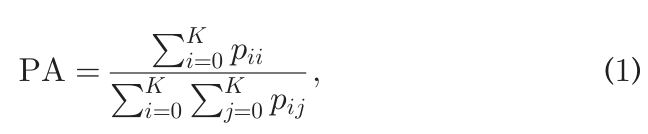
ENPA = (\sum_{i=0}^{K} p_{ii})/(\sum_{i=0}^{K}\sum_{j=0}^{K}p_{ij}), \tag{1}
Source: p.12 S138
ENwhere pᵢⱼ is the number of pixels of class i predicted as belonging to class j.
中其中 pᵢⱼ 表示真实类别为 i、被预测为类别 j 的像素数。
Source: p.12 S139
ENMean Pixel Accuracy (MPA) is an extension of PA, in which the ratio of correct pixels is computed in a per-class manner and then averaged over the total number of classes
中平均像素准确率(MPA)是像素准确率(PA)的扩展:先按类别计算像素分类正确的比例,再对所有类别取平均:
Source: p.12 E002

ENMPA = \frac{1}{K+1}\sum_{i=0}^{K}\frac{p_{ii}}{\sum_{j=0}^{K}p_{ij}}. \tag{2}
Source: p.12 S140
ENIntersection over Union (IoU), or the Jaccard Index, is defined as the area of intersection between the predicted segmentation map A and the ground truth map B, divided by the area of the union between the two maps, and ranges between 0 and 1
中交并比(IoU),也称 Jaccard 指数,定义为预测分割图 A 与真值图 B 交集的面积除以并集的面积,取值在0和1之间:
Source: p.12 E003

ENIoU = J(A,B) = \frac{|A\cap B|}{|A\cup B|}. \tag{3}
Source: p.12 S141
ENMean-IoU is defined as the average IoU over all classes.
中平均交并比(mIoU)是所有类别的 IoU 的平均值。
Source: p.12 S142
ENPrecision / Recall / F1 score can be defined for each class, as well as at the aggregate level, as follows:
中精确率、召回率和 F1 分数既可按类别定义,也可在总体层面定义,如下所示:
Source: p.12 E004

ENPrecision = \frac{TP}{TP+FP};\quad Recall = \frac{TP}{TP+FN}, \tag{4}
Source: p.12 S143
ENwhere TP refers to the true positive fraction, FP refers to the false positive fraction, and FN refers to the false negative fraction. Usually one is interested in a combined version of precision and recall rates; the F1 score is defined as the harmonic mean of precision and recall
中其中 TP 表示真阳性比例,FP 表示假阳性比例,FN 表示假阴性比例。通常需要结合考察精确率与召回率,因此将 F1 分数定义为二者的调和平均数:
Source: p.12 E005

ENF1 = \frac{2\,Precision\,Recall}{Precision+Recall}. \tag{5}
Source: p.12 S144
ENDice coefficient, commonly used in medical image analysis, can be defined as twice the overlap area of the predicted and ground-truth maps divided by the total number of pixels.
中Dice 系数常用于医学图像分析,可以定义为预测分割图与真值图重叠面积的两倍除以两图像素数之和。
Source: p.12 E006

ENDice = \frac{2|A\cap B|}{|A|+|B|}. \tag{6}
Source: p.12 S145
ENIt is very similar to the IoU (3) and when applied to binary maps, with foreground as the positive class, the Dice coefficient is identical to the F1 score (7)
中它与交并比(式3)很相似。对于把前景视为正类的二值图,Dice 系数与 F1 分数相同,见式(7)。
Source: p.12 E007

ENDice = \frac{2TP}{2TP+FP+FN} = F1. \tag{7}
5.2 基于深度学习的模型:量化性能
Source: p.12 S146
EN5.2 Quantitative Performance of DL-Based Models
Source: pp.12–13 S147
ENIn this section we tabulate the performance of several of the previously discussed algorithms on popular segmentation benchmarks. Although most publications report model performance on standard datasets and use standard metrics, some of them fail to do so, making across-the-board comparisons difficult. Furthermore, only a few publications provide additional information, such as execution time and memory footprint, in a reproducible way, which is important to industrial applications (such as drones, self-driving cars, robotics, etc.) that may run on embedded systems with limited computational power and storage, thus requiring light-weight models.
中本节以表格列出此前讨论的若干算法在常用分割基准上的表现。多数论文在标准数据集上使用标准指标报告模型性能,但也有一些并未这样做,因此难以全面比较。此外,只有少数论文以可复现的方式提供了运行时间、内存占用等额外信息。这些信息对工业应用(如无人机、自动驾驶汽车、机器人等)很重要:这类应用可能在算力和存储有限的嵌入式系统上运行,因而需要轻量化模型。
Source: p.13 S148
ENThe following tables summarize the performances of several of the prominent DL-based segmentation models on different datasets:
中下列表格汇总了若干具有代表性的深度学习分割模型在不同数据集上的性能。
Source: p.13 S149
ENTable 1 focuses on the PASCAL VOC test set. Clearly, there has been much improvement in the accuracy of the models since the introduction of the first DL-based image segmentation model, the FCN.
中表1关注 PASCAL VOC 测试集。自引入第一个基于深度学习的图像分割模型 FCN 以来,模型的准确率明显提高。
表1
Placed near: p.13 S149
Source: p.13 T001 / C038
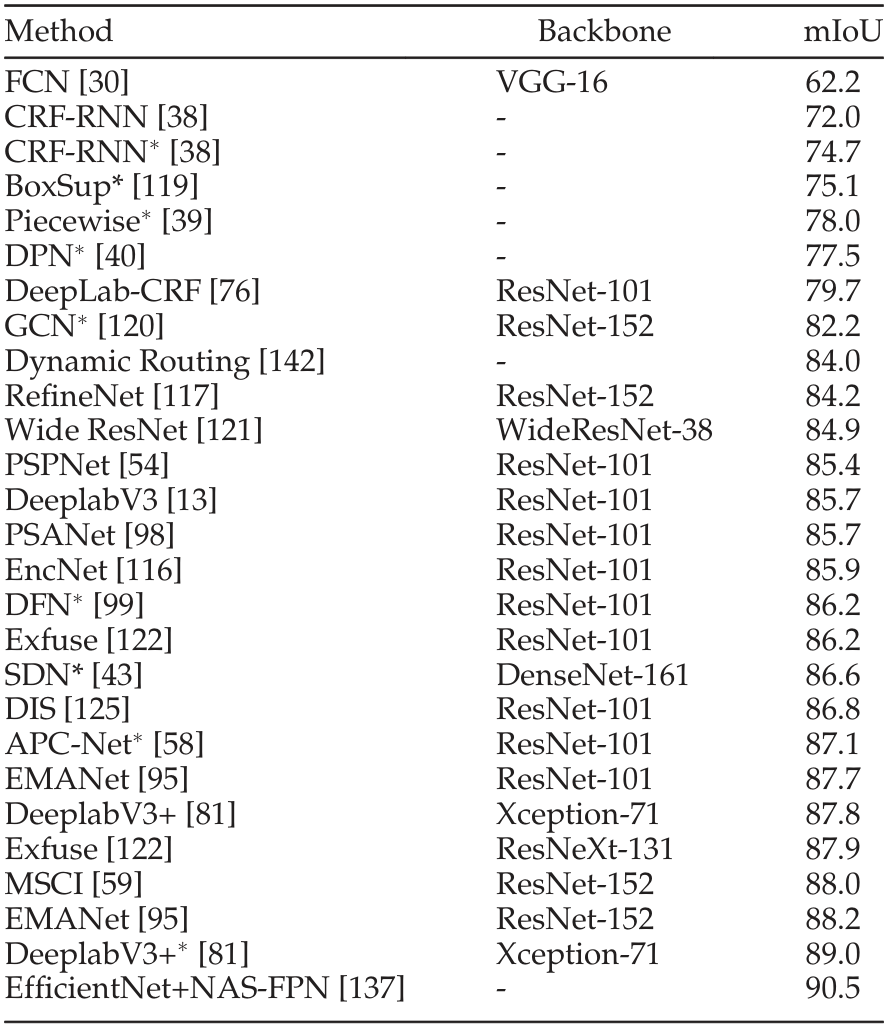
ENTABLE 1 Accuracies of Segmentation Models on the PASCAL VOC Test Set
中表1 分割模型在 PASCAL VOC 测试集上的准确率
图表词汇: 表头:方法、骨干网络、平均交并比(mIoU)。
Source: p.13 S194
EN* Models pre-trained on other datasets (MS-COCO, ImageNet, etc.).
中* 表示在其他数据集(MS COCO、ImageNet 等)上预训练的模型。
查看可复制表格
Method | Backbone | mIoU
FCN [30] | VGG-16 | 62.2
CRF-RNN [38] | - | 72.0
CRF-RNN* [38] | - | 74.7
BoxSup* [119] | - | 75.1
Piecewise* [39] | - | 78.0
DPN* [40] | - | 77.5
DeepLab-CRF [76] | ResNet-101 | 79.7
GCN* [120] | ResNet-152 | 82.2
Dynamic Routing [142] | - | 84.0
RefineNet [117] | ResNet-152 | 84.2
Wide ResNet [121] | WideResNet-38 | 84.9
PSPNet [54] | ResNet-101 | 85.4
DeeplabV3 [13] | ResNet-101 | 85.7
PSANet [98] | ResNet-101 | 85.7
EncNet [116] | ResNet-101 | 85.9
DFN* [99] | ResNet-101 | 86.2
Exfuse [122] | ResNet-101 | 86.2
SDN* [43] | DenseNet-161 | 86.6
DIS [125] | ResNet-101 | 86.8
APC-Net* [58] | ResNet-101 | 87.1
EMANet [95] | ResNet-101 | 87.7
DeeplabV3+ [81] | Xception-71 | 87.8
Exfuse [122] | ResNeXt-131 | 87.9
MSCI [59] | ResNet-152 | 88.0
EMANet [95] | ResNet-152 | 88.2
DeeplabV3+* [81] | Xception-71 | 89.0
EfficientNet+NAS-FPN [137] | - | 90.5
方法 | 骨干网络 | 平均交并比(mIoU)
FCN [30] | VGG-16 | 62.2
CRF-RNN [38] | - | 72.0
CRF-RNN* [38] | - | 74.7
BoxSup* [119] | - | 75.1
Piecewise* [39] | - | 78.0
DPN* [40] | - | 77.5
DeepLab-CRF [76] | ResNet-101 | 79.7
GCN* [120] | ResNet-152 | 82.2
Dynamic Routing [142] | - | 84.0
RefineNet [117] | ResNet-152 | 84.2
Wide ResNet [121] | WideResNet-38 | 84.9
PSPNet [54] | ResNet-101 | 85.4
DeeplabV3 [13] | ResNet-101 | 85.7
PSANet [98] | ResNet-101 | 85.7
EncNet [116] | ResNet-101 | 85.9
DFN* [99] | ResNet-101 | 86.2
Exfuse [122] | ResNet-101 | 86.2
SDN* [43] | DenseNet-161 | 86.6
DIS [125] | ResNet-101 | 86.8
APC-Net* [58] | ResNet-101 | 87.1
EMANet [95] | ResNet-101 | 87.7
DeeplabV3+ [81] | Xception-71 | 87.8
Exfuse [122] | ResNeXt-131 | 87.9
MSCI [59] | ResNet-152 | 88.0
EMANet [95] | ResNet-152 | 88.2
DeeplabV3+* [81] | Xception-71 | 89.0
EfficientNet+NAS-FPN [137] | - | 90.5
Source: p.13 S150
ENTable 2 focuses on the Cityscape test dataset. The latest models feature about 23 percent relative gain over the pioneering FCN model on this dataset.
中表2关注 Cityscapes 测试集。在这一数据集上,最新模型比开创性的 FCN 模型相对提升约23%。
表2
Placed near: p.13 S150
Source: p.13 T002 / C039
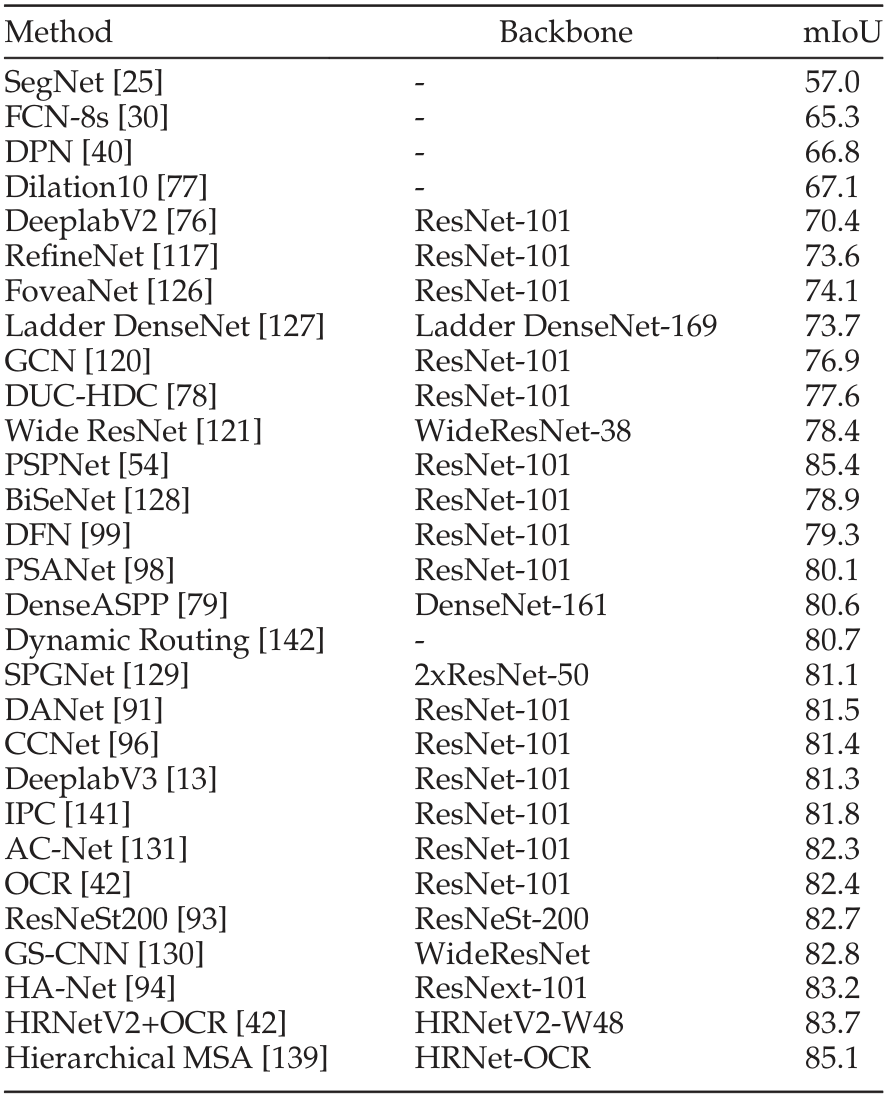
ENTABLE 2 Accuracies of Segmentation Models on the Cityscapes Dataset
中表2 分割模型在 Cityscapes 数据集上的准确率
图表词汇: 表头:方法、骨干网络、平均交并比(mIoU)。
查看可复制表格
Method | Backbone | mIoU
SegNet [25] | - | 57.0
FCN-8s [30] | - | 65.3
DPN [40] | - | 66.8
Dilation10 [77] | - | 67.1
DeeplabV2 [76] | ResNet-101 | 70.4
RefineNet [117] | ResNet-101 | 73.6
FoveaNet [126] | ResNet-101 | 74.1
Ladder DenseNet [127] | Ladder DenseNet-169 | 73.7
GCN [120] | ResNet-101 | 76.9
DUC-HDC [78] | ResNet-101 | 77.6
Wide ResNet [121] | WideResNet-38 | 78.4
PSPNet [54] | ResNet-101 | 85.4
BiSeNet [128] | ResNet-101 | 78.9
DFN [99] | ResNet-101 | 79.3
PSANet [98] | ResNet-101 | 80.1
DenseASPP [79] | DenseNet-161 | 80.6
Dynamic Routing [142] | - | 80.7
SPGNet [129] | 2xResNet-50 | 81.1
DANet [91] | ResNet-101 | 81.5
CCNet [96] | ResNet-101 | 81.4
DeeplabV3 [13] | ResNet-101 | 81.3
IPC [141] | ResNet-101 | 81.8
AC-Net [131] | ResNet-101 | 82.3
OCR [42] | ResNet-101 | 82.4
ResNeSt200 [93] | ResNeSt-200 | 82.7
GS-CNN [130] | WideResNet | 82.8
HA-Net [94] | ResNext-101 | 83.2
HRNetV2+OCR [42] | HRNetV2-W48 | 83.7
Hierarchical MSA [139] | HRNet-OCR | 85.1
方法 | 骨干网络 | 平均交并比(mIoU)
SegNet [25] | - | 57.0
FCN-8s [30] | - | 65.3
DPN [40] | - | 66.8
Dilation10 [77] | - | 67.1
DeeplabV2 [76] | ResNet-101 | 70.4
RefineNet [117] | ResNet-101 | 73.6
FoveaNet [126] | ResNet-101 | 74.1
Ladder DenseNet [127] | Ladder DenseNet-169 | 73.7
GCN [120] | ResNet-101 | 76.9
DUC-HDC [78] | ResNet-101 | 77.6
Wide ResNet [121] | WideResNet-38 | 78.4
PSPNet [54] | ResNet-101 | 85.4
BiSeNet [128] | ResNet-101 | 78.9
DFN [99] | ResNet-101 | 79.3
PSANet [98] | ResNet-101 | 80.1
DenseASPP [79] | DenseNet-161 | 80.6
Dynamic Routing [142] | - | 80.7
SPGNet [129] | 2xResNet-50 | 81.1
DANet [91] | ResNet-101 | 81.5
CCNet [96] | ResNet-101 | 81.4
DeeplabV3 [13] | ResNet-101 | 81.3
IPC [141] | ResNet-101 | 81.8
AC-Net [131] | ResNet-101 | 82.3
OCR [42] | ResNet-101 | 82.4
ResNeSt200 [93] | ResNeSt-200 | 82.7
GS-CNN [130] | WideResNet | 82.8
HA-Net [94] | ResNext-101 | 83.2
HRNetV2+OCR [42] | HRNetV2-W48 | 83.7
Hierarchical MSA [139] | HRNet-OCR | 85.1
Source: p.13 S151
ENTable 3 focuses on the MS COCO stuff test set. This dataset is more challenging than PASCAL VOC, and Cityescapes, as the highest mIoU is approximately 40 percent.
中表3关注 MS COCO Stuff 测试集。该数据集比 PASCAL VOC 和 Cityscapes 更具挑战性,因为最高 mIoU 约为40%。
表3
Placed near: p.13 S151
Source: p.13 T003 / C040
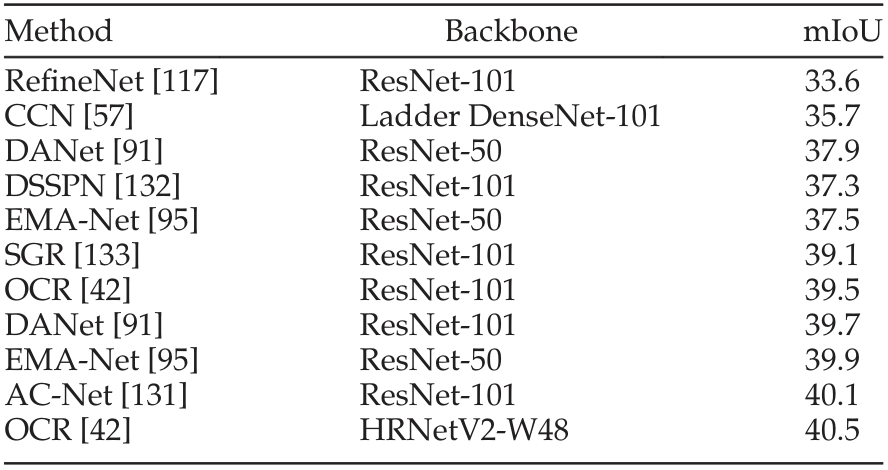
ENTABLE 3 Accuracies of Segmentation Models on the MS COCO Stuff Dataset
中表3 分割模型在 MS COCO Stuff 数据集上的准确率
图表词汇: 表头:方法、骨干网络、平均交并比(mIoU)。
查看可复制表格
Method | Backbone | mIoU
RefineNet [117] | ResNet-101 | 33.6
CCN [57] | Ladder DenseNet-101 | 35.7
DANet [91] | ResNet-50 | 37.9
DSSPN [132] | ResNet-101 | 37.3
EMA-Net [95] | ResNet-50 | 37.5
SGR [133] | ResNet-101 | 39.1
OCR [42] | ResNet-101 | 39.5
DANet [91] | ResNet-101 | 39.7
EMA-Net [95] | ResNet-50 | 39.9
AC-Net [131] | ResNet-101 | 40.1
OCR [42] | HRNetV2-W48 | 40.5
方法 | 骨干网络 | 平均交并比(mIoU)
RefineNet [117] | ResNet-101 | 33.6
CCN [57] | Ladder DenseNet-101 | 35.7
DANet [91] | ResNet-50 | 37.9
DSSPN [132] | ResNet-101 | 37.3
EMA-Net [95] | ResNet-50 | 37.5
SGR [133] | ResNet-101 | 39.1
OCR [42] | ResNet-101 | 39.5
DANet [91] | ResNet-101 | 39.7
EMA-Net [95] | ResNet-50 | 39.9
AC-Net [131] | ResNet-101 | 40.1
OCR [42] | HRNetV2-W48 | 40.5
Source: p.13 S152
ENTable 4 focuses on the ADE20k validation set. This dataset is also more challenging than the PASCAL VOC and Cityescapes datasets.
中表4关注 ADE20K 验证集。该数据集也比 PASCAL VOC 和 Cityscapes 更具挑战性。
表4
Placed near: p.13 S152
Source: p.14 T004 / C041
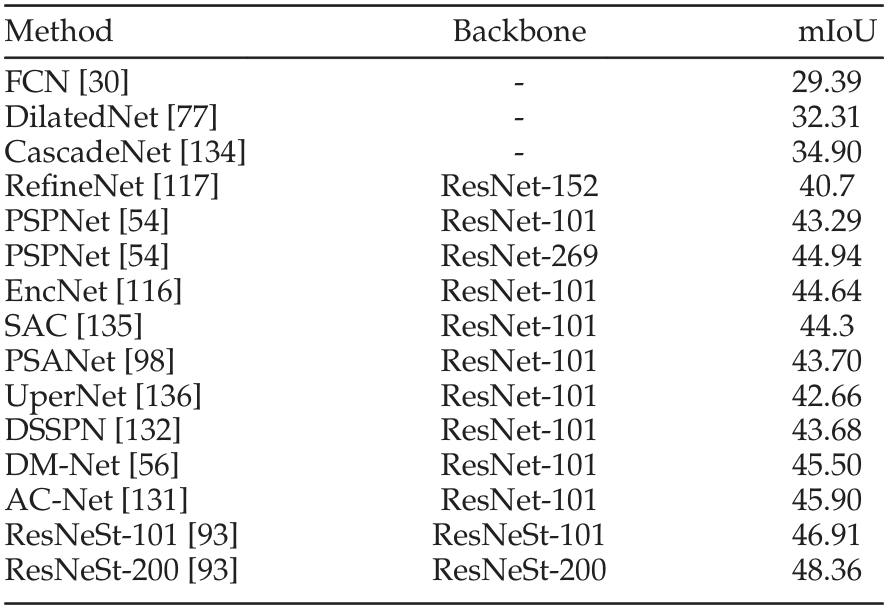
ENTABLE 4 Accuracies of Segmentation Models on the ADE20k Validation Dataset
中表4 分割模型在 ADE20K 验证集上的准确率
图表词汇: 表头:方法、骨干网络、平均交并比(mIoU)。
查看可复制表格
Method | Backbone | mIoU
FCN [30] | - | 29.39
DilatedNet [77] | - | 32.31
CascadeNet [134] | - | 34.90
RefineNet [117] | ResNet-152 | 40.7
PSPNet [54] | ResNet-101 | 43.29
PSPNet [54] | ResNet-269 | 44.94
EncNet [116] | ResNet-101 | 44.64
SAC [135] | ResNet-101 | 44.3
PSANet [98] | ResNet-101 | 43.70
UperNet [136] | ResNet-101 | 42.66
DSSPN [132] | ResNet-101 | 43.68
DM-Net [56] | ResNet-101 | 45.50
AC-Net [131] | ResNet-101 | 45.90
ResNeSt-101 [93] | ResNeSt-101 | 46.91
ResNeSt-200 [93] | ResNeSt-200 | 48.36
方法 | 骨干网络 | 平均交并比(mIoU)
FCN [30] | - | 29.39
DilatedNet [77] | - | 32.31
CascadeNet [134] | - | 34.90
RefineNet [117] | ResNet-152 | 40.7
PSPNet [54] | ResNet-101 | 43.29
PSPNet [54] | ResNet-269 | 44.94
EncNet [116] | ResNet-101 | 44.64
SAC [135] | ResNet-101 | 44.3
PSANet [98] | ResNet-101 | 43.70
UperNet [136] | ResNet-101 | 42.66
DSSPN [132] | ResNet-101 | 43.68
DM-Net [56] | ResNet-101 | 45.50
AC-Net [131] | ResNet-101 | 45.90
ResNeSt-101 [93] | ResNeSt-101 | 46.91
ResNeSt-200 [93] | ResNeSt-200 | 48.36
Source: p.13 S153
ENTable 5 provides the performance of prominent instance segmentation algorithms on COCO test-dev 2017 dataset, in terms of average precision, and their speed.
中表5给出主要实例分割算法在 COCO test-dev 2017 数据集上的平均精度和运行速度。
表5
Placed near: p.13 S153
Source: p.14 T005 / C042
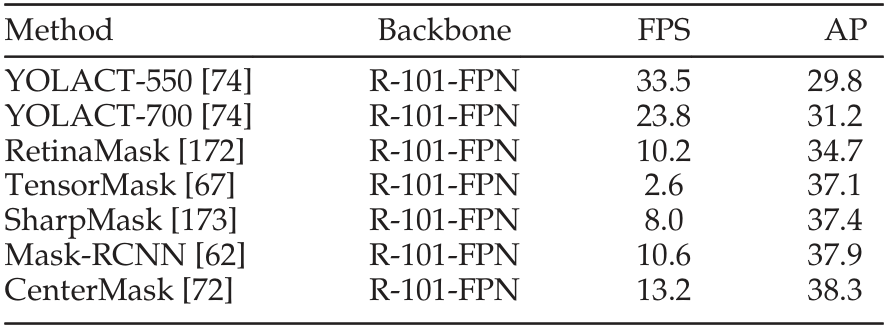
ENTABLE 5 Instance Segmentation Model Performance on COCO Test-Dev 2017
中表5 实例分割模型在 COCO Test-Dev 2017 上的表现
图表词汇: 表头:方法、骨干网络、每秒帧数(FPS)、平均精度(AP)。
查看可复制表格
Method | Backbone | FPS | AP
YOLACT-550 [74] | R-101-FPN | 33.5 | 29.8
YOLACT-700 [74] | R-101-FPN | 23.8 | 31.2
RetinaMask [172] | R-101-FPN | 10.2 | 34.7
TensorMask [67] | R-101-FPN | 2.6 | 37.1
SharpMask [173] | R-101-FPN | 8.0 | 37.4
Mask-RCNN [62] | R-101-FPN | 10.6 | 37.9
CenterMask [72] | R-101-FPN | 13.2 | 38.3
方法 | 骨干网络 | 每秒帧数(FPS) | 平均精度(AP)
YOLACT-550 [74] | R-101-FPN | 33.5 | 29.8
YOLACT-700 [74] | R-101-FPN | 23.8 | 31.2
RetinaMask [172] | R-101-FPN | 10.2 | 34.7
TensorMask [67] | R-101-FPN | 2.6 | 37.1
SharpMask [173] | R-101-FPN | 8.0 | 37.4
Mask-RCNN [62] | R-101-FPN | 10.6 | 37.9
CenterMask [72] | R-101-FPN | 13.2 | 38.3
Source: p.13 S154
ENTable 6 provides the performance of prominent panoptic segmentation algorithms on MS-COCO val dataset, in terms of panoptic quality [143].
中表6以全景质量[143]为指标,列出主要全景分割算法在 MS COCO 验证集上的表现。
表6
Placed near: p.13 S154
Source: p.14 T006 / C043
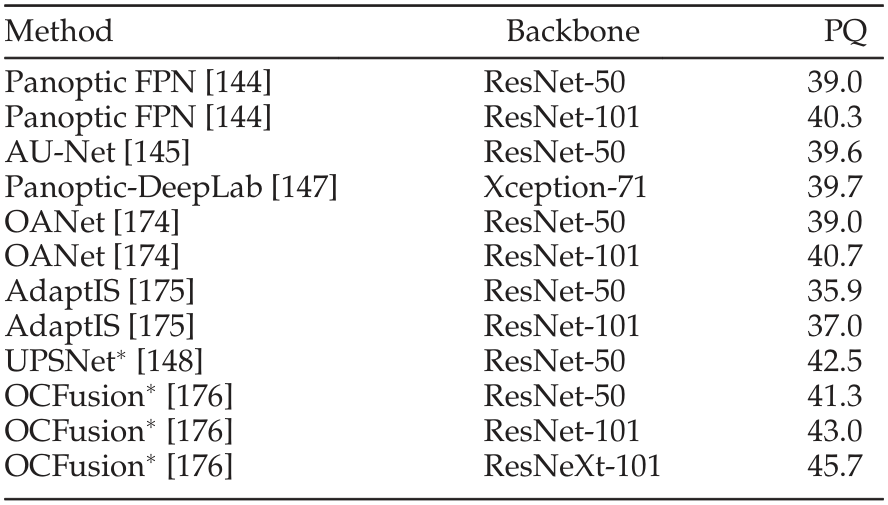
ENTABLE 6 Panoptic Segmentation Model Performance on MS-COCO Val
中表6 全景分割模型在 MS COCO 验证集上的表现
图表词汇: 表头:方法、骨干网络、全景质量(PQ)。
Source: p.14 S195
EN* Use of deformable convolution.
查看可复制表格
Method | Backbone | PQ
Panoptic FPN [144] | ResNet-50 | 39.0
Panoptic FPN [144] | ResNet-101 | 40.3
AU-Net [145] | ResNet-50 | 39.6
Panoptic-DeepLab [147] | Xception-71 | 39.7
OANet [174] | ResNet-50 | 39.0
OANet [174] | ResNet-101 | 40.7
AdaptIS [175] | ResNet-50 | 35.9
AdaptIS [175] | ResNet-101 | 37.0
UPSNet* [148] | ResNet-50 | 42.5
OCFusion* [176] | ResNet-50 | 41.3
OCFusion* [176] | ResNet-101 | 43.0
OCFusion* [176] | ResNeXt-101 | 45.7
方法 | 骨干网络 | 全景质量(PQ)
Panoptic FPN [144] | ResNet-50 | 39.0
Panoptic FPN [144] | ResNet-101 | 40.3
AU-Net [145] | ResNet-50 | 39.6
Panoptic-DeepLab [147] | Xception-71 | 39.7
OANet [174] | ResNet-50 | 39.0
OANet [174] | ResNet-101 | 40.7
AdaptIS [175] | ResNet-50 | 35.9
AdaptIS [175] | ResNet-101 | 37.0
UPSNet* [148] | ResNet-50 | 42.5
OCFusion* [176] | ResNet-50 | 41.3
OCFusion* [176] | ResNet-101 | 43.0
OCFusion* [176] | ResNeXt-101 | 45.7
Source: p.13 S155
ENFinally,
Table 7 summarizes the performance of several prominent models for RGB-D segmentation on the NYUD-v2 and SUN-RGBD datasets.
中最后,
表7汇总了几种主要 RGB-D 分割模型在 NYUDv2 和 SUN-RGBD 数据集上的表现。
表7
Placed near: p.13 S155
Source: p.14 T007 / C044
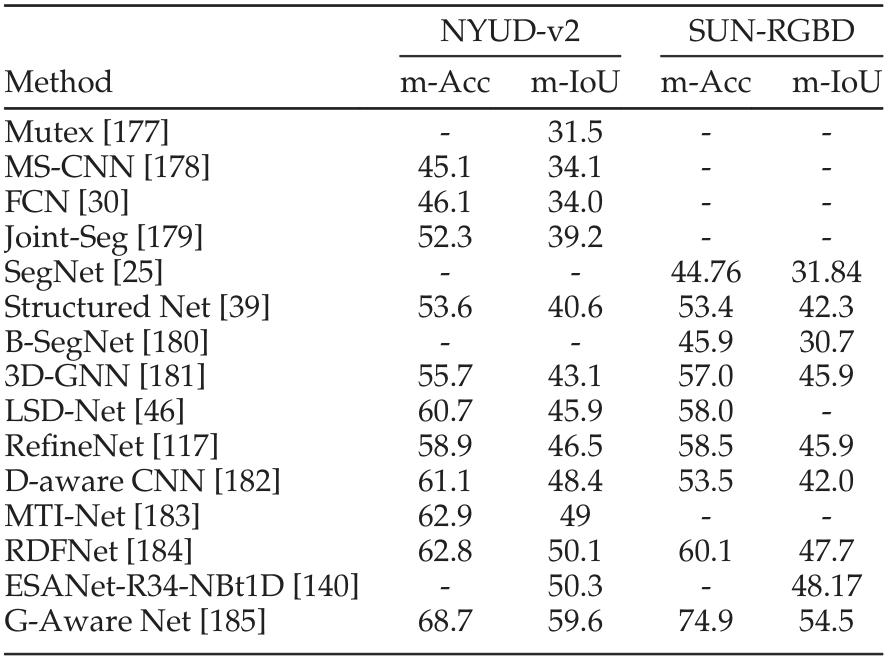
ENTABLE 7 Segmentation Model Performance on the NYUD-v2 and SUN-RGBD
中表7 分割模型在 NYUD-v2 和 SUN-RGBD 数据集上的表现
图表词汇: 两组指标分别对应 NYUD-v2、SUN-RGBD;m-Acc 为平均准确率,m-IoU 为平均交并比。
查看可复制表格
NYUD-v2 | SUN-RGBD
Method | m-Acc | m-IoU | m-Acc | m-IoU
Mutex [177] | - | 31.5 | - | -
MS-CNN [178] | 45.1 | 34.1 | - | -
FCN [30] | 46.1 | 34.0 | - | -
Joint-Seg [179] | 52.3 | 39.2 | - | -
SegNet [25] | - | - | 44.76 | 31.84
Structured Net [39] | 53.6 | 40.6 | 53.4 | 42.3
B-SegNet [180] | - | - | 45.9 | 30.7
3D-GNN [181] | 55.7 | 43.1 | 57.0 | 45.9
LSD-Net [46] | 60.7 | 45.9 | 58.0 | -
RefineNet [117] | 58.9 | 46.5 | 58.5 | 45.9
D-aware CNN [182] | 61.1 | 48.4 | 53.5 | 42.0
MTI-Net [183] | 62.9 | 49 | - | -
RDFNet [184] | 62.8 | 50.1 | 60.1 | 47.7
ESANet-R34-NBt1D [140] | - | 50.3 | - | 48.17
G-Aware Net [185] | 68.7 | 59.6 | 74.9 | 54.5
NYUD-v2 | SUN-RGBD
方法 | 平均准确率(m-Acc) | 平均交并比(m-IoU) | 平均准确率(m-Acc) | 平均交并比(m-IoU)
Mutex [177] | - | 31.5 | - | -
MS-CNN [178] | 45.1 | 34.1 | - | -
FCN [30] | 46.1 | 34.0 | - | -
Joint-Seg [179] | 52.3 | 39.2 | - | -
SegNet [25] | - | - | 44.76 | 31.84
Structured Net [39] | 53.6 | 40.6 | 53.4 | 42.3
B-SegNet [180] | - | - | 45.9 | 30.7
3D-GNN [181] | 55.7 | 43.1 | 57.0 | 45.9
LSD-Net [46] | 60.7 | 45.9 | 58.0 | -
RefineNet [117] | 58.9 | 46.5 | 58.5 | 45.9
D-aware CNN [182] | 61.1 | 48.4 | 53.5 | 42.0
MTI-Net [183] | 62.9 | 49 | - | -
RDFNet [184] | 62.8 | 50.1 | 60.1 | 47.7
ESANet-R34-NBt1D [140] | - | 50.3 | - | 48.17
G-Aware Net [185] | 68.7 | 59.6 | 74.9 | 54.5
Source: pp.13–14 S156
ENIn summary, we have witnessed been significant improvement in the performance of deep segmentation models over the past 5–6 years, with a relative improvement of 25-42 percent in mIoU on different datasets. However, some publications suffer from lack of reproducibility for multiple reasons—they report performance on non-standard benchmarks/databases, or only on arbitrary subsets of the test set from a popular benchmark, or they do not adequately describe the experimental setup and sometimes evaluate model performance only on a subset of object classes. Most importantly, many publications do not provide the source-code for their model implementations. Fortunately, with the increasing popularity of deep learning models, the trend has been positive and many research groups are moving toward reproducible frameworks and open-sourcing their implementations.
中总体来看,在过去5–6年里,深度分割模型的性能显著进步,在不同数据集上的 mIoU 相对提升了25%–42%。不过,一些论文由于种种原因难以复现:有的在非标准的基准或数据库上报告性能,有的仅在常用基准测试集上任意选取子集,有的没有充分描述实验设置,有时还只在一部分对象类别上评估模型。最重要的是,许多论文没有提供模型实现的源代码。随着深度学习模型日益普及,情况有所好转:许多研究团队开始采用可复现的框架,并公开其实现的源代码。
6 挑战与机遇
Source: p.14 S157
EN6 CHALLENGES AND OPPORTUNITIES
Source: p.14 S158
ENWithout a doubt, image segmentation has benefited greatly from deep learning, but several challenges lie ahead. We will next discuss some of the promising research directions that we believe will help in further advancing image segmentation algorithms.
中图像分割无疑从深度学习中获益良多,但还面临若干挑战。接下来,我们讨论一些有前景的研究方向。我们认为这些方向有助于进一步推进图像分割算法。
6.1 更具挑战性的数据集
Source: p.14 S159
EN6.1 More Challenging Datasets
Source: p.14 S160
ENSeveral large-scale image datasets have been created for semantic segmentation and instance segmentation. However, there remains a need for more challenging datasets, as well as datasets of different kinds of images. For still images, datasets with a large number of objects and overlapping objects would be very valuable. This can enable the training of models that handle dense object scenarios better, as well as large overlaps among objects as is common in real-world scenarios. With the rising popularity of 3D image segmentation, especially in medical image analysis, there is also a strong need for large-scale annotated 3D image datasets, which are more difficult to create than their lower dimensional counterparts.
中已有多个为语义分割和实例分割构建的大规模图像数据集,不过仍需要更具挑战性的数据集,以及覆盖不同图像类型的数据集。对于静态图像,包含大量对象且对象彼此重叠的数据集将很有价值。真实场景中的对象常有大面积重叠,这类数据有助于训练出更善于处理密集对象和大量重叠的模型。随着三维图像分割越来越普及,特别是在医学图像分析中,对大规模带标注三维图像数据集的需求也很强;这类数据集比低维数据集更难构建。
6.2 结合深度学习与早期分割模型
Source: p.14 S161
EN6.2 Combining DL and Earlier Segmentation Models
Source: p.14 S162
ENThere is now broad agreement that the performance of DL-based segmentation algorithms is plateauing, especially in certain application domains such as medical image analysis. To advance to the next level of performance, we must further explore the combination of CNN-based image segmentation models with prominent “classical” model-based image segmentation methods. The integration of CNNs with graphical models has been studied, but their integration with active contours, graph cuts, and other segmentation models is fairly recent and deserves further work.
中目前已有广泛共识:深度学习分割算法的性能提升正在趋于停滞,医学图像分析等特定应用领域尤其如此。若要进一步提高性能,必须更深入地探索怎样将基于 CNN 的图像分割模型与有代表性的基于模型的“经典”图像分割方法结合起来。已有研究探讨 CNN 与图模型的结合,但把 CNN 与主动轮廓、图割及其他分割模型相结合的工作出现较晚,值得继续研究。
6.3 可解释的深度模型
Source: p.14 S163
EN6.3 Interpretable Deep Models
Source: pp.14–15 S164
ENWhile DL-based models have achieved promising performance on challenging benchmarks, there remain open questions about these models. For example, what exactly are deep models learning? How should we interpret the features learned by these models? What is a minimal neural architecture that can achieve a certain segmentation accuracy on a given dataset? Although some techniques are available to visualize the learned convolutional kernels of these models, a comprehensive study of the underlying behavior/dynamics of these models is lacking. A better understanding of the theoretical aspects of these models can enable the development of better models curated toward various segmentation scenarios.
中虽然深度学习模型已在有挑战性的基准上表现出良好的潜力,但仍有一些问题没有解答。例如,深度模型究竟学到了什么?该如何解释模型学到的特征?对于给定数据集,要达到某一分割准确率,最小的神经网络架构是什么?尽管已有一些技术能把这些模型学到的卷积核可视化,人们还缺乏对模型内部行为与动态过程的全面研究。更深入理解其理论基础,有助于为不同的分割场景开发更合适的模型。
6.4 弱监督学习与无监督学习
Source: p.15 S165
EN6.4 Weakly-Supervised and Unsupervised Learning
Source: p.15 S166
ENWeakly-supervised (a.k.a. few shot) learning [186] and unsupervised learning [187] are becoming very active research areas. These techniques promise to be specially valuable for image segmentation, as collecting pixel-accurately labeled training images is problematic in many application domains, particularly so in medical image analysis. The transfer learning approach is to train a generic image segmentation model on a large set of labeled samples (perhaps from a public benchmark) and then fine-tune that model on a few samples from some specific target application. Self-supervised learning is another promising direction that is attracting much attraction in various fields. With the help of self-supervised learning, many details in images can be captured in order to train segmentation models with far fewer training samples. Models based on reinforcement learning could also be another potential future direction, as they have scarcely received attention for image segmentation. For example, MOREL [188] introduced a deep reinforcement learning approach for moving object segmentation in videos.
中弱监督学习(原文此处亦称 few-shot learning,即少样本学习)[186]与无监督学习[187]正成为非常活跃的研究方向。它们有望对图像分割特别有价值,因为许多应用领域很难收集逐像素精确标注的训练图像,医学图像分析尤其如此。迁移学习的做法是先用大量有标注的样本(可能来自公开基准)训练一个通用分割模型,再用目标应用中的少量样本微调。自监督学习是另一个有前景的方向,在不同领域受到广泛关注。借助自监督学习,可以提取图像中的许多细节,从而用少得多的训练样本来训练分割模型。基于强化学习的模型也可能是一个值得探索的方向,因为它们在图像分割中迄今很少受到关注。例如,MOREL[188]提出使用深度强化学习来分割视频中的运动对象。
6.5 面向各类应用的实时模型
Source: p.15 S167
EN6.5 Real-Time Models for Various Applications
Source: p.15 S168
ENIn many applications, accuracy is the most important factor; however, there are applications in which it is also critical to have segmentation models that can run in near real-time, or at common camera frame rates (at least 25 frames per second). This is useful for computer vision systems that are, for example, deployed in autonomous vehicles. Most of the current models are far from this frame-rate; e.g., FCN-8 takes roughly 100 ms to process a low-resolution image. Models based on dilated convolution help to increase the speed of segmentation models to some extent, but there is still plenty of room for improvement.
中许多应用首要关注准确率,但有些应用同样要求分割模型近实时运行,或达到常用相机的帧率(至少25帧/秒)。例如,这对部署在自动驾驶车辆上的计算机视觉系统很有用。当时大多数模型远达不到这一帧率:例如 FCN-8 处理一幅低分辨率图像约需100 ms。基于空洞卷积的模型在一定程度上提高了分割速度,但仍有很大改进空间。
6.6 节省内存的模型
Source: p.15 S169
EN6.6 Memory Efficient Models
Source: p.15 S170
ENMany modern segmentation models require a significant amount of memory even during the inference stage. So far, much effort has been directed towards improving the accuracy of such models, but in order to fit them into specific devices, such as mobile phones, the networks must be simplified. This can be done either by using simpler models, or by using model compression techniques, or even by training a complex model and using knowledge distillation techniques to compress it into a smaller, memory efficient network that mimics the complex model.
中许多现代分割模型即使在推理阶段也需要大量内存。以往的大量工作集中在提高这类模型的准确率;但要让模型在手机等特定设备上运行,必须简化网络。可以使用较简单的模型,或采用模型压缩技术;也可以先训练复杂模型,再用知识蒸馏将其压缩为一个能够模仿复杂模型、体积更小且更节省内存的网络。
6.7 应用
Source: p.15 S171
Source: p.15 S172
ENDL-based segmentation methods have been successfully applied to satellite images in remote sensing [189], such as to support urban planning [190] and precision agriculture [191]. Images collected by airborne platforms [192] and drones [193] have also been segmented using DL-based segmentation methods in order to address important environmental problems including ones related to climate change. The main challenges of the remote sensing domain stem from the typically formidable size of the imagery (often collected by imaging spectrometers with hundreds or even thousands of spectral bands) and the limited ground-truth information necessary to evaluate the accuracy of the segmentation algorithms. Similarly, DL-based segmentation techniques in the evaluation of construction materials [194] face challenges related to the massive volume of the related image data and the limited reference information for validation purposes. Last but not least, an important application field for DL-based segmentation has been biomedical imaging [195]. Here, an opportunity is to design standardized image databases useful in evaluating new infectious diseases and tracking pandemics [196].
中基于深度学习的分割已成功应用于遥感卫星图像[189],如支持城市规划[190]和精准农业[191]。研究人员也用这类方法分割机载平台[192]和无人机[193]采集的影像,以解决重要环境问题,包括与气候变化有关的问题。遥感领域的主要挑战在于影像体量往往很大(通常由具有数百乃至数千个光谱波段的成像光谱仪采集),而评估分割算法准确率所需的真值信息又很有限。类似地,在建筑材料评估[194]中应用深度学习分割时,也面临相关图像数据量巨大、可用于验证的参考信息有限的问题。生物医学影像[195]也是深度学习分割的一个重要应用领域。在该领域,一个机会是设计标准化图像数据库,用于评估新发传染病和追踪大流行[196]。
7 结论
Source: p.15 S173
Source: p.15 S174
ENWe have surveyed image segmentation algorithms based on deep learning models, which have achieved impressive performance in various image segmentation tasks and benchmarks, grouped into architectural categories such as: CNN and FCN, RNN, R-CNN, dilated CNN, attention-based models, generative and adversarial models, among others. We have summarized the quantitative performance of these models on some popular benchmarks, such as the PASCAL VOC, MS COCO, Cityscapes, and ADE20k datasets. Finally, we discussed some of the open challenges and promising research directions for deep-learning-based image segmentation in the coming years.
中本文综述了基于深度学习模型的图像分割算法。这些算法在多种分割任务和基准上取得了显著成果。我们按照架构对算法分类,包括 CNN 与 FCN、RNN、R-CNN、空洞 CNN、基于注意力的模型、生成与对抗模型等。我们汇总了这些模型在 PASCAL VOC、MS COCO、Cityscapes 和 ADE20K 等常用基准上的量化性能,并讨论了基于深度学习的图像分割仍待解决的若干挑战及未来几年的有前景的研究方向。
致谢
Source: p.15 S175
Source: p.15 S176
ENThe authors would like to thank Tsung-Yi Lin of Google Brain, as well as Jingdong Wang and Yuhui Yuan of Microsoft Research Asia for providing helpful comments that improved the manuscript.
中作者感谢 Google Brain 的 Tsung-Yi Lin,以及微软亚洲研究院的 Jingdong Wang 和 Yuhui Yuan。他们提出的有益意见帮助改进了本文。
参考文献
Source: p.15 S177
Source: p.15 R001
EN[1] A. Rosenfeld and A. C. Kak, Digital Picture Processing. Cambridge, MA, USA: Academic Press, 1976.
Source: p.15 R002
EN[2] R. Szeliski, Computer Vision: Algorithms and Applications. Berlin, Germany: Springer, 2010.
Source: p.15 R003
EN[3] D. Forsyth and J. Ponce, Computer Vision: A Modern Approach. Upper Saddle River, NJ, USA: Prentice Hall, 2002.
Source: p.15 R004
EN[4] N. Otsu, “A threshold selection method from gray-level histograms,” IEEE Trans. Syst. Man Cybern., vol. SMC-9, no. 1, pp. 62– 66, Jan. 1979.
Source: p.15 R005
EN[5] R. Nock and F. Nielsen, “Statistical region merging,” IEEE Trans. Pattern Anal. Mach. Intell., vol. 26, no. 11, pp. 1452–1458, Nov. 2004.
Source: p.15 R006
EN[6] N. Dhanachandra, K. Manglem, and Y. J. Chanu, “Image segmentation using K-means clustering algorithm and subtractive clustering algorithm,” Procedia Comput. Sci., vol. 54, pp. 764–771, 2015.
Source: p.15 R007
EN[7] L. Najman and M. Schmitt, “Watershed of a continuous function,” Signal Process., vol. 38, no. 1, pp. 99–112, 1994.
Source: p.15 R008
EN[8] M. Kass, A. Witkin, and D. Terzopoulos, “Snakes: Active contour models,” Int. J. Comput. Vis., vol. 1, no. 4, pp. 321–331, 1988.
Source: p.15 R009
EN[9] Y. Boykov, O. Veksler, and R. Zabih, “Fast approximate energy minimization via graph cuts,” IEEE Trans. Pattern Anal. Mach. Intell., vol. 23, no. 11, pp. 1222–1239, Nov. 2001.
Source: p.15 R010
EN[10] N. Plath, M. Toussaint, and S. Nakajima, “Multi-class image segmentation using conditional random fields and global classification,” in Proc. 26th Int. Conf. Mach. Learn., 2009, pp. 817–824.
Source: p.15 R011
EN[11] J.-L. Starck, M. Elad, and D. L. Donoho, “Image decomposition via the combination of sparse representations and a variational approach,” IEEE Trans. Image Process., vol. 14, no. 10, pp. 1570– 1582, Oct. 2005.
Source: p.16 R012
EN[12] S. Minaee and Y. Wang, “An ADMM approach to masked signal decomposition using subspace representation,” IEEE Trans. Image Process., vol. 28, no. 7, pp. 3192–3204, Jul. 2019.
Source: p.16 R013
EN[13] L.-C. Chen, G. Papandreou, F. Schroff, and H. Adam, “Rethinking atrous convolution for semantic image segmentation,” 2017, arXiv: 1706.05587.
Source: p.16 R014
EN[14] S. Minaee, Y. Boykov, F. Porikli, A. Plaza, N. Kehtarnavaz, and D. Terzopoulos, “Image segmentation using deep learning: A survey,” 2020, arXiv: 2001.05566.
Source: p.16 R015
EN[15] Y. LeCun, L. Bottou, Y. Bengio, and P. Haffner, “Gradient-based learning applied to document recognition,” Proc. IEEE, vol. 86, no. 11, pp. 2278–2324, Nov. 1998.
Source: p.16 R016
EN[16] K. Fukushima, “Neocognitron: A self-organizing neural network model for a mechanism of pattern recognition unaffected by shift in position,” Biol. Cybern., vol. 36, no. 4, pp. 193–202, 1980.
Source: p.16 R017
EN[17] A. Waibel, T. Hanazawa, G. Hinton, K. Shikano, and K. J. Lang, “Phoneme recognition using time-delay neural networks,” IEEE Trans. Acoust. Speech Signal Process., vol. 37, no. 3, pp. 328–339, Mar. 1989.
Source: p.16 R018
EN[18] A. Krizhevsky, I. Sutskever, and G. E. Hinton, “ImageNet classification with deep convolutional neural networks,” in Proc. 25th Int. Conf. Neural Inf. Process. Syst., 2012, pp. 1097–1105.
Source: p.16 R019
EN[19] K. Simonyan and A. Zisserman, “Very deep convolutional networks for large-scale image recognition,” 2014, arXiv:1409.1556.
Source: p.16 R020
EN[20] K. He, X. Zhang, S. Ren, and J. Sun, “Deep residual learning for image recognition,” in Proc. IEEE Conf. Comput. Vis. Pattern Recognit., 2016, pp. 770–778.
Source: p.16 R021
Source: p.16 R022
EN[22] D. E. Rumelhart et al., “Learning representations by back-propagating errors,” Cogn. Model., vol. 5, no. 3, 1988, Art. no. 1.
Source: p.16 R023
EN[23] S. Hochreiter and J. Schmidhuber, “Long short-term memory,” Neural Comput., vol. 9, no. 8, pp. 1735–1780, 1997.
Source: p.16 R024
EN[24] I. Goodfellow, Y. Bengio, and A. Courville, Deep Learning. Cambridge, MA, USA: MIT Press, 2016.
Source: p.16 R025
EN[25] V. Badrinarayanan, A. Kendall, and R. Cipolla, “SegNet: A deep convolutional encoder-decoder architecture for image segmentation,” IEEE Trans. Pattern Anal. Mach. Intell., vol. 39, no. 12, pp. 2481–2495, Dec. 2017.
Source: p.16 R026
EN[26] I. Goodfellow et al., “Generative adversarial nets,” in Proc. 27th Int. Conf. Neural Inf. Process. Syst., 2014, pp. 2672–2680.
Source: p.16 R027
EN[27] A. Radford, L. Metz, and S. Chintala, “Unsupervised representation learning with deep convolutional generative adversarial networks,” 2015, arXiv:1511.06434.
Source: p.16 R028
EN[28] M. Mirza and S. Osindero, “Conditional generative adversarial nets,” 2014, arXiv:1411.1784.
Source: p.16 R029
EN[29] M. Arjovsky, S. Chintala, and L. Bottou, “Wasserstein GAN,” 2017, arXiv: 1701.07875.
Source: p.16 R030
EN[30] J. Long, E. Shelhamer, and T. Darrell, “Fully convolutional networks for semantic segmentation,” in Proc. IEEE Conf. Comput. Vis. Pattern Recognit., 2015, pp. 3431–3440.
Source: p.16 R031
EN[31] G. Wang, W. Li, S. Ourselin, and T. Vercauteren, “Automatic brain tumor segmentation using cascaded anisotropic convolutional neural networks,” in Proc. Int. MICCAI Brainlesion Workshop, 2017, pp. 178–190.
Source: p.16 R032
EN[32] Y. Li, H. Qi, J. Dai, X. Ji, and Y. Wei, “Fully convolutional instance-aware semantic segmentation,” in Proc. IEEE Conf. Comput. Vis. Pattern Recognit., 2017, pp. 2359–2367.
Source: p.16 R033
EN[33] Y. Yuan, M. Chao, and Y.-C. Lo, “Automatic skin lesion segmentation using deep fully convolutional networks with Jaccard distance,” IEEE Trans. Med. Imag., vol. 36, no. 9, pp. 1876–1886, Sep. 2017.
Source: p.16 R034
EN[34] N. Liu, H. Li, M. Zhang, J. Liu, Z. Sun, and T. Tan, “Accurate iris segmentation in non-cooperative environments using fully convolutional networks,” in Proc. Int. Conf. Biometrics, 2016, pp. 1–8.
Source: p.16 R035
EN[35] W. Liu, A. Rabinovich, and A. C. Berg, “ParseNet: Looking wider to see better,” 2015, arXiv:1506.04579.
Source: p.16 R036
EN[36] L.-C. Chen, G. Papandreou, I. Kokkinos, K. Murphy, and A. L. Yuille, “Semantic image segmentation with deep convolutional nets and fully connected CRFs,” 2014, arXiv:1412.7062.
Source: p.16 R037
EN[37] A. G. Schwing and R. Urtasun, “Fully connected deep structured networks,” 2015, arXiv:1503.02351.
Source: p.16 R038
EN[38] S. Zheng et al., “Conditional random fields as recurrent neural networks,” in Proc. IEEE Int. Conf. Comput. Vis., 2015, pp. 1529– 1537.
Source: p.16 R039
EN[39] G. Lin, C. Shen, A. Van Den Hengel, and I. Reid, “Efficient piece-wise training of deep structured models for semantic segmentation,” in Proc. IEEE Conf. Comput. Vis. Pattern Recognit., 2016, pp. 3194–3203.
Source: p.16 R040
EN[40] Z. Liu, X. Li, P. Luo, C.-C. Loy, and X. Tang, “Semantic image segmentation via deep parsing network,” in Proc. IEEE Int. Conf. Comput. Vis., 2015, pp. 1377–1385.
Source: p.16 R041
EN[41] H. Noh, S. Hong, and B. Han, “Learning deconvolution network for semantic segmentation,” in Proc. IEEE Int. Conf. Comput. Vis., 2015, pp. 1520–1528.
Source: p.16 R042
EN[42] Y. Yuan, X. Chen, and J. Wang, “Object-contextual representations for semantic segmentation,” 2019, arXiv: 1909.11065.
Source: p.16 R043
EN[43] J. Fu, J. Liu, Y. Wang, J. Zhou, C. Wang, and H. Lu, “Stacked deconvolutional network for semantic segmentation,” IEEE Trans. Image Process., early access, Jan. 25, 2019, doi: 10.1109/ TIP.2019.2895460.
Source: p.16 R044
EN[44] A. Chaurasia and E. Culurciello, “LinkNet: Exploiting encoder representations for efficient semantic segmentation,” in Proc. IEEE Int. Conf. Visual Commun. Image Process., 2017, pp. 1–4.
Source: p.16 R045
EN[45] X. Xia and B. Kulis, “W-Net: A deep model for fully unsupervised image segmentation,” 2017, arXiv: 1711.08506.
Source: p.16 R046
EN[46] Y. Cheng, R. Cai, Z. Li, X. Zhao, and K. Huang, “Locality-sensitive deconvolution networks with gated fusion for RGB-D indoor semantic segmentation,” in Proc. IEEE Conf. Comput. Vis. Pattern Recognit., 2017, pp. 3029–3037.
Source: p.16 R047
EN[47] O. Ronneberger, P. Fischer, and T. Brox, “U-Net: Convolutional networks for biomedical image segmentation,” in Proc. Int. Conf. Med. Image Comput. Comput.-Assisted Intervention, 2015, pp. 234– 241.
Source: p.16 R048
EN[48] Z. Zhou, M. M. R. Siddiquee, N. Tajbakhsh, and J. Liang, “UNet++: A nested U-Net architecture for medical image segmentation,” in Proc. Int. Workshop Deep Learn. Med. Image Anal. Multimodal Learn. Clin. Decis. Support, 2018, pp. 3–11.
Source: p.16 R049
EN[49] Z. Zhang, Q. Liu, and Y. Wang, “Road extraction by deep residual U-Net,” IEEE Geosci. Remote Sens. Lett., vol. 15, no. 5, pp. 749– 753, May 2018. Ö. Çiçek, A. Abdulkadir, S. S. Lienkamp, T. Brox, and O. Ronne-
Source: p.16 R050
EN[50] berger, “3D U-Net: Learning dense volumetric segmentation from sparse annotation,” in Proc. Int. Conf. Med. Image Comput. Comput.-Assisted Intervention, 2016, pp. 424–432.
Source: p.16 R051
EN[51] F. Milletari, N. Navab, and S.-A. Ahmadi, “V-Net: Fully convolutional neural networks for volumetric medical image segmentation,” in Proc. 4th Int. Conf. 3D Vis., 2016, pp. 565–571.
Source: p.16 R052
EN[52] T. Brosch, L. Y. Tang, Y. Yoo, D. K. Li, A. Traboulsee, and R. Tam, “Deep 3D convolutional encoder networks with shortcuts for multiscale feature integration applied to multiple sclerosis lesion segmentation,” IEEE Trans. Med. Imag., vol. 35, no. 5, pp. 1229– 1239, May 2016.
Source: p.16 R053
EN[53] T.-Y. Lin, P. Dollár, R. Girshick, K. He, B. Hariharan, and S. Belongie, “Feature pyramid networks for object detection,” in Proc. IEEE Conf. Comput. Vis. Pattern Recognit., 2017, pp. 2117– 2125.
Source: p.16 R054
EN[54] H. Zhao, J. Shi, X. Qi, X. Wang, and J. Jia, “Pyramid scene parsing network,” in Proc. IEEE Conf. Comput. Vis. Pattern Recognit., 2017, pp. 2881–2890.
Source: p.16 R055
EN[55] G. Ghiasi and C. C. Fowlkes, “Laplacian pyramid reconstruction and refinement for semantic segmentation,” in Proc. Eur. Conf. Comput. Vis., 2016, pp. 519–534.
Source: p.16 R056
EN[56] J. He, Z. Deng, and Y. Qiao, “Dynamic multi-scale filters for semantic segmentation,” in Proc. IEEE Int. Conf. Comput. Vis., 2019, pp. 3562–3572.
Source: p.16 R057
EN[57] H. Ding, X. Jiang, B. Shuai, A. Qun Liu, and G. Wang, “Context contrasted feature and gated multi-scale aggregation for scene segmentation,” in Proc. IEEE Conf. Comput. Vis. Pattern Recognit., 2018, pp. 2393–2402.
Source: p.16 R058
EN[58] J. He, Z. Deng, L. Zhou, Y. Wang, and Y. Qiao, “Adaptive pyramid context network for semantic segmentation,” in Proc. Conf. Comput. Vis. Pattern Recognit., 2019, pp. 7519–7528.
Source: p.16 R059
EN[59] D. Lin, Y. Ji, D. Lischinski, D. Cohen-Or, and H. Huang, “Multi-scale context intertwining for semantic segmentation,” in Proc. Eur. Conf. Comput. Vis., 2018, pp. 603–619.
Source: p.16 R060
EN[60] G. Li, Y. Xie, L. Lin, and Y. Yu, “Instance-level salient object segmentation,” in Proc. IEEE Conf. Comput. Vis. Pattern Recognit., 2017, pp. 2386–2395.
Source: p.16 R061
EN[61] S. Ren, K. He, R. Girshick, and J. Sun, “Faster R-CNN: Towards real-time object detection with region proposal networks,” in Proc. 28th Int. Conf. Neural Inf. Process. Syst., 2015, pp. 91–99.
Source: p.17 R062
EN[62] K. He, G. Gkioxari, P. Dollár, and R. Girshick, “Mask R-CNN,” in Proc. IEEE Int. Conf. Comput. Vis., 2017, pp. 2961–2969.
Source: p.17 R063
EN[63] S. Liu, L. Qi, H. Qin, J. Shi, and J. Jia, “Path aggregation network for instance segmentation,” in Proc. IEEE Conf. Comput. Vis. Pattern Recognit., 2018, pp. 8759–8768.
Source: p.17 R064
EN[64] J. Dai, K. He, and J. Sun, “Instance-aware semantic segmentation via multi-task network cascades,” in Proc. IEEE Conf. Comput. Vis. Pattern Recognit., 2016, pp. 3150–3158.
Source: p.17 R065
EN[65] R. Hu, P. Dollár, K. He, T. Darrell, and R. Girshick, “Learning to segment every thing,” in Proc. IEEE Conf. Comput. Vis. Pattern Recognit., 2018, pp. 4233–4241.
Source: p.17 R066
EN[66] L.-C. Chen, A. Hermans, G. Papandreou, F. Schroff, P. Wang, and H. Adam, “MaskLab: Instance segmentation by refining object detection with semantic and direction features,” in Proc. IEEE Conf. Comput. Vis. Pattern Recognit., 2018, pp. 4013–4022.
Source: p.17 R067
EN[67] X. Chen, R. Girshick, K. He, and P. Dollár, “TensorMask: A foundation for dense object segmentation,” 2019, arXiv: 1903.12174.
Source: p.17 R068
EN[68] J. Dai, Y. Li, K. He, and J. Sun, “R-FCN: Object detection via region-based fully convolutional networks,” in Proc. 30th Int. Conf. Neural Inf. Process. Syst., 2016, pp. 379–387.
Source: p.17 R069
EN[69] P. O. Pinheiro, R. Collobert, and P. Dollár, “Learning to segment object candidates,” in Proc. 28th Int. Conf. Neural Inf. Process. Syst., 2015, pp. 1990–1998.
Source: p.17 R070
EN[70] E. Xie et al., “PolarMask: Single shot instance segmentation with polar representation,” 2019, arXiv: 1909.13226.
Source: p.17 R071
EN[71] Z. Hayder, X. He, and M. Salzmann, “Boundary-aware instance segmentation,” in Proc. IEEE Conf. Comput. Vis. Pattern Recognit., 2017, pp. 5696–5704.
Source: p.17 R072
EN[72] Y. Lee and J. Park, “CenterMask: Real-time anchor-free instance segmentation,” in Proc. IEEE Conf. Comput. Vis. Pattern Recognit., 2020, pp. 13 906–13 915.
Source: p.17 R073
EN[73] M. Bai and R. Urtasun, “Deep watershed transform for instance segmentation,” in Proc. IEEE Conf. Comput. Vis. Pattern Recognit., 2017, pp. 5221–5229.
Source: p.17 R074
EN[74] D. Bolya, C. Zhou, F. Xiao, and Y. J. Lee, “YOLACT: Real-time instance segmentation,” in Proc. IEEE Int. Conf. Comput. Vis., 2019, pp. 9157–9166.
Source: p.17 R075
EN[75] A. Fathi et al., “Semantic instance segmentation via deep metric learning,” 2017, arXiv: 1703.10277.
Source: p.17 R076
EN[76] L.-C. Chen, G. Papandreou, I. Kokkinos, K. Murphy, and A. L. Yuille, “DeepLab: Semantic image segmentation with deep convolutional nets, atrous convolution, and fully connected CRFs,” IEEE Trans. Pattern Anal. Mach. Intell., vol. 40, no. 4, pp. 834–848, Apr. 2018.
Source: p.17 R077
EN[77] F. Yu and V. Koltun, “Multi-scale context aggregation by dilated convolutions,” 2015, arXiv:1511.07122.
Source: p.17 R078
EN[78] P. Wang et al., “Understanding convolution for semantic segmentation,” in Proc. IEEE Winter Conf. Appl. Comput. Vis., 2018, pp. 1451–1460.
Source: p.17 R079
EN[79] M. Yang, K. Yu, C. Zhang, Z. Li, and K. Yang, “DenseASPP for semantic segmentation in street scenes,” in Proc. IEEE Conf. Comput. Vis. Pattern Recognit., 2018, pp. 3684–3692.
Source: p.17 R080
EN[80] A. Paszke, A. Chaurasia, S. Kim, and E. Culurciello, “ENet: A deep neural network architecture for real-time semantic segmentation,” 2016, arXiv:1606.02147.
Source: p.17 R081
EN[81] L.-C. Chen, Y. Zhu, G. Papandreou, F. Schroff, and H. Adam, “Encoder-decoder with atrous separable convolution for semantic image segmentation,” in Proc. Eur. Conf. Comput. Vis., 2018, pp. 801–818.
Source: p.17 R082
EN[82] F. Visin et al., “ReSeg: A recurrent neural network-based model for semantic segmentation,” in Proc. IEEE Conf. Comput. Vis. Pattern Recognit. Workshops, 2016, pp. 41–48.
Source: p.17 R083
EN[83] F. Visin, K. Kastner, K. Cho, M. Matteucci, A. Courville, and Y. Bengio, “ReNet: A recurrent neural network based alternative to convolutional networks,” 2015, arXiv:1505.00393.
Source: p.17 R084
EN[84] W. Byeon, T. M. Breuel, F. Raue, and M. Liwicki, “Scene labeling with LSTM recurrent neural networks,” in Proc. IEEE Conf. Comput. Vis. Pattern Recognit., 2015, pp. 3547–3555.
Source: p.17 R085
EN[85] X. Liang, X. Shen, J. Feng, L. Lin, and S. Yan, “Semantic object parsing with graph LSTM,” in Proc. Eur. Conf. Comput. Vis., 2016, pp. 125–143.
Source: p.17 R086
EN[86] Y. Xiang and D. Fox, “DA-RNN: Semantic mapping with data associated recurrent neural networks,” 2017, arXiv: 1703.03098.
Source: p.17 R087
EN[87] R. Hu, M. Rohrbach, and T. Darrell, “Segmentation from natural language expressions,” in Proc. Eur. Conf. Comput. Vis., 2016, pp. 108–124.
Source: p.17 R088
EN[88] L.-C. Chen, Y. Yang, J. Wang, W. Xu, and A. L. Yuille, “Attention to scale: Scale-aware semantic image segmentation,” in Proc. IEEE Conf. Comput. Vis. Pattern Recognit., 2016, pp. 3640–3649.
Source: p.17 R089
EN[89] Q. Huang et al., “Semantic segmentation with reverse attention,” 2017, arXiv: 1707.06426.
Source: p.17 R090
EN[90] H. Li, P. Xiong, J. An, and L. Wang, “Pyramid attention network for semantic segmentation,” 2018, arXiv: 1805.10180.
Source: p.17 R091
EN[91] J. Fu et al., “Dual attention network for scene segmentation,” in Proc. IEEE Conf. Comput. Vis. Pattern Recognit., 2019, pp. 3146– 3154.
Source: p.17 R092
EN[92] Y. Yuan and J. Wang, “OCNet: Object context network for scene parsing,” 2018, arXiv: 1809.00916.
Source: p.17 R093
EN[93] H. Zhang et al., “ResNeSt: Split-attention networks,” 2020, arXiv: 2004.08955.
Source: p.17 R094
EN[94] S. Choi, J. T. Kim, and J. Choo, “Cars can’t fly up in the sky: Improving urban-scene segmentation via height-driven attention networks,” in Proc. IEEE/CVF Conf. Comput. Vis. Pattern Recognit., 2020, pp. 9373–9383.
Source: p.17 R095
EN[95] X. Li, Z. Zhong, J. Wu, Y. Yang, Z. Lin, and H. Liu, “Expectation-maximization attention networks for semantic segmentation,” in Proc. IEEE Int. Conf. Comput. Vis., 2019, pp. 9167–9176.
Source: p.17 R096
EN[96] Z. Huang, X. Wang, L. Huang, C. Huang, Y. Wei, and W. Liu, “CCNet: Criss-cross attention for semantic segmentation,” in Proc. IEEE Int. Conf. Comput. Vis., 2019, pp. 603–612.
Source: p.17 R097
EN[97] M. Ren and R. S. Zemel, “End-to-end instance segmentation with recurrent attention,” in Proc. IEEE Conf. Comput. Vis. Pattern Recognit., 2017, pp. 6656–6664.
Source: p.17 R098
EN[98] H. Zhao et al., “PSANet: Point-wise spatial attention network for scene parsing,” in Proc. Eur. Conf. Comput. Vis., 2018, pp. 267–283.
Source: p.17 R099
EN[99] C. Yu, J. Wang, C. Peng, C. Gao, G. Yu, and N. Sang, “Learning a discriminative feature network for semantic segmentation,” in Proc. IEEE Conf. Comput. Vis. Pattern Recognit., 2018, pp. 1857– 1866.
Source: p.17 R100
EN[100] P. Luc, C. Couprie, S. Chintala, and J. Verbeek, “Semantic segmentation using adversarial networks,” 2016, arXiv:1611.08408.
Source: p.17 R101
EN[101] N. Souly, C. Spampinato, and M. Shah, “Semi supervised semantic segmentation using generative adversarial network,” in Proc. IEEE Int. Conf. Comput. Vis., 2017, pp. 5688–5696.
Source: p.17 R102
EN[102] W.-C. Hung, Y.-H. Tsai, Y.-T. Liou, Y.-Y. Lin, and M.-H. Yang, “Adversarial learning for semi-supervised semantic segmentation,” 2018, arXiv: 1802.07934.
Source: p.17 R103
EN[103] Y. Xue, T. Xu, H. Zhang, L. R. Long, and X. Huang, “SegAN: Adversarial network with multi-scale L1 loss for medical image segmentation,” Neuroinformatics, vol. 16, no. 3/4, pp. 383–392, 2018.
Source: p.17 R104
EN[104] M. Majurski et al., “Cell image segmentation using generative adversarial networks, transfer learning, and augmentations,” in Proc. IEEE Conf. Comput. Vis. Pattern Recognit. Workshops, 2019, pp. 1114–1122.
Source: p.17 R105
EN[105] K. Ehsani, R. Mottaghi, and A. Farhadi, “SegAN: Segmenting and generating the invisible,” in Proc. IEEE Conf. Comput. Vis. Pattern Recognit., 2018, pp. 6144–6153.
Source: p.17 R106
EN[106] T. F. Chan and L. A. Vese, “Active contours without edges,” IEEE Trans. Image Process., vol. 10, no. 2, pp. 266–277, Feb. 2001.
Source: p.17 R107
EN[107] X. Chen, B. M. Williams, S. R. Vallabhaneni, G. Czanner, R. Williams, and Y. Zheng, “Learning active contour models for medical image segmentation,” in Proc. IEEE Conf. Comput. Vis. Pattern Recognit., 2019, pp. 11 632–11 640.
Source: p.17 R108
EN[108] S. Gur, L. Wolf, L. Golgher, and P. Blinder, “Unsupervised microvascular image segmentation using an active contours mimicking neural network,” in Proc. IEEE Int. Conf. Comput. Vis., 2019, pp. 10 722–10 731.
Source: p.17 R109
EN[109] P. Marquez-Neila, L. Baumela, and L. Alvarez, “A morphological approach to curvature-based evolution of curves and surfaces,” IEEE Trans. Pattern Anal. Mach. Intell., vol. 36, no. 1, pp. 2–17, Jan. 2014.
Source: p.17 R110
EN[110] T. H. N. Le, K. G. Quach, K. Luu, C. N. Duong, and M. Savvides, “Reformulating level sets as deep recurrent neural network approach to semantic segmentation,” IEEE Trans. Image Process., vol. 27, no. 5, pp. 2393–2407, May 2018.
Source: p.17 R111
EN[111] C. Rupprecht, E. Huaroc, M. Baust, and N. Navab, “Deep active contours,” 2016, arXiv:1607.05074.
Source: p.17 R112
EN[112] A. Hatamizadeh et al., “Deep active lesion segmentation,” in Proc. Int. Workshop Mach. Learn. Med. Imag., 2019, vol. 11861, pp. 98–105.
Source: p.18 R113
EN[113] D. Marcos et al., “Learning deep structured active contours end-to-end,” in Proc. IEEE Conf. Comput. Vis. Pattern Recognit., 2018, pp. 8877–8885.
Source: p.18 R114
EN[114] D. Cheng, R. Liao, S. Fidler, and R. Urtasun, “DARNet: Deep active ray network for building segmentation,” in Proc. IEEE Conf. Comput. Vis. Pattern Recognit., 2019, pp. 7431–7439.
Source: p.18 R115
EN[115] A. Hatamizadeh, D. Sengupta, and D. Terzopoulos, “End-to-end trainable deep active contour models for automated image segmentation: Delineating buildings in aerial imagery,” in Proc. Eur. Conf. Comput. Vis., 2020, pp. 730–746.
Source: p.18 R116
EN[116] H. Zhang et al., “Context encoding for semantic segmentation,” in Proc. IEEE Conf. Comput. Vis. Pattern Recognit., 2018, pp. 7151– 7160.
Source: p.18 R117
EN[117] G. Lin, A. Milan, C. Shen, and I. Reid, “RefineNet: Multi-path refinement networks for high-resolution semantic segmentation,” in Proc. IEEE Conf. Comput. Vis. Pattern Recognit., 2017, pp. 1925– 1934.
Source: p.18 R118
EN[118] G. Song, H. Myeong, and K. M. Lee, “SeedNet: Automatic seed generation with deep reinforcement learning for robust interactive segmentation,” in Proc. IEEE Conf. Comput. Vis. Pattern Recognit., 2018, pp. 1760–1768.
Source: p.18 R119
EN[119] J. Dai, K. He, and J. Sun, “BoxSup: Exploiting bounding boxes to supervise convolutional networks for semantic segmentation,” in Proc. IEEE Int. Conf. Comput. Vis., 2015, pp. 1635–1643.
Source: p.18 R120
EN[120] C. Peng, X. Zhang, G. Yu, G. Luo, and J. Sun, “Large kernel matters — Improve semantic segmentation by global convolutional network,” in Proc. IEEE Conf. Comput. Vis. Pattern Recognit., 2017, pp. 4353–4361.
Source: p.18 R121
EN[121] Z. Wu, C. Shen, and A. Van Den Hengel, “Wider or deeper: Revisiting the ResNet model for visual recognition,” Pattern Recognit., vol. 90, pp. 119–133, 2019.
Source: p.18 R122
EN[122] Z. Zhang, X. Zhang, C. Peng, X. Xue, and J. Sun, “ExFuse: Enhancing feature fusion for semantic segmentation,” in Proc. Eur. Conf. Comput. Vis., 2018, pp. 269–284.
Source: p.18 R123
EN[123] M. Mostajabi, P. Yadollahpour, and G. Shakhnarovich, “Feedforward semantic segmentation with zoom-out features,” in Proc. IEEE Conf. Comput. Vis. Pattern Recognit., 2015, pp. 3376– 3385.
Source: p.18 R124
EN[124] W. Wang, J. Shen, and F. Porikli, “Saliency-aware geodesic video object segmentation,” in Proc. IEEE Conf. Comput. Vis. Pattern Recognit., 2015, pp. 3395–3402.
Source: p.18 R125
EN[125] P. Luo, G. Wang, L. Lin, and X. Wang, “Deep dual learning for semantic image segmentation,” in Proc. IEEE Int. Conf. Comput. Vis., 2017, pp. 2718–2726.
Source: p.18 R126
EN[126] X. Li et al., “FoveaNet: Perspective-aware urban scene parsing,” in Proc. IEEE Int. Conf. Comput. Vis., 2017, pp. 784–792.
Source: p.18 R127
EN[127] I. Kreso, S. Segvic, and J. Krapac, “Ladder-style densenets for semantic segmentation of large natural images,” in Proc. IEEE Int. Conf. Comput. Vis., 2017, pp. 238–245.
Source: p.18 R128
EN[128] C. Yu, J. Wang, C. Peng, C. Gao, G. Yu, and N. Sang, “BiSeNet: Bilateral segmentation network for real-time semantic segmentation,” in Proc. Eur. Conf. Comput. Vis., 2018, pp. 325–341.
Source: p.18 R129
EN[129] B. Cheng et al., “SPGNet: Semantic prediction guidance for scene parsing,” in Proc. IEEE Int. Conf. Comput. Vis., 2019, pp. 5218–5228.
Source: p.18 R130
EN[130] T. Takikawa, D. Acuna, V. Jampani, and S. Fidler, “Gated-SCNN: Gated shape CNNs for semantic segmentation,” in Proc. IEEE Int. Conf. Comput. Vis., 2019, pp. 5229–5238.
Source: p.18 R131
EN[131] J. Fu et al., “Adaptive context network for scene parsing,” in Proc. IEEE Int. Conf. Comput. Vis., 2019, pp. 6748–6757.
Source: p.18 R132
EN[132] X. Liang, H. Zhou, and E. Xing, “Dynamic-structured semantic propagation network,” in Proc. IEEE Conf. Comput. Vis. Pattern Recognit., 2018, pp. 752–761.
Source: p.18 R133
EN[133] X. Liang, Z. Hu, H. Zhang, L. Lin, and E. P. Xing, “Symbolic graph reasoning meets convolutions,” in Proc. 32nd Int. Conf. Neural Inf. Process. Syst., 2018, pp. 1853–1863.
Source: p.18 R134
EN[134] B. Zhou, H. Zhao, X. Puig, S. Fidler, A. Barriuso, and A. Torralba, “Scene parsing through ADE20K dataset,” in Proc. IEEE Conf. Comput. Vis. Pattern Recognit., 2017, pp. 1858–1868.
Source: p.18 R135
EN[135] R. Zhang, S. Tang, Y. Zhang, J. Li, and S. Yan, “Scale-adaptive convolutions for scene parsing,” in Proc. IEEE Int. Conf. Comput. Vis., 2017, pp. 2031–2039.
Source: p.18 R136
EN[136] T. Xiao, Y. Liu, B. Zhou, Y. Jiang, and J. Sun, “Unified perceptual parsing for scene understanding,” in Proc. Eur. Conf. Comput. Vis., 2018, pp. 418–434.
Source: p.18 R137
EN[137] B. Zoph et al., “Rethinking pre-training and self-training,” 2020, arXiv: 2006.06882.
Source: p.18 R138
EN[138] X. Zhang, H. Xu, H. Mo, J. Tan, C. Yang, and W. Ren, “DCNAS: Densely connected neural architecture search for semantic image segmentation,” 2020, arXiv: 2003.11883.
Source: p.18 R139
EN[139] A. Tao, K. Sapra, and B. Catanzaro, “Hierarchical multi-scale attention for semantic segmentation,” 2020, arXiv: 2005.10821.
Source: p.18 R140
EN[140] D. Seichter, M. Köhler, B. Lewandowski, T. Wengefeld, and H.-M. Gross, “Efficient RGB-D semantic segmentation for indoor scene analysis,” 2020, arXiv: 2011.06961.
Source: p.18 R141
EN[141] M. Zhen et al., “Joint semantic segmentation and boundary detection using iterative pyramid contexts,” in Proc. IEEE/CVF Conf. Comput. Vis. Pattern Recognit., 2020, pp. 13 666–13 675.
Source: p.18 R142
EN[142] Y. Li et al., “Learning dynamic routing for semantic segmentation,” in Proc. IEEE/CVF Conf. Comput. Vis. Pattern Recognit., 2020, pp. 8553–8562.
Source: p.18 R143
EN[143] A. Kirillov, K. He, R. Girshick, C. Rother, and P. Dollár, “Panoptic segmentation,” in Proc. IEEE Conf. Comput. Vis. Pattern Recognit., 2019, pp. 9404–9413.
Source: p.18 R144
EN[144] A. Kirillov, R. Girshick, K. He, and P. Dollar, “Panoptic feature pyramid networks,” in Proc. IEEE Conf. Comput. Vis. Pattern Recognit., 2019, pp. 6399–6408.
Source: p.18 R145
EN[145] Y. Li et al., “Attention-guided unified network for panoptic segmentation,” in Proc. IEEE Conf. Comput. Vis. Pattern Recognit., 2019, pp. 7019–7028.
Source: p.18 R146
EN[146] L. Porzi, S. R. Bulo, A. Colovic, and P. Kontschieder, “Seamless scene segmentation,” in Proc. IEEE Conf. Comput. Vis. Pattern Recognit., 2019, pp. 8277–8286.
Source: p.18 R147
EN[147] B. Cheng et al., “Panoptic-DeepLab,” 2019, arXiv: 1910.04751.
Source: p.18 R148
EN[148] Y. Xiong et al., “UPSNet: A unified panoptic segmentation network,” in Proc. IEEE Conf. Comput. Vis. Pattern Recognit., 2019, pp. 8818–8826.
Source: p.18 R149
EN[149] R. Mohan and A. Valada, “EfficientPS: Efficient panoptic segmentation,” 2020, arXiv: 2004.02307.
Source: p.18 R150
EN[150] M. Everingham, L. Van Gool, C. K. Williams, J. Winn, and A. Zisserman, “The PASCAL visual object classes (VOC) challenge,” Int. J. Comput. Vis., vol. 88, pp. 303–338, 2010.
Source: p.18 R151
Source: p.18 R152
EN[152] R. Mottaghi et al., “The role of context for object detection and semantic segmentation in the wild,” in Proc. IEEE Conf. Comput. Vis. Pattern Recognit., 2014, pp. 891–898.
Source: p.18 R153
EN[153] T.-Y. Lin et al., “Microsoft COCO: Common objects in context,” in Proc. Eur. Conf. Comput. Vis., 2014, pp. 740–755.
Source: p.18 R154
EN[154] M. Cordts et al., “The cityscapes dataset for semantic urban scene understanding,” in Proc. IEEE Conf. Comput. Vis. Pattern Recognit., 2016, pp. 3213–3223.
Source: p.18 R155
EN[155] C. Liu, J. Yuen, and A. Torralba, “Nonparametric scene parsing: Label transfer via dense scene alignment,” in Proc. IEEE Conf. Comput. Vis. Pattern Recognit., 2009, pp. 1972–1979.
Source: p.18 R156
EN[156] S. Gould, R. Fulton, and D. Koller, “Decomposing a scene into geometric and semantically consistent regions,” in Proc. Int. Conf. Comput. Vis., 2009, pp. 1–8.
Source: p.18 R157
EN[157] D. Martin, C. Fowlkes, D. Tal, and J. Malik, “A database of human segmented natural images and its application to evaluating segmentation algorithms and measuring ecological statistics,” in Proc. Int. Conf. Comput. Vis., 2001, vol. 2, pp. 416– 423.
Source: p.18 R158
EN[158] A. Prest, C. Leistner, J. Civera, C. Schmid, and V. Ferrari, “Learning object class detectors from weakly annotated video,” in Proc. IEEE Conf. Comput. Vis. Pattern Recognit., 2012, pp. 3282– 3289.
Source: p.18 R159
EN[159] S. D. Jain and K. Grauman, “Supervoxel-consistent foreground propagation in video,” in Proc. Eur. Conf. Comput. Vis., 2014, pp. 656–671.
Source: p.18 R160
EN[160] A. Geiger, P. Lenz, C. Stiller, and R. Urtasun, “Vision meets robotics: The KITTI dataset,” The Int. J. Robot. Res., vol. 32, no. 11, pp. 1231–1237, 2013.
Source: p.18 R161
EN[161] J. M. Alvarez, T. Gevers, Y. LeCun, and A. M. Lopez, “Road scene segmentation from a single image,” in Proc. Eur. Conf. Comput. Vis., 2012, pp. 376–389.
Source: p.18 R162
EN[162] B. Hariharan, P. Arbeláez, L. Bourdev, S. Maji, and J. Malik, “Semantic contours from inverse detectors,” in Proc. Int. Conf. Comput. Vis., 2011, pp. 991–998.
Source: p.18 R163
EN[163] X. Chen, R. Mottaghi, X. Liu, S. Fidler, R. Urtasun, and A. Yuille, “Detect what you can: Detecting and representing objects using holistic models and body parts,” in Proc. IEEE Conf. Comput. Vis. Pattern Recognit., 2014, pp. 1971–1978.
Source: p.19 R164
EN[164] G. Ros, L. Sellart, J. Materzynska, D. Vazquez, and A. M. Lopez, “The SYNTHIA dataset: A large collection of synthetic images for semantic segmentation of urban scenes,” in Proc. IEEE Conf. Comput. Vis. Pattern Recognit., 2016, pp. 3234–3243.
Source: p.19 R165
EN[165] X. Shen et al., “Automatic portrait segmentation for image stylization,” Comput. Graph. Forum, vol. 35, no. 2, pp. 93–102, 2016.
Source: p.19 R166
EN[166] N. Silberman, D. Hoiem, P. Kohli, and R. Fergus, “Indoor segmentation and support inference from RGBD images,” in Proc. Eur. Conf. Comput. Vis., 2012, pp. 746–760.
Source: p.19 R167
EN[167] J. Xiao, A. Owens, and A. Torralba, “Sun3D: A database of big spaces reconstructed using SFM and object labels,” in Proc. IEEE Int. Conf. Comput. Vis., 2013, pp. 1625–1632.
Source: p.19 R168
EN[168] S. Song, S. P. Lichtenberg, and J. Xiao, “Sun RGB-D: A RGB-D scene understanding benchmark suite,” in Proc. IEEE Conf. Comput. Vis. Pattern Recognit., 2015, pp. 567–576.
Source: p.19 R169
EN[169] A. Dai, A. X. Chang, M. Savva, M. Halber, T. Funkhouser, and M. Nießner, “ScanNet: Richly-annotated 3D reconstructions of indoor scenes,” in Proc. IEEE Conf. Comput. Vis. Pattern Recognit., 2017, pp. 5828–5839.
Source: p.19 R170
EN[170] I. Armeni, A. Sax, A. Zamir, and S. Savarese, “Joint 2D-3D-semantic data for indoor scene understanding,” Feb. 2017, ArXiv e-prints.
Source: p.19 R171
EN[171] K. Lai, L. Bo, X. Ren, and D. Fox, “A large-scale hierarchical multi-view RGB-D object dataset,” in Proc. IEEE Int. Conf. Robot. Autom., 2011, pp. 1817–1824.
Source: p.19 R172
EN[172] C.-Y. Fu, M. Shvets, and A. C. Berg, “RetinaMask: Learning to predict masks improves state-of-the-art single-shot detection for free,” 2019, arXiv: 1901.03353.
Source: p.19 R173
EN[173] P. O. Pinheiro, T.-Y. Lin, R. Collobert, and P. Dollár, “Learning to refine object segments,” in Proc. Eur. Conf. Comput. Vis., 2016, pp. 75–91.
Source: p.19 R174
EN[174] H. Liu et al., “An end-to-end network for panoptic segmentation,” in Proc. IEEE Conf. Comput. Vis. Pattern Recognit., 2019, pp. 6172–6181.
Source: p.19 R175
EN[175] K. Sofiiuk, O. Barinova, and A. Konushin, “AdaptIS: Adaptive instance selection network,” in Proc. IEEE Int. Conf. Comput. Vis., 2019, pp. 7355–7363.
Source: p.19 R176
EN[176] J. Lazarow, K. Lee, K. Shi, and Z. Tu, “Learning instance occlusion for panoptic segmentation,” in Proc. IEEE Conf. Comput. Vis. Pattern Recognit., 2020, pp. 10 720–10 729.
Source: p.19 R177
EN[177] Z. Deng, S. Todorovic, and L. J. Latecki, “Semantic segmentation of RGBD images with mutex constraints,” in Proc. IEEE Int. Conf. Comput. Vis., 2015, pp. 1733–1741.
Source: p.19 R178
EN[178] D. Eigen and R. Fergus, “Predicting depth, surface normals and semantic labels with a common multi-scale convolutional architecture,” in Proc. IEEE Int. Conf. Comput. Vis., 2015, pp. 2650–2658.
Source: p.19 R179
EN[179] A. Mousavian, H. Pirsiavash, and J. Kosecka, “Joint semantic segmentation and depth estimation with deep convolutional networks,” in Proc. 4th Int. Conf. 3D Vis., 2016, pp. 611–619.
Source: p.19 R180
EN[180] A. Kendall, V. Badrinarayanan, and R. Cipolla, “Bayesian SegNet: Model uncertainty in deep convolutional encoder-decoder architectures for scene understanding,” 2015, arXiv:1511.02680.
Source: p.19 R181
EN[181] X. Qi, R. Liao, J. Jia, S. Fidler, and R. Urtasun, “3D graph neural networks for RGBD semantic segmentation,” in Proc. IEEE Int. Conf. Comput. Vis., 2017, pp. 5199–5208.
Source: p.19 R182
EN[182] W. Wang and U. Neumann, “Depth-aware CNN for RGB-D segmentation,” in Proc. Eur. Conf. Comput. Vis., 2018, pp. 135–150.
Source: p.19 R183
EN[183] S. Vandenhende, S. Georgoulis, and L. Van Gool, “MTI-net: Multi-scale task interaction networks for multi-task learning,” 2020, arXiv: 2001.06902.
Source: p.19 R184
EN[184] S.-J. Park, K.-S. Hong, and S. Lee, “RDFNet: RGB-D multi-level residual feature fusion for indoor semantic segmentation,” in Proc. IEEE Int. Conf. Comput. Vis., 2017, pp. 4980–4989.
Source: p.19 R185
EN[185] J. Jiao, Y. Wei, Z. Jie, H. Shi, R. W. Lau, and T. S. Huang, “Geometry-aware distillation for indoor semantic segmentation,” in Proc. IEEE Conf. Comput. Vis. Pattern Recognit., 2019, pp. 2869–2878.
Source: p.19 R186
EN[186] Z.-H. Zhou, “A brief introduction to weakly supervised learning,” Nat. Sci. Rev., vol. 5, no. 1, pp. 44–53, 2018.
Source: p.19 R187
EN[187] L. Jing and Y. Tian, “Self-supervised visual feature learning with deep neural networks: A survey,” IEEE Trans. Pattern Anal. Mach. Intell., early access, May 4, 2020, doi: 10.1109/TPAMI.2020.2992393.
Source: p.19 R188
EN[188] V. Goel, J. Weng, and P. Poupart, “Unsupervised video object segmentation for deep reinforcement learning,” in Proc. 32nd Int. Conf. Neural Inf. Process. Syst., 2018, pp. 5683–5694.
Source: p.19 R189
EN[189] L. Ma, Y. Liu, X. Zhang, Y. Ye, G. Yin, and B. A. Johnson, “Deep learning in remote sensing applications: A meta-analysis and review,” ISPRS J. Photogrammetry Remote Sens., vol. 152, pp. 166– 177, 2019.
Source: p.19 R190
EN[190] L. Gao, Y. Zhang, F. Zou, J. Shao, and J. Lai, “Unsupervised urban scene segmentation via domain adaptation,” Neurocomputing, vol. 406, pp. 295–301, 2020.
Source: p.19 R191
EN[191] M. Paoletti, J. Haut, J. Plaza, and A. Plaza, “Deep learning classifiers for hyperspectral imaging: A review,” ISPRS J. Photogrammetry Remote Sens., vol. 158, pp. 279–317, 2019.
Source: p.19 R192
EN[192] J. F. Abrams et al., “Habitat-Net: Segmentation of habitat images using deep learning,” Ecological Informat., vol. 51, pp. 121–128, 2019.
Source: p.19 R193
EN[193] M. Kerkech, A. Hafiane, and R. Canals, “Vine disease detection in UAV multispectral images using optimized image registration and deep learning segmentation approach,” Comput. Electron. Agriculture, vol. 174, 2020, Art. no. 105446.
Source: p.19 R194
EN[194] Y. Song, Z. Huang, C. Shen, H. Shi, and D. A. Lange, “Deep learning-based automated image segmentation for concrete petrographic analysis,” Cement Concrete Res., vol. 135, 2020, Art. no. 106118.
Source: p.19 R195
EN[195] N. Tajbakhsh, L. Jeyaseelan, Q. Li, J. N. Chiang, Z. Wu, and X. Ding, “Embracing imperfect datasets: A review of deep learning solutions for medical image segmentation,” Med. Image Anal., vol. 63, 2020, Art. no. 101693.
Source: p.19 R196
EN[196] A. Amyar, R. Modzelewski, H. Li, and S. Ruan, “Multi-task deep learning based CT imaging analysis for COVID-19 pneumonia: Classification and segmentation,” Comput. Biol. Med., vol. 126, 2020, Art. no. 104037.
作者简介
Shervin Minaee
Source: p.19 P001

Source: p.19 S178
ENShervin Minaee (Member, IEEE) received the PhD degree in electrical engineering and computer science from New York University, New York, in 2018. He is currently a machine learning lead in the computer vision team at Snapchat, Inc. His research interests include computer vision, image segmentation, biometric recognition, and applied deep learning. He has published more than 40 papers and patents during his PhD. He previously worked as a research scientist at Samsung Research, AT&T Labs, Huawei Labs, and as a data scientist at Expedia group. He has been a reviewer for more than 20 computer vision related journals from IEEE, ACM, Elsevier, and Springer. He has won several awards, including the Best Research Presentation at Samsung Research America, in 2017 and the Verizon Open Innovation Challenge Award, in 2016.
中Shervin Minaee(IEEE 会员)于2018年在纽约大学获得电气工程与计算机科学博士学位。论文发表时,他是 Snapchat 公司计算机视觉团队的机器学习负责人。他的研究兴趣包括计算机视觉、图像分割、生物特征识别和深度学习应用。读博期间,他发表论文和专利共40余项。他曾任三星研究院、AT&T 实验室和华为实验室的研究科学家,也曾任 Expedia 集团数据科学家。他为 IEEE、ACM、Elsevier 和 Springer 的20多种计算机视觉相关期刊担任审稿人。他获得多项荣誉,包括2017年三星美国研究院最佳研究报告奖和2016年 Verizon 开放创新挑战奖。
Yuri Boykov
Source: p.19 P002

Source: p.19 S179
ENYuri Boykov (Member, IEEE) is currently a professor at the Cheriton School of Computer Science, University of Waterloo, Canada. His research interests include the area of computer vision and biomedical image analysis with focus on modeling and optimization for structured segmentation, restoration, registration, stereo, motion, model fitting, recognition, photo-video editing and other data analysis problems. He is an editor for the International Journal of Computer Vision (IJCV). His work was listed among the 10 most influential papers in the IEEE Transactions on Pattern Analysis and Machine Intelligence (Top Picks for 30 years). In 2017 Google Scholar listed his work on segmentation as a “classic paper in computer vision and pattern recognition” (from 2006). In 2011, he received the Helmholtz Prize from the IEEE and the Test of Time Award from the International Conference on Computer Vision.
中Yuri Boykov(IEEE 会员)在论文发表时任加拿大滑铁卢大学 Cheriton 计算机科学学院教授。他的研究领域包括计算机视觉和生物医学图像分析,重点研究结构化分割、复原、配准、立体视觉、运动、模型拟合、识别、照片与视频编辑以及其他数据分析问题中的建模与优化。他是《International Journal of Computer Vision》(IJCV)的编辑。他的工作被《IEEE Transactions on Pattern Analysis and Machine Intelligence》选为30年十大最具影响力的论文之一。2017年,Google Scholar 将他2006年发表的分割论文列为“计算机视觉与模式识别领域的经典论文”。2011年,他获 IEEE 的 Helmholtz 奖和国际计算机视觉会议的时间检验奖(Test of Time Award)。
Fatih Porikli
Source: p.20 P003

Source: p.20 S180
ENFatih Porikli (Fellow, IEEE) received the PhD degree from New York University, New York, in 2002. He is currently a senior director at Qualcomm, San Diego. He was a full professor with the Research School of Engineering, Australian National University, Australia and, until recently, a vice president at Huawei CBG Device; Hardware, San Diego. He led the Computer Vision Research Group at NICTA, Australia, and was a distinguished research scientist at Mitsubishi Electric Research Laboratories, Cambridge, Massachusetts. He was the recipient of the R&D 100 Scientist of the Year Award, in 2006. He won six best paper awards, authored more than 250 papers, co-edited two books, and invented more than 100 patents. He has served as the general chair and technical program chair of many IEEE conferences and as an associate editor of premier IEEE and Springer journals for the past 15 years.
中Fatih Porikli(IEEE 会士)于2002年在纽约大学获得博士学位。论文发表时,他担任美国圣迭戈高通公司的高级总监。他曾任澳大利亚国立大学工程研究学院正教授,且在此之前不久还担任圣迭戈华为消费者业务集团(CBG)终端硬件部门副总裁。他曾领导澳大利亚 NICTA 的计算机视觉研究组,并任马萨诸塞州剑桥三菱电机研究实验室的杰出研究科学家。他获2006年 R&D 100 年度科学家奖及6项最佳论文奖,发表250多篇论文,合编2部书,并有100多项发明专利。截至论文发表时,他在过去15年里担任过多场 IEEE 会议的大会主席及技术程序主席,并担任过 IEEE 和 Springer 领先期刊的副编辑。
Antonio Plaza
Source: p.20 P004
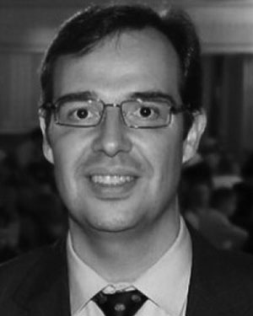
Source: p.20 S181
ENAntonio Plaza (Fellow, IEEE) received the MSc and PhD degrees from the Department of Technology of Computers and Communications, University of Extremadura, Spain,1999 and 2002, respectively, both in computer engineering. He is currently a professor at the Department of Technology of Computers and Communications, University of Extremadura, Spain. He has authored more than 600 publications, including 300 JCR journal papers (more than 170 in IEEE journals), 24 book chapters, and more than 300 peer-reviewed conference proceedings papers. He is a recipient of the Best Column Award of the IEEE Signal Processing Magazine, in 2015, the 2013 Best Paper Award of the IEEE Journal of Selected Topics in Applied Earth Observations and Remote Sensing journal, and the most highly cited paper (2005–2010) in the Journal of Parallel and Distributed Computing. He is included in the 2018, 2019, and 2020 Highly Cited Researchers List.
中Antonio Plaza(IEEE 会士)分别于1999年和2002年在西班牙埃斯特雷马杜拉大学计算机与通信技术系获得计算机工程硕士和博士学位,论文发表时任该系教授。他发表了600余项学术成果,其中包括300篇 JCR 期刊论文(超过170篇发表于 IEEE 期刊)、24个书籍章节和300多篇经同行评审的会议论文。他曾获《IEEE Signal Processing Magazine》2015年最佳专栏奖、《IEEE Journal of Selected Topics in Applied Earth Observations and Remote Sensing》2013年最佳论文奖,并在《Journal of Parallel and Distributed Computing》上发表了该刊2005–2010年间被引次数最多的论文。他入选2018、2019及2020年的全球高被引研究人员名单。
Nasser Kehtarnavaz
Source: p.20 P005
Source: p.20 S182
ENNasser Kehtarnavaz (Fellow, IEEE) is currently an Erik Jonsson distinguished professor at the Department of Electrical and Computer Engineering and the director of the Embedded Machine Learning Laboratory at the University of Texas at Dallas, Richardson, Texas. His research interests include signal and image processing, machine learning, deep learning, and real-time implementation on embedded processors. He has authored or coauthored ten books and more than 400 journal papers, conference papers, patents, manuals, and editorials in these areas. He is a fellow of SPIE, a licensed professional engineer, and editor-in-chief of the Journal of Real-Time Image Processing.
中Nasser Kehtarnavaz(IEEE 会士)在论文发表时担任美国得克萨斯州理查森市得克萨斯大学达拉斯分校电气与计算机工程系 Erik Jonsson 杰出教授,同时担任嵌入式机器学习实验室主任。他的研究兴趣包括信号与图像处理、机器学习、深度学习及在嵌入式处理器上的实时实现。他在这些领域独著或合著10部书,以及400余项期刊论文、会议论文、专利、手册及社论。他是 SPIE 会士和持照专业工程师,并任《Journal of Real-Time Image Processing》主编。
Demetri Terzopoulos
Source: p.20 P006
Source: p.20 S183
ENDemetri Terzopoulos (Fellow, IEEE) received the PhD degree in artificial intelligence from the Massachusetts Institute of Technology (MIT), Cambridge, Massachusetts, in 1984. He is currently a distinguished professor and chancellor’s professor of computer science at the University of California, Los Angeles, Los Angeles, California, where he directs the UCLA Computer Graphics & Vision Laboratory, and is co-founder and chief scientist of VoxelCloud, Inc. He is or was a Guggenheim fellow, a fellow of the ACM, IETI, Royal Society of Canada, and Royal Society of London, and a member of the European Academy of Sciences, the New York Academy of Sciences, and Sigma Xi. Among his many awards are an Academy Award from the Academy of Motion Picture Arts and Sciences for his pioneering work on physics-based computer animation, and the Computer Pioneer Award, Helmholtz Prize, and inaugural Computer Vision Distinguished Researcher Award from the IEEE for his pioneering and sustained research on deformable models and their applications. Deformable models, a term he coined, is listed in the IEEE Taxonomy.
中Demetri Terzopoulos(IEEE 会士)于1984年在美国马萨诸塞州剑桥的麻省理工学院(MIT)获得人工智能博士学位。论文发表时,他在加利福尼亚大学洛杉矶分校任计算机科学杰出教授及校长讲席教授,领导该校的计算机图形与视觉实验室,同时是 VoxelCloud 公司联合创始人兼首席科学家。他曾获古根海姆研究基金,是或曾是 ACM、IETI、加拿大皇家学会和伦敦皇家学会的会士,以及欧洲科学院、纽约科学院和 Sigma Xi 的成员。他获得多项荣誉,其中包括美国电影艺术与科学学院颁发的奥斯卡奖,表彰他在基于物理的计算机动画方面的开创性工作;IEEE 也颁给他计算机先驱奖、Helmholtz 奖与首届计算机视觉杰出研究者奖,表彰他对可变形模型及其应用所作的开创性、持续性研究。“可变形模型”一词由他提出,已收入 IEEE 术语分类体系。
Source: p.20 S184
EN" For more information on this or any other computing topic, please visit our Digital Library at
www.computer.org/csdl.
作者单位、论文信息与出版者附注
Source: p.1 S185
EN• Shervin Minaee is with the Snapchat Machine Learning Research, Venice, CA 90405 USA. E-mail:
shervin.minaee@nyu.edu.
Source: p.1 S186
EN• Yuri Boykov is with the University of Waterloo, Waterloo, ON N2L 3G1, Canada. E-mail:
yboykov@uwaterloo.ca.
Source: p.1 S187
EN• Fatih Porikli is with the Australian National University, Canberra, ACT 0200, Australia, and also with Huawei, San Diego, CA 92121 USA. E-mail:
fatih.porikli@anu.edu.au.
Source: p.1 S188
EN• Antonio Plaza is with the University of Extremadura, 06006 Badajoz, Spain. E-mail:
aplaza@unex.es.
Source: p.1 S189
EN• Nasser Kehtarnavaz is with the University of Texas at Dallas, Richardson, TX 75080 USA. E-mail:
kehtar@utdallas.edu.
Source: p.1 S190
EN• Demetri Terzopoulos is with the University of California, Los Angeles, Los Angeles, CA 90095 USA. E-mail:
dt@cs.ucla.edu.
中Demetri Terzopoulos 任职于加利福尼亚大学洛杉矶分校,美国加利福尼亚州洛杉矶,邮编 90095。电子邮箱:
dt@cs.ucla.edu。
Source: p.1 S191
ENManuscript received 18 Jan. 2020; revised 28 Jan. 2021; accepted 7 Feb. 2021. Date of publication 17 Feb. 2021; date of current version 3 June 2022. (Corresponding author: Shervin Minaee.) Recommended for acceptance by L. Wang. Digital Object Identifier no. 10.1109/TPAMI.2021.3059968
中稿件于2020年1月18日收到,2021年1月28日修订,2021年2月7日录用。在线发布日期:2021年2月17日;当前版本日期:2022年6月3日。通信作者:Shervin Minaee。L. Wang 推荐录用。数字对象标识符(DOI):10.1109/TPAMI.2021.3059968。
Source: p.1 S192
Source: pp.1–20 S193
ENAuthorized licensed use limited to: UCLA Library. Downloaded on June 05,2022 at 04:20:43 UTC from IEEE Xplore. Restrictions apply.
中授权使用仅限加利福尼亚大学洛杉矶分校图书馆。于2022年6月5日 04:20:43 UTC 从 IEEE Xplore 下载,适用相关限制。
常用术语
| 英文 |
中文 |
用法 |
| convolution |
卷积 |
卷积层:convolutional layer |
| convolutional neural network (CNN) |
卷积神经网络 |
原文复数 CNNs,译文用 CNN |
| deep learning (DL) |
深度学习 |
与深度神经网络(DNN)区分 |
| deep neural network (DNN) |
深度神经网络 |
原文复数 DNNs,译文用 DNN |
| feature map |
特征图 |
与 segmentation map(分割图)区分 |
| receptive field |
感受野 |
卷积或神经元所覆盖的输入范围 |
| backbone |
骨干网络 |
表头 Backbone 同译 |
| semantic segmentation |
语义分割 |
识别每个像素的类别 |
| instance segmentation |
实例分割 |
对同一类别的不同对象实例分别分割 |
| panoptic segmentation |
全景分割 |
统一语义分割与实例分割 |
| fully convolutional network (FCN) |
全卷积网络 |
不是 fully connected(全连接) |
| recurrent neural network (RNN) |
循环神经网络 |
按序列状态传递处理信息 |
| long short-term memory (LSTM) |
长短期记忆网络 |
作记忆单元时译为 LSTM 单元 |
| encoder-decoder |
编码器-解码器 |
原文模型名称中的连字符保留 |
| autoencoder |
自编码器 |
原文也作 auto-encoder |
| skip connection |
跳跃连接 |
原文也作 skip-connection |
| transposed convolution |
转置卷积 |
原文该处也作 deconvolution(反卷积) |
| dilated convolution |
空洞卷积 |
又称 atrous convolution |
| dilation rate |
膨胀率 |
卷积核相邻采样点的间距因子 |
| depthwise separable convolution |
深度可分离卷积 |
由逐通道卷积和逐点卷积构成 |
| Atrous Spatial Pyramid Pooling (ASPP) |
空洞空间金字塔池化 |
DeepLab 架构中的多尺度模块 |
| pooling |
池化 |
unpooling 译为反池化 |
| upsampling |
上采样 |
原文也作 up-sampling |
| multiscale |
多尺度 |
原文也作 multi-scale |
| Feature Pyramid Network (FPN) |
特征金字塔网络 |
自底向上和自顶向下路径加横向连接 |
| context |
上下文 |
global context 译为全局上下文 |
| graphical model |
图模型 |
此处涉及概率图模型 |
| Conditional Random Field (CRF) |
条件随机场 |
fully-connected CRF:全连接 CRF |
| Markov Random Field (MRF) |
马尔可夫随机场 |
原文复数 MRFs |
| Region of Interest (RoI) |
感兴趣区域 |
RoIPool 为模块名 |
| Region Proposal Network (RPN) |
区域提议网络 |
proposal 译为提议 |
| bounding box |
边界框 |
box detection 按语境译为边界框检测 |
| mask |
掩膜 |
指图像分割掩膜 |
| logit |
未归一化得分 |
译文保留 logits |
| attention |
注意力 |
reverse attention 译为反向注意力 |
| self-attention |
自注意力 |
与一般注意力机制区分 |
| generative adversarial network (GAN) |
生成对抗网络 |
generator:生成器;discriminator:判别器 |
| active contour model (ACM) |
主动轮廓模型 |
level set 译为水平集 |
| superpixel |
超像素 |
原文也作 super-pixel |
| ground truth |
真值 |
ground-truth map:真值图 |
| RGB-D |
彩色-深度 |
同时记录彩色与深度信息 |
| pixel accuracy (PA) |
像素准确率 |
总体像素级正确比例 |
| mean pixel accuracy (MPA) |
平均像素准确率 |
先分类别计算,再取平均 |
| intersection over union (IoU) |
交并比 |
也称 Jaccard 指数;mIoU:平均交并比 |
| precision |
精确率 |
与 accuracy(准确率)区分 |
| recall |
召回率 |
F1 分数是精确率与召回率的调和平均数 |
| average precision (AP) |
平均精度 |
与 precision 和准确率区分 |
| panoptic quality (PQ) |
全景质量 |
全景分割指标 |
| Dice coefficient |
Dice 系数 |
二值分割情形下等于 F1 分数 |
| weakly supervised learning |
弱监督学习 |
与半监督、自监督分别使用 |
| semi-supervised learning |
半监督学习 |
combined labeled/unlabeled training |
| self-supervised learning |
自监督学习 |
不等同于半监督 |
| data augmentation |
数据增强 |
用于增加或变换训练样本 |
| knowledge distillation |
知识蒸馏 |
用于训练小模型模仿复杂模型 |
阅读提示
模型之间的架构联系主要集中在第3节;如果重点是比较结果,先看第5.1节的指标定义,再查第5.2节对应数据集的表格。正文与性能表的模型缩写或数字有疑问时,见翻译与原文对照说明。