Deep learning
Yann LeCun、Yoshua Bengio、Geoffrey Hinton
Nature 521, 436–444 (2015) · DOI: 10.1038/nature14539
全文中英对照。正文、图注、参考文献中的评述与末尾声明已翻译;103 条书目信息保留原文。文中“目前”“近期”“未来”均指论文发表于 2015 年时的语境。
章节导航
正文
SOURCE p.1 S001
SOURCE p.1 S002
ENYann LeCun1,2, Yoshua Bengio3 & Geoffrey Hinton4,5
中Yann LeCun¹˒²、Yoshua Bengio³、Geoffrey Hinton⁴˒⁵
SOURCE p.1 S003
EN1Facebook AI Research, 770 Broadway, New York, New York 10003 USA. 2New York University, 715 Broadway, New York, New York 10003, USA. 3Department of Computer Science and Operations Research Université de Montréal, Pavillon André-Aisenstadt, PO Box 6128 Centre-Ville STN Montréal, Quebec H3C 3J7, Canada. 4Google, 1600 Amphitheatre Parkway, Mountain View, California 94043, USA. 5Department of Computer Science, University of Toronto, 6 King’s College Road, Toronto, Ontario M5S 3G4, Canada.
中¹ Facebook 人工智能研究院,美国纽约州纽约市 Broadway 770 号,邮编 10003。² 纽约大学,美国纽约州纽约市 Broadway 715 号,邮编 10003。³ 蒙特利尔大学计算机科学与运筹学系,André-Aisenstadt 楼,Centre-Ville STN 邮政信箱 6128,加拿大魁北克省蒙特利尔,邮编 H3C 3J7。⁴ Google,美国加利福尼亚州山景城 Amphitheatre Parkway 1600 号,邮编 94043。⁵ 多伦多大学计算机科学系,加拿大安大略省多伦多市 King's College Road 6 号,邮编 M5S 3G4。
摘要
SOURCE p.1 S004
ENDeep learning allows computational models that are composed of multiple processing layers to learn representations of data with multiple levels of abstraction. These methods have dramatically improved the state-of-the-art in speech recognition, visual object recognition, object detection and many other domains such as drug discovery and genomics. Deep learning discovers intricate structure in large data sets by using the backpropagation algorithm to indicate how a machine should change its internal parameters that are used to compute the representation in each layer from the representation in the previous layer. Deep convolutional nets have brought about breakthroughs in processing images, video, speech and audio, whereas recurrent nets have shone light on sequential data such as text and speech.
中深度学习使由多个处理层组成的计算模型能够学习具有多个抽象层次的数据表示。这些方法显著提升了语音识别、视觉对象识别、目标检测,以及药物发现和基因组学等许多领域的最佳性能。深度学习利用反向传播算法,指出机器应如何改变内部参数,使各层能够根据前一层的表示计算本层表示,从而发现大型数据集中的复杂结构。深度卷积网络使图像、视频、语音和音频处理取得了突破,而循环网络则为文本、语音等序列数据的处理开辟了新途径。
引言
SOURCE p.1 S005
ENMachine-learning technology powers many aspects of modern society: from web searches to content filtering on social networks to recommendations on e-commerce websites, and it is increasingly present in consumer products such as cameras and smartphones. Machine-learning systems are used to identify objects in images, transcribe speech into text, match news items, posts or products with users’ interests, and select relevant results of search. Increasingly, these applications make use of a class of techniques called deep learning.
中机器学习技术支撑着现代社会的许多方面:从网络搜索、社交网络内容过滤,到电子商务网站的推荐;它也越来越多地出现在相机、智能手机等消费产品中。机器学习系统用于识别图像中的对象、将语音转写为文字、把新闻、帖子或商品与用户兴趣相匹配,以及选择相关的搜索结果。这些应用正越来越多地采用一类称为深度学习的技术。
SOURCE p.1 S006
ENConventional machine-learning techniques were limited in their ability to process natural data in their raw form. For decades, constructing a pattern-recognition or machine-learning system required careful engineering and considerable domain expertise to design a feature extractor that transformed the raw data (such as the pixel values of an image) into a suitable internal representation or feature vector from which the learning subsystem, often a classifier, could detect or classify patterns in the input.
中传统机器学习技术直接处理自然数据原始形式的能力有限。几十年来,构建模式识别或机器学习系统,需要精心的工程设计和丰富的领域知识,以设计一个特征提取器:它把原始数据(例如图像的像素值)变换为合适的内部表示或特征向量,再由学习子系统——通常是分类器——检测或分类输入中的模式。
SOURCE p.1 S007
ENRepresentation learning is a set of methods that allows a machine to be fed with raw data and to automatically discover the representations needed for detection or classification. Deep-learning methods are representation-learning methods with multiple levels of representation, obtained by composing simple but non-linear modules that each transform the representation at one level (starting with the raw input) into a representation at a higher, slightly more abstract level. With the composition of enough such transformations, very complex functions can be learned. For classification tasks, higher layers of representation amplify aspects of the input that are important for discrimination and suppress irrelevant variations. An image, for example, comes in the form of an array of pixel values, and the learned features in the first layer of representation typically represent the presence or absence of edges at particular orientations and locations in the image. The second layer typically detects motifs by spotting particular arrangements of edges, regardless of small variations in the edge positions. The third layer may assemble motifs into larger combinations that correspond to parts of familiar objects, and subsequent layers would detect objects as combinations of these parts. The key aspect of deep learning is that these layers of features are not designed by human engineers: they are learned from data using a general-purpose learning procedure.
中表示学习是一类允许机器直接接收原始数据,并自动发现检测或分类所需表示的方法。深度学习是具有多个表示层次的表示学习方法:它通过组合简单但非线性的模块来获得这些层次,每个模块把一个层次的表示(从原始输入开始)变换为更高、稍微更抽象的表示。组合足够多的这类变换,便能学习非常复杂的函数。对于分类任务,高层表示会增强输入中对判别重要的方面,并抑制无关变化。例如,图像以像素值数组的形式输入;第一层表示中学到的特征通常表示图像中特定方向、特定位置的边缘是否存在。第二层通常通过发现边缘的特定排列来检测局部模式,而不受边缘位置微小变化的影响。第三层可以把局部模式组合成更大的结构,对应于熟悉对象的部件;随后各层则把这些部件的组合作为对象进行检测。深度学习的关键在于,这些层次的特征不是人工工程师设计的,而是使用通用学习过程从数据中学到的。
SOURCE p.1 S008
ENDeep learning is making major advances in solving problems that have resisted the best attempts of the artificial intelligence community for many years. It has turned out to be very good at discovering intricate structures in high-dimensional data and is therefore applicable to many domains of science, business and government. In addition to beating records in image recognition1–4 and speech recognition5–7, it has beaten other machine-learning techniques at predicting the activity of potential drug molecules8, analysing particle accelerator data9,10, reconstructing brain circuits11, and predicting the effects of mutations in non-coding DNA on gene expression and disease12,13. Perhaps more surprisingly, deep learning has produced extremely promising results for various tasks in natural language understanding14, particularly topic classification, sentiment analysis, question answering15 and language translation16,17.
中深度学习正在解决一些人工智能研究界多年来尽最大努力仍难以解决的问题,并取得重大进展。事实证明,它非常擅长发现高维数据中的复杂结构,因此适用于科学、商业和政府事务的许多领域。除了刷新图像识别[1–4]和语音识别[5–7]的纪录,它在预测潜在药物分子的活性[8]、分析粒子加速器数据[9,10]、重建脑神经回路[11],以及预测非编码 DNA 中的突变对基因表达和疾病的影响[12,13]等任务上,也超过了其他机器学习技术。或许更令人惊讶的是,深度学习在自然语言理解[14]的多种任务上取得了极有前景的结果,尤其包括主题分类、情感分析、问答[15]和语言翻译[16,17]。
SOURCE p.1 S009
ENWe think that deep learning will have many more successes in the near future because it requires very little engineering by hand, so it can easily take advantage of increases in the amount of available computation and data. New learning algorithms and architectures that are currently being developed for deep neural networks will only accelerate this progress.
中我们认为,深度学习在不久的将来还会取得更多成功,因为它只需要很少的人工工程设计,因此能够很容易地利用可用计算量和数据量的增长。目前正在为深度神经网络开发的新学习算法和新架构,只会进一步加快这一进程。
监督学习
SOURCE p.1 S010
ENThe most common form of machine learning, deep or not, is supervised learning. Imagine that we want to build a system that can classify images as containing, say, a house, a car, a person or a pet. We first collect a large data set of images of houses, cars, people and pets, each labelled with its category. During training, the machine is shown an image and produces an output in the form of a vector of scores, one for each category. We want the desired category to have the highest score of all categories, but this is unlikely to happen before training. We compute an objective function that measures the error (or distance) between the output scores and the desired pattern of scores. The machine then modifies its internal adjustable parameters to reduce this error. These adjustable parameters, often called weights, are real numbers that can be seen as ‘knobs’ that define the input–output function of the machine. In a typical deep-learning system, there may be hundreds of millions of these adjustable weights, and hundreds of millions of labelled examples with which to train the machine.
中无论是否采用深度模型,机器学习最常见的形式都是监督学习。设想我们要构建一个系统,将图像分类为包含房屋、汽车、人或宠物。首先,我们收集一个由房屋、汽车、人和宠物图像组成的大型数据集,每张图像都标注所属类别。在训练过程中,机器看到一张图像,并输出一个分数向量,每个类别对应一个分数。我们希望正确类别的分数在所有类别中最高,但在训练之前,这通常不会发生。我们计算一个目标函数,衡量输出分数与期望分数模式之间的误差(或距离)。随后,机器修改内部可调参数,以减小这一误差。这些可调参数通常称为权重,是一些实数,可以视为定义机器输入—输出函数的“旋钮”。典型的深度学习系统可能拥有数亿个这样的可调权重,并利用数亿个带标签的样本进行训练。
SOURCE p.1 S011
ENTo properly adjust the weight vector, the learning algorithm computes a gradient vector that, for each weight, indicates by what amount the error would increase or decrease if the weight were increased by a tiny amount. The weight vector is then adjusted in the opposite direction to the gradient vector.
中为了恰当地调整权重向量,学习算法计算一个梯度向量。对于每个权重,该向量都指出:如果权重增加一个微小量,误差会增加或减小多少。随后,沿梯度向量的相反方向调整权重向量。
SOURCE p.1,2 S012
ENThe objective function, averaged over all the training examples, can be seen as a kind of hilly landscape in the high-dimensional space of weight values. The negative gradient vector indicates the direction of steepest descent in this landscape, taking it closer to a minimum, where the output error is low on average.
中对全部训练样本取平均后的目标函数,可以看作权重取值构成的高维空间中的一片丘陵地形。负梯度向量指出这片地形中下降最快的方向,使权重趋近某个极小值点,在那里平均输出误差较低。
SOURCE p.2 S013
ENIn practice, most practitioners use a procedure called stochastic gradient descent (SGD). This consists of showing the input vector for a few examples, computing the outputs and the errors, computing the average gradient for those examples, and adjusting the weights accordingly. The process is repeated for many small sets of examples from the training set until the average of the objective function stops decreasing. It is called stochastic because each small set of examples gives a noisy estimate of the average gradient over all examples. This simple procedure usually finds a good set of weights surprisingly quickly when compared with far more elaborate optimization techniques18. After training, the performance of the system is measured on a different set of examples called a test set. This serves to test the generalization ability of the machine — its ability to produce sensible answers on new inputs that it has never seen during training.
中实际中,大多数从业者使用一种称为随机梯度下降(SGD)的过程。它先输入少量样本的输入向量,计算输出和误差,再计算这些样本的平均梯度,并据此调整权重。对训练集中的许多小批样本反复执行这一过程,直到目标函数的平均值不再下降。之所以称为“随机”,是因为每一小批样本只能给出全部样本平均梯度的一个带噪声估计。与复杂得多的优化技术相比,这个简单过程通常能以令人惊讶的速度找到一组好的权重[18]。训练完成后,在另一组称为测试集的样本上评估系统性能。这用于检验机器的泛化能力,即对训练时从未见过的新输入给出合理答案的能力。
SOURCE p.2 S014
ENMany of the current practical applications of machine learning use linear classifiers on top of hand-engineered features. A two-class linear classifier computes a weighted sum of the feature vector components. If the weighted sum is above a threshold, the input is classified as belonging to a particular category.
中当前机器学习的许多实际应用,仍是在人工设计的特征之上使用线性分类器。二分类线性分类器计算特征向量各分量的加权和。如果该加权和超过一个阈值,就把输入归为某个特定类别。
SOURCE p.2,3 S015
ENSince the 1960s we have known that linear classifiers can only carve their input space into very simple regions, namely half-spaces separated by a hyperplane19. But problems such as image and speech recognition require the input–output function to be insensitive to irrelevant variations of the input, such as variations in position, orientation or illumination of an object, or variations in the pitch or accent of speech, while being very sensitive to particular minute variations (for example, the difference between a white wolf and a breed of wolf-like white dog called a Samoyed). At the pixel level, images of two Samoyeds in different poses and in different environments may be very different from each other, whereas two images of a Samoyed and a wolf in the same position and on similar backgrounds may be very similar to each other. A linear classifier, or any other ‘shallow’ classifier operating on raw pixels could not possibly distinguish the latter two, while putting the former two in the same category. This is why shallow classifiers require a good feature extractor that solves the selectivity–invariance dilemma — one that produces representations that are selective to the aspects of the image that are important for discrimination, but that are invariant to irrelevant aspects such as the pose of the animal. To make classifiers more powerful, one can use generic non-linear features, as with kernel methods20, but generic features such as those arising with the Gaussian kernel do not allow the learner to generalize well far from the training examples21. The conventional option is to hand design good feature extractors, which requires a considerable amount of engineering skill and domain expertise. But this can all be avoided if good features can be learned automatically using a general-purpose learning procedure. This is the key advantage of deep learning.
中从 20 世纪 60 年代起,我们就知道线性分类器只能把输入空间划分为非常简单的区域,即由一个超平面分隔的半空间[19]。然而,图像和语音识别等问题要求输入—输出函数对输入中的无关变化不敏感,例如对象位置、方向或光照的变化,以及语音音高或口音的变化;同时又必须对某些细微变化十分敏感,例如白狼与一种外形像狼的白色犬种——萨摩耶犬——之间的差异。在像素层面,两只姿态不同、所处环境不同的萨摩耶犬图像可能相差很大;而姿态相同、背景相似的一只萨摩耶犬和一只狼的图像,却可能非常相似。直接作用于原始像素的线性分类器,或任何其他“浅层”分类器,都不可能既区分后两张图像,又把前两张归入同一类别。因此,浅层分类器需要一个能够解决“选择性—不变性”两难问题的好特征提取器:产生的表示要对图像中有助于判别的方面具有选择性,却对动物姿态等无关方面保持不变。为了增强分类器,可以像核方法[20]那样采用通用的非线性特征,但高斯核等产生的通用特征,不能使学习器很好地泛化到远离训练样本的区域[21]。传统选择是人工设计好的特征提取器,这需要相当多的工程技能和领域知识。但如果能够使用通用学习过程自动学到好特征,这些工作就都可以避免。这正是深度学习的关键优势。
SOURCE p.3 S016
ENA deep-learning architecture is a multilayer stack of simple modules, all (or most) of which are subject to learning, and many of which compute non-linear input–output mappings. Each module in the stack transforms its input to increase both the selectivity and the invariance of the representation. With multiple non-linear layers, say a depth of 5 to 20, a system can implement extremely intricate functions of its inputs that are simultaneously sensitive to minute details — distinguishing Samoyeds from white wolves — and insensitive to large irrelevant variations such as the background, pose, lighting and surrounding objects.
中深度学习架构是由简单模块逐层堆叠而成的,其中全部或大多数模块都需要学习,许多模块计算的是非线性输入—输出映射。每个模块变换输入,以同时增强表示的选择性和不变性。采用多个非线性层——例如深度为 5 至 20 层——系统就能实现极为复杂的输入函数:既对细微差别敏感,能够区分萨摩耶犬与白狼,又不受背景、姿态、光照和周围物体等较大无关变化的影响。
用反向传播训练多层架构
SOURCE p.3 S017
ENFrom the earliest days of pattern recognition22,23, the aim of researchers has been to replace hand-engineered features with trainable multilayer networks, but despite its simplicity, the solution was not widely understood until the mid 1980s. As it turns out, multilayer architectures can be trained by simple stochastic gradient descent. As long as the modules are relatively smooth functions of their inputs and of their internal weights, one can compute gradients using the backpropagation procedure. The idea that this could be done, and that it worked, was discovered independently by several different groups during the 1970s and 1980s24–27.
中从模式识别研究的早期[22,23]开始,研究者就希望用可训练的多层网络替代人工设计的特征。然而,尽管解决方案很简单,直到 20 世纪 80 年代中期,它才被广泛理解。事实证明,简单的随机梯度下降就可以训练多层架构。只要模块相对于其输入和内部权重的函数足够平滑,就能使用反向传播过程计算梯度。20 世纪 70 年代和 80 年代,多个研究团队独立发现了这种做法及其有效性[24–27]。
SOURCE p.3 S018
ENThe backpropagation procedure to compute the gradient of an objective function with respect to the weights of a multilayer stack of modules is nothing more than a practical application of the chain rule for derivatives. The key insight is that the derivative (or gradient) of the objective with respect to the input of a module can be computed by working backwards from the gradient with respect to the output of that module (or the input of the subsequent module) (Fig. 1). The backpropagation equation can be applied repeatedly to propagate gradients through all modules, starting from the output at the top (where the network produces its prediction) all the way to the bottom (where the external input is fed). Once these gradients have been computed, it is straightforward to compute the gradients with respect to the weights of each module.
中反向传播用来计算目标函数相对于多层模块堆叠中各权重的梯度,本质上只是求导链式法则的一种实用应用。其关键认识在于:从目标函数相对于某模块输出(也就是后续模块输入)的梯度出发,向后计算,就能得到目标函数相对于该模块输入的导数或梯度(图 1)。反向传播方程可以反复应用,把梯度从顶部输出端——网络产生预测的位置——一直传递到底部——接收外部输入的位置。得到这些梯度后,就很容易计算目标函数相对于每个模块权重的梯度。
SOURCE p.2 S019
图1 多层神经网络与反向传播
Placed near: S018
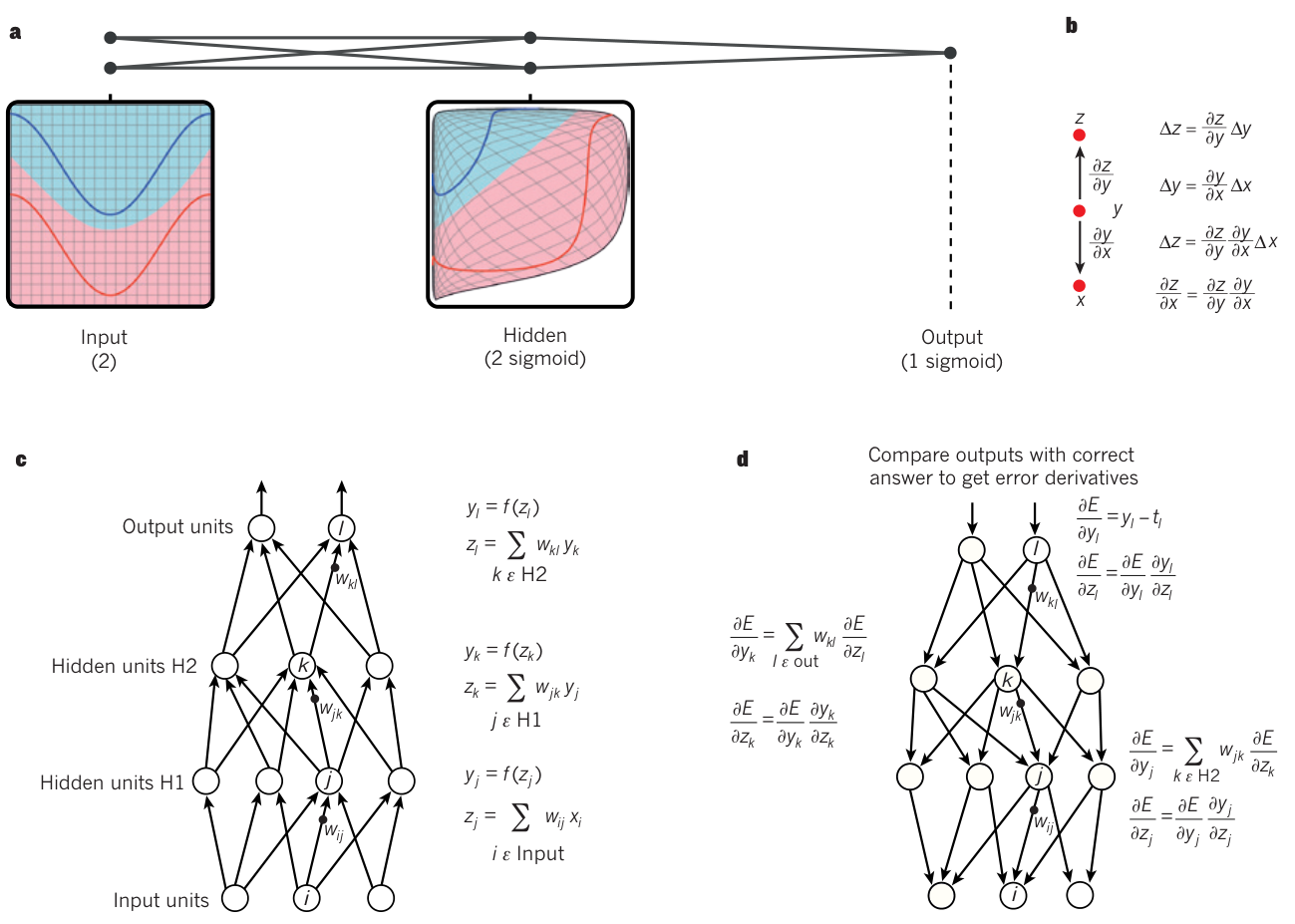
ENFigure 1 | Multilayer neural networks and backpropagation. a, A multi-layer neural network (shown by the connected dots) can distort the input space to make the classes of data (examples of which are on the red and blue lines) linearly separable. Note how a regular grid (shown on the left) in input space is also transformed (shown in the middle panel) by hidden units. This is an illustrative example with only two input units, two hidden units and one output unit, but the networks used for object recognition or natural language processing contain tens or hundreds of thousands of units. Reproduced with permission from C. Olah (
http://colah.github.io/). b, The chain rule of derivatives tells us how two small effects (that of a small change of x on y, and that of y on z) are composed. A small change Δx in x gets transformed first into a small change Δy in y by getting multiplied by ∂y/∂x (that is, the definition of partial derivative). Similarly, the change Δy creates a change Δz in z. Substituting one equation into the other gives the chain rule of derivatives — how Δx gets turned into Δz through multiplication by the product of ∂y/∂x and ∂z/∂x. It also works when x, y and z are vectors (and the derivatives are Jacobian matrices). c, The equations used for computing the forward pass in a neural net with two hidden layers and one output layer, each constituting a module through which one can backpropagate gradients. At each layer, we first compute the total input z to each unit, which is a weighted sum of the outputs of the units in the layer below. Then a non-linear function f(.) is applied to z to get the output of the unit. For simplicity, we have omitted bias terms. The non-linear functions used in neural networks include the rectified linear unit (ReLU) f(z) = max(0,z), commonly used in recent years, as well as the more conventional sigmoids, such as the hyberbolic tangent, f(z) = (exp(z) − exp(−z))/(exp(z) + exp(−z)) and logistic function logistic, f(z) = 1/(1 + exp(−z)). d, The equations used for computing the backward pass. At each hidden layer we compute the error derivative with respect to the output of each unit, which is a weighted sum of the error derivatives with respect to the total inputs to the units in the layer above. We then convert the error derivative with respect to the output into the error derivative with respect to the input by multiplying it by the gradient of f(z). At the output layer, the error derivative with respect to the output of a unit is computed by differentiating the cost function. This gives yl − tl if the cost function for unit l is 0.5(yl − tl)2, where tl is the target value. Once the ∂E/∂zk is known, the error-derivative for the weight wjk on the connection from unit j in the layer below is just yj ∂E/∂zk.
中图 1|多层神经网络与反向传播。a,多层神经网络(由相连的点表示)能够扭曲输入空间,使不同类别的数据(红线和蓝线上的样本)变为线性可分。注意,输入空间中的规则网格(左图)也被隐藏单元变换了(中图)。这只是一个包含 2 个输入单元、2 个隐藏单元和 1 个输出单元的示例;用于对象识别或自然语言处理的网络则包含数万或数十万个单元。经 C. Olah 授权转载(
http://colah.github.io/)。b,求导链式法则说明两种微小作用如何复合:x 的微小变化对 y 的影响,以及 y 对 z 的影响。x 的微小变化 Δx 首先乘以 ∂y/∂x,变成 y 的微小变化 Δy,这就是偏导数的定义。类似地,Δy 导致 z 产生变化 Δz。将一个方程代入另一个方程,便得到求导链式法则:Δx 乘以 ∂y/∂x 与 ∂z/∂y 的乘积后变成 Δz。当 x、y、z 是向量、导数是雅可比矩阵时,该法则同样成立。c,具有 2 个隐藏层和 1 个输出层的神经网络前向计算所用方程。每一层构成一个可以反向传播梯度的模块。在每层中,首先计算每个单元的总输入 z,即下一层各单元输出的加权和;然后将非线性函数 f(·) 作用于 z,得到该单元输出。为简洁起见,图中省略了偏置项。神经网络使用的非线性函数包括近年来常用的整流线性单元(ReLU)f(z)=max(0,z),以及更传统的 S 形函数,例如双曲正切 f(z)=(exp(z)−exp(−z))/(exp(z)+exp(−z)) 和逻辑函数 f(z)=1/(1+exp(−z))。d,反向计算所用方程。在每个隐藏层,我们计算误差相对于各单元输出的导数,它是误差相对于上一层各单元总输入的导数的加权和。然后乘以 f(z) 的导数,将误差对输出的导数转为对输入的导数。在输出层,通过对代价函数求导,得到误差相对于单元输出的导数。若单元 l 的代价函数为 0.5(y_l−t_l)²,其中 t_l 是目标值,则该导数为 y_l−t_l。一旦知道 ∂E/∂z_k,从下一层单元 j 连到本层单元 k 的连接权重 w_jk 的误差导数就是 y_j·∂E/∂z_k。
图内说明: 图内术语:Input 输入;Hidden 隐藏层;Output 输出;Input units 输入单元;Hidden units 隐藏单元;Output units 输出单元;Compare outputs with correct answer to get error derivatives 将输出与正确答案比较,得到误差导数。原式保留在图中。译注:图1b英文图注将链式法则乘积的第二项印为 ∂z/∂x;这里依据同图公式写为 ∂z/∂y,英文对照保留原文。
SOURCE p.3 S020
ENMany applications of deep learning use feedforward neural network architectures (Fig. 1), which learn to map a fixed-size input (for example, an image) to a fixed-size output (for example, a probability for each of several categories). To go from one layer to the next, a set of units compute a weighted sum of their inputs from the previous layer and pass the result through a non-linear function. At present, the most popular non-linear function is the rectified linear unit (ReLU), which is simply the half-wave rectifier f(z) = max(z, 0). In past decades, neural nets used smoother non-linearities, such as tanh(z) or 1/(1 + exp(−z)), but the ReLU typically learns much faster in networks with many layers, allowing training of a deep supervised network without unsupervised pre-training28. Units that are not in the input or output layer are conventionally called hidden units. The hidden layers can be seen as distorting the input in a non-linear way so that categories become linearly separable by the last layer (Fig. 1).
中深度学习的许多应用采用前馈神经网络架构(图 1),学习从固定大小的输入(例如一张图像)到固定大小的输出(例如若干类别各自的概率)的映射。从一层到下一层时,一组单元计算来自前一层输入的加权和,并让结果通过一个非线性函数。目前最流行的非线性函数是整流线性单元(ReLU),即半波整流器 f(z)=max(z,0)。过去几十年,神经网络常使用更平滑的非线性函数,如 tanh(z) 或 1/(1+exp(−z));但在层数很多的网络中,ReLU 通常学习得快得多,从而可以在不进行无监督预训练的情况下训练深度监督网络[28]。不属于输入层或输出层的单元通常称为隐藏单元。隐藏层可以看作对输入进行非线性扭曲,使各类别到最后一层时变得线性可分(图 1)。
SOURCE p.3 S021
ENIn the late 1990s, neural nets and backpropagation were largely forsaken by the machine-learning community and ignored by the computer-vision and speech-recognition communities. It was widely thought that learning useful, multistage, feature extractors with little prior knowledge was infeasible. In particular, it was commonly thought that simple gradient descent would get trapped in poor local minima — weight configurations for which no small change would reduce the average error.
中20 世纪 90 年代后期,机器学习研究界基本放弃了神经网络和反向传播,计算机视觉与语音识别研究界也忽视了它们。当时普遍认为,在先验知识很少的情况下,无法学到有用的多级特征提取器。尤其是,人们通常认为简单的梯度下降会陷入差的局部极小值,也就是无论怎样微小地改变权重,都不能降低平均误差的权重配置。
SOURCE p.3,4 S022
ENIn practice, poor local minima are rarely a problem with large networks. Regardless of the initial conditions, the system nearly always reaches solutions of very similar quality. Recent theoretical and empirical results strongly suggest that local minima are not a serious issue in general. Instead, the landscape is packed with a combinatorially large number of saddle points where the gradient is zero, and the surface curves up in most dimensions and curves down in the remainder29,30. The analysis seems to show that saddle points with only a few downward curving directions are present in very large numbers, but almost all of them have very similar values of the objective function. Hence, it does not much matter which of these saddle points the algorithm gets stuck at.
中实际中,对于大型网络,差的局部极小值很少构成问题。不管初始条件如何,系统几乎总能得到质量非常接近的解。近期理论与实证结果强烈表明,一般来说局部极小值并不是严重问题。相反,目标函数地形中密布着数量呈组合级增长的鞍点:这些点的梯度为零,曲面在大多数维度上向上弯曲,在其余维度上向下弯曲[29,30]。分析似乎表明,只有少数向下弯曲方向的鞍点数量极多,但其中几乎所有点的目标函数值都非常接近。因此,算法具体停在哪一个鞍点上,并不是很重要。
SOURCE p.4 S023
ENInterest in deep feedforward networks was revived around 2006 (refs 31–34) by a group of researchers brought together by the Canadian Institute for Advanced Research (CIFAR). The researchers introduced unsupervised learning procedures that could create layers of feature detectors without requiring labelled data. The objective in learning each layer of feature detectors was to be able to reconstruct or model the activities of feature detectors (or raw inputs) in the layer below. By ‘pre-training’ several layers of progressively more complex feature detectors using this reconstruction objective, the weights of a deep network could be initialized to sensible values. A final layer of output units could then be added to the top of the network and the whole deep system could be fine-tuned using standard backpropagation33–35. This worked remarkably well for recognizing handwritten digits or for detecting pedestrians, especially when the amount of labelled data was very limited36.
中2006 年前后,由加拿大高级研究院(CIFAR)聚集的一批研究者重新激发了人们对深度前馈网络的兴趣[31–34]。他们提出了无需带标签数据就能建立多层特征检测器的无监督学习过程。学习每一层特征检测器的目标,是能够重建或建模其下一层特征检测器的活动,或者原始输入。以这一重建目标逐层“预训练”越来越复杂的特征检测器,可以把深度网络的权重初始化到合理值。然后,在网络顶部添加最终输出层,再用标准反向传播微调整个深度系统[33–35]。这种方法在手写数字识别和行人检测中效果很好,尤其是在带标签数据极其有限时[36]。
SOURCE p.4 S024
ENThe first major application of this pre-training approach was in speech recognition, and it was made possible by the advent of fast graphics processing units (GPUs) that were convenient to program37 and allowed researchers to train networks 10 or 20 times faster. In 2009, the approach was used to map short temporal windows of coefficients extracted from a sound wave to a set of probabilities for the various fragments of speech that might be represented by the frame in the centre of the window. It achieved record-breaking results on a standard speech recognition benchmark that used a small vocabulary38 and was quickly developed to give record-breaking results on a large vocabulary task39. By 2012, versions of the deep net from 2009 were being developed by many of the major speech groups6 and were already being deployed in Android phones. For smaller data sets, unsupervised pre-training helps to prevent overfitting40, leading to significantly better generalization when the number of labelled examples is small, or in a transfer setting where we have lots of examples for some ‘source’ tasks but very few for some ‘target’ tasks. Once deep learning had been rehabilitated, it turned out that the pre-training stage was only needed for small data sets.
中这种预训练方法的第一个重要应用是语音识别。它得益于易于编程的高速图形处理器(GPU)的出现[37],使研究者能够以原来 10 倍或 20 倍的速度训练网络。2009 年,该方法被用于把从声波中提取的一小段时间窗内的系数,映射为一组概率,表示时间窗中央帧可能对应的各种语音片段。它在一个小词汇量的标准语音识别基准上取得了破纪录的结果[38],随后很快发展到在大词汇量任务上也刷新纪录[39]。到 2012 年,许多主要语音研究团队都在开发 2009 年这一深度网络的不同版本[6],并且已将其部署到 Android 手机。对于较小的数据集,无监督预训练有助于防止过拟合[40];因此,当带标签样本很少,或者在某些“源”任务样本很多而某些“目标”任务样本很少的迁移场景中,它能显著改善泛化。深度学习重新获得认可后,人们发现,只有小数据集才需要预训练阶段。
SOURCE p.4 S025
ENThere was, however, one particular type of deep, feedforward network that was much easier to train and generalized much better than networks with full connectivity between adjacent layers. This was the convolutional neural network (ConvNet)41,42. It achieved many practical successes during the period when neural networks were out of favour and it has recently been widely adopted by the computer-vision community.
中不过,有一种特殊的深度前馈网络,比相邻层全连接的网络更容易训练,泛化也好得多。这就是卷积神经网络(ConvNet)[41,42]。在神经网络不受青睐的时期,它已取得许多实际成功,最近又被计算机视觉研究界广泛采用。
卷积神经网络
SOURCE p.4 S026
ENConvNets are designed to process data that come in the form of multiple arrays, for example a colour image composed of three 2D arrays containing pixel intensities in the three colour channels. Many data modalities are in the form of multiple arrays: 1D for signals and sequences, including language; 2D for images or audio spectrograms; and 3D for video or volumetric images. There are four key ideas behind ConvNets that take advantage of the properties of natural signals: local connections, shared weights, pooling and the use of many layers.
中卷积网络用于处理以多个数组形式表示的数据,例如彩色图像由 3 个二维数组组成,分别存储三个颜色通道中的像素强度。许多模态的数据都呈现为多个数组:信号和序列(包括语言)是一维的,图像或音频频谱图是二维的,视频或体图像则是三维的。卷积网络有四个利用自然信号特性的核心思想:局部连接、权重共享、池化,以及使用多层结构。
SOURCE p.4 S027
ENThe architecture of a typical ConvNet (Fig. 2) is structured as a series of stages. The first few stages are composed of two types of layers: convolutional layers and pooling layers. Units in a convolutional layer are organized in feature maps, within which each unit is connected to local patches in the feature maps of the previous layer through a set of weights called a filter bank. The result of this local weighted sum is then passed through a non-linearity such as a ReLU. All units in a feature map share the same filter bank. Different feature maps in a layer use different filter banks. The reason for this architecture is twofold. First, in array data such as images, local groups of values are often highly correlated, forming distinctive local motifs that are easily detected. Second, the local statistics of images and other signals are invariant to location. In other words, if a motif can appear in one part of the image, it could appear anywhere, hence the idea of units at different locations sharing the same weights and detecting the same pattern in different parts of the array. Mathematically, the filtering operation performed by a feature map is a discrete convolution, hence the name.
中典型卷积网络的架构(图 2)由一系列阶段组成。前几个阶段包含两种层:卷积层和池化层。卷积层中的单元组织为特征图;每个单元通过一组称为滤波器组的权重,与前一层特征图中的局部区域相连。这个局部加权和再通过 ReLU 等非线性函数。同一张特征图中的所有单元共享同一滤波器组,同层的不同特征图则使用不同滤波器组。这一架构有两方面原因。首先,在图像等数组数据中,局部的一组数值往往高度相关,会形成容易检测的、有辨识度的局部模式。其次,图像和其他信号的局部统计特性不随位置改变。换言之,一个模式若能出现在图像的某一部分,也可能出现在任何地方。因此,让不同位置的单元共享相同权重,就能在数组不同部分检测相同模式。从数学上说,一张特征图执行的滤波操作是离散卷积,“卷积网络”由此得名。
SOURCE p.3 S028
图2 卷积网络内部
Placed near: S027
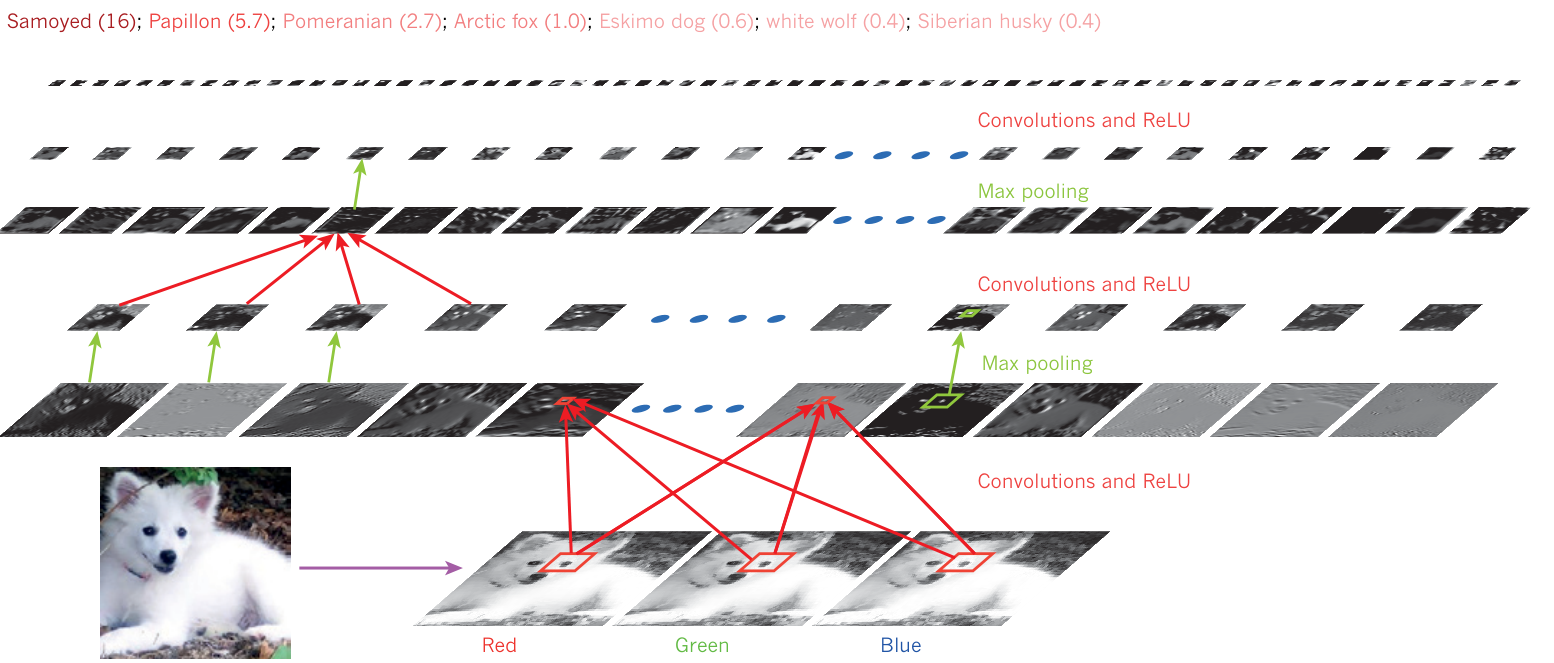
ENFigure 2 | Inside a convolutional network. The outputs (not the filters) of each layer (horizontally) of a typical convolutional network architecture applied to the image of a Samoyed dog (bottom left; and RGB (red, green, blue) inputs, bottom right). Each rectangular image is a feature map corresponding to the output for one of the learned features, detected at each of the image positions. Information flows bottom up, with lower-level features acting as oriented edge detectors, and a score is computed for each image class in output. ReLU, rectified linear unit.
中图 2|卷积网络内部。图中展示典型卷积网络处理一张萨摩耶犬图像时,各层的输出而非滤波器;每层的输出沿水平方向排列。左下方是输入图像,右下方是 RGB(红、绿、蓝)通道输入。每个矩形图像都是一张特征图,对应某个已学得特征在图像各位置的检测输出。信息自下而上流动;低层特征起有方向性的边缘检测器的作用,输出端为每个图像类别计算分数。ReLU 表示整流线性单元。
图内说明: 图内术语:Convolutions and ReLU 卷积与整流线性单元;Max pooling 最大池化;Red/Green/Blue 红/绿/蓝。输出类别及分数:萨摩耶犬 16;蝴蝶犬 5.7;博美犬 2.7;北极狐 1.0;爱斯基摩犬 0.6;白狼 0.4;西伯利亚哈士奇 0.4。
SOURCE p.4 S029
ENAlthough the role of the convolutional layer is to detect local conjunctions of features from the previous layer, the role of the pooling layer is to merge semantically similar features into one. Because the relative positions of the features forming a motif can vary somewhat, reliably detecting the motif can be done by coarse-graining the position of each feature. A typical pooling unit computes the maximum of a local patch of units in one feature map (or in a few feature maps). Neighbouring pooling units take input from patches that are shifted by more than one row or column, thereby reducing the dimension of the representation and creating an invariance to small shifts and distortions. Two or three stages of convolution, non-linearity and pooling are stacked, followed by more convolutional and fully-connected layers. Backpropagating gradients through a ConvNet is as simple as through a regular deep network, allowing all the weights in all the filter banks to be trained.
中卷积层的作用是检测前一层特征在局部的组合,而池化层的作用则是将语义上相似的特征合并。由于构成局部模式的各特征,其相对位置可能稍有变化,因此,对各特征的位置进行粗粒化,就能可靠地检测该模式。典型池化单元计算一张或少数几张特征图中一个局部单元区域的最大值。相邻池化单元所接收的区域相互错开不止一行或一列,因此可以降低表示的维度,并形成对微小平移和形变的不变性。将卷积、非线性变换与池化堆叠两三个阶段后,再接更多卷积层和全连接层。在卷积网络中反向传播梯度,与在普通深度网络中一样简单,因此能够训练所有滤波器组的全部权重。
SOURCE p.4 S030
ENDeep neural networks exploit the property that many natural signals are compositional hierarchies, in which higher-level features are obtained by composing lower-level ones. In images, local combinations of edges form motifs, motifs assemble into parts, and parts form objects. Similar hierarchies exist in speech and text from sounds to phones, phonemes, syllables, words and sentences. The pooling allows representations to vary very little when elements in the previous layer vary in position and appearance.
中深度神经网络利用了许多自然信号具有组合式层级结构这一性质:高层特征由低层特征组合而成。图像中,边缘的局部组合形成局部模式,局部模式组成部件,部件再组成对象。语音和文本中也存在类似层级,从声音到音素的具体发音、音位、音节、单词,再到句子。池化使前一层元素的位置和外观发生变化时,表示仍然只发生很小的变化。
SOURCE p.4 S031
ENThe convolutional and pooling layers in ConvNets are directly inspired by the classic notions of simple cells and complex cells in visual neuroscience43, and the overall architecture is reminiscent of the LGN–V1–V2–V4–IT hierarchy in the visual cortex ventral pathway44. When ConvNet models and monkeys are shown the same picture, the activations of high-level units in the ConvNet explains half of the variance of random sets of 160 neurons in the monkey’s inferotemporal cortex45. ConvNets have their roots in the neocognitron46, the architecture of which was somewhat similar, but did not have an end-to-end supervised-learning algorithm such as backpropagation. A primitive 1D ConvNet called a time-delay neural net was used for the recognition of phonemes and simple words47,48.
中卷积网络中的卷积层和池化层,直接受到视觉神经科学中简单细胞、复杂细胞经典概念的启发[43],其整体架构也类似于视觉皮层腹侧通路中的 LGN–V1–V2–V4–IT 层级[44]。当向卷积网络模型和猴子展示同一幅图片时,卷积网络高层单元的激活能够解释猴颞下皮层中随机选取的 160 个神经元群体反应方差的一半[45]。卷积网络源自新认知机(neocognitron)[46];后者的架构有些相似,却没有反向传播这样的端到端监督学习算法。一种称为时延神经网络的早期一维卷积网络,被用于识别音位和简单单词[47,48]。
SOURCE p.4 S032
ENThere have been numerous applications of convolutional networks going back to the early 1990s, starting with time-delay neural networks for speech recognition47 and document reading42. The document reading system used a ConvNet trained jointly with a probabilistic model that implemented language constraints. By the late 1990s this system was reading over 10% of all the cheques in the United States. A number of ConvNet-based optical character recognition and handwriting recognition systems were later deployed by Microsoft49. ConvNets were also experimented with in the early 1990s for object detection in natural images, including faces and hands50,51, and for face recognition52.
中卷积网络的众多应用可以追溯到 20 世纪 90 年代初,最早包括用于语音识别的时延神经网络[47]和文档识读[42]。文档识读系统将卷积网络与实现语言约束的概率模型联合训练。到 20 世纪 90 年代后期,该系统已在识读美国超过 10% 的支票。后来,微软部署了多种基于卷积网络的光学字符识别和手写识别系统[49]。20 世纪 90 年代初,人们还试验了使用卷积网络检测自然图像中的人脸、手等对象[50,51],以及进行人脸识别[52]。
利用深度卷积网络理解图像
SOURCE p.4 S033
ENSince the early 2000s, ConvNets have been applied with great success to the detection, segmentation and recognition of objects and regions in images. These were all tasks in which labelled data was relatively abundant, such as traffic sign recognition53, the segmentation of biological images54 particularly for connectomics55, and the detection of faces, text, pedestrians and human bodies in natural images36,50,51,56–58. A major recent practical success of ConvNets is face recognition59.
中自 21 世纪初以来,卷积网络在图像中对象和区域的检测、分割与识别方面取得了巨大成功。这些任务的带标签数据都比较充足,例如交通标志识别[53]、生物图像分割[54]——特别是连接组学中的分割[55]——以及自然图像中人脸、文字、行人和人体的检测[36,50,51,56–58]。近期卷积网络一个重要的实际成功是人脸识别[59]。
SOURCE p.4,5 S034
ENImportantly, images can be labelled at the pixel level, which will have applications in technology, including autonomous mobile robots and self-driving cars60,61. Companies such as Mobileye and NVIDIA are using such ConvNet-based methods in their upcoming vision systems for cars. Other applications gaining importance involve natural language understanding14 and speech recognition7.
中重要的是,图像可以在像素层面进行标注,这将应用于自主移动机器人和自动驾驶汽车等技术[60,61]。Mobileye、NVIDIA 等公司正在其即将推出的车载视觉系统中使用这种基于卷积网络的方法。另一些日益重要的应用包括自然语言理解[14]和语音识别[7]。
SOURCE p.5 S035
ENDespite these successes, ConvNets were largely forsaken by the mainstream computer-vision and machine-learning communities until the ImageNet competition in 2012. When deep convolutional networks were applied to a data set of about a million images from the web that contained 1,000 different classes, they achieved spectacular results, almost halving the error rates of the best competing approaches1. This success came from the efficient use of GPUs, ReLUs, a new regularization technique called dropout62, and techniques to generate more training examples by deforming the existing ones. This success has brought about a revolution in computer vision; ConvNets are now the dominant approach for almost all recognition and detection tasks4,58,59,63–65 and approach human performance on some tasks. A recent stunning demonstration combines ConvNets and recurrent net modules for the generation of image captions (Fig. 3).
中尽管有这些成功,直到 2012 年 ImageNet 竞赛之前,主流计算机视觉和机器学习研究界仍基本忽视卷积网络。将深度卷积网络用于一个约含 100 万张网络图像、涵盖 1,000 个类别的数据集时,它取得了惊人的结果,使最强竞争方法的错误率几乎减半[1]。这一成功来自对 GPU 的高效使用、ReLU、一种称为 dropout 的新正则化技术[62],以及通过使已有样本发生形变来产生更多训练样本的技术。它在计算机视觉领域引发了一场革命;卷积网络如今成为几乎所有识别和检测任务的主导方法[4,58,59,63–65],并在某些任务上接近人类表现。近期一项令人瞩目的展示,将卷积网络和循环网络模块结合起来,生成图像描述(图 3)。
SOURCE p.5 S036
图3 从图像到文本
Placed near: S035
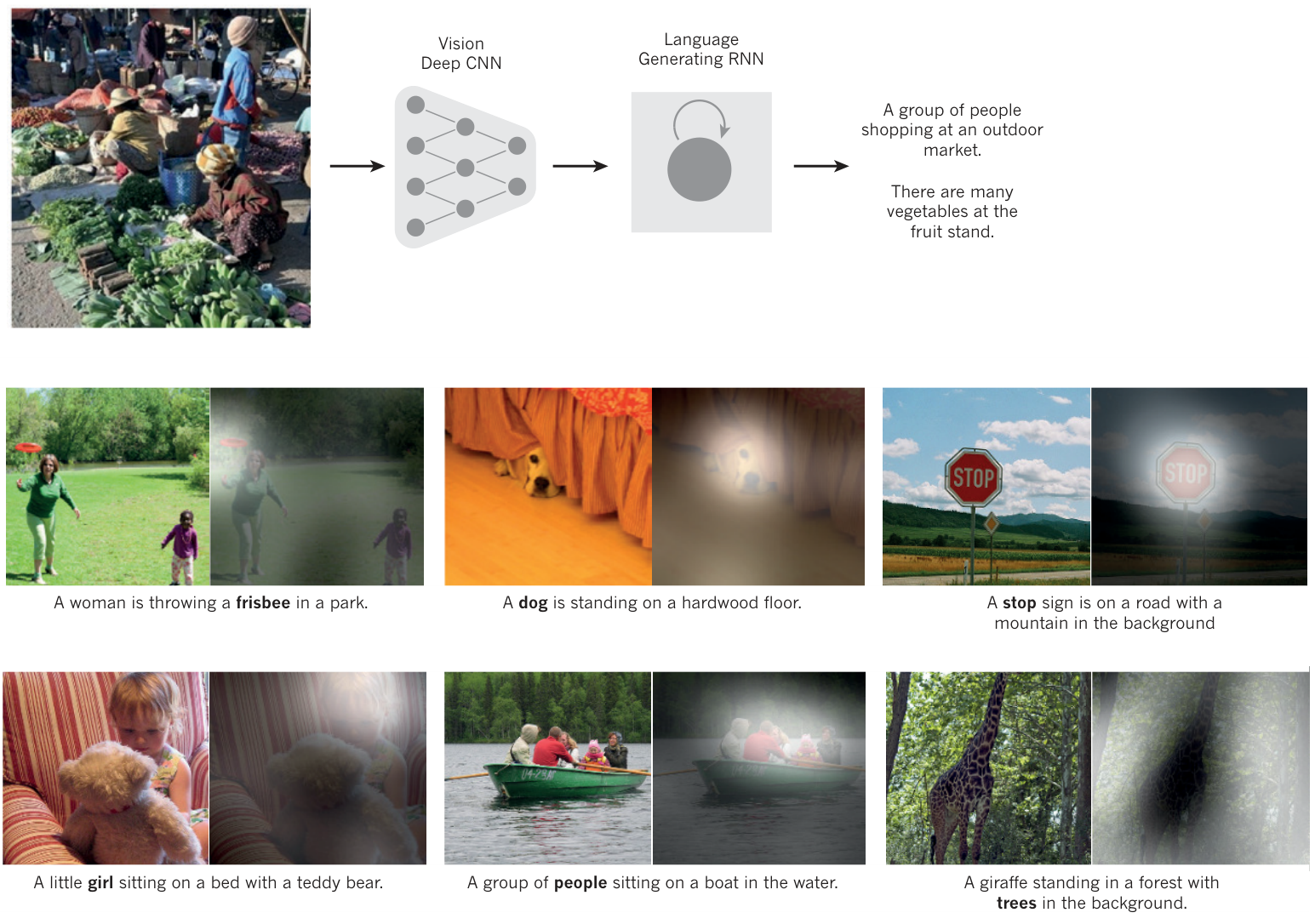
ENFigure 3 | From image to text. Captions generated by a recurrent neural network (RNN) taking, as extra input, the representation extracted by a deep convolution neural network (CNN) from a test image, with the RNN trained to ‘translate’ high-level representations of images into captions (top). Reproduced with permission from ref. 102. When the RNN is given the ability to focus its attention on a different location in the input image (middle and bottom; the lighter patches were given more attention) as it generates each word (bold), we found86 that it exploits this to achieve better ‘translation’ of images into captions.
中图 3|从图像到文本。循环神经网络(RNN)将深度卷积神经网络(CNN)从测试图像提取的表示作为额外输入,并生成描述;训练 RNN 的目标是把图像的高层表示“翻译”为描述文字(上图)。经文献[102]授权转载。当赋予 RNN 在生成每个词(粗体)时将注意力聚焦到输入图像不同位置的能力时(中、下图;较亮区域得到更多注意力),我们发现[86],它会利用这一能力,更好地把图像“翻译”为描述。
图内说明: 图中生成文字的中文对应:一群人在露天市场购物;水果摊上有许多蔬菜;一位女士正在公园里扔飞盘;一只狗站在硬木地板上;一个停车标志立在道路上,背景是山;一个小女孩坐在床上,身旁有一只泰迪熊;一群人坐在水中的一艘船上;一只长颈鹿站在森林里,背景是树木。Vision/Deep CNN 表示视觉/深度卷积神经网络;Language/Generating RNN 表示语言/生成式循环神经网络。
SOURCE p.5 S037
ENRecent ConvNet architectures have 10 to 20 layers of ReLUs, hundreds of millions of weights, and billions of connections between units. Whereas training such large networks could have taken weeks only two years ago, progress in hardware, software and algorithm parallelization have reduced training times to a few hours.
中近期的卷积网络架构有 10 至 20 层 ReLU、数亿个权重,以及单元之间数十亿条连接。仅在两年前,训练如此庞大的网络可能还需要数周;硬件、软件和算法并行化的进步,已将训练时间缩短到数小时。
SOURCE p.5 S038
ENThe performance of ConvNet-based vision systems has caused most major technology companies, including Google, Facebook, Microsoft, IBM, Yahoo!, Twitter and Adobe, as well as a quickly growing number of start-ups to initiate research and development projects and to deploy ConvNet-based image understanding products and services.
中基于卷积网络的视觉系统所展现的性能,促使 Google、Facebook、Microsoft、IBM、Yahoo!、Twitter、Adobe 等多数主要科技公司,以及迅速增多的初创企业,启动研究开发项目,并部署基于卷积网络的图像理解产品和服务。
SOURCE p.5 S039
ENConvNets are easily amenable to efficient hardware implementations in chips or field-programmable gate arrays66,67. A number of companies such as NVIDIA, Mobileye, Intel, Qualcomm and Samsung are developing ConvNet chips to enable real-time vision applications in smartphones, cameras, robots and self-driving cars.
中卷积网络很容易在芯片或现场可编程门阵列上实现高效硬件运算[66,67]。NVIDIA、Mobileye、Intel、Qualcomm、Samsung 等公司正在开发卷积网络芯片,以支持智能手机、相机、机器人和自动驾驶汽车上的实时视觉应用。
分布式表示与语言处理
SOURCE p.5 S040
ENDeep-learning theory shows that deep nets have two different exponential advantages over classic learning algorithms that do not use distributed representations21. Both of these advantages arise from the power of composition and depend on the underlying data-generating distribution having an appropriate componential structure40. First, learning distributed representations enable generalization to new combinations of the values of learned features beyond those seen during training (for example, 2n combinations are possible with n binary features)68,69. Second, composing layers of representation in a deep net brings the potential for another exponential advantage70 (exponential in the depth).
中深度学习理论表明,与不使用分布式表示的经典学习算法相比,深度网络具有两种不同的指数级优势[21]。这两种优势均源于组合的力量,并依赖于底层数据生成分布具有合适的组合结构[40]。第一,学习分布式表示能够泛化到训练时未出现过的、已学特征取值的新组合,例如 n 个二值特征可以构成 2ⁿ 种组合[68,69]。第二,在深度网络中组合多层表示,还有可能带来另一种随深度呈指数增长的优势[70]。
SOURCE p.5,6 S041
ENThe hidden layers of a multilayer neural network learn to represent the network’s inputs in a way that makes it easy to predict the target outputs. This is nicely demonstrated by training a multilayer neural network to predict the next word in a sequence from a local context of earlier words71. Each word in the context is presented to the network as a one-of-N vector, that is, one component has a value of 1 and the rest are 0. In the first layer, each word creates a different pattern of activations, or word vectors (Fig. 4). In a language model, the other layers of the network learn to convert the input word vectors into an output word vector for the predicted next word, which can be used to predict the probability for any word in the vocabulary to appear as the next word. The network learns word vectors that contain many active components each of which can be interpreted as a separate feature of the word, as was first demonstrated27 in the context of learning distributed representations for symbols. These semantic features were not explicitly present in the input. They were discovered by the learning procedure as a good way of factorizing the structured relationships between the input and output symbols into multiple ‘micro-rules’. Learning word vectors turned out to also work very well when the word sequences come from a large corpus of real text and the individual micro-rules are unreliable71. When trained to predict the next word in a news story, for example, the learned word vectors for Tuesday and Wednesday are very similar, as are the word vectors for Sweden and Norway. Such representations are called distributed representations because their elements (the features) are not mutually exclusive and their many configurations correspond to the variations seen in the observed data. These word vectors are composed of learned features that were not determined ahead of time by experts, but automatically discovered by the neural network. Vector representations of words learned from text are now very widely used in natural language applications14,17,72–76.
中多层神经网络的隐藏层会学习一种输入表示,使目标输出易于预测。一个很好的例子是:训练多层神经网络,根据前面若干词组成的局部上下文,预测序列中的下一个词[71]。上下文中的每个词以 N 选一向量输入网络,即一个分量为 1,其余为 0。在第一层,每个词产生不同的激活模式,也就是词向量(图 4)。语言模型中,网络的其他层学习把输入词向量变换为预测下一个词的输出词向量,由此可预测词表中任意词成为下一个词的概率。网络学到的词向量含有许多活跃分量,每个分量都可以解释为该词的一个单独的特征;这一点最早在学习符号的分布式表示时得到展示[27]。这些语义特征并没有显式存在于输入中,而是由学习过程发现的:它们把输入、输出符号之间的结构性关系分解为多条“微规则”。后来发现,当词序列来自大型真实文本语料、单条微规则不可靠时,词向量学习仍然非常有效[71]。例如,在预测新闻报道中下一个词的训练中,Tuesday(星期二)与 Wednesday(星期三)的词向量会非常相似,Sweden(瑞典)与 Norway(挪威)也一样。这类表示称为分布式表示,因为其元素(特征)并不相互排斥,众多配置对应于观测数据中的不同变化。组成这些词向量的特征,不是由专家事先指定,而是神经网络自动发现的。如今,从文本中学习到的词向量表示已广泛用于自然语言应用[14,17,72–76]。
SOURCE p.6 S042
图4 已学习词向量的可视化
Placed near: S041
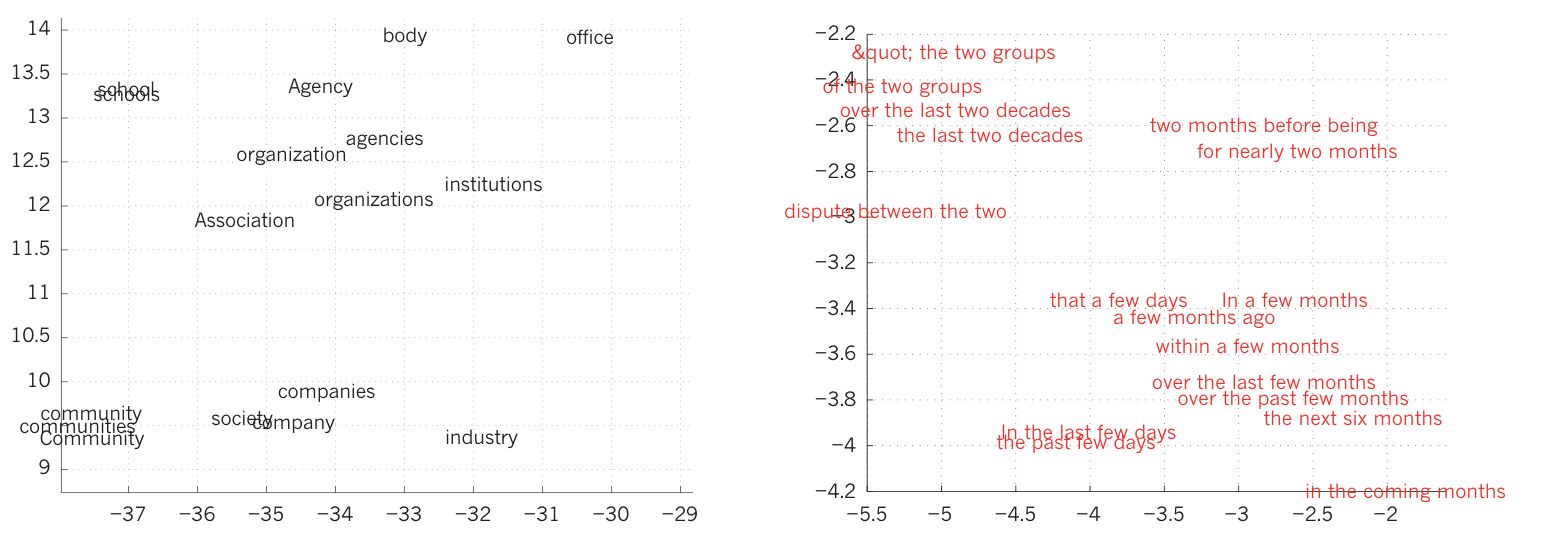
ENFigure 4 | Visualizing the learned word vectors. On the left is an illustration of word representations learned for modelling language, non-linearly projected to 2D for visualization using the t-SNE algorithm103. On the right is a 2D representation of phrases learned by an English-to-French encoder–decoder recurrent neural network75. One can observe that semantically similar words or sequences of words are mapped to nearby representations. The distributed representations of words are obtained by using backpropagation to jointly learn a representation for each word and a function that predicts a target quantity such as the next word in a sequence (for language modelling) or a whole sequence of translated words (for machine translation)18,75.
中图 4|已学习词向量的可视化。左图展示为语言建模学得的词表示,使用 t-SNE 算法[103]将其非线性投影到二维以便可视化。右图是由英译法编码器—解码器循环神经网络学习到的短语的二维表示[75]。可以观察到,语义相似的词或词序列被映射到相邻的表示。词的分布式表示通过反向传播获得:同时学习每个词的表示,以及预测某个目标量的函数,例如语言建模中的下一个词,或机器翻译中的整个译文词序列[18,75]。
图内说明: 图内坐标为二维可视化坐标。左图示例包括 community(社区)、society(社会)、industry(行业)、company(公司)、school(学校)、organization(组织)、institution(机构)、office(办公室)、agency(机构)、association(协会)等及其复数形式。右图展示有关过去/未来数月、数日、两个群体和过去二十年等短语的表示,原短语保留以便比较其语义邻近关系。
SOURCE p.6 S043
ENThe issue of representation lies at the heart of the debate between the logic-inspired and the neural-network-inspired paradigms for cognition. In the logic-inspired paradigm, an instance of a symbol is something for which the only property is that it is either identical or non-identical to other symbol instances. It has no internal structure that is relevant to its use; and to reason with symbols, they must be bound to the variables in judiciously chosen rules of inference. By contrast, neural networks just use big activity vectors, big weight matrices and scalar non-linearities to perform the type of fast ‘intuitive’ inference that underpins effortless commonsense reasoning.
中表示问题处于认知研究中逻辑启发范式与神经网络启发范式之争的核心。在逻辑启发范式中,一个符号实例唯一的属性,是它与其他符号实例相同或不同;它没有与使用方式有关的内部结构。要用符号推理,必须把它们绑定到精心选定的推理规则中的变量上。相反,神经网络仅用大型激活向量、大型权重矩阵和标量非线性函数,就能执行那种支撑轻松常识推理的快速“直觉式”推断。
SOURCE p.6 S044
ENBefore the introduction of neural language models71, the standard approach to statistical modelling of language did not exploit distributed representations: it was based on counting frequencies of occurrences of short symbol sequences of length up to N (called N-grams). The number of possible N-grams is on the order of VN, where V is the vocabulary size, so taking into account a context of more than a handful of words would require very large training corpora. N-grams treat each word as an atomic unit, so they cannot generalize across semantically related sequences of words, whereas neural language models can because they associate each word with a vector of real valued features, and semantically related words end up close to each other in that vector space (Fig. 4).
中在神经语言模型提出之前[71],语言统计建模的标准方法并不利用分布式表示,而是统计长度不超过 N 的短符号序列(称为 N 元语法)的出现频率。可能的 N 元语法数量的量级为 Vᴺ,其中 V 是词表大小,因此,要考虑超过寥寥几个词的上下文,就需要极大的训练语料。N 元语法把每个词当作一个原子单元,因此无法在语义相关的词序列之间进行泛化;神经语言模型则能够做到,因为它为每个词赋予一个由实值特征组成的向量,语义相关的词最终会在该向量空间中相互靠近(图 4)。
循环神经网络
SOURCE p.6 S045
ENWhen backpropagation was first introduced, its most exciting use was for training recurrent neural networks (RNNs). For tasks that involve sequential inputs, such as speech and language, it is often better to use RNNs (Fig. 5). RNNs process an input sequence one element at a time, maintaining in their hidden units a ‘state vector’ that implicitly contains information about the history of all the past elements of the sequence. When we consider the outputs of the hidden units at different discrete time steps as if they were the outputs of different neurons in a deep multilayer network (Fig. 5, right), it becomes clear how we can apply backpropagation to train RNNs.
中反向传播刚提出时,最令人兴奋的用途是训练循环神经网络(RNN)。对于语音、语言等涉及序列输入的任务,使用 RNN 往往更好(图 5)。RNN 每次处理输入序列中的一个元素,并在隐藏单元中维持一个“状态向量”,隐式包含序列中全部过去元素的历史信息。如果把不同离散时间步的隐藏单元输出,看作深层多层网络中不同神经元的输出(图 5 右图),就很容易理解如何运用反向传播训练 RNN。
SOURCE p.7 S046
图5 循环神经网络及其时间展开
Placed near: S045
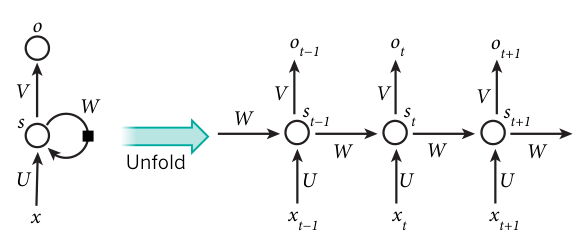
ENFigure 5 | A recurrent neural network and the unfolding in time of the computation involved in its forward computation. The artificial neurons (for example, hidden units grouped under node s with values st at time t) get inputs from other neurons at previous time steps (this is represented with the black square, representing a delay of one time step, on the left). In this way, a recurrent neural network can map an input sequence with elements xt into an output sequence with elements ot, with each ot depending on all the previous xtʹ (for tʹ ≤ t). The same parameters (matrices U,V,W ) are used at each time step. Many other architectures are possible, including a variant in which the network can generate a sequence of outputs (for example, words), each of which is used as inputs for the next time step. The backpropagation algorithm (Fig. 1) can be directly applied to the computational graph of the unfolded network on the right, to compute the derivative of a total error (for example, the log-probability of generating the right sequence of outputs) with respect to all the states st and all the parameters.
中图 5|循环神经网络及其前向计算沿时间的展开。人工神经元,例如归于节点 s、在时刻 t 取值为 s_t 的隐藏单元,接收来自先前时间步其他神经元的输入(左图中的黑色方块代表一个时间步的延迟)。这样,循环神经网络就可以把由元素 x_t 构成的输入序列映射为由元素 o_t 构成的输出序列,每个 o_t 都依赖此前所有 x_t′,其中 t′≤t。每个时间步使用相同的参数矩阵 U、V、W。还存在许多其他架构,例如一种变体可以生成输出序列(如单词),并把每次输出用作下一时间步的输入。反向传播算法(图 1)可以直接应用于右图展开网络的计算图,以计算总误差——例如生成正确输出序列的对数概率——相对于所有状态 s_t 和全部参数的导数。
图内说明: 图内术语:Unfold 沿时间展开;x 为输入,s 为状态,o 为输出;U、V、W 为各时间步共享的参数矩阵。
SOURCE p.6 S047
ENRNNs are very powerful dynamic systems, but training them has proved to be problematic because the backpropagated gradients either grow or shrink at each time step, so over many time steps they typically explode or vanish77,78.
中RNN 是非常强大的动力系统,但事实证明,其训练存在困难:反向传播的梯度在每个时间步都会变大或变小,因此跨越很多时间步后,通常会发生梯度爆炸或梯度消失[77,78]。
SOURCE p.6,7 S048
ENThanks to advances in their architecture79,80 and ways of training them81,82, RNNs have been found to be very good at predicting the next character in the text83 or the next word in a sequence75, but they can also be used for more complex tasks. For example, after reading an English sentence one word at a time, an English ‘encoder’ network can be trained so that the final state vector of its hidden units is a good representation of the thought expressed by the sentence. This thought vector can then be used as the initial hidden state of (or as extra input to) a jointly trained French ‘decoder’ network, which outputs a probability distribution for the first word of the French translation. If a particular first word is chosen from this distribution and provided as input to the decoder network it will then output a probability distribution for the second word of the translation and so on until a full stop is chosen17,72,76. Overall, this process generates sequences of French words according to a probability distribution that depends on the English sentence. This rather naive way of performing machine translation has quickly become competitive with the state-of-the-art, and this raises serious doubts about whether understanding a sentence requires anything like the internal symbolic expressions that are manipulated by using inference rules. It is more compatible with the view that everyday reasoning involves many simultaneous analogies that each contribute plausibility to a conclusion84,85.
中得益于网络架构[79,80]和训练方式[81,82]的进步,人们发现 RNN 非常擅长预测文本中的下一个字符[83]或序列中的下一个词[75];它还可以处理更复杂的任务。例如,逐词读入一句英语后,可以训练一个英语“编码器”网络,使隐藏单元的最终状态向量很好地表示该句表达的思想。这个思想向量可作为联合训练的法语“解码器”网络的初始隐藏状态,或额外输入;后者输出法语译文第一个词的概率分布。从该分布选择某个首词并输入解码器后,它就会输出第二个词的概率分布,如此继续,直到选出句号[17,72,76]。总体而言,该过程按照一个依赖英语句子的概率分布生成法语词序列。这种相当朴素的机器翻译方法,很快便能与当时最先进的方法竞争,由此让人强烈怀疑:理解句子是否真的需要某种用推理规则操纵的内部符号表达式。它更符合另一种观点,即日常推理涉及许多同时进行的类比,各自为结论增添可信性[84,85]。
SOURCE p.7 S049
ENInstead of translating the meaning of a French sentence into an English sentence, one can learn to ‘translate’ the meaning of an image into an English sentence (Fig. 3). The encoder here is a deep ConvNet that converts the pixels into an activity vector in its last hidden layer. The decoder is an RNN similar to the ones used for machine translation and neural language modelling. There has been a surge of interest in such systems recently (see examples mentioned in ref. 86).
中除了把法语句子的含义翻译成英语句子,还可以学习把图像的含义“翻译”为英语句子(图 3)。这里的编码器是深度卷积网络,把像素变换成最后一个隐藏层中的激活向量。解码器则是与机器翻译、神经语言建模所用网络相似的 RNN。近期,这类系统引发了大量关注,实例见文献[86]。
SOURCE p.7 S050
ENRNNs, once unfolded in time (Fig. 5), can be seen as very deep feedforward networks in which all the layers share the same weights. Although their main purpose is to learn long-term dependencies, theoretical and empirical evidence shows that it is difficult to learn to store information for very long78.
中RNN 沿时间展开后(图 5),可以看作各层共享同一组权重的极深前馈网络。尽管其主要目的是学习长期依赖,理论与实证证据表明,要学会长时间保存信息仍然很困难[78]。
SOURCE p.7 S051
ENTo correct for that, one idea is to augment the network with an explicit memory. The first proposal of this kind is the long short-term memory (LSTM) networks that use special hidden units, the natural behaviour of which is to remember inputs for a long time79. A special unit called the memory cell acts like an accumulator or a gated leaky neuron: it has a connection to itself at the next time step that has a weight of one, so it copies its own real-valued state and accumulates the external signal, but this self-connection is multiplicatively gated by another unit that learns to decide when to clear the content of the memory.
中为解决这一问题,一种思路是给网络增加显式记忆。此类方法中最早提出的是长短期记忆(LSTM)网络,使用本身就适于长时间记住输入的特殊隐藏单元[79]。一种称为记忆单元的特殊单元,类似于累加器或带门控的泄漏神经元:它有一条通向下一时间步自身的连接,权重为 1,因此能够复制自身实值状态并累积外部信号;但该自连接受到另一个单元的乘性门控,后者学习决定何时清除记忆内容。
SOURCE p.7 S052
ENLSTM networks have subsequently proved to be more effective than conventional RNNs, especially when they have several layers for each time step87, enabling an entire speech recognition system that goes all the way from acoustics to the sequence of characters in the transcription. LSTM networks or related forms of gated units are also currently used for the encoder and decoder networks that perform so well at machine translation17,72,76.
中后来证明,LSTM 网络比传统 RNN 更有效,尤其是每个时间步包含多层时[87]。它使完整的语音识别系统能够直接从声学输入得到转写文本的字符序列。目前,LSTM 或相关门控单元也被用于机器翻译中表现优异的编码器、解码器网络[17,72,76]。
SOURCE p.7 S053
ENOver the past year, several authors have made different proposals to augment RNNs with a memory module. Proposals include the Neural Turing Machine in which the network is augmented by a ‘tape-like’ memory that the RNN can choose to read from or write to88, and memory networks, in which a regular network is augmented by a kind of associative memory89. Memory networks have yielded excellent performance on standard question-answering benchmarks. The memory is used to remember the story about which the network is later asked to answer questions.
中过去一年,多位作者提出了给 RNN 增加记忆模块的不同方案。其中包括神经图灵机:它给网络增加“纸带式”记忆,RNN 可以选择读取或写入[88];以及记忆网络:给普通网络增加一种联想记忆[89]。记忆网络在标准问答基准上取得了出色表现。记忆用于保存故事,之后网络再回答有关该故事的问题。
SOURCE p.7 S054
ENBeyond simple memorization, neural Turing machines and memory networks are being used for tasks that would normally require reasoning and symbol manipulation. Neural Turing machines can be taught ‘algorithms’. Among other things, they can learn to output a sorted list of symbols when their input consists of an unsorted sequence in which each symbol is accompanied by a real value that indicates its priority in the list88. Memory networks can be trained to keep track of the state of the world in a setting similar to a text adventure game and after reading a story, they can answer questions that require complex inference90. In one test example, the network is shown a 15-sentence version of the The Lord of the Rings and correctly answers questions such as “where is Frodo now?”89.
中除简单记忆外,神经图灵机和记忆网络还被用于通常需要推理和符号操作的任务。神经图灵机可以被教授“算法”。例如,输入是一个未排序序列,每个符号附带一个表示其在列表中优先级的实数时,它能够学习输出排好序的符号列表[88]。记忆网络可以在类似文字冒险游戏的环境中,经过训练来追踪世界状态;读完一个故事后,它可以回答需要复杂推断的问题[90]。在一个测试例子中,网络读入由 15 个句子组成的《魔戒》故事,并正确回答“佛罗多现在在哪里?”等问题[89]。
深度学习的未来
SOURCE p.7 S055
ENUnsupervised learning91–98 had a catalytic effect in reviving interest in deep learning, but has since been overshadowed by the successes of purely supervised learning. Although we have not focused on it in this Review, we expect unsupervised learning to become far more important in the longer term. Human and animal learning is largely unsupervised: we discover the structure of the world by observing it, not by being told the name of every object.
中无监督学习[91–98]曾在重新激发深度学习研究兴趣方面起到催化作用,但后来其光芒被纯监督学习的成功所掩盖。虽然本综述没有重点讨论无监督学习,我们预计,从更长远看,它会变得重要得多。人类和动物的学习大多是无监督的:我们通过观察发现世界的结构,而不是依靠别人告诉我们每一个对象的名称。
SOURCE p.7 S056
ENHuman vision is an active process that sequentially samples the optic array in an intelligent, task-specific way using a small, high-resolution fovea with a large, low-resolution surround. We expect much of the future progress in vision to come from systems that are trained end-to-end and combine ConvNets with RNNs that use reinforcement learning to decide where to look. Systems combining deep learning and reinforcement learning are in their infancy, but they already outperform passive vision systems99 at classification tasks and produce impressive results in learning to play many different video games100.
中人类视觉是一个主动过程:利用面积小、分辨率高的中央凹和范围大、分辨率低的周边视野,以智能且针对具体任务的方式,依次采样视野。我们预计,未来视觉领域的许多进展,将来自经过端到端训练、将卷积网络与 RNN 结合,并利用强化学习决定看向何处的系统。深度学习与强化学习相结合的系统尚处于起步阶段,但它们在分类任务上已经超过被动视觉系统[99],在学习玩多种电子游戏方面也取得了令人印象深刻的结果[100]。
SOURCE p.7 S057
ENNatural language understanding is another area in which deep learning is poised to make a large impact over the next few years. We expect systems that use RNNs to understand sentences or whole documents will become much better when they learn strategies for selectively attending to one part at a time76,86.
中自然语言理解是深度学习有望在未来几年产生重大影响的另一个领域。我们预计,使用 RNN 理解句子或整篇文档的系统,在学会每次选择性地关注某一部分的策略后,表现将大幅改善[76,86]。
SOURCE p.7 S058
ENUltimately, major progress in artificial intelligence will come about through systems that combine representation learning with complex reasoning. Although deep learning and simple reasoning have been used for speech and handwriting recognition for a long time, new paradigms are needed to replace rule-based manipulation of symbolic expressions by operations on large vectors101. ■
中最终,人工智能的重大进展将来自把表示学习与复杂推理结合起来的系统。尽管深度学习和简单推理早已用于语音及手写识别,仍然需要新的范式,用对大型向量的操作,替代基于规则的符号表达式操纵[101]。
SOURCE p.7 S059
ENReceived 25 February; accepted 1 May 2015.
中收稿:2015 年 2 月 25 日;接受:2015 年 5 月 1 日。
致谢
SOURCE p.9 S060
ENThe authors would like to thank the Natural Sciences and Engineering Research Council of Canada, the Canadian Institute For Advanced Research (CIFAR), the National Science Foundation and Office of Naval Research for support. Y.L. and Y.B. are CIFAR fellows.
中作者感谢加拿大自然科学与工程研究理事会、加拿大高级研究院(CIFAR)、美国国家科学基金会和美国海军研究办公室提供支持。Y.L. 与 Y.B. 为 CIFAR 研究员。
作者信息
SOURCE p.9 S061
ENReprints and permissions information is available at
www.nature.com/reprints. The authors declare no competing financial interests. Readers are welcome to comment on the online version of this paper at go.nature.com/7cjbaa. Correspondence should be addressed to Y.L. (
yann@cs.nyu.edu).
参考文献
SOURCE p.7 R001
EN[1] Krizhevsky, A., Sutskever, I. & Hinton, G. ImageNet classification with deep convolutional neural networks. In Proc. Advances in Neural Information Processing Systems 25 1090–1098 (2012).
中[1] Krizhevsky, A., Sutskever, I. & Hinton, G. ImageNet classification with deep convolutional neural networks. In Proc. Advances in Neural Information Processing Systems 25 1090–1098 (2012).
SOURCE p.7 N001
ENThis report was a breakthrough that used convolutional nets to almost halve the error rate for object recognition, and precipitated the rapid adoption of deep learning by the computer vision community.
中这项突破性研究使用卷积网络,将对象识别错误率几乎减半,并促使计算机视觉研究界迅速采用深度学习。
SOURCE p.7 R002
EN[2] Farabet, C., Couprie, C., Najman, L. & LeCun, Y. Learning hierarchical features for scene labeling. IEEE Trans. Pattern Anal. Mach. Intell. 35, 1915–1929 (2013).
中[2] Farabet, C., Couprie, C., Najman, L. & LeCun, Y. Learning hierarchical features for scene labeling. IEEE Trans. Pattern Anal. Mach. Intell. 35, 1915–1929 (2013).
SOURCE p.7 R003
EN[3] Tompson, J., Jain, A., LeCun, Y. & Bregler, C. Joint training of a convolutional network and a graphical model for human pose estimation. In Proc. Advances in Neural Information Processing Systems 27 1799–1807 (2014).
中[3] Tompson, J., Jain, A., LeCun, Y. & Bregler, C. Joint training of a convolutional network and a graphical model for human pose estimation. In Proc. Advances in Neural Information Processing Systems 27 1799–1807 (2014).
SOURCE p.7 R004
EN[4] Szegedy, C. et al. Going deeper with convolutions. Preprint at
http://arxiv.org/ abs/1409.4842 (2014).
中[4] Szegedy, C. et al. Going deeper with convolutions. Preprint at
http://arxiv.org/ abs/1409.4842 (2014).
SOURCE p.7 R005
EN[5] Mikolov, T., Deoras, A., Povey, D., Burget, L. & Cernocky, J. Strategies for training large scale neural network language models. In Proc. Automatic Speech Recognition and Understanding 196–201 (2011).
中[5] Mikolov, T., Deoras, A., Povey, D., Burget, L. & Cernocky, J. Strategies for training large scale neural network language models. In Proc. Automatic Speech Recognition and Understanding 196–201 (2011).
SOURCE p.7 R006
EN[6] Hinton, G. et al. Deep neural networks for acoustic modeling in speech recognition. IEEE Signal Processing Magazine 29, 82–97 (2012).
中[6] Hinton, G. et al. Deep neural networks for acoustic modeling in speech recognition. IEEE Signal Processing Magazine 29, 82–97 (2012).
SOURCE p.7 N006
ENThis joint paper from the major speech recognition laboratories, summarizing the breakthrough achieved with deep learning on the task of phonetic classification for automatic speech recognition, was the first major industrial application of deep learning.
中这篇由主要语音识别实验室联合发表的论文,总结了深度学习在自动语音识别的音位分类任务上取得的突破,这是深度学习的首个重要工业应用。
SOURCE p.7 R007
EN[7] Sainath, T., Mohamed, A.-R., Kingsbury, B. & Ramabhadran, B. Deep convolutional neural networks for LVCSR. In Proc. Acoustics, Speech and Signal Processing 8614–8618 (2013).
中[7] Sainath, T., Mohamed, A.-R., Kingsbury, B. & Ramabhadran, B. Deep convolutional neural networks for LVCSR. In Proc. Acoustics, Speech and Signal Processing 8614–8618 (2013).
SOURCE p.7 R008
EN[8] Ma, J., Sheridan, R. P., Liaw, A., Dahl, G. E. & Svetnik, V. Deep neural nets as a method for quantitative structure-activity relationships. J. Chem. Inf. Model. 55, 263–274 (2015).
中[8] Ma, J., Sheridan, R. P., Liaw, A., Dahl, G. E. & Svetnik, V. Deep neural nets as a method for quantitative structure-activity relationships. J. Chem. Inf. Model. 55, 263–274 (2015).
SOURCE p.7 R009
EN[9] Ciodaro, T., Deva, D., de Seixas, J. & Damazio, D. Online particle detection with neural networks based on topological calorimetry information. J. Phys. Conf. Series 368, 012030 (2012).
中[9] Ciodaro, T., Deva, D., de Seixas, J. & Damazio, D. Online particle detection with neural networks based on topological calorimetry information. J. Phys. Conf. Series 368, 012030 (2012).
SOURCE p.7 R010
EN[10] Kaggle. Higgs boson machine learning challenge. Kaggle
https://www.kaggle. com/c/higgs-boson (2014).
中[10] Kaggle. Higgs boson machine learning challenge. Kaggle
https://www.kaggle. com/c/higgs-boson (2014).
SOURCE p.7 R011
EN[11] Helmstaedter, M. et al. Connectomic reconstruction of the inner plexiform layer in the mouse retina. Nature 500, 168–174 (2013).
中[11] Helmstaedter, M. et al. Connectomic reconstruction of the inner plexiform layer in the mouse retina. Nature 500, 168–174 (2013).
SOURCE p.8 R012
EN[12] Leung, M. K., Xiong, H. Y., Lee, L. J. & Frey, B. J. Deep learning of the tissue-regulated splicing code. Bioinformatics 30, i121–i129 (2014).
中[12] Leung, M. K., Xiong, H. Y., Lee, L. J. & Frey, B. J. Deep learning of the tissue-regulated splicing code. Bioinformatics 30, i121–i129 (2014).
SOURCE p.8 R013
EN[13] Xiong, H. Y. et al. The human splicing code reveals new insights into the genetic determinants of disease. Science 347, 6218 (2015).
中[13] Xiong, H. Y. et al. The human splicing code reveals new insights into the genetic determinants of disease. Science 347, 6218 (2015).
SOURCE p.8 R014
EN[14] Collobert, R., et al. Natural language processing (almost) from scratch. J. Mach. Learn. Res. 12, 2493–2537 (2011).
中[14] Collobert, R., et al. Natural language processing (almost) from scratch. J. Mach. Learn. Res. 12, 2493–2537 (2011).
SOURCE p.8 R015
EN[15] Bordes, A., Chopra, S. & Weston, J. Question answering with subgraph embeddings. In Proc. Empirical Methods in Natural Language Processing http:// arxiv.org/abs/1406.3676v3 (2014).
中[15] Bordes, A., Chopra, S. & Weston, J. Question answering with subgraph embeddings. In Proc. Empirical Methods in Natural Language Processing http:// arxiv.org/abs/1406.3676v3 (2014).
SOURCE p.8 R016
EN[16] Jean, S., Cho, K., Memisevic, R. & Bengio, Y. On using very large target vocabulary for neural machine translation. In Proc. ACL-IJCNLP
http://arxiv.org/ abs/1412.2007 (2015).
中[16] Jean, S., Cho, K., Memisevic, R. & Bengio, Y. On using very large target vocabulary for neural machine translation. In Proc. ACL-IJCNLP
http://arxiv.org/ abs/1412.2007 (2015).
SOURCE p.8 R017
EN[17] Sutskever, I. Vinyals, O. & Le. Q. V. Sequence to sequence learning with neural networks. In Proc. Advances in Neural Information Processing Systems 27 3104–3112 (2014).
中[17] Sutskever, I. Vinyals, O. & Le. Q. V. Sequence to sequence learning with neural networks. In Proc. Advances in Neural Information Processing Systems 27 3104–3112 (2014).
SOURCE p.8 N017
ENThis paper showed state-of-the-art machine translation results with the architecture introduced in ref. 72, with a recurrent network trained to read a sentence in one language, produce a semantic representation of its meaning, and generate a translation in another language.
中本文利用文献[72]提出的架构,取得了当时最先进的机器翻译结果:训练循环网络读取一种语言的句子,产生其含义的语义表示,再生成另一种语言的译文。
SOURCE p.8 R018
EN[18] Bottou, L. & Bousquet, O. The tradeoffs of large scale learning. In Proc. Advances in Neural Information Processing Systems 20 161–168 (2007).
中[18] Bottou, L. & Bousquet, O. The tradeoffs of large scale learning. In Proc. Advances in Neural Information Processing Systems 20 161–168 (2007).
SOURCE p.8 R019
EN[19] Duda, R. O. & Hart, P. E. Pattern Classification and Scene Analysis (Wiley, 1973).
中[19] Duda, R. O. & Hart, P. E. Pattern Classification and Scene Analysis (Wiley, 1973).
SOURCE p.8 R020
EN[20] Schölkopf, B. & Smola, A. Learning with Kernels (MIT Press, 2002).
中[20] Schölkopf, B. & Smola, A. Learning with Kernels (MIT Press, 2002).
SOURCE p.8 R021
EN[21] Bengio, Y., Delalleau, O. & Le Roux, N. The curse of highly variable functions for local kernel machines. In Proc. Advances in Neural Information Processing Systems 18 107–114 (2005).
中[21] Bengio, Y., Delalleau, O. & Le Roux, N. The curse of highly variable functions for local kernel machines. In Proc. Advances in Neural Information Processing Systems 18 107–114 (2005).
SOURCE p.8 R022
EN[22] Selfridge, O. G. Pandemonium: a paradigm for learning in mechanisation of thought processes. In Proc. Symposium on Mechanisation of Thought Processes 513–526 (1958).
中[22] Selfridge, O. G. Pandemonium: a paradigm for learning in mechanisation of thought processes. In Proc. Symposium on Mechanisation of Thought Processes 513–526 (1958).
SOURCE p.8 R023
EN[23] Rosenblatt, F. The Perceptron — A Perceiving and Recognizing Automaton. Tech. Rep. 85-460-1 (Cornell Aeronautical Laboratory, 1957).
中[23] Rosenblatt, F. The Perceptron — A Perceiving and Recognizing Automaton. Tech. Rep. 85-460-1 (Cornell Aeronautical Laboratory, 1957).
SOURCE p.8 R024
EN[24] Werbos, P. Beyond Regression: New Tools for Prediction and Analysis in the Behavioral Sciences. PhD thesis, Harvard Univ. (1974).
中[24] Werbos, P. Beyond Regression: New Tools for Prediction and Analysis in the Behavioral Sciences. PhD thesis, Harvard Univ. (1974).
SOURCE p.8 R025
EN[25] Parker, D. B. Learning Logic Report TR–47 (MIT Press, 1985).
中[25] Parker, D. B. Learning Logic Report TR–47 (MIT Press, 1985).
SOURCE p.8 R026
EN[26] LeCun, Y. Une procédure d’apprentissage pour Réseau à seuil assymétrique in Cognitiva 85: a la Frontière de l’Intelligence Artificielle, des Sciences de la Connaissance et des Neurosciences [in French] 599–604 (1985).
中[26] LeCun, Y. Une procédure d’apprentissage pour Réseau à seuil assymétrique in Cognitiva 85: a la Frontière de l’Intelligence Artificielle, des Sciences de la Connaissance et des Neurosciences [in French] 599–604 (1985).
SOURCE p.8 R027
EN[27] Rumelhart, D. E., Hinton, G. E. & Williams, R. J. Learning representations by back-propagating errors. Nature 323, 533–536 (1986).
中[27] Rumelhart, D. E., Hinton, G. E. & Williams, R. J. Learning representations by back-propagating errors. Nature 323, 533–536 (1986).
SOURCE p.8 R028
EN[28] Glorot, X., Bordes, A. & Bengio. Y. Deep sparse rectifier neural networks. In Proc. 14th International Conference on Artificial Intelligence and Statistics 315–323 (2011).
中[28] Glorot, X., Bordes, A. & Bengio. Y. Deep sparse rectifier neural networks. In Proc. 14th International Conference on Artificial Intelligence and Statistics 315–323 (2011).
SOURCE p.8 N028
ENThis paper showed that supervised training of very deep neural networks is much faster if the hidden layers are composed of ReLU.
中本文表明,如果隐藏层由 ReLU 构成,对极深神经网络进行监督训练的速度会快得多。
SOURCE p.8 R029
EN[29] Dauphin, Y. et al. Identifying and attacking the saddle point problem in high-dimensional non-convex optimization. In Proc. Advances in Neural Information Processing Systems 27 2933–2941 (2014).
中[29] Dauphin, Y. et al. Identifying and attacking the saddle point problem in high-dimensional non-convex optimization. In Proc. Advances in Neural Information Processing Systems 27 2933–2941 (2014).
SOURCE p.8 R030
EN[30] Choromanska, A., Henaff, M., Mathieu, M., Arous, G. B. & LeCun, Y. The loss surface of multilayer networks. In Proc. Conference on AI and Statistics http:// arxiv.org/abs/1412.0233 (2014).
中[30] Choromanska, A., Henaff, M., Mathieu, M., Arous, G. B. & LeCun, Y. The loss surface of multilayer networks. In Proc. Conference on AI and Statistics http:// arxiv.org/abs/1412.0233 (2014).
SOURCE p.8 R031
EN[31] Hinton, G. E. What kind of graphical model is the brain? In Proc. 19th International Joint Conference on Artificial intelligence 1765–1775 (2005).
中[31] Hinton, G. E. What kind of graphical model is the brain? In Proc. 19th International Joint Conference on Artificial intelligence 1765–1775 (2005).
SOURCE p.8 R032
EN[32] Hinton, G. E., Osindero, S. & Teh, Y.-W. A fast learning algorithm for deep belief nets. Neural Comp. 18, 1527–1554 (2006).
中[32] Hinton, G. E., Osindero, S. & Teh, Y.-W. A fast learning algorithm for deep belief nets. Neural Comp. 18, 1527–1554 (2006).
SOURCE p.8 N032
ENThis paper introduced a novel and effective way of training very deep neural networks by pre-training one hidden layer at a time using the unsupervised learning procedure for restricted Boltzmann machines.
中本文提出一种新颖而有效的极深神经网络训练方法:采用受限玻尔兹曼机的无监督学习过程,每次预训练一个隐藏层。
SOURCE p.8 R033
EN[33] Bengio, Y., Lamblin, P., Popovici, D. & Larochelle, H. Greedy layer-wise training of deep networks. In Proc. Advances in Neural Information Processing Systems 19 153–160 (2006).
中[33] Bengio, Y., Lamblin, P., Popovici, D. & Larochelle, H. Greedy layer-wise training of deep networks. In Proc. Advances in Neural Information Processing Systems 19 153–160 (2006).
SOURCE p.8 N033
ENThis report demonstrated that the unsupervised pre-training method introduced in ref. 32 significantly improves performance on test data and generalizes the method to other unsupervised representation-learning techniques, such as auto-encoders.
中本报告表明,文献[32]提出的无监督预训练方法显著提高了测试数据上的性能,并将其推广到自编码器等其他无监督表示学习技术。
SOURCE p.8 R034
EN[34] Ranzato, M., Poultney, C., Chopra, S. & LeCun, Y. Efficient learning of sparse representations with an energy-based model. In Proc. Advances in Neural Information Processing Systems 19 1137–1144 (2006).
中[34] Ranzato, M., Poultney, C., Chopra, S. & LeCun, Y. Efficient learning of sparse representations with an energy-based model. In Proc. Advances in Neural Information Processing Systems 19 1137–1144 (2006).
SOURCE p.8 R035
EN[35] Hinton, G. E. & Salakhutdinov, R. Reducing the dimensionality of data with neural networks. Science 313, 504–507 (2006).
中[35] Hinton, G. E. & Salakhutdinov, R. Reducing the dimensionality of data with neural networks. Science 313, 504–507 (2006).
SOURCE p.8 R036
EN[36] Sermanet, P., Kavukcuoglu, K., Chintala, S. & LeCun, Y. Pedestrian detection with unsupervised multi-stage feature learning. In Proc. International Conference on Computer Vision and Pattern Recognition
http://arxiv.org/abs/1212.0142 (2013).
中[36] Sermanet, P., Kavukcuoglu, K., Chintala, S. & LeCun, Y. Pedestrian detection with unsupervised multi-stage feature learning. In Proc. International Conference on Computer Vision and Pattern Recognition
http://arxiv.org/abs/1212.0142 (2013).
SOURCE p.8 R037
EN[37] Raina, R., Madhavan, A. & Ng, A. Y. Large-scale deep unsupervised learning using graphics processors. In Proc. 26th Annual International Conference on Machine Learning 873–880 (2009).
中[37] Raina, R., Madhavan, A. & Ng, A. Y. Large-scale deep unsupervised learning using graphics processors. In Proc. 26th Annual International Conference on Machine Learning 873–880 (2009).
SOURCE p.8 R038
EN[38] Mohamed, A.-R., Dahl, G. E. & Hinton, G. Acoustic modeling using deep belief networks. IEEE Trans. Audio Speech Lang. Process. 20, 14–22 (2012).
中[38] Mohamed, A.-R., Dahl, G. E. & Hinton, G. Acoustic modeling using deep belief networks. IEEE Trans. Audio Speech Lang. Process. 20, 14–22 (2012).
SOURCE p.8 R039
EN[39] Dahl, G. E., Yu, D., Deng, L. & Acero, A. Context-dependent pre-trained deep neural networks for large vocabulary speech recognition. IEEE Trans. Audio Speech Lang. Process. 20, 33–42 (2012).
中[39] Dahl, G. E., Yu, D., Deng, L. & Acero, A. Context-dependent pre-trained deep neural networks for large vocabulary speech recognition. IEEE Trans. Audio Speech Lang. Process. 20, 33–42 (2012).
SOURCE p.8 R040
EN[40] Bengio, Y., Courville, A. & Vincent, P. Representation learning: a review and new perspectives. IEEE Trans. Pattern Anal. Machine Intell. 35, 1798–1828 (2013).
中[40] Bengio, Y., Courville, A. & Vincent, P. Representation learning: a review and new perspectives. IEEE Trans. Pattern Anal. Machine Intell. 35, 1798–1828 (2013).
SOURCE p.8 R041
EN[41] LeCun, Y. et al. Handwritten digit recognition with a back-propagation network. In Proc. Advances in Neural Information Processing Systems 396–404 (1990).
中[41] LeCun, Y. et al. Handwritten digit recognition with a back-propagation network. In Proc. Advances in Neural Information Processing Systems 396–404 (1990).
SOURCE p.8 N041
ENThis is the first paper on convolutional networks trained by backpropagation for the task of classifying low-resolution images of handwritten digits.
中这是第一篇使用反向传播训练卷积网络、以分类低分辨率手写数字图像的论文。
SOURCE p.8 R042
EN[42] LeCun, Y., Bottou, L., Bengio, Y. & Haffner, P. Gradient-based learning applied to document recognition. Proc. IEEE 86, 2278–2324 (1998).
中[42] LeCun, Y., Bottou, L., Bengio, Y. & Haffner, P. Gradient-based learning applied to document recognition. Proc. IEEE 86, 2278–2324 (1998).
SOURCE p.8 N042
ENThis overview paper on the principles of end-to-end training of modular systems such as deep neural networks using gradient-based optimization showed how neural networks (and in particular convolutional nets) can be combined with search or inference mechanisms to model complex outputs that are interdependent, such as sequences of characters associated with the content of a document.
中这篇综述讨论使用基于梯度的优化,端到端训练深度神经网络等模块化系统的原理,并展示如何将神经网络,尤其是卷积网络,与搜索或推断机制结合起来,对彼此依赖的复杂输出建模,例如与文档内容对应的字符序列。
SOURCE p.8 R043
EN[43] Hubel, D. H. & Wiesel, T. N. Receptive fields, binocular interaction, and functional architecture in the cat’s visual cortex. J. Physiol. 160, 106–154 (1962).
中[43] Hubel, D. H. & Wiesel, T. N. Receptive fields, binocular interaction, and functional architecture in the cat’s visual cortex. J. Physiol. 160, 106–154 (1962).
SOURCE p.8 R044
EN[44] Felleman, D. J. & Essen, D. C. V. Distributed hierarchical processing in the primate cerebral cortex. Cereb. Cortex 1, 1–47 (1991).
中[44] Felleman, D. J. & Essen, D. C. V. Distributed hierarchical processing in the primate cerebral cortex. Cereb. Cortex 1, 1–47 (1991).
SOURCE p.8 R045
EN[45] Cadieu, C. F. et al. Deep neural networks rival the representation of primate it cortex for core visual object recognition. PLoS Comp. Biol. 10, e1003963 (2014).
中[45] Cadieu, C. F. et al. Deep neural networks rival the representation of primate it cortex for core visual object recognition. PLoS Comp. Biol. 10, e1003963 (2014).
SOURCE p.8 R046
EN[46] Fukushima, K. & Miyake, S. Neocognitron: a new algorithm for pattern recognition tolerant of deformations and shifts in position. Pattern Recognition 15, 455–469 (1982).
中[46] Fukushima, K. & Miyake, S. Neocognitron: a new algorithm for pattern recognition tolerant of deformations and shifts in position. Pattern Recognition 15, 455–469 (1982).
SOURCE p.8 R047
EN[47] Waibel, A., Hanazawa, T., Hinton, G. E., Shikano, K. & Lang, K. Phoneme recognition using time-delay neural networks. IEEE Trans. Acoustics Speech Signal Process. 37, 328–339 (1989).
中[47] Waibel, A., Hanazawa, T., Hinton, G. E., Shikano, K. & Lang, K. Phoneme recognition using time-delay neural networks. IEEE Trans. Acoustics Speech Signal Process. 37, 328–339 (1989).
SOURCE p.8 R048
EN[48] Bottou, L., Fogelman-Soulié, F., Blanchet, P. & Lienard, J. Experiments with time delay networks and dynamic time warping for speaker independent isolated digit recognition. In Proc. EuroSpeech 89 537–540 (1989).
中[48] Bottou, L., Fogelman-Soulié, F., Blanchet, P. & Lienard, J. Experiments with time delay networks and dynamic time warping for speaker independent isolated digit recognition. In Proc. EuroSpeech 89 537–540 (1989).
SOURCE p.8 R049
EN[49] Simard, D., Steinkraus, P. Y. & Platt, J. C. Best practices for convolutional neural networks. In Proc. Document Analysis and Recognition 958–963 (2003).
中[49] Simard, D., Steinkraus, P. Y. & Platt, J. C. Best practices for convolutional neural networks. In Proc. Document Analysis and Recognition 958–963 (2003).
SOURCE p.8 R050
EN[50] Vaillant, R., Monrocq, C. & LeCun, Y. Original approach for the localisation of objects in images. In Proc. Vision, Image, and Signal Processing 141, 245–250 (1994).
中[50] Vaillant, R., Monrocq, C. & LeCun, Y. Original approach for the localisation of objects in images. In Proc. Vision, Image, and Signal Processing 141, 245–250 (1994).
SOURCE p.8 R051
EN[51] Nowlan, S. & Platt, J. in Neural Information Processing Systems 901–908 (1995).
中[51] Nowlan, S. & Platt, J. in Neural Information Processing Systems 901–908 (1995).
SOURCE p.8 R052
EN[52] Lawrence, S., Giles, C. L., Tsoi, A. C. & Back, A. D. Face recognition: a convolutional neural-network approach. IEEE Trans. Neural Networks 8, 98–113 (1997).
中[52] Lawrence, S., Giles, C. L., Tsoi, A. C. & Back, A. D. Face recognition: a convolutional neural-network approach. IEEE Trans. Neural Networks 8, 98–113 (1997).
SOURCE p.8 R053
EN[53] Ciresan, D., Meier, U. Masci, J. & Schmidhuber, J. Multi-column deep neural network for traffic sign classification. Neural Networks 32, 333–338 (2012).
中[53] Ciresan, D., Meier, U. Masci, J. & Schmidhuber, J. Multi-column deep neural network for traffic sign classification. Neural Networks 32, 333–338 (2012).
SOURCE p.8 R054
EN[54] Ning, F. et al. Toward automatic phenotyping of developing embryos from videos. IEEE Trans. Image Process. 14, 1360–1371 (2005).
中[54] Ning, F. et al. Toward automatic phenotyping of developing embryos from videos. IEEE Trans. Image Process. 14, 1360–1371 (2005).
SOURCE p.8 R055
EN[55] Turaga, S. C. et al. Convolutional networks can learn to generate affinity graphs for image segmentation. Neural Comput. 22, 511–538 (2010).
中[55] Turaga, S. C. et al. Convolutional networks can learn to generate affinity graphs for image segmentation. Neural Comput. 22, 511–538 (2010).
SOURCE p.8 R056
EN[56] Garcia, C. & Delakis, M. Convolutional face finder: a neural architecture for fast and robust face detection. IEEE Trans. Pattern Anal. Machine Intell. 26, 1408–1423 (2004).
中[56] Garcia, C. & Delakis, M. Convolutional face finder: a neural architecture for fast and robust face detection. IEEE Trans. Pattern Anal. Machine Intell. 26, 1408–1423 (2004).
SOURCE p.8 R057
EN[57] Osadchy, M., LeCun, Y. & Miller, M. Synergistic face detection and pose estimation with energy-based models. J. Mach. Learn. Res. 8, 1197–1215 (2007).
中[57] Osadchy, M., LeCun, Y. & Miller, M. Synergistic face detection and pose estimation with energy-based models. J. Mach. Learn. Res. 8, 1197–1215 (2007).
SOURCE p.8 R058
EN[58] Tompson, J., Goroshin, R. R., Jain, A., LeCun, Y. Y. & Bregler, C. C. Efficient object localization using convolutional networks. In Proc. Conference on Computer Vision and Pattern Recognition
http://arxiv.org/abs/1411.4280 (2014).
中[58] Tompson, J., Goroshin, R. R., Jain, A., LeCun, Y. Y. & Bregler, C. C. Efficient object localization using convolutional networks. In Proc. Conference on Computer Vision and Pattern Recognition
http://arxiv.org/abs/1411.4280 (2014).
SOURCE p.8 R059
EN[59] Taigman, Y., Yang, M., Ranzato, M. & Wolf, L. Deepface: closing the gap to human-level performance in face verification. In Proc. Conference on Computer Vision and Pattern Recognition 1701–1708 (2014).
中[59] Taigman, Y., Yang, M., Ranzato, M. & Wolf, L. Deepface: closing the gap to human-level performance in face verification. In Proc. Conference on Computer Vision and Pattern Recognition 1701–1708 (2014).
SOURCE p.8 R060
EN[60] Hadsell, R. et al. Learning long-range vision for autonomous off-road driving. J. Field Robot. 26, 120–144 (2009).
中[60] Hadsell, R. et al. Learning long-range vision for autonomous off-road driving. J. Field Robot. 26, 120–144 (2009).
SOURCE p.8 R061
EN[61] Farabet, C., Couprie, C., Najman, L. & LeCun, Y. Scene parsing with multiscale feature learning, purity trees, and optimal covers. In Proc. International Conference on Machine Learning
http://arxiv.org/abs/1202.2160 (2012).
中[61] Farabet, C., Couprie, C., Najman, L. & LeCun, Y. Scene parsing with multiscale feature learning, purity trees, and optimal covers. In Proc. International Conference on Machine Learning
http://arxiv.org/abs/1202.2160 (2012).
SOURCE p.8 R062
EN[62] Srivastava, N., Hinton, G., Krizhevsky, A., Sutskever, I. & Salakhutdinov, R. Dropout: a simple way to prevent neural networks from overfitting. J. Machine Learning Res. 15, 1929–1958 (2014).
中[62] Srivastava, N., Hinton, G., Krizhevsky, A., Sutskever, I. & Salakhutdinov, R. Dropout: a simple way to prevent neural networks from overfitting. J. Machine Learning Res. 15, 1929–1958 (2014).
SOURCE p.8 R063
EN[63] Sermanet, P. et al. Overfeat: integrated recognition, localization and detection using convolutional networks. In Proc. International Conference on Learning Representations
http://arxiv.org/abs/1312.6229 (2014).
中[63] Sermanet, P. et al. Overfeat: integrated recognition, localization and detection using convolutional networks. In Proc. International Conference on Learning Representations
http://arxiv.org/abs/1312.6229 (2014).
SOURCE p.8 R064
EN[64] Girshick, R., Donahue, J., Darrell, T. & Malik, J. Rich feature hierarchies for accurate object detection and semantic segmentation. In Proc. Conference on Computer Vision and Pattern Recognition 580–587 (2014).
中[64] Girshick, R., Donahue, J., Darrell, T. & Malik, J. Rich feature hierarchies for accurate object detection and semantic segmentation. In Proc. Conference on Computer Vision and Pattern Recognition 580–587 (2014).
SOURCE p.8 R065
EN[65] Simonyan, K. & Zisserman, A. Very deep convolutional networks for large-scale image recognition. In Proc. International Conference on Learning Representations
http://arxiv.org/abs/1409.1556 (2014).
中[65] Simonyan, K. & Zisserman, A. Very deep convolutional networks for large-scale image recognition. In Proc. International Conference on Learning Representations
http://arxiv.org/abs/1409.1556 (2014).
SOURCE p.8 R066
EN[66] Boser, B., Sackinger, E., Bromley, J., LeCun, Y. & Jackel, L. An analog neural network processor with programmable topology. J. Solid State Circuits 26, 2017–2025 (1991).
中[66] Boser, B., Sackinger, E., Bromley, J., LeCun, Y. & Jackel, L. An analog neural network processor with programmable topology. J. Solid State Circuits 26, 2017–2025 (1991).
SOURCE p.8 R067
EN[67] Farabet, C. et al. Large-scale FPGA-based convolutional networks. In Scaling up Machine Learning: Parallel and Distributed Approaches (eds Bekkerman, R., Bilenko, M. & Langford, J.) 399–419 (Cambridge Univ. Press, 2011).
中[67] Farabet, C. et al. Large-scale FPGA-based convolutional networks. In Scaling up Machine Learning: Parallel and Distributed Approaches (eds Bekkerman, R., Bilenko, M. & Langford, J.) 399–419 (Cambridge Univ. Press, 2011).
SOURCE p.8 R068
EN[68] Bengio, Y. Learning Deep Architectures for AI (Now, 2009).
中[68] Bengio, Y. Learning Deep Architectures for AI (Now, 2009).
SOURCE p.8 R069
EN[69] Montufar, G. & Morton, J. When does a mixture of products contain a product of mixtures? J. Discrete Math. 29, 321–347 (2014).
中[69] Montufar, G. & Morton, J. When does a mixture of products contain a product of mixtures? J. Discrete Math. 29, 321–347 (2014).
SOURCE p.8 R070
EN[70] Montufar, G. F., Pascanu, R., Cho, K. & Bengio, Y. On the number of linear regions of deep neural networks. In Proc. Advances in Neural Information Processing Systems 27 2924–2932 (2014).
中[70] Montufar, G. F., Pascanu, R., Cho, K. & Bengio, Y. On the number of linear regions of deep neural networks. In Proc. Advances in Neural Information Processing Systems 27 2924–2932 (2014).
SOURCE p.8 R071
EN[71] Bengio, Y., Ducharme, R. & Vincent, P. A neural probabilistic language model. In Proc. Advances in Neural Information Processing Systems 13 932–938 (2001).
中[71] Bengio, Y., Ducharme, R. & Vincent, P. A neural probabilistic language model. In Proc. Advances in Neural Information Processing Systems 13 932–938 (2001).
SOURCE p.8 N071
ENThis paper introduced neural language models, which learn to convert a word symbol into a word vector or word embedding composed of learned semantic features in order to predict the next word in a sequence.
中本文提出了神经语言模型,它学习把单词符号转换为由已学语义特征构成的词向量或词嵌入,以预测序列中的下一个词。
SOURCE p.8,9 R072
EN[72] Cho, K. et al. Learning phrase representations using RNN encoder-decoder for statistical machine translation. In Proc. Conference on Empirical Methods in Natural Language Processing 1724–1734 (2014).
中[72] Cho, K. et al. Learning phrase representations using RNN encoder-decoder for statistical machine translation. In Proc. Conference on Empirical Methods in Natural Language Processing 1724–1734 (2014).
SOURCE p.9 R073
EN[73] Schwenk, H. Continuous space language models. Computer Speech Lang. 21, 492–518 (2007).
中[73] Schwenk, H. Continuous space language models. Computer Speech Lang. 21, 492–518 (2007).
SOURCE p.9 R074
EN[74] Socher, R., Lin, C. C-Y., Manning, C. & Ng, A. Y. Parsing natural scenes and natural language with recursive neural networks. In Proc. International Conference on Machine Learning 129–136 (2011).
中[74] Socher, R., Lin, C. C-Y., Manning, C. & Ng, A. Y. Parsing natural scenes and natural language with recursive neural networks. In Proc. International Conference on Machine Learning 129–136 (2011).
SOURCE p.9 R075
EN[75] Mikolov, T., Sutskever, I., Chen, K., Corrado, G. & Dean, J. Distributed representations of words and phrases and their compositionality. In Proc. Advances in Neural Information Processing Systems 26 3111–3119 (2013).
中[75] Mikolov, T., Sutskever, I., Chen, K., Corrado, G. & Dean, J. Distributed representations of words and phrases and their compositionality. In Proc. Advances in Neural Information Processing Systems 26 3111–3119 (2013).
SOURCE p.9 R076
EN[76] Bahdanau, D., Cho, K. & Bengio, Y. Neural machine translation by jointly learning to align and translate. In Proc. International Conference on Learning Representations
http://arxiv.org/abs/1409.0473 (2015).
中[76] Bahdanau, D., Cho, K. & Bengio, Y. Neural machine translation by jointly learning to align and translate. In Proc. International Conference on Learning Representations
http://arxiv.org/abs/1409.0473 (2015).
SOURCE p.9 R077
EN[77] Hochreiter, S. Untersuchungen zu dynamischen neuronalen Netzen [in German] Diploma thesis, T.U. Münich (1991).
中[77] Hochreiter, S. Untersuchungen zu dynamischen neuronalen Netzen [in German] Diploma thesis, T.U. Münich (1991).
SOURCE p.9 R078
EN[78] Bengio, Y., Simard, P. & Frasconi, P. Learning long-term dependencies with gradient descent is difficult. IEEE Trans. Neural Networks 5, 157–166 (1994).
中[78] Bengio, Y., Simard, P. & Frasconi, P. Learning long-term dependencies with gradient descent is difficult. IEEE Trans. Neural Networks 5, 157–166 (1994).
SOURCE p.9 R079
EN[79] Hochreiter, S. & Schmidhuber, J. Long short-term memory. Neural Comput. 9, 1735–1780 (1997).
中[79] Hochreiter, S. & Schmidhuber, J. Long short-term memory. Neural Comput. 9, 1735–1780 (1997).
SOURCE p.9 N079
ENThis paper introduced LSTM recurrent networks, which have become a crucial ingredient in recent advances with recurrent networks because they are good at learning long-range dependencies.
中本文提出 LSTM 循环网络。由于它善于学习长距离依赖,已成为近期循环网络进展中的关键组成部分。
SOURCE p.9 R080
SOURCE p.9 R081
EN[81] Sutskever, I. Training Recurrent Neural Networks. PhD thesis, Univ. Toronto (2012).
中[81] Sutskever, I. Training Recurrent Neural Networks. PhD thesis, Univ. Toronto (2012).
SOURCE p.9 R082
EN[82] Pascanu, R., Mikolov, T. & Bengio, Y. On the difficulty of training recurrent neural networks. In Proc. 30th International Conference on Machine Learning 1310– 1318 (2013).
中[82] Pascanu, R., Mikolov, T. & Bengio, Y. On the difficulty of training recurrent neural networks. In Proc. 30th International Conference on Machine Learning 1310– 1318 (2013).
SOURCE p.9 R083
EN[83] Sutskever, I., Martens, J. & Hinton, G. E. Generating text with recurrent neural networks. In Proc. 28th International Conference on Machine Learning 1017– 1024 (2011).
中[83] Sutskever, I., Martens, J. & Hinton, G. E. Generating text with recurrent neural networks. In Proc. 28th International Conference on Machine Learning 1017– 1024 (2011).
SOURCE p.9 R084
EN[84] Lakoff, G. & Johnson, M. Metaphors We Live By (Univ. Chicago Press, 2008).
中[84] Lakoff, G. & Johnson, M. Metaphors We Live By (Univ. Chicago Press, 2008).
SOURCE p.9 R085
EN[85] Rogers, T. T. & McClelland, J. L. Semantic Cognition: A Parallel Distributed Processing Approach (MIT Press, 2004).
中[85] Rogers, T. T. & McClelland, J. L. Semantic Cognition: A Parallel Distributed Processing Approach (MIT Press, 2004).
SOURCE p.9 R086
EN[86] Xu, K. et al. Show, attend and tell: Neural image caption generation with visual attention. In Proc. International Conference on Learning Representations http:// arxiv.org/abs/1502.03044 (2015).
中[86] Xu, K. et al. Show, attend and tell: Neural image caption generation with visual attention. In Proc. International Conference on Learning Representations http:// arxiv.org/abs/1502.03044 (2015).
SOURCE p.9 R087
EN[87] Graves, A., Mohamed, A.-R. & Hinton, G. Speech recognition with deep recurrent neural networks. In Proc. International Conference on Acoustics, Speech and Signal Processing 6645–6649 (2013).
中[87] Graves, A., Mohamed, A.-R. & Hinton, G. Speech recognition with deep recurrent neural networks. In Proc. International Conference on Acoustics, Speech and Signal Processing 6645–6649 (2013).
SOURCE p.9 R088
EN[88] Graves, A., Wayne, G. & Danihelka, I. Neural Turing machines.
http://arxiv.org/ abs/1410.5401 (2014).
中[88] Graves, A., Wayne, G. & Danihelka, I. Neural Turing machines.
http://arxiv.org/ abs/1410.5401 (2014).
SOURCE p.9 R089
EN[89] Weston, J. Chopra, S. & Bordes, A. Memory networks.
http://arxiv.org/ abs/1410.3916 (2014).
中[89] Weston, J. Chopra, S. & Bordes, A. Memory networks.
http://arxiv.org/ abs/1410.3916 (2014).
SOURCE p.9 R090
EN[90] Weston, J., Bordes, A., Chopra, S. & Mikolov, T. Towards AI-complete question answering: a set of prerequisite toy tasks.
http://arxiv.org/abs/1502.05698 (2015).
中[90] Weston, J., Bordes, A., Chopra, S. & Mikolov, T. Towards AI-complete question answering: a set of prerequisite toy tasks.
http://arxiv.org/abs/1502.05698 (2015).
SOURCE p.9 R091
EN[91] Hinton, G. E., Dayan, P., Frey, B. J. & Neal, R. M. The wake-sleep algorithm for unsupervised neural networks. Science 268, 1558–1161 (1995).
中[91] Hinton, G. E., Dayan, P., Frey, B. J. & Neal, R. M. The wake-sleep algorithm for unsupervised neural networks. Science 268, 1558–1161 (1995).
SOURCE p.9 R092
EN[92] Salakhutdinov, R. & Hinton, G. Deep Boltzmann machines. In Proc. International Conference on Artificial Intelligence and Statistics 448–455 (2009).
中[92] Salakhutdinov, R. & Hinton, G. Deep Boltzmann machines. In Proc. International Conference on Artificial Intelligence and Statistics 448–455 (2009).
SOURCE p.9 R093
EN[93] Vincent, P., Larochelle, H., Bengio, Y. & Manzagol, P.-A. Extracting and composing robust features with denoising autoencoders. In Proc. 25th International Conference on Machine Learning 1096–1103 (2008).
中[93] Vincent, P., Larochelle, H., Bengio, Y. & Manzagol, P.-A. Extracting and composing robust features with denoising autoencoders. In Proc. 25th International Conference on Machine Learning 1096–1103 (2008).
SOURCE p.9 R094
EN[94] Kavukcuoglu, K. et al. Learning convolutional feature hierarchies for visual recognition. In Proc. Advances in Neural Information Processing Systems 23 1090–1098 (2010).
中[94] Kavukcuoglu, K. et al. Learning convolutional feature hierarchies for visual recognition. In Proc. Advances in Neural Information Processing Systems 23 1090–1098 (2010).
SOURCE p.9 R095
EN[95] Gregor, K. & LeCun, Y. Learning fast approximations of sparse coding. In Proc. International Conference on Machine Learning 399–406 (2010).
中[95] Gregor, K. & LeCun, Y. Learning fast approximations of sparse coding. In Proc. International Conference on Machine Learning 399–406 (2010).
SOURCE p.9 R096
EN[96] Ranzato, M., Mnih, V., Susskind, J. M. & Hinton, G. E. Modeling natural images using gated MRFs. IEEE Trans. Pattern Anal. Machine Intell. 35, 2206–2222 (2013).
中[96] Ranzato, M., Mnih, V., Susskind, J. M. & Hinton, G. E. Modeling natural images using gated MRFs. IEEE Trans. Pattern Anal. Machine Intell. 35, 2206–2222 (2013).
SOURCE p.9 R097
EN[97] Bengio, Y., Thibodeau-Laufer, E., Alain, G. & Yosinski, J. Deep generative stochastic networks trainable by backprop. In Proc. 31st International Conference on Machine Learning 226–234 (2014).
中[97] Bengio, Y., Thibodeau-Laufer, E., Alain, G. & Yosinski, J. Deep generative stochastic networks trainable by backprop. In Proc. 31st International Conference on Machine Learning 226–234 (2014).
SOURCE p.9 R098
EN[98] Kingma, D., Rezende, D., Mohamed, S. & Welling, M. Semi-supervised learning with deep generative models. In Proc. Advances in Neural Information Processing Systems 27 3581–3589 (2014).
中[98] Kingma, D., Rezende, D., Mohamed, S. & Welling, M. Semi-supervised learning with deep generative models. In Proc. Advances in Neural Information Processing Systems 27 3581–3589 (2014).
SOURCE p.9 R099
EN[99] Ba, J., Mnih, V. & Kavukcuoglu, K. Multiple object recognition with visual attention. In Proc. International Conference on Learning Representations http:// arxiv.org/abs/1412.7755 (2014).
中[99] Ba, J., Mnih, V. & Kavukcuoglu, K. Multiple object recognition with visual attention. In Proc. International Conference on Learning Representations http:// arxiv.org/abs/1412.7755 (2014).
SOURCE p.9 R100
EN[100] Mnih, V. et al. Human-level control through deep reinforcement learning. Nature 518, 529–533 (2015).
中[100] Mnih, V. et al. Human-level control through deep reinforcement learning. Nature 518, 529–533 (2015).
SOURCE p.9 R101
EN[101] Bottou, L. From machine learning to machine reasoning. Mach. Learn. 94, 133–149 (2014).
中[101] Bottou, L. From machine learning to machine reasoning. Mach. Learn. 94, 133–149 (2014).
SOURCE p.9 R102
EN[102] Vinyals, O., Toshev, A., Bengio, S. & Erhan, D. Show and tell: a neural image caption generator. In Proc. International Conference on Machine Learning http:// arxiv.org/abs/1502.03044 (2014).
中[102] Vinyals, O., Toshev, A., Bengio, S. & Erhan, D. Show and tell: a neural image caption generator. In Proc. International Conference on Machine Learning http:// arxiv.org/abs/1502.03044 (2014).
SOURCE p.9 R103
EN[103] van der Maaten, L. & Hinton, G. E. Visualizing data using t-SNE. J. Mach. Learn. Research 9, 2579–2605 (2008).
中[103] van der Maaten, L. & Hinton, G. E. Visualizing data using t-SNE. J. Mach. Learn. Research 9, 2579–2605 (2008).
术语表
| deep learning | 深度学习 |
| representation learning | 表示学习 |
| distributed representation | 分布式表示 |
| feature map | 特征图 |
| backpropagation | 反向传播 |
| stochastic gradient descent (SGD) | 随机梯度下降 |
| convolutional neural network (ConvNet/CNN) | 卷积神经网络 |
| recurrent neural network (RNN) | 循环神经网络 |
| rectified linear unit (ReLU) | 整流线性单元 |
| pooling | 池化 |
| invariance | 不变性 |
| saddle point | 鞍点 |
| word embedding | 词嵌入 |
| long short-term memory (LSTM) | 长短期记忆 |
| memory cell | 记忆单元 |
| attention | 注意力 |
阅读提示
先看“监督学习”与图1,再看“卷积神经网络”与图2;语言处理和循环网络部分可结合图3至图5阅读。原文页码与各段落的 Source 标记可用于追溯。