Original title: 3D Diffusion Policy: Generalizable Visuomotor Policy Learning via Simple 3D Representations
Authors: Yanjie Ze, Gu Zhang, Kangning Zhang, Chenyuan Hu, Muhan Wang, Huazhe Xu
Version: arXiv:2403.03954v7 · RSS 2024
License: CC BY 4.0。本地全文中文改编,保留原作者署名与英文书目;改动为翻译、排版和明确标注的读者校注。
章节导航
SOURCE p.1 · abstract
ENImitation learning provides an efficient way to teach robots dexterous skills; however, learning complex skills robustly and generalizablely usually consumes large amounts of human demonstrations. To tackle this challenging problem, we present 3D Diffusion Policy (DP3), a novel visual imitation learning approach that incorporates the power of 3D visual representations into diffusion policies, a class of conditional action generative models. The core design of DP3 is the utilization of a compact 3D visual representation, extracted from sparse point clouds with an efficient point encoder. In our experiments involving 72 simulation tasks, DP3 successfully handles most tasks with just 10 demonstrations and surpasses baselines with a 24.2% relative improvement. In 4 real robot tasks, DP3 demonstrates precise control with a high success rate of 85% , given only 40 demonstrations of each task, and shows excellent generalization abilities in diverse aspects, including space, viewpoint, appearance, and instance. Interestingly, in real robot experiments, DP3 rarely violates safety requirements, in contrast to baseline methods which frequently do, necessitating human intervention. Our extensive evaluation highlights the critical importance of 3D representations in real-world robot learning. Code and videos are available on 3d-diffusion-policy.github.io .
中模仿学习能高效地教会机器人灵巧技能,但稳健、可泛化地学习复杂技能通常需要大量人类示范。为解决这一挑战,我们提出三维扩散策略(3D Diffusion Policy,DP3),把三维视觉表示的能力融入条件动作生成模型——扩散策略。核心设计是用高效点编码器从稀疏点云提取紧凑三维表示。在 72 项仿真任务中,DP3 仅用 10 条示范就能处理多数任务,相对基线提升 24.2%。在 4 项真实机器人任务中,每项仅给 40 条示范,平均成功率达到 85%,并展现空间、视角、外观、实例等多方面泛化。有趣的是,真实实验中 DP3 很少违反安全要求,而基线常需人工干预。广泛评估凸显了三维表示对真实机器人学习的重要性。代码与视频见 3d-diffusion-policy.github.io。
SOURCE p.1 · S0.F1
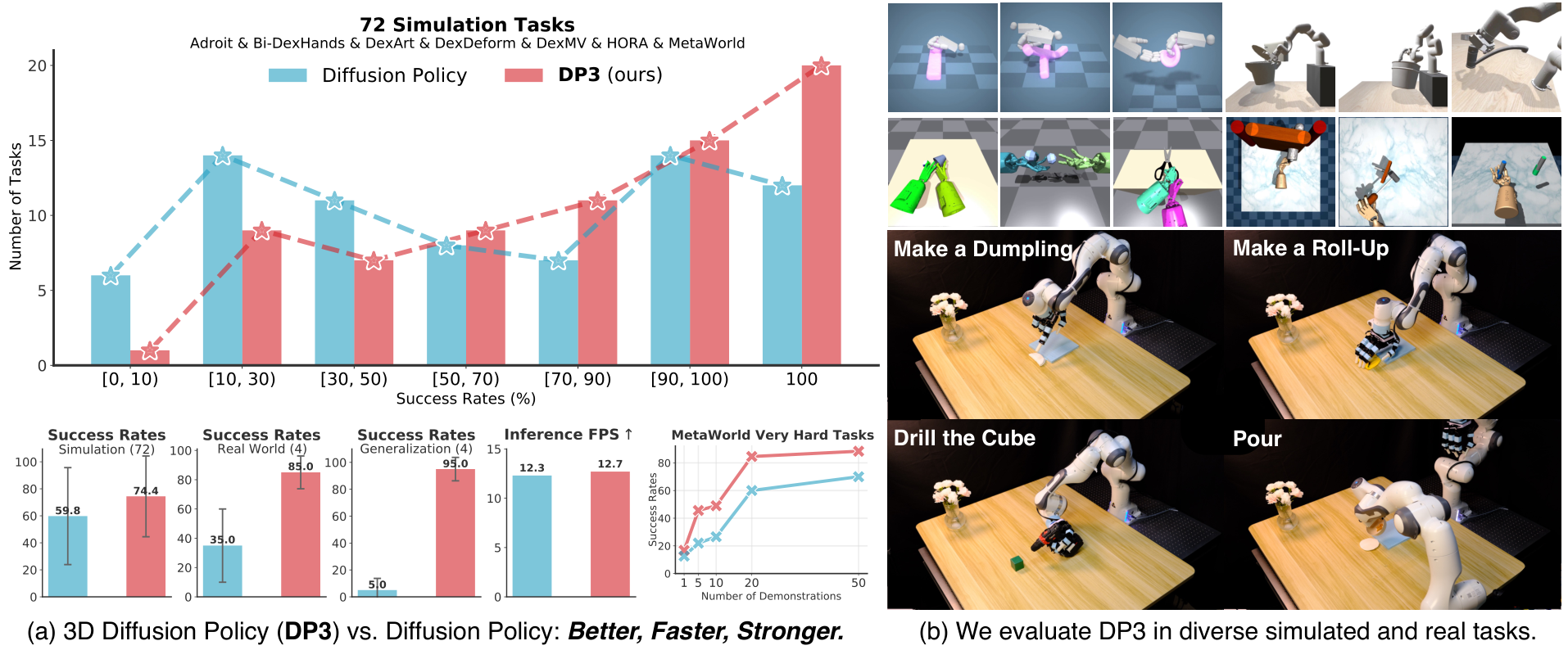
Original caption: Fig. 1: 3D Diffusion Policy (DP3) is a visual imitation learning algorithm that marries 3D visual representations with diffusion policies, achieving surprising effectiveness in diverse simulation and real-world tasks, with a practical inference speed.
中图 1:DP3 将三维视觉表示与扩散策略结合,在多种仿真与真实任务中取得显著效果,并保持实用的推理速度。
SOURCE p.1 · S1
I 引言
SOURCE p.1 · S1.p1
ENImitation learning provides an efficient way to teach robots a wide range of motor skills, such as grasping [ 68 , 60 , 82 ] , legged locomotion [ 40 ] , dexterous manipulation [ 1 , 16 ] , humanoid loco-manipulation [ 54 ] , and mobile manipulation [ 57 , 12 ] . Visual imitation learning, which takes high-dimensional visual observations such as images or depth maps, eases the need for task-specific state estimation and thus gains the popularity [ 10 , 60 , 82 , 11 , 20 ] .
中模仿学习能高效地教会机器人多种运动技能,如抓取 [68,60,82]、足式运动 [40]、灵巧操作 [1,16]、类人移动操作 [54]、移动操作 [57,12]。以图像或深度图等高维视觉观测为输入的视觉模仿学习,减少了任务专用状态估计的需求,因此广受关注 [10,60,82,11,20]。
SOURCE p.1 · S1.p2
ENHowever, the generality of visual imitation learning comes at a cost of vast demonstrations [ 16 , 10 , 11 ] . For example, the state-of-the-art method Diffusion Policy [ 10 ] necessitates 100 to 200 human-collected demonstrations for each real-world task. To collect the required extensive number of demonstrations, the entire data-gathering process can span several days due to its long-horizon nature and failure-prone process. One solution is online learning [ 16 ] , where the policy continues to evolve through interaction with environments and a learned reward function from expert demonstrations. Nevertheless, online learning in real-world scenarios introduces its own challenges, such as safety considerations, the necessity for automatic resetting, human intervention, and additional robot hardware costs. Therefore, how to enable (offline) imitation learning algorithms to learn robust and generalizable skills with as few demonstrations as possible is a fundamental problem, especially for practical real-world robot learning.
中但视觉模仿学习的通用性往往以大量示范为代价 [16,10,11]。例如先进的 Diffusion Policy [10] 每项真实任务需要人工采集 100–200 条示范;长时程、易失败的采集过程可能持续数天。一种解法是在线学习 [16],通过环境交互和从专家示范学得的奖励函数继续改进策略。但真实在线学习涉及安全、自动复位、人工干预和硬件成本。因此,如何使离线模仿学习用尽可能少的示范学到稳健、可泛化技能,是实际机器人学习的基础问题。
SOURCE p.1 · S1.p3
ENTo tackle this challenging problem, we introduce 3D Diffusion Policy (DP3) , a simple yet effective visual imitation learning algorithm that integrates the strengths of 3D visual representations with diffusion policies. DP3 encodes sparsely sampled point clouds into a compact 3D representation using a straightforward and efficient MLP encoder. Subsequently, DP3 denoises random noise into a coherent action sequence, conditioned on this compact 3D representation and the robot poses. This integration leverages not only the spatial understanding capabilities inherent in 3D modalities but also the expressiveness of diffusion models.
中我们提出简单有效的 DP3,将三维表示与扩散策略结合。它用直接、高效的 MLP 编码器把稀疏采样点云压成紧凑三维表示,再以该表示与机器人位姿为条件,将随机噪声去噪为连贯动作序列,同时利用三维模态固有的空间理解与扩散模型的表达能力。
SOURCE p.2 · S1.p4
ENTo comprehensively evaluate DP3, we have developed a simulation benchmark comprising 72 diverse robotic tasks from 7 domains, alongside 4 real-world tasks including challenging dexterous manipulation on deformable objects. Our extensive experiments demonstrate that although DP3 is conceptually straightforward, it exhibits several notable advantages over 2D-based diffusion policies and other baselines:
中为全面评估,我们构建了来自 7 个领域的 72 项多样仿真任务及 4 项真实任务,其中包含可变形物体的困难灵巧操作。虽然概念简单,DP3 相对二维扩散策略与其他基线展现了若干优势:
SOURCE p.2 · S1.p5
EN1. Efficiency & Effectiveness. DP3 not only achieves superior accuracy but also does so with significantly fewer demonstrations and fewer training steps. 2. Generalizability. The 3D nature of DP3 facilitates generalization capabilities across multiple aspects: space, viewpoint, instance, and appearance. 3. Safe deployment. An interesting observation in our real-world experiments is that DP3 seldom gives erratic commands in real-world tasks, unlike baseline methods which often do and exhibit unexpected behaviors, posing potential damage to the robot hardware.
中1. 效率与效果:示范和训练步数显著更少,精度仍更高。2. 泛化:三维特性促进空间、视角、实例、外观等方面的泛化。3. 安全部署:真实任务中,DP3 很少发出异常命令;基线却常出现不可预料行为,可能损伤硬件。
SOURCE p.2 · S1.p6
ENWe conduct several analyses of our 3D visual representations. Intriguingly, we observed that while other baseline methods, such as BCRNN [ 35 ] and IBC [ 11 ] , benefit from the incorporation of 3D representations, they do not achieve enhancements comparable to DP3. Additionally, DP3 consistently outperforms other 3D modalities, including depth and voxel representations, and surpasses other point encoders like PointNeXt [ 46 ] and Point Transformer [ 84 ] . These ablation studies highlight that the success of DP3 is not just due to the usage of 3D visual representations, but also because of its careful design.
中我们进一步分析三维表示。有趣的是,BCRNN [35]、IBC [11] 等也受益于三维输入,但提升不及 DP3。DP3 持续优于深度图、体素等其他三维模态,以及 PointNeXt [46]、Point Transformer [84] 等点编码器。这说明成功不仅源于采用三维表示,也来自精心设计。
SOURCE p.2 · S1.p7
ENIn summary, our contributions are four-fold: 1. We propose 3D Diffusion Policy (DP3), an effective visuomotor policy that generalizes across diverse aspects with few demonstrations. 2. To reduce the variance brought by benchmarks and tasks, we evaluate DP3 in a broad range of simulated and real-world tasks, showing the universality of DP3. 3. We conduct comprehensive analyses on visual representations in DP3 and show that a simple point cloud representation is preferred over other intricate 3D representations and is better suited for diffusion policies over other policy backbones. 4. DP3 is able to perform real-world deformable object manipulation using a dexterous hand with only 40 demonstrations, demonstrating that complex high-dimensional tasks could be handled with little human data.
中贡献有四点:(1)提出少示范、多方面泛化的有效视觉运动策略 DP3;(2)为减小基准和任务选择造成的偏差,在广泛仿真与真实任务上验证通用性;(3)全面分析表示,说明简单点云优于复杂三维表示,且相对其他策略骨干更适合扩散策略;(4)仅凭 40 条示范即可用灵巧手操作真实可变形物体,说明少量人类数据也能处理复杂高维任务。
SOURCE p.2 · S1.p8
SOURCE p.2 · S2
II 相关工作
SOURCE p.2 · S2.SS1
II-A 机器人学中的扩散模型
ENII-A Diffusion Models in Robotics
SOURCE p.2 · S2.SS1.p1
ENDiffusion models, a category of generative models that progressively transform random noise into a data sample, have achieved great success in high-fidelity image generation [ 23 , 63 , 51 , 62 ] . Owing to their impressive expressiveness, diffusion models have recently been applied in robotics, including in fields such as reinforcement learning [ 70 , 2 ] , imitation learning [ 10 , 39 , 50 , 72 , 64 , 41 ] , reward learning [ 25 , 37 ] , grasping [ 71 , 66 , 61 ] , and motion planning [ 52 , 27 ] . In this work, we focus on representing visuomotor policies as conditional diffusion models, referred to as diffusion policies , following the framework established in [ 10 , 39 ] . Unlike prior methods that primarily focus on images and states as conditions, we pioneer in incorporating 3D conditioning into diffusion policies.
中扩散模型逐步将随机噪声变为数据样本,已在高保真图像生成中取得成功 [23,63,51,62]。凭借强表达性,它们被用于强化学习 [70,2]、模仿学习 [10,39,50,72,64,41]、奖励学习 [25,37]、抓取 [71,66,61]、运动规划 [52,27]。本文遵循 [10,39],把视觉运动策略表示为条件扩散模型,即扩散策略。以往主要以图像和状态为条件,本文率先引入三维条件。
SOURCE p.2 · S2.SS2
II-B 视觉模仿学习
ENII-B Visual Imitation Learning
SOURCE p.2 · S2.SS2.p1
ENImitation learning offers an efficient way for robots to acquire human-like skills, typically relying on extensive observation-action pairs from expert demonstrations. Given the challenges in accurately estimating object states in the real world, visual observations such as images have emerged as a practical alternative. While 2D image-based policies [ 38 , 11 , 10 , 35 , 16 , 56 , 68 , 15 ] have predominated the field, the significance of 3D is increasingly recognized [ 60 , 82 , 80 , 14 , 13 , 28 , 69 ] .
中模仿学习通常依赖专家示范的大量观测-动作对,使机器人高效获得类人技能。真实环境物体状态难以精确估计,图像等视觉观测因此成为实用替代。二维图像策略长期占主导 [38,11,10,35,16,56,68,15],但三维的重要性正得到更多认可 [60,82,80,14,13,28,69]。
SOURCE p.2 · S2.SS2.p2
ENRecent 3D-based policies, including PerAct [ 60 ] , GNFactor [ 82 ] , RVT [ 14 ] , ACT3D [ 13 ] , and NeRFuser [ 74 ] , have demonstrated notable advancements in low-dimensional control tasks. However, these works face two primary challenges: (1) Impractical setting. These methods convert the imitation learning problem into a prediction-and-planning paradigm using keyframe pose extraction. While effective, this formulation is less suitable for high-dimensional control tasks. (2) Slow inference. The intricate architectures of these methods result in slow inference speeds. For instance, PerAct [ 60 ] runs at an inference speed of 2.23 FPS, making it hard to address tasks that require dense commands, such as highly dynamic environments. Another closely related work 3D Diffuser Actor [ 28 ] runs at 1.67 FPS mainly due to the usage of attention to language tokens and the difference in the task setting 1 1 1 The inference speed depends on a number of factors, such as the number of camera views used, the input observation size in pixels, the number of diffusion timesteps and the temporal horizon of prediction. Since the two papers tested on different setups, the authors of 3D Diffuser Actor [ 28 ] used DP3’s code to set it up on CALVIN, a multi-task language-conditioned setup. They equipped DP3 with attention to language tokens, identical to their model for fair comparison. They used two cameras to unproject and obtain a point cloud. They ran both DP3 and 3D Diffuser Actor on the same NVIDIA 2080 Ti GPU. Inference for 3D Diffuser Actor takes 600ms and predicts 6 action steps. Inference for DP3 takes 581ms and predicts 4 action steps. As a result, the control frequency of 3D Diffuser Actor on CALVIN is higher than DP3’s. . Compared to this line of works, we endeavor to develop a universal and fast 3D policy capable of tackling a broader spectrum of robotic tasks, encompassing both high-dimensional and low-dimensional control tasks.
中PerAct [60]、GNFactor [82]、RVT [14]、ACT3D [13]、NeRFuser [74] 等三维策略已推动低维控制,但有两项主要挑战。(1)设置不够实用:通过关键帧位姿提取,将模仿学习变为预测加规划,虽有效却不适合高维控制。(2)推理慢:复杂结构使 PerAct 仅达 2.23 FPS,难以处理需要稠密命令的动态任务。相关工作 3D Diffuser Actor [28] 达 1.67 FPS,主要与语言词元注意力和任务设置不同有关。原文脚注特别说明:速度依赖相机数、像素大小、扩散步数和预测时域;两文原始设置不同,3D Diffuser Actor 作者在语言条件多任务 CALVIN 上用 DP3 代码复配,使 DP3 同样具备语言注意力,两相机反投影,同用 NVIDIA 2080 Ti。3D Diffuser Actor 推理 600 ms、预测 6 步;DP3 为 581 ms、预测 4 步。因此在该 CALVIN 设置,前者控制频率高于 DP3。相较这类工作,我们旨在构建通用且快速的三维策略,同时处理高维与低维控制。
SOURCE p.3 · S2.SS3
II-C 灵巧技能学习
ENII-C Learning Dexterous Skills
SOURCE p.3 · S2.SS3.p1
ENAchieving human-like manipulation skills in robots has been a longstanding objective pursued by robotics researchers. Reinforcement learning has been a key tool in this endeavor, enabling robots with dexterous hands to master a variety of tasks, such as pouring water [ 47 , 81 ] , opening doors [ 49 , 21 , 8 ] , rotating objects [ 44 , 76 , 78 , 45 ] , reorienting objects [ 18 , 7 , 6 ] , spinning pens [ 33 ] , grasping tools [ 1 ] , executing handovers [ 83 , 24 ] , and building Legos [ 9 ] . Imitation learning offers another pathway, with approaches like DIME [ 3 ] and DexMV [ 47 ] translating human hand movements into robotic actions through retargeting and enabling learning from human videos. Our work, however, diverges from these specific design-centric methods. We demonstrate that enabling the acquisition of these complex skills with minimal demonstrations could be achieved by improving the imitation learning algorithm itself.
中使机器人具备类人操作技能是长期目标。强化学习已让灵巧手学会倒水 [47,81]、开门 [49,21,8]、旋转物体 [44,76,78,45]、重定向物体 [18,7,6]、转笔 [33]、抓工具 [1]、交接 [83,24]、搭乐高 [9]。模仿学习提供另一条路;DIME [3]、DexMV [47] 用重定向把人手运动转成机器人动作,从人类视频中学习。本文不同于这些专门设计:我们展示,只改进模仿学习算法本身,就能用少量示范获得复杂技能。
SOURCE p.3 · S3
III 方法
SOURCE p.3 · S3.p1
ENGiven a small set of expert demonstrations that contain complex robot skill trajectories, we want to learn a visuomotor policy
π:O↦A that maps the visual observations
o∈O to actions
a∈A , such that our robots not only reproduce the skill but also generalize beyond the training data. To this end, we introduce 3D Diffusion Policy (DP3) , which mainly consists of two critical parts: (a) Perception. DP3 perceives the environments with point cloud data and processes these visual observations with an efficient point encoder into visual features; (b) Decision. DP3 utilizes the expressive Diffusion Policy [ 10 ] as the action-making backbone, which generates action sequences conditioning on our 3D visual features. An overview of DP3 is in Figure 2 . We will detail each part in the following sections.
中给定少量包含复杂技能轨迹的专家示范,目标是学习视觉运动策略
π:O↦A,将视觉观测
o∈O 映射到动作
a∈A,既复现技能,也超出训练数据泛化。DP3 主要有两部分:(a)感知:用高效点编码器把环境点云变为视觉特征;(b)决策:以表达能力强的 Diffusion Policy [10] 为骨干,在三维特征条件下生成动作序列。总览见图 2,后文分别介绍。
SOURCE p.4 · S2.F2
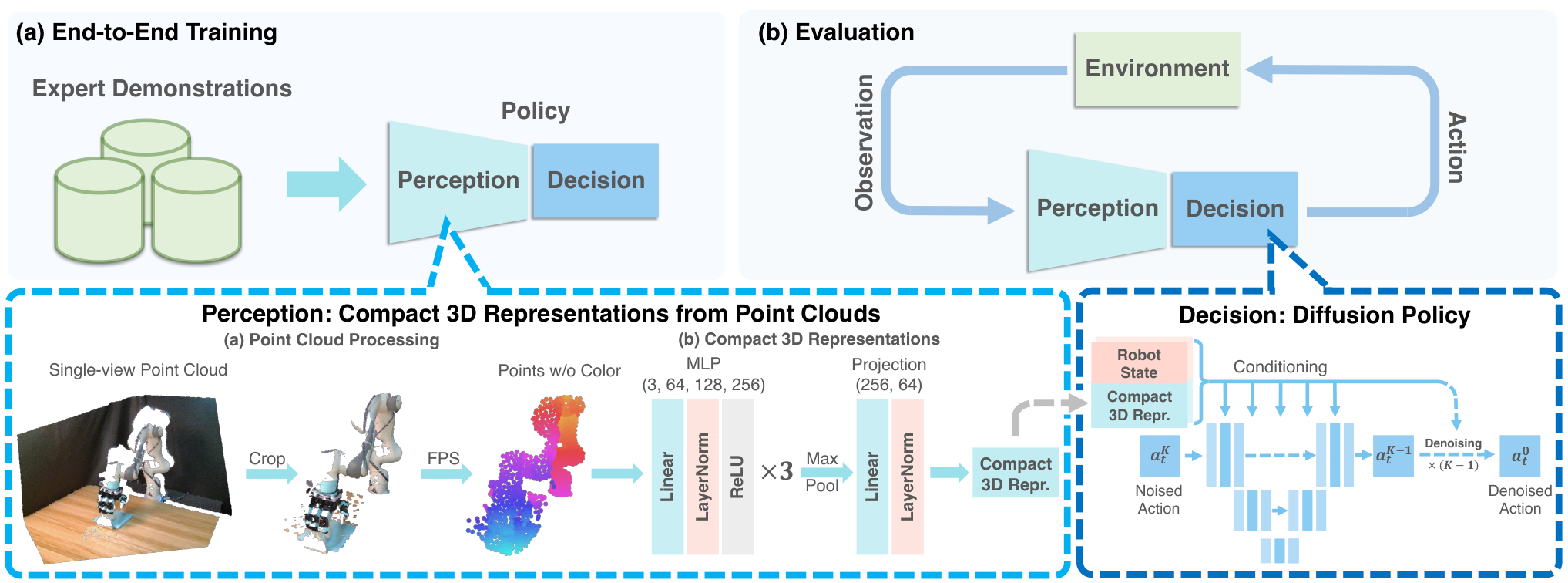
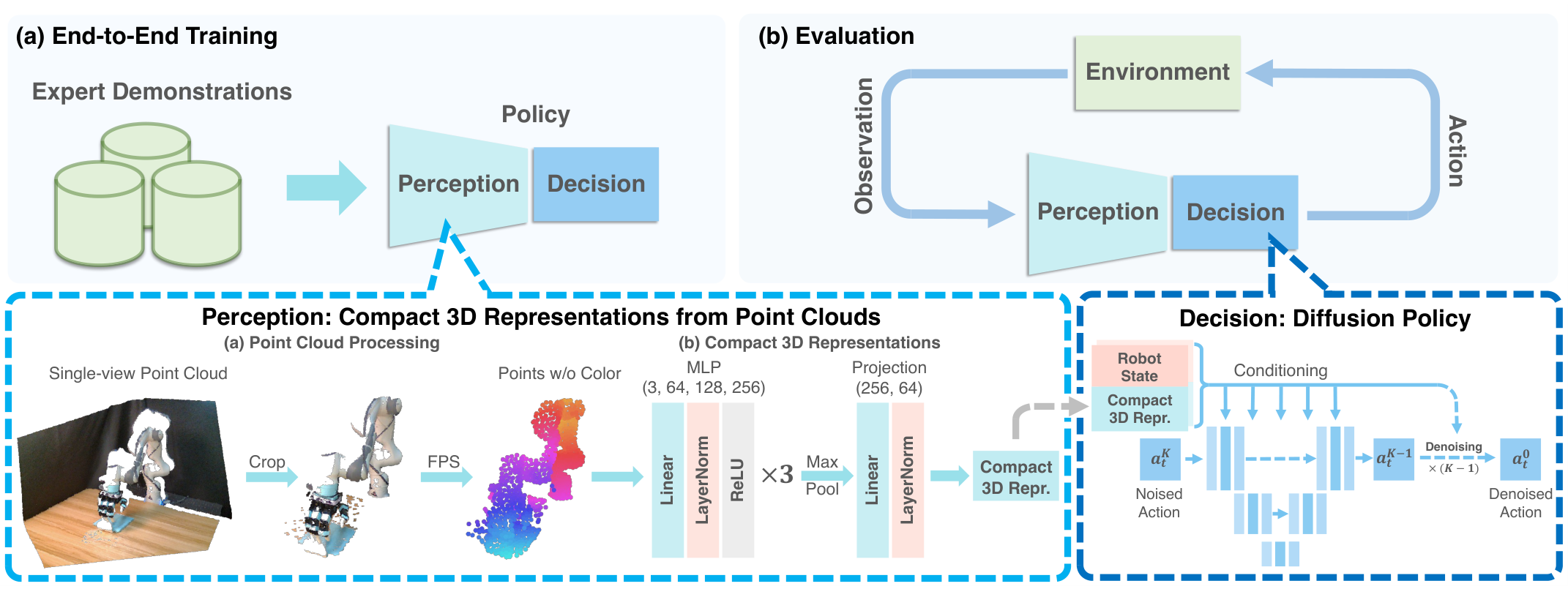
Original caption: Fig. 2: Overview of 3D Diffusion Policy (DP3). Above: In the training phase, DP3 simultaneously trains its perception module and decision-making process in an end-to-end manner using expert demonstrations. During evaluation, DP3 determines actions based on visual observations from the environment. Below: DP3 perceives its environment through single-view point clouds. These are transformed into compact 3D representations by a lightweight MLP encoder. Subsequently, DP3 generates actions conditioning on these 3D representations and the robot’s states, using a diffusion-based backbone.
中图 2:DP3 总览。上:训练阶段根据专家示范端到端联合训练感知与决策;评估时从环境视觉观测决定动作。下:单视角点云经轻量 MLP 编码为紧凑三维表示,再与机器人状态一起作为扩散骨干的条件,生成动作。
高清 PDF 裁图: 原文 p.4,bbox=[49, 53, 563, 246],300 DPI。
SOURCE p.3 · S3.SS1
III-A 一个启发性示例
ENIII-A A Motivating Example
SOURCE p.3 · S3.SS1.p1
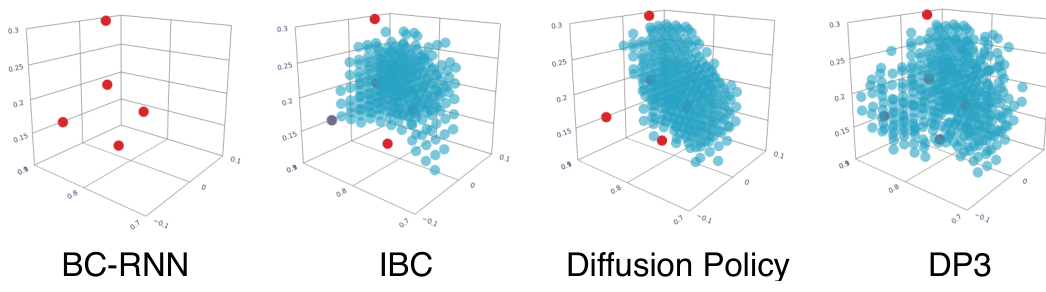
ENTo better illustrate the generalization ability of DP3, we first give a straightforward example. We use the MetaWorld Reach task [ 77 ] as our testbed. In this task, the goal is for the gripper to accurately reach a designated target point. To evaluate the effectiveness of imitation learning algorithms in not only fitting training data but also generalizing to new scenarios, we visualize the
∙ training points and the
∙ successful evaluation points in 3D space, as shown in Figure 3 . We observe that with merely five training points, DP3 reaches points distributed over the 3D space, while for 2D-based methods, Diffusion Policy [ 10 ] and IBC [ 11 ] learn to reach within a plane-like area, and BCRNN [ 35 ] fails to cover the space. This example demonstrates the superior generalization and efficiency of DP3, particularly in scenarios where available data is limited.
中先用 MetaWorld Reach [77] 说明泛化能力:夹爪需要准确到达指定目标点。为检验不仅拟合训练点、也能泛化到新场景,图 3 可视化三维空间中的
∙ 训练点与
∙ 成功测试点。仅 5 个训练点,DP3 即能到达分布在三维空间的目标;二维 Diffusion Policy [10] 与 IBC [11] 主要局限于近似平面区域,BCRNN [35] 无法覆盖空间。该例说明 DP3 在数据有限时的泛化与效率优势。
SOURCE p.4 · S3.F3
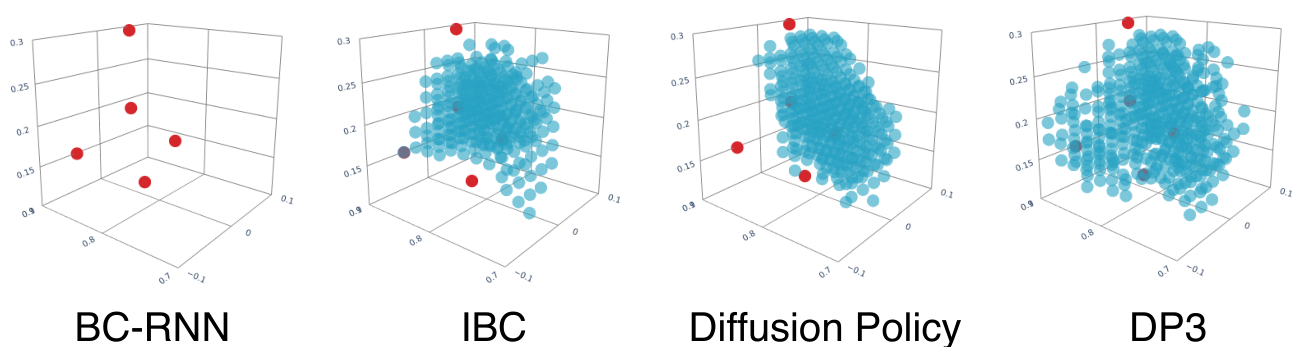
Original caption: Fig. 3: Generalization in 3D space with few data. We use MetaWorld Reach as an example task, given only 5 demonstrations (visualized by ∙ ). We evaluate 1000 times to cover the 3D space and visualize the ∙ successful evaluation points. DP3 learns the generalizable skill in 3D space; Diffusion Policy and IBC [ 11 ] only succeed in partial space; BC-RNN [ 35 ] fails to learn such a simple skill with limited data. Number of successful trials from left to right: 0 / 285 / 327 / 415 .
中图 3:少数据下的三维空间泛化。MetaWorld Reach 仅用 5 条示范(
∙),评估 1000 次覆盖空间,画出
∙ 成功点。DP3 学到三维可泛化技能;Diffusion Policy、IBC [11] 仅在部分空间成功,BC-RNN [35] 在有限数据下连这一简单技能也未学会。由左到右成功次数为
0 /
285 /
327 /
415。
高清 PDF 裁图: 原文 p.4,bbox=[49, 487, 300, 557],300 DPI。
SOURCE p.3 · S3.SS2
III-B 感知
SOURCE p.3 · S3.SS2.p1
ENWe now detail the perception module in DP3. DP3 focuses on only utilizing a single-view camera for policy learning for all the tasks, which is different from previous works [ 10 , 18 ] that set up multiple cameras around robots. This is primarily chosen for its practical applicability in real-world tasks.
中DP3 的所有任务都仅使用单视角相机,不同于围绕机器人布置多相机的既有工作 [10,18],主要出于真实任务的实用性。
SOURCE p.3 · S3.SS2.p2
ENRepresenting 3D scenes with point clouds. The 3D scene could be represented in different ways, such as RGB-D images, point clouds, voxels [ 7 ] , implicit functions [ 36 ] , and 3D gaussians [ 29 ] . Among them, DP3 uses sparse point clouds as the 3D representation. As evidenced in our ablations (see Table IV ), point clouds are found to be more efficient compared to other explicit representations, such as RGB-D, depth, and voxels.
中点云表示三维场景。三维场景可表示为 RGB-D、点云、体素 [7]、隐式函数 [36]、三维高斯 [29] 等。DP3 采用稀疏点云;表 IV 消融表明,相比 RGB-D、深度图、体素等显式表示,它更高效。
SOURCE p.3 · S3.SS2.p3
ENFor both simulation and the real world, we obtain depth images with size
84×84 from a single camera. We then convert depth into point clouds with camera extrinsics and intrinsics. We do not use color channels for better appearance generalization.
中仿真与真实环境均从单相机取得
84×84 深度图,再用相机内外参转换为点云。为更好地泛化外观,不使用颜色通道。
SOURCE p.4 · S3.T1
Original table: 原表全部数值和英文专名按下方表保留;表头、通用动作描述提供中文对照。
Original caption: TABLE I: Main simulation results. Averaged over 72 tasks, DP3 achieves 24.2% relative improvement compared to Diffusion Policy, with a smaller variance. Success rates for individual tasks are in Appendix -C .
中表 I:仿真主要结果。72 项任务平均,DP3 相比 Diffusion Policy 相对提高
24.2%,且方差更小。逐任务成功率见附录 C。
SOURCE p.4 · S3.T2
Original table: 原表全部数值和英文专名按下方表保留;表头、通用动作描述提供中文对照。
Original caption: TABLE II: Comparing DP3 with more baselines in simulation. We include IBC, BCRNN, and their 3D variants, termed as IBC+3D and BCRNN+3D. The 3D variants use our DP3 Encoder for a fair comparison.
中表 II:更多仿真基线,包括 IBC、BCRNN 及 IBC+3D、BCRNN+3D。为公平比较,三维版本均用 DP3 Encoder。
SOURCE p.3 · S3.SS2.p4
ENPoint cloud processing. Since the point clouds converted from depth may contain redundant points, such as points from the table and the ground, we crop out these points and only leave points within a bounding box.
中点云处理。深度转换的点云可能包含桌面、地面等冗余点,我们裁剪,仅保留边界框内的点。
SOURCE p.3 · S3.SS2.p5
ENWe further downsample points by farthest point sampling (FPS, [ 42 ] ), which helps cover the 3D space sufficiently and reduces the randomness of point cloud sampling, compared to uniform sampling. In practice, we find downsampling
512 or
1024 points is sufficient for all the tasks in both simulation and the real world.
中进一步采用最远点采样 FPS [42] 下采样。相比均匀采样,它更充分覆盖三维空间、降低随机性。实践中,仿真与真实任务下采样到
512 或
1024 个点已足够。
SOURCE p.3 · S3.SS2.p6
ENEncoding point clouds into compact representations. We then encode point clouds into compact 3D representations with a lightweight MLP network, as shown in Figure 2 . The network, termed as DP3 Encoder , is conceptually simple: it consists of a three-layer MLP, a max-pooling function as an order-equivariant operation to pool point cloud features, and a projection head to project the features into a compact vector. LayerNorm layers are interleaved to stabilize training [ 22 ] . The final 3D feature, denoted as
v , is only
64 dimension. As shown in our ablation studies (see Table V ), this simple encoder could even outperform pre-trained point encoders such as PointNeXt [ 46 ] , aligning with observations from [ 20 ] , where a properly designed small encoder is better than pre-trained large encoders in visuomotor control tasks.
中紧凑编码。点云经轻量 MLP 转为紧凑三维表示(图 2)。DP3 Encoder 由三层 MLP、用于汇聚点特征的最大池化和投影头组成,层间插入 LayerNorm 稳定训练 [22]。最终特征
v 仅
64 维。原文称池化为“order-equivariant”;就最终集合特征而言,最大池化对点排列不变。表 V 显示,这一简单编码器甚至优于预训练 PointNeXt [46],与 [20] 的观察一致:视觉运动控制中,适当设计的小编码器可能优于预训练大编码器。
SOURCE p.3 · S3.SS3
III-C 决策
SOURCE p.3 · S3.SS3.p1
ENConditional action generation. The decision module in DP3 is formulated as a conditional denoising diffusion model [ 23 , 10 , 39 ] that conditions on 3D visual features
v and robot poses
q , then denoises a random Gaussian noise into actions
a . Specifically, starting from a Gaussian noise
aK , the denoising network
ϵθ performs
K iterations to gradually denoise a random noise
aK into the noise-free action
a0 ,
ak−1=αk(ak−γkϵθ(ak,k,v,q))+σkN(0,I), (1) where
N(0,I) is Gaussian noise,
αk ,
γk , and
σk are functions of
k and depend on the noise scheduler. This process is also called the reverse process [ 23 ] .
中条件动作生成。DP3 决策模块是条件去噪扩散模型 [23,10,39],以三维特征
v 与机器人位姿
q 为条件,将高斯噪声去噪成动作
a。从
aK 开始,去噪网络
ϵθ 迭代
K 次,逐渐把随机噪声
aK 变为无噪动作
a0:
ak−1=αk(ak−γkϵθ(ak,k,v,q))+σkN(0,I),(1)。其中
N(0,I) 为高斯噪声,
αk、
γk、
σk 为依赖噪声调度器的
k 的函数。这也称反向过程 [23]。
SOURCE p.3 · S3.SS3.p2
ENTraining objective. To train the denoising network
ϵθ , we randomly sample a data point
a0 from the dataset and do a diffusion process [ 23 ] on the data point to get the noise at
k iteration
ϵk . The training objective is to predict the noise added to the original data,
L=MSE(ϵk,ϵθ(αkˉa0+βkˉϵk,k,v,q)), (2) where
αkˉ and
βkˉ are noise schedule that performs one step noise adding [ 23 ] .
中训练目标。训练去噪网络
ϵθ 时,从数据集中随机取数据点
a0,施加扩散过程 [23] 得到第
k 次迭代的含噪数据
ϵk。目标是预测加入原始数据的噪声:
L=MSE(ϵk,ϵθ(αkˉa0+βkˉϵk,k,v,q)),(2)。其中
αkˉ、
βkˉ 为一次加噪的噪声调度 [23]。实现采用样本预测,见下一段;本段保留原文通用噪声预测表述。
SOURCE p.4 · S3.SS3.p3
ENImplementation details. We use the convolutional network-based diffusion policy [ 10 ] . We use DDIM [ 62 ] as the noise scheduler and use sample prediction instead of epsilon prediction for better high-dimensional action generation, with 100 timesteps at training and 10 timesteps at inference. We train 1000 epochs for MetaWorld tasks due to its simplicity and 3000 epochs for other simulated and real-world tasks, with batch size 128 for DP3 and all the baselines.
中实现细节。采用卷积网络扩散策略 [10] 和 DDIM [62] 调度器。为更好生成高维动作,用样本预测替代 epsilon 预测;训练 100 步、推理 10 步。MetaWorld 较简单,训练 1000 个 epoch;其余仿真和真实任务训练 3000 个 epoch。DP3 和所有基线 batch 均为 128。
SOURCE p.4 · S4
IV 仿真实验
ENIV Simulation Experiments
SOURCE p.4 · S4.SS1
IV-A 实验设置
SOURCE p.4 · S4.SS1.p1
ENSimulation benchmark. Though the simulation environments are increasingly realistic nowadays [ 34 , 73 , 65 , 85 ] , a notable gap between simulation and real-world scenarios persists [ 80 , 30 , 7 ] . This discrepancy underscores two key aspects: (a) the importance of real robot experiments and (b) the necessity of large-scale diverse simulation tasks for more scientific benchmarking. Therefore, for simulation experiments, we collect in total 72 tasks from 7 domains, covering diverse robotic skills. These tasks range from challenging scenarios like bi-manual manipulation [ 8 ] , deformable object manipulation [ 31 ] , and articulated object manipulation [ 5 ] , to simpler tasks like parallel gripper manipulation [ 77 ] . These tasks are built with different simulators including MuJoCo [ 65 ] , Sapien [ 73 ] , IsaacGym [ 34 ] , and PlasticineLab [ 26 ] , ensuring our benchmarking is not limited by the choice of simulator. Tasks in MetaWorld [ 77 ] are categorized into various difficulty levels based on [ 55 ] . A brief overview is shown in Table III . The 3D observations are visualized in Figure 4 .
中仿真基准。尽管仿真日趋逼真 [34,73,65,85],与真实环境仍有明显差距 [80,30,7],这强调了真实实验的重要性,也要求大规模多样仿真任务以进行更科学比较。我们收集 7 个领域共 72 项任务,覆盖双手操作 [8]、可变形物体 [31]、铰接物体 [5] 等困难任务,也包括平行夹爪操作 [77]。任务基于 MuJoCo [65]、Sapien [73]、IsaacGym [34]、PlasticineLab [26],避免基准受制于单一仿真器。MetaWorld 按 [55] 分难度。概览见表 III,三维观测见图 4。
SOURCE p.5 · S4.F4
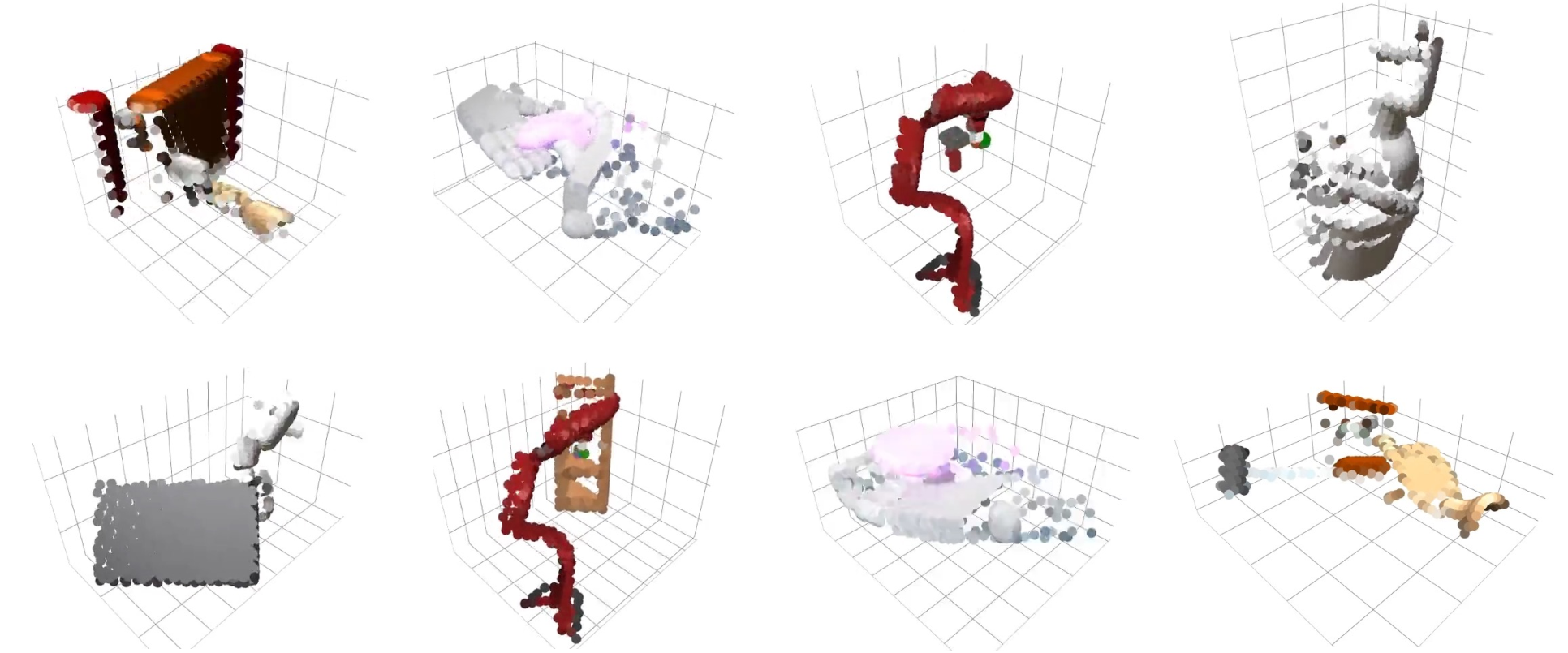
Original caption: Fig. 4: 3D visual observations in simulation. We sample some simulated tasks and show the downsampled point clouds in these tasks.
中图 4:仿真中的三维视觉观测。选取若干任务,展示下采样点云。
SOURCE p.5 · S4.SS1.p2
ENExpert demonstrations. Human-teleoperated data is used in DexDeform; Script policies are used in MetaWorld; Trajectories for other domains are collected with agents trained by reinforcement learning (RL) algorithms, where we use VRL3 [ 67 ] is used for Adroit; PPO [ 53 ] is used in all other domains. We generate successful trajectories with RL agents and ensure all imitation learning algorithms are using the same demonstrations. The success rates for experts are given in Appendix -C .
中专家示范。DexDeform 使用人工遥操;MetaWorld 使用脚本策略;其他领域使用强化学习智能体:Adroit 用 VRL3 [67],其他用 PPO [53]。从智能体生成成功轨迹,确保各模仿算法使用相同示范。专家成功率见附录 C。
SOURCE p.5 · S4.SS1.p3
ENBaselines. The primary focus of this work is to underscore the significance of the 3D modality in diffusion policies. To this end, our main baseline is the image-based diffusion policy [ 10 ] , simply referred to as Diffusion Policy . Additionally, we incorporate comparisons with IBC [ 11 ] , BCRNN [ 35 ] , and their 3D variations. However, given that these algorithms showed limited effectiveness in our challenging tasks, we evaluate them on only 10 tasks (see Table II ). We emphasize that the image and depth resolution for all 2D and 3D methods are the same across all experiments, ensuring a fair comparison.
中基线。本文重点是三维模态在扩散策略中的意义,因此主要基线是图像扩散策略 [10],简称 Diffusion Policy。还比较 IBC [11]、BCRNN [35] 及其三维版本;它们在困难任务中效果有限,因此只评估 10 项(表 II)。所有二维和三维方法使用相同图像、深度分辨率,以保证公平。
SOURCE p.5 · S4.SS1.p4
ENEvaluation metric. We run 3 seeds for each experiment with seed number
0,1,2 . For each seed, we evaluate 20 episodes every 200 training epochs and then compute the average of the highest 5 success rates. We report the mean and std of success rates across 3 seeds.
中指标。每项实验运行 3 个种子
0,1,2。每种子每训练 200 个 epoch 评估 20 回合,取最高的 5 个成功率求平均,再报告 3 种子的均值和标准差。
SOURCE p.5 · S4.T3
Original table: 原表全部数值和英文专名按下方表保留;表头、通用动作描述提供中文对照。
| 仿真基准(72 项) |
| 领域 |
机器人 |
物体 |
仿真器 |
ActD |
任务数 |
示范数 |
| Adroit |
Shadow |
刚体/铰接 |
MuJoCo |
28 |
3 |
10 |
| Bi-DexHands |
Shadow |
刚体/铰接 |
IsaacGym |
52 |
6 |
10 |
| DexArt |
Allegro |
铰接 |
Sapien |
22 |
4 |
100 |
| DexDeform |
Shadow |
可变形 |
PlasticineLab |
52 |
6 |
10 |
| DexMV |
Shadow |
刚体/流体 |
Sapien |
30 |
2 |
10 |
| HORA |
Allegro |
刚体 |
IsaacGym |
16 |
1 |
100 |
| MetaWorld |
夹爪 |
刚体/铰接 |
MuJoCo |
4 |
50 |
10 |
Original caption: TABLE III: Task suite of DP3, including Adroit [ 49 ] , Bi-DexHands [ 8 ] , DexArt [ 5 ] , DexDeform [ 31 ] , DexMV [ 47 ] , HORA [ 44 ] , MetaWorld [ 77 ] , and our real robot tasks. ActD: the highest action dimension for the domain. #Demo: Number of expert demonstrations used for each task in the domain. Art: articulated objects. Deform: deformable objects.
中表 III:DP3 任务套件,包括 Adroit [49]、Bi-DexHands [8]、DexArt [5]、DexDeform [31]、DexMV [47]、HORA [44]、MetaWorld [77] 与自建真实任务。ActD 是领域最高动作维数;#Demo 是各任务专家示范数;Art 为铰接物体,Deform 为可变形物体。
SOURCE p.5 · S4.SS2
IV-B 效率与效果
ENIV-B Efficiency and Effectiveness
SOURCE p.5 · S4.SS2.p1
ENDP3 shows surprising efficiency across diverse tasks, mainly reflected in the following three perspectives: 1. High accuracy. Summarized results are in Figure 1 (a) and results for each domain are in Table I . We observe that DP3 achieves a success rate exceeding 90% in nearly 30 tasks, whereas Diffusion Policy does in fewer than 15 tasks. Additionally, DP3 did not record any task with a success rate below 10%, in contrast to Diffusion Policy, which had more than 10 tasks below 10%. Note that most of the tasks are only trained with 10 demonstrations. 2. Learning efficiency. While we train all the algorithms for 3000 epochs to guarantee convergence, we observe that DP3 typically reaches convergence within approximately 500 epochs across all tasks, as illustrated in Figure 5 . In contrast, Diffusion Policy tends to converge at a much slower pace or converge into sub-optimal results. 3. Efficient scaling with demonstrations. As shown in Figure 6 , we find that in Adroit tasks, both DP3 and Diffusion Policy perform reasonably while DP3 achieves a comparable accuracy with fewer demonstrations. For some MetaWorld tasks above the easy level such as Assembly and Disassemble, DP3 could achieve higher accuracy when demonstrations are sufficient. This underscores that the 3D modality is not just beneficial but essential for certain manipulation tasks. 4. Competitive inference speed. As depicted in Figure 1 , DP3 achieves an inference speed marginally surpassing Diffusion Policy. Contrary to the prevailing assumption that 3D-based policies are slower [ 60 , 82 , 72 ] , DP3 manages to achieve efficient inference speeds, primarily attributed to the utilization of sparse point clouds and compact 3D representations.
中DP3 的高效性体现在以下方面(原文先称三个方面,实际列出四项)。(1)精度高:概览见图 1(a)、逐领域见表 I。近 30 项成功率超过 90%,Diffusion Policy 不到 15 项;DP3 无任务低于 10%,后者有 10 余项低于 10%。多数任务仅用 10 条示范。(2)学习效率:为保证收敛各算法训练 3000 epoch,但 DP3 通常约 500 epoch 已收敛(图 5),二维策略更慢或收敛到次优。(3)示范扩展:Adroit 中两者均有效,DP3 用更少示范达到相近精度。Assembly、Disassemble 等高于简单等级的 MetaWorld 任务,在示范充分时 DP3 更精确,说明三维模态对某些任务可能是必要的。(4)推理有竞争力:图 1 中 DP3 略快于二维策略。与三维策略较慢的通常看法 [60,82,72] 相反,稀疏点云与紧凑表示让它实现高效推理。
SOURCE p.6 · S4.F5
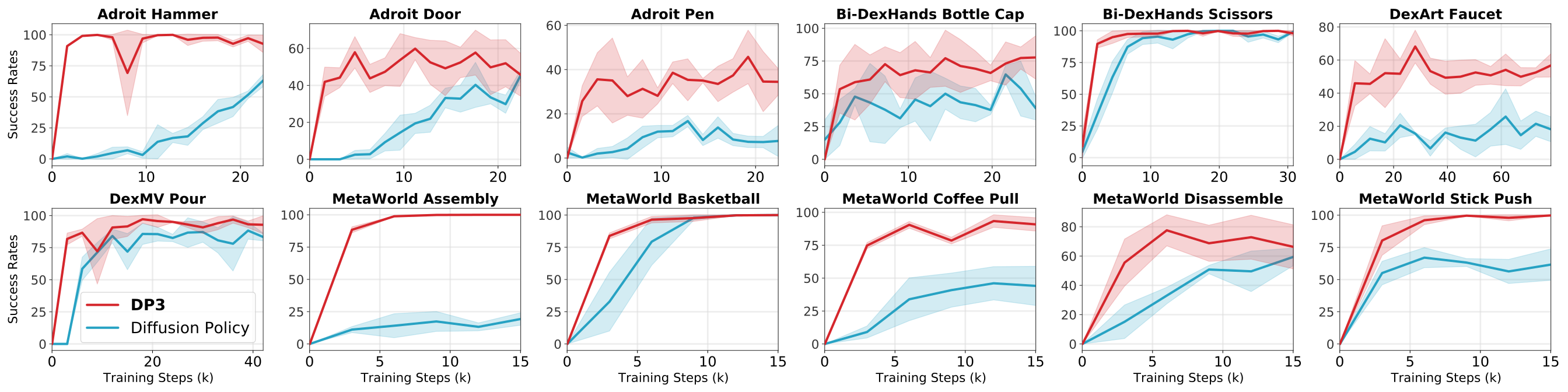
Original caption: Fig. 5: Learning efficiency. We sample 12 simulation tasks and show the learning curves of DP3 and Diffusion Policy. DP3 demonstrates a rapid convergence towards high accuracy. In contrast, Diffusion Policy exhibits a slower learning progress and achieves notably lower convergence in most tasks.
中图 5:学习效率。选取 12 项仿真任务展示学习曲线,DP3 快速收敛到高精度,Diffusion Policy 学习较慢,多数任务最终精度明显较低。
SOURCE p.6 · S4.F6
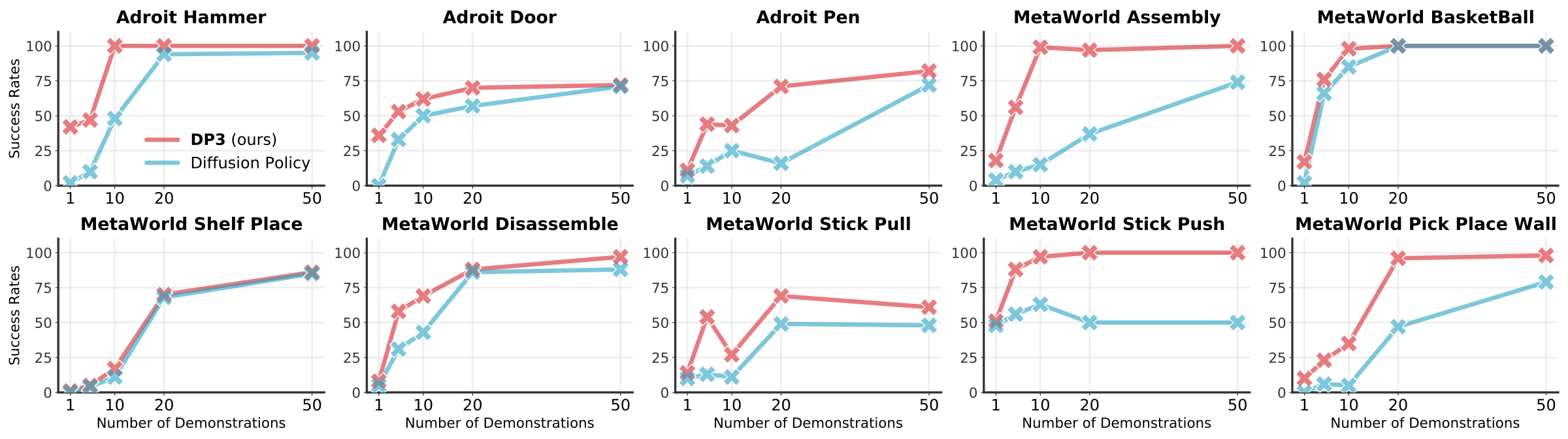
Original caption: Fig. 6: Efficient scaling with demonstrations. We sample 10 simulation tasks and train DP3 and Diffusion Policy with an increasing number of demonstrations. DP3 addresses all these tasks well and generally improves the accuracy with more demonstrations. Diffusion Policy also scales well on some tasks while still falling short of accuracy.
中图 6:随示范数高效扩展。在 10 项仿真任务中增加示范数训练。DP3 均能良好完成,通常示范越多精度越高;Diffusion Policy 在部分任务也能扩展,但精度仍不足。
SOURCE p.5 · S4.SS3
IV-C 消融
SOURCE p.5 · S4.SS3.p1
ENWe select 6 tasks to conduct more ablation studies: Hammer ( H ), Door ( D ), Pen ( P ) from Adroit and Assembly ( A ), Disassemble ( DA ), Stick-Push ( SP ) from MetaWorld. These tasks include both high-dimensional and low-dimensional control tasks, and each task only uses 10 demonstrations. We use the abbreviations of these tasks in the tables for simplicity.
中选取 6 项任务:Adroit 的 Hammer(H)、Door(D)、Pen(P),以及 MetaWorld 的 Assembly(A)、Disassemble(DA)、Stick-Push(SP),覆盖高低维控制,每项仅用 10 条示范。表格用这些缩写。
SOURCE p.6 · S4.SS3.p2
ENChoice of 3D representations. In DP3, we deliberately select point clouds to represent the 3D scene. To compare different choices of 3D representations, we implement other 3D representations, including RGB-D, depth, and voxel. We also compare with oracle states, which include object states, target goals, and robot velocity besides robot poses. The RGB-D and depth images are processed using the same image encoder as Diffusion Policy, while voxel representations employ the VoxelCNN, as implemented in [ 7 ] . As demonstrated in Table IV , these alternative 3D representations fall short of DP3. We note that RGB-D and depth images are close and not comparable to point clouds, indicating that the proper usage of depth information is essential. Additionally, we observe that point clouds and oracle states are very competitive, showing that point clouds might help learn an optimal policy from demonstrations.
中三维表示选择。我们比较 RGB-D、深度、体素,以及除机器人位姿外包含物体状态、目标和机器人速度的真值状态。RGB-D、深度图用与 Diffusion Policy 相同的图像编码器;体素用 [7] 的 VoxelCNN。表 IV 显示这些表示均逊于 DP3。RGB-D 与深度图相近,但都不及点云,说明正确使用深度信息很重要。点云与真值状态竞争力相当,提示点云可能帮助从示范学到最优策略。
SOURCE p.6 · S4.T4
Original table: 原表全部数值和英文专名按下方表保留;表头、通用动作描述提供中文对照。
Original caption: TABLE IV: Ablation on 3D representations. We replace the visual observation and the corresponding encoder in DP3 to evaluate different 3D representations.
中表 IV:三维表示消融。替换 DP3 的视觉输入和对应编码器,评估不同三维表示。
SOURCE p.6 · S4.SS3.p3
ENChoice of point cloud encoders. We compare DP3 Encoder with other widely used point encoders, including PointNet [ 42 ] , PointNet++ [ 43 ] , PointNeXt [ 46 ] , and Point Transformer [ 84 ] . We also include the pre-trained models of PointNet++ and PointNeXt. Surprisingly, we find that none of these complex models and the pre-trained ones are competitive to DP3 Encoder, as shown in Table V .
中点编码器选择。比较 DP3 Encoder 与 PointNet [42]、PointNet++ [43]、PointNeXt [46]、Point Transformer [84],也纳入预训练 PointNet++、PointNeXt。表 V 中,这些复杂及预训练模型均不及 DP3 Encoder。
SOURCE p.6 · S4.T5
Original table: 原表全部数值和英文专名按下方表保留;表头、通用动作描述提供中文对照。
Original caption: TABLE V: Ablation on point cloud encoders. We replace DP3 Encoder with other widely used encoders, including PointNet [ 42 ] , PointNet++ [ 43 ] , PointNeXt [ 46 ] , and Point Transformer [ 84 ] . We also include the pre-trained encoders.
中表 V:点云编码器消融。替换 DP3 Encoder 为常见点编码器,并包括预训练版本。
SOURCE p.6 · S4.SS3.p4
ENGradually modifying a PointNet. To elucidate the performance disparity between DP3 Encoder and a commonly used point cloud encoder, e.g. , PointNet, we gradually modify a PointNet to make it aligned with a DP3 Encoder. Through extensive experiments shown in Table VI , we identify that the T-Net and BatchNorm layers in PointNet are primary inhibitors to its efficiency. By omitting these two elements, PointNet attains an average success rate of
72.3 , competitive to
78.3 achieved by our DP3 Encoder.One plausible explanation for the T-Net is that our control tasks use the fixed camera and do not require feature transformations from the T-Net. Further replacing high-dimensional features with a lower-dimensional one would not hurt the performance much (
72.5→72.3 ) but increase the speed. We would explore the reason for the failures of other encoders in the future.
中逐步修改 PointNet。为解释性能差异,逐步把 PointNet 改为 DP3 风格。表 VI 显示,T-Net 和 BatchNorm 是效率的主要阻碍。去掉二者后平均成功率
72.3,已可媲美 DP3 Encoder 的
78.3。一个可能解释是,控制任务使用固定相机,不需 T-Net 的特征变换。再降低高维特征维数,几乎不损性能(
72.5→72.3),却提高速度。其他编码器失败原因留待未来。
SOURCE p.7 · S4.T6
Original table: 原表全部数值和英文专名按下方表保留;表头、通用动作描述提供中文对照。
Original caption: TABLE VI: Gradually modifying a PointNet to a DP3-style encoder. Conv: use convolutional layers or linear layers. w/ T-Net: with or without T-Net. w/ BN: with or without BacthNorm layers. 1024 Dim: set feature dimensions before the projection layer to be 1024 or 256. Average success rates for 6 ablation tasks are reported.
中表 VI:逐步将 PointNet 改为 DP3 风格。Conv:卷积层或线性层;w/ T-Net、w/ BN:是否使用 T-Net、BatchNorm;1024 Dim:投影前特征为 1024 还是 256 维。报告 6 项消融任务平均成功率。
SOURCE p.7 · S4.SS3.p5
ENDesign choices in DP3. Besides the 3D representations, the effectiveness of DP3 is contributed by several small design choices, as shown in Table VII . (a) Cropping point clouds helps largely improve accuracy; (b) Incorporating LayerNorm layers could help stabilize training across different tasks [ 22 , 4 ] ; (c) Sample prediction in the noise sampler brings faster convergence, also shown in Figure 7 ; (d) The projection head in DP3 Encoder accelerates the inference by projecting features to the lower dimension, without hurting accuracy; (e) Removing color channels ensures robust appearance generalization; (f) In low-dimensional control tasks, DPM-solver++ [ 32 ] as the noise sampler is competitive to DDIM, while DPM-solver++ could not handle high-dimensional control tasks well.
中设计选择。除三维表示外,表 VII 的细节也贡献效果:(a)裁剪点云显著提高精度;(b)LayerNorm 有助于跨任务稳定训练 [22,4];(c)采样器采用样本预测收敛更快(图 7);(d)投影头降维加速,不损精度;(e)去掉颜色保证稳健外观泛化;(f)低维控制中 DPM-solver++ [32] 与 DDIM 相当,但前者难以处理高维控制。
SOURCE p.7 · S4.F7
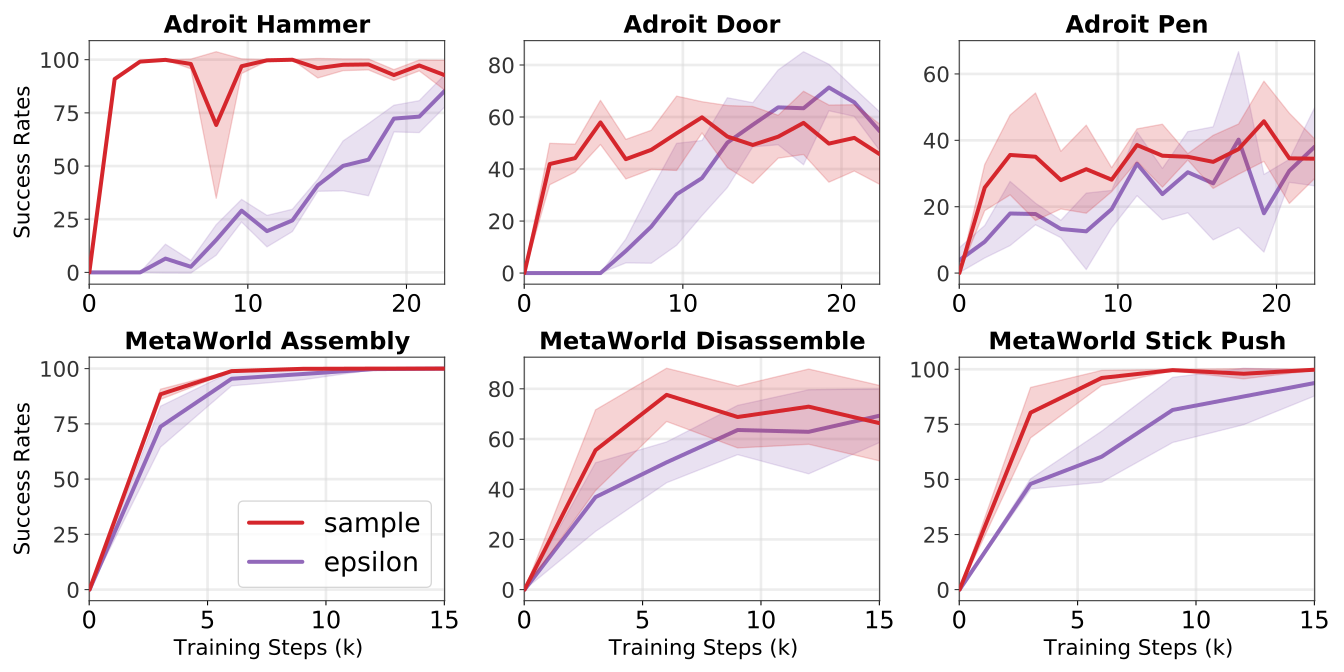
Original caption: Fig. 7: Learning curves of DP3 with sample prediction and epsilon prediction. With sample prediction, DP3 generally converges faster, while epsilon prediction is also competitive.
中图 7:样本预测与 epsilon 预测的学习曲线。样本预测通常收敛更快,但 epsilon 预测也有竞争力。
SOURCE p.7 · S4.T7
Original table: 原表全部数值和英文专名按下方表保留;表头、通用动作描述提供中文对照。
Original caption: TABLE VII: Ablation on design choices in DP3. Most of the design choices would not affect the accuracy but bring other benefits such as appearance generalization by removing color.
中表 VII:DP3 设计消融。多数选择不直接影响精度,却带来其他好处,如去颜色改善外观泛化。
SOURCE p.7 · S5
V 真实世界实验
ENV Real World Experiments
SOURCE p.7 · S5.SS1
V-A 实验设置
SOURCE p.7 · S5.SS1.p1
ENReal robot benchmark. DP3 is evaluated across 4 tasks on 2 different robots, including an Allegro hand and a gripper. We use one RealSense L515 camera to obtain real-world visual observations. All the tasks are visualized in Figure 10 and summarized in Table III . Our real-world setup and everyday objects used in our tasks are shown in Figure 8 . We now briefly describe our tasks:
中真实机器人基准。用 Allegro 手和夹爪两类机器人评估 4 项任务,通过一台 RealSense L515 获取视觉观测。任务见图 10、表 III,配置与日常物体见图 8。任务简述如下。
SOURCE p.7 · S5.F8
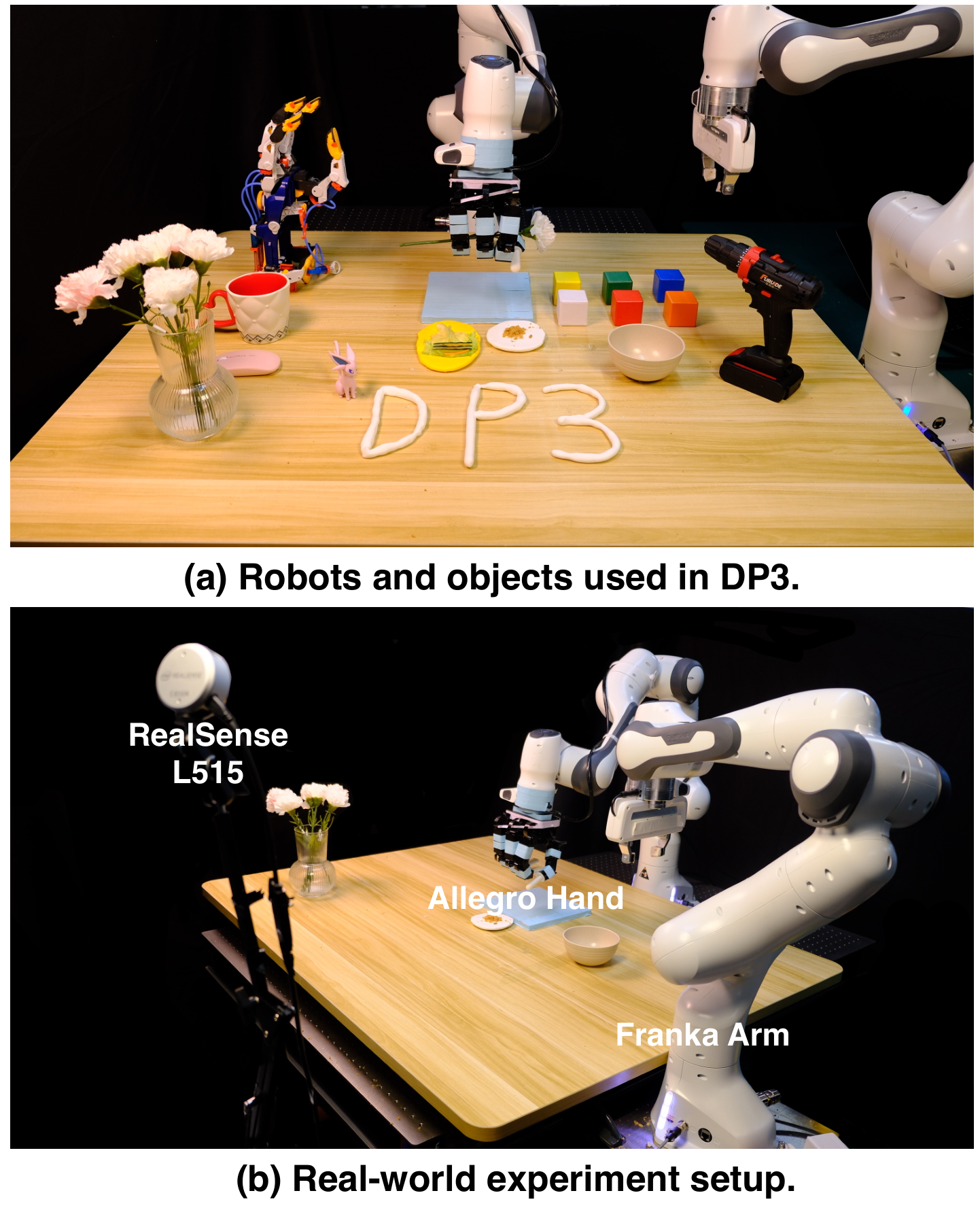
Original caption: Fig. 8: (a) Our robots and objects. (b) Our real-world experiment setup. We use an Allegro hand and a gripper based on Franka arms and include diverse everyday objects in our manipulation tasks. A RealSense L515 camera is applied to capture visual observations.
中图 8:(a)机器人与物体;(b)真实实验配置。Franka 机械臂安装 Allegro 手或夹爪,操作多种日常物体,RealSense L515 采集观测。
SOURCE p.9 · S5.F10
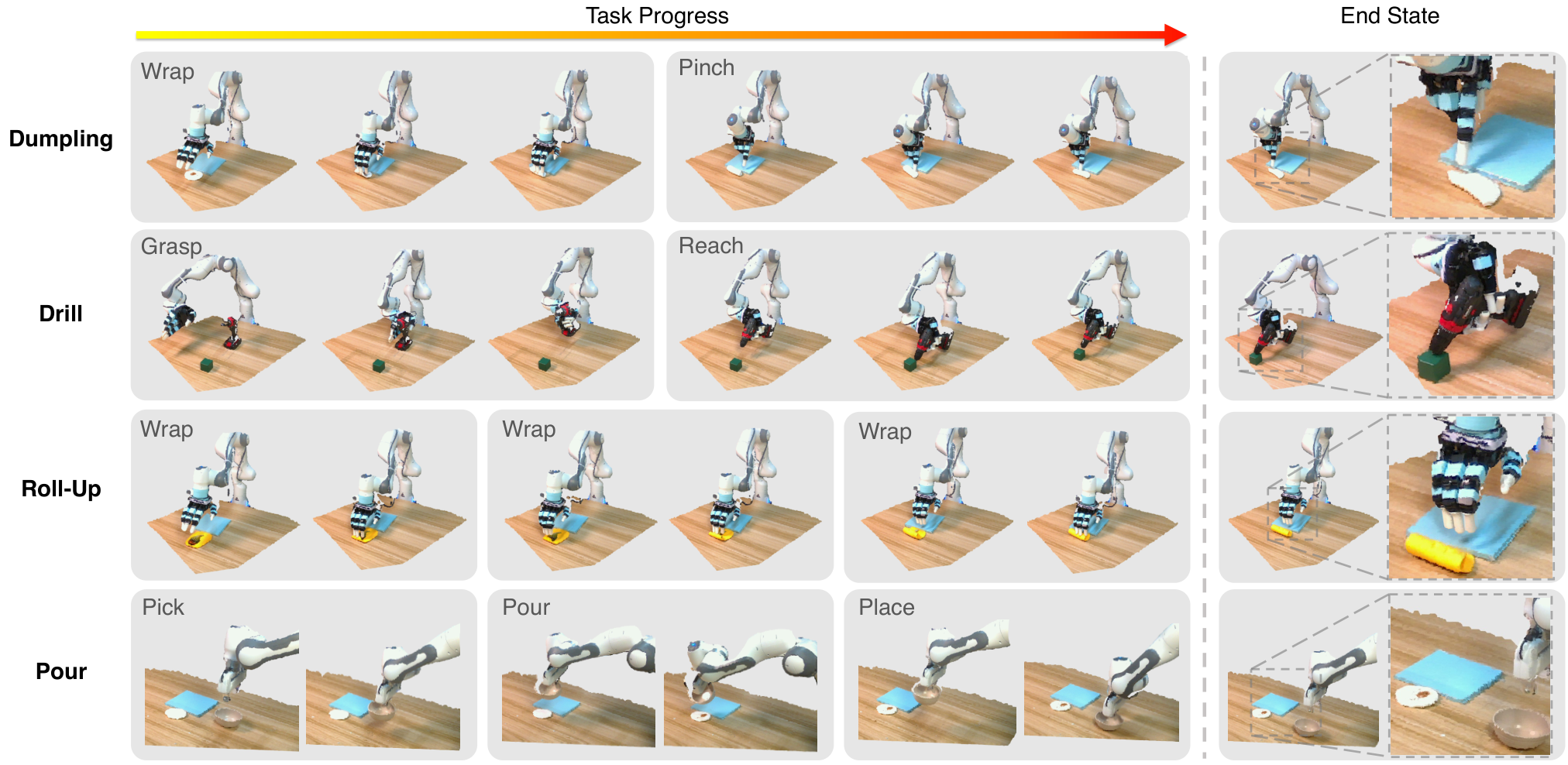
Original caption: Fig. 10: Our real robot benchmark consists of 4 challenging tasks. The Allegro hand is required to make a Dumpling , Drill the cube, and make a Roll-Up . The gripper is required to Pour dried meat floss in the bowl. Each task contains multiple stages. We visualize the point clouds of the collected trajectories.
中图 10:四项困难真实任务。Allegro 手完成包饺子、电钻触碰、卷起,夹爪完成倾倒肉松。每项均有多个阶段;图中展示采集轨迹的点云。
SOURCE p.7 · S5.SS1.p2
EN1. Roll-Up. The Allegro hand wraps the plasticine multiple times to make a roll-up. 2. Dumpling. The Allegro hand first wraps the plasticine and then pinchs it to make dumpling pleats. 3. Drill. The Allegro hand grasps the drill up and moves towards the green cube to touch the cube with the drill. 4. Pour. The gripper grasps the bowl, moves towards the plasticine, pours out the dried meat floss in the bowl, and places the bowl on the table. The randomization in each task is shown in Figure 9 . For Roll-Up and Dumpling, the plasticine’s shape and the appearance of the objects placed upon the plasticine are randomized. For Drill and Pour, the variations come from the random positions of the cube, drill, and bowl.
中1. Roll-Up(卷起):Allegro 多次包卷橡皮泥形成卷。2. Dumpling(包饺子):先包裹橡皮泥,再捏出褶。3. Drill(电钻触碰):抓起电钻,移向绿方块,用电钻碰方块。4. Pour(倾倒):夹爪抓碗,移向橡皮泥,将碗中干肉松倒出,再放回桌面。任务随机化见图 9:卷起与包饺子改变橡皮泥形状及上方物体外观;电钻与倾倒改变方块、电钻、碗的位置。
SOURCE p.8 · S5.F9
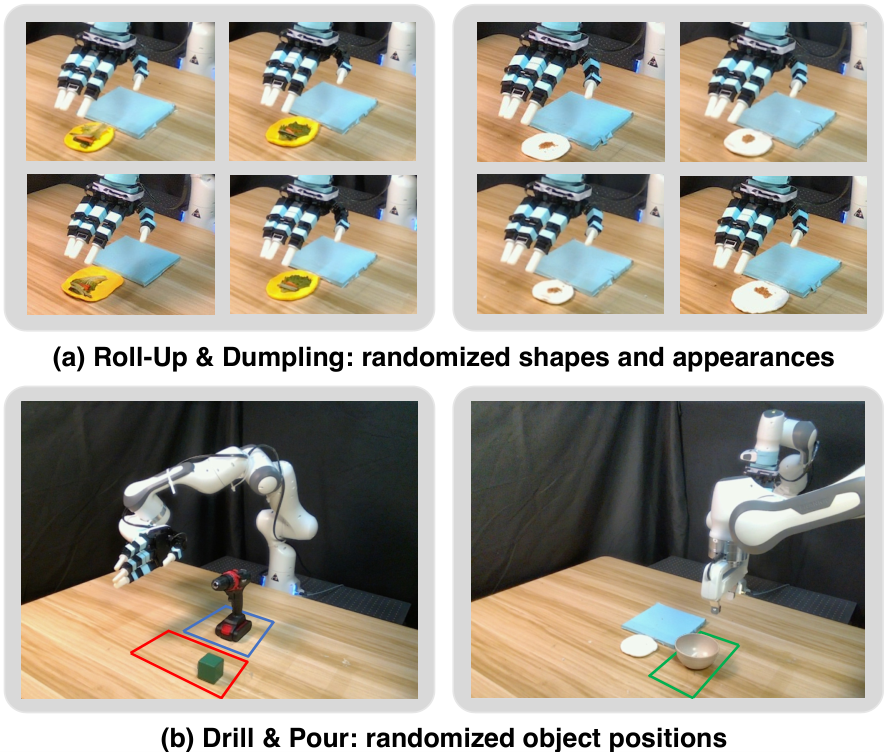
Original caption: Fig. 9: Randomization in collected demonstrations for real-world tasks. Roll-Up : The shape of the plasticine and the vegetables on it varies in each trajectory. Dumpling : The shape of the plasticine and the distribution of the meat floss on it are different in each trajectory. Drill : The red and blue rectangles respectively mark the range of positions where the cube and drill can be placed. Pour : The green rectangle marks the range of positions of the bowl.
中图 9:真实任务示范的随机化。卷起:每条轨迹橡皮泥形状及上方蔬菜不同;包饺子:橡皮泥形状与肉松分布不同;电钻:红、蓝框分别标出方块与电钻的位置范围;倾倒:绿框标出碗的位置范围。
SOURCE p.8 · S5.SS1.p3
ENNotably, our tasks using the multi-finger hand are carefully designed to show its advantage over the parallel gripper: In Roll-Up and Dumpling, robots could wrap plasticine without requiring extra tools, unlike RoboCook [ 59 ] ; In Drill, the drill in the real world is large and heavy, which is quite difficult for the gripper to grasp.
中多指手任务特意展示其相对平行夹爪的优势:卷起与包饺子无需 RoboCook [59] 那样的额外工具即可包裹橡皮泥;真实电钻又大又重,夹爪难以抓取。
SOURCE p.8 · S5.SS1.p4
ENExpert demonstrations are collected by human teleoperation. The Franka arm and the gripper are teleoperated by the keyboard. The Allegro hand is teleoperated with human hands by vision-based retargeting [ 48 , 17 ] . Since our tasks contain more than one stage and include complex multi-finger robots and deformable objects, making the process of demonstration collection very time-consuming, we only provide 40 demonstrations for each task.
中专家示范由人遥操采集:键盘控制 Franka 臂与夹爪,基于视觉重定向 [48,17] 用人手控制 Allegro。任务多阶段,涉及复杂多指机器人与可变形物体,采集很费时,因此每项仅提供 40 条示范。
SOURCE p.8 · S5.SS1.p5
ENBaselines. Based on our simulation experiments, image-based and depth-based diffusion policies are still powerful, thus we select them as baselines for real-world experiments. Different vision modalities are visualized in Figure 11 .
中基线。仿真显示图像、深度图扩散策略仍较强,因此选为真实实验基线。不同模态见图 11。
SOURCE p.9 · S5.F11
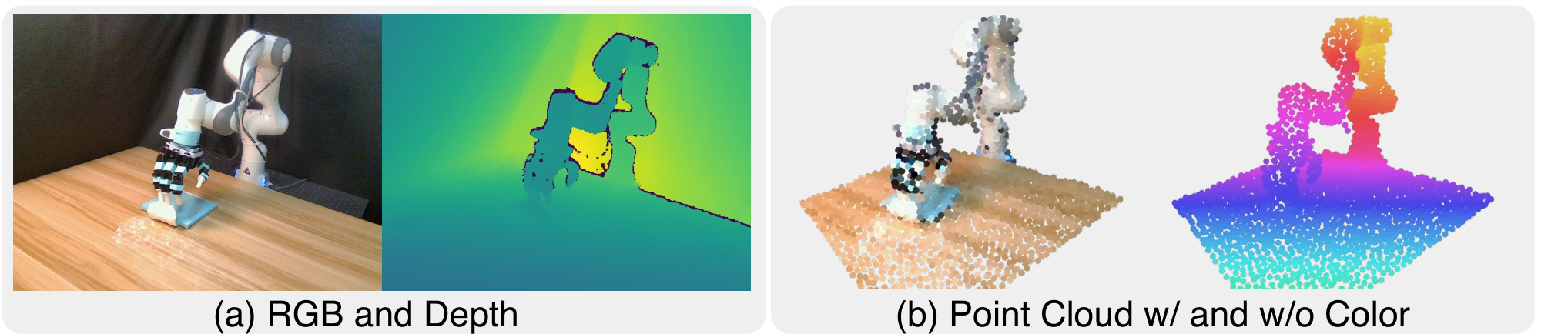
Original caption: Fig. 11: Different vision modalities in the real world, include images, depths, and point clouds.
中图 11:真实环境中的图像、深度图、点云视觉模态。
SOURCE p.8 · S5.SS2
V-B 效果
SOURCE p.8 · S5.SS2.p1
ENResults for our real robot tasks are given in Table VIII . Consistent with our simulation findings, we observe in real-world experiments that DP3 could handle all tasks with high success rates, given only 40 demonstrations. Interestingly, we also observe that while both image-based and depth-based diffusion policies have comparatively low average accuracies, they exhibit distinct strengths in specific tasks. For instance, the image-based diffusion policy excels in the Drill task but fails entirely in Roll-Up. In contrast, the depth-based policy achieves a notable success rate of
40% in Roll-Up.
中结果见表 VIII。与仿真一致,每项仅 40 条示范,DP3 仍能高成功率处理全部任务。图像与深度图策略虽平均精度较低,却各有强项:图像策略擅长电钻,却在卷起完全失败;深度策略在卷起达到
40% 成功率。
SOURCE p.8 · S5.T8
Original table: 原表全部数值和英文专名按下方表保留;表头、通用动作描述提供中文对照。
Original caption: TABLE VIII: Main results for real robot experiments. Each task is evaluated with 10 trials.
中表 VIII:真实机器人主要结果。每项任务评估 10 次。
SOURCE p.8 · S5.SS3
V-C 泛化
SOURCE p.8 · S5.SS3.p1
ENBesides the effectiveness in handling all tasks, DP3 show strong generalization abilities in the real world. We categorize the generalization abilities of DP3 into 4 aspects and detail each aspect as follows.
中除有效处理全部任务外,DP3 在真实环境展现强泛化,我们分为四方面逐项说明。
SOURCE p.8 · S5.SS3.p2
ENSpatial generalization. As illustrated in our motivating example, DP3 could better extrapolate in 3D space. We demonstrate this property in the real world, as shown in Table IX . We find that baselines fail to generalize to all test positions while DP3 succeed in 4 out of 5 trials.
中空间泛化。启发性示例显示 DP3 更能在三维空间外推;表 IX 在真实任务验证。所有基线均无法泛化至测试位置,而 DP3 五次中成功四次。
SOURCE p.8 · S5.T9
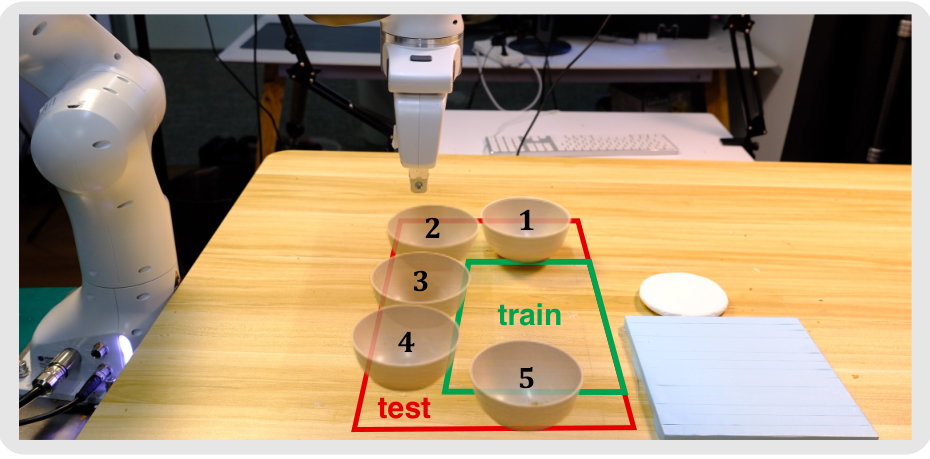
Original table: 原表全部数值和英文专名按下方表保留;表头、通用动作描述提供中文对照。
Original caption: TABLE IX: Spatial generalization on Pour. We place the bowl at 5 different positions that are unseen in the training data. Each position is evaluated with one trial.
中表 IX:倾倒任务空间泛化。将碗放在训练未见的 5 个位置,每位置评估 1 次。
SOURCE p.8 · S5.SS3.p3
ENAppearance generalization. DP3 is designed to process point clouds without color information, inherently enabling it to generalize across various appearances effectively. As demonstrated in Table X , DP3 consistently exhibits successful generalization to cubes of differing colors, while baseline methods could not achieve. It is noteworthy that the depth-based diffusion policy also does not incorporate color as input. However, due to its lower accuracy on the training object, the ability to generalize is also limited.
中外观泛化。DP3 不用颜色,因此自然有利于跨外观泛化。表 X 中,它对不同颜色方块持续泛化成功,基线未能做到。深度策略也无颜色,但在训练物体上精度较低,限制了泛化。
SOURCE p.8 · S5.SS3.p4
ENOne solution to improve the appearance generalization ability of image-based methods is applying strong data augmentation during training [ 20 , 19 ] , which however could impede the learning process [ 79 , 19 ] . More importantly, the primary objective of this work is to demonstrate that DP3, even without the aid of any data augmentation, can effectively generalize, thereby underscoring the potential of 3D representations in real robot learning.
中图像方法可用强数据增强改善外观泛化 [20,19],但可能妨碍学习 [79,19]。本文更重要的目标,是说明 DP3 即使不做任何数据增强,也能有效泛化,凸显三维表示的潜力。
SOURCE p.9 · S5.T10

Original table: 原表全部数值和英文专名按下方表保留;表头、通用动作描述提供中文对照。
Original caption: TABLE X: Appearance generalization on Drill. Algorithms are trained with the green cube only and evaluated on 5 different colored cubes. Each color is evaluated with one trial.
中表 X:电钻任务外观泛化。仅用绿方块训练,在 5 种颜色方块上各评估 1 次。
SOURCE p.8 · S5.SS3.p5
ENInstance generalization. Achieving generalization across diverse instances, which vary in shape, size, and appearance, presents a significantly greater challenge compared to mere appearance generalization. In Table XI , we demonstrate that DP3 effectively manages a wide range of everyday objects. This success can be primarily attributed to the inherent characteristics of point clouds. Specifically, the use of point clouds allows for policies that are less prone to confusion, particularly when these point clouds are downsampled. This feature significantly enhances the model’s ability to adapt to varied instances.
中实例泛化。跨形状、尺寸、外观不同实例,比单纯外观泛化更难。表 XI 中 DP3 可处理广泛日常物体,主要归因于点云的固有性质:特别经下采样后,策略不易混淆,从而提高适应不同实例的能力。
SOURCE p.9 · S5.T11
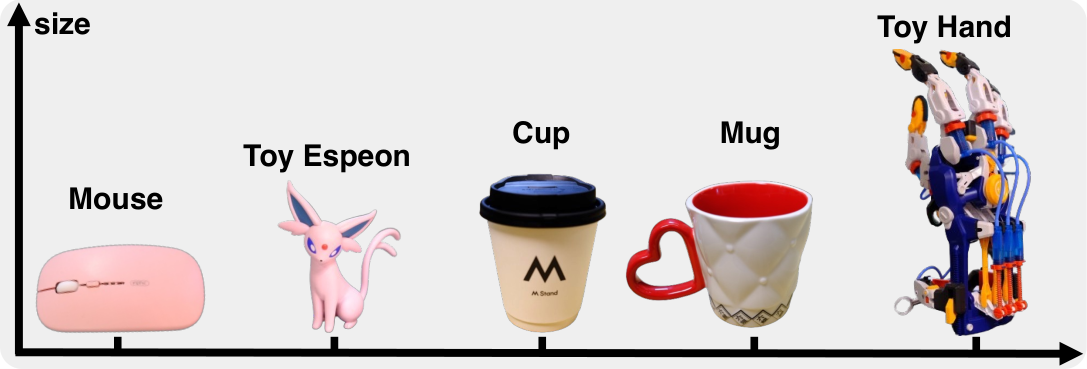
Original table: 原表全部数值和英文专名按下方表保留;表头、通用动作描述提供中文对照。
Original caption: TABLE XI: Instance generalization on Drill. We replace the cube used in Drill with five objects in varied sizes from our daily life. Each instance is evaluated with one trial.
中表 XI:电钻任务实例泛化。用日常生活中 5 种不同尺寸物体替换方块,每实例评估 1 次。
SOURCE p.9 · S5.SS3.p6
ENView generalization. Generalizing image-based methods across different views is notably challenging [ 75 ] , and acquiring training data from multiple views can be time-consuming and costly [ 82 , 58 ] . We demonstrate in Table XII that DP3 effectively addresses this generalization problem when the camera views are altered slightly. It is important to note that since the camera view is altered, we manually transform the point clouds and adjust the cropped space of the point clouds. Accurate transformation isn’t necessary due to the robustness of our network. However, it is crucial to acknowledge that while the network can generalize across minor variations in camera views, significant changes might be hard to handle.
中视角泛化。图像策略跨视角泛化很困难 [75],多视角采集又费时昂贵 [82,58]。表 XII 显示 DP3 能处理相机视角小幅改变。重要的是,视角变化后,我们手动变换点云并调整裁剪空间;网络稳健,因此不必精确变换。但它虽能泛化到小幅视角变化,显著变化仍可能困难。
SOURCE p.10 · S5.T12

Original table: 原表全部数值和英文专名按下方表保留;表头、通用动作描述提供中文对照。
Original caption: TABLE XII: View generalization on Roll-Up. Each view is evaluated with one trial.
中表 XII:卷起任务视角泛化。每视角评估 1 次。
SOURCE p.9 · S5.SS3.p7
ENCluttered Scenes . Despite the simplicity of the DP3 Encoder, we demonstrate that DP3 is capable of handling tasks in complex real-world cluttered environments. To illustrate this, we design a pick & place task (i.e. pick the cube and place it in the bowl) set in cluttered scenes using a gripper and collect 50 demonstrations for training. The results presented in Table XIII show that DP3 solves the task with a high success rate. Aligning with our simulation experiments, DP3 equipped with PointNeXt fails to address the task. Meanwhile, DP3 using color point clouds as input performs comparably to the original DP3 when picking the training yellow cube, yet it struggles with other colored cubes and diverse objects. This demonstrates the effectiveness and generalization ability of DP3 in complex scenes.
中杂乱场景。尽管编码器简单,DP3 也能处理复杂杂乱真实环境。我们设计夹爪抓方块并放碗中的任务,采集 50 条示范。表 XIII 中,DP3 高成功率完成;与仿真一致,换 PointNeXt 后失败。用彩色点云时,抓训练黄方块与原 DP3 相当,却难以处理其他颜色与物体,说明原 DP3 在复杂场景中的有效性与泛化。
SOURCE p.10 · S5.T13
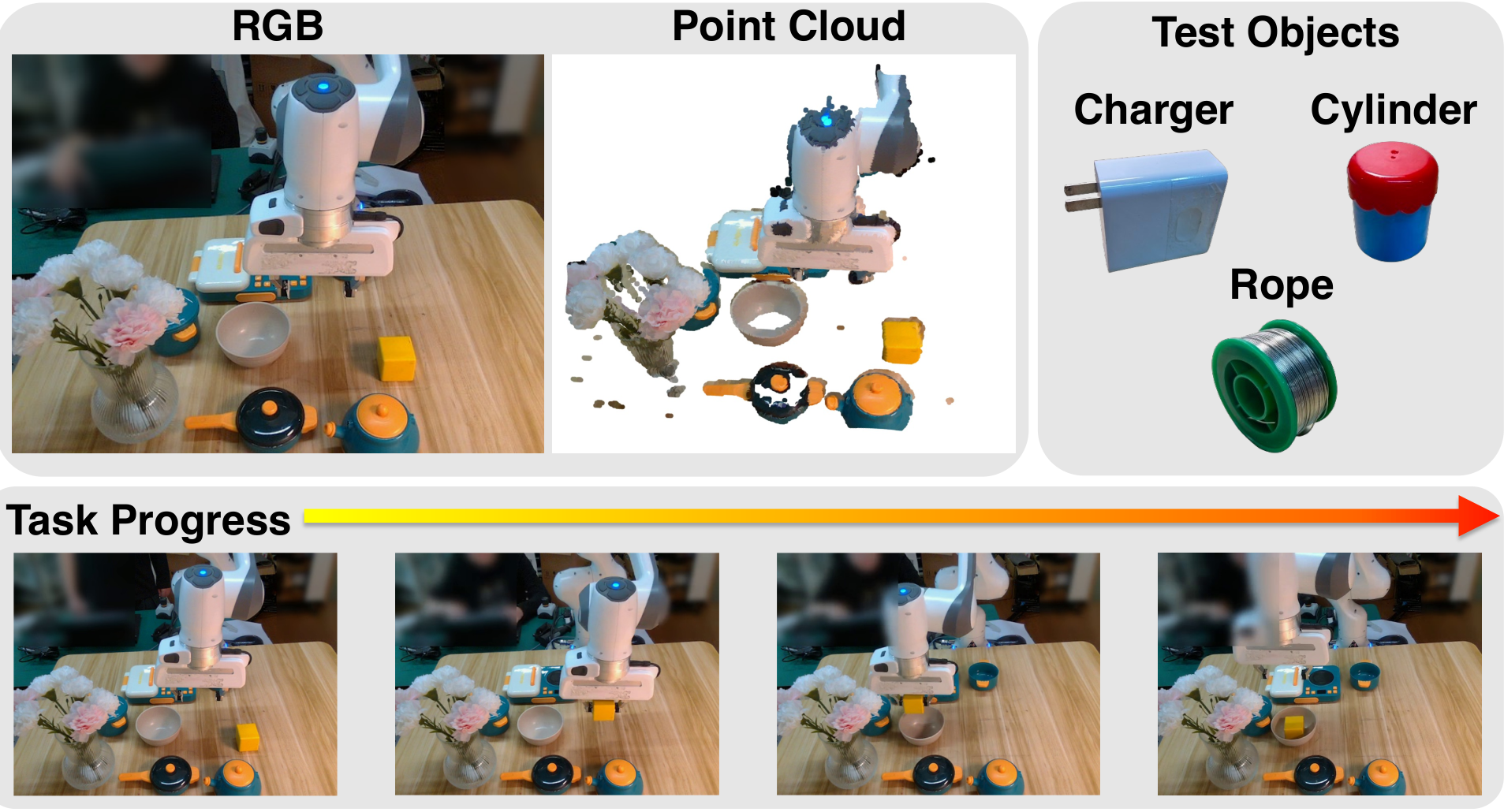
Original table: 原表全部数值和英文专名按下方表保留;表头、通用动作描述提供中文对照。
Original caption: TABLE XIII: Results in cluttered scenes. Each algorithm is evaluated with 10 trials in the training color. Each out-of-domain color and object are evaluated with one trial.
中表 XIII:杂乱场景结果。训练颜色每算法评估 10 次;每种域外颜色、物体各评估 1 次。
SOURCE p.10 · S5.SS4
V-D 部署安全观察
ENV-D Observation on Deployment Safety
SOURCE p.10 · S5.SS4.p1
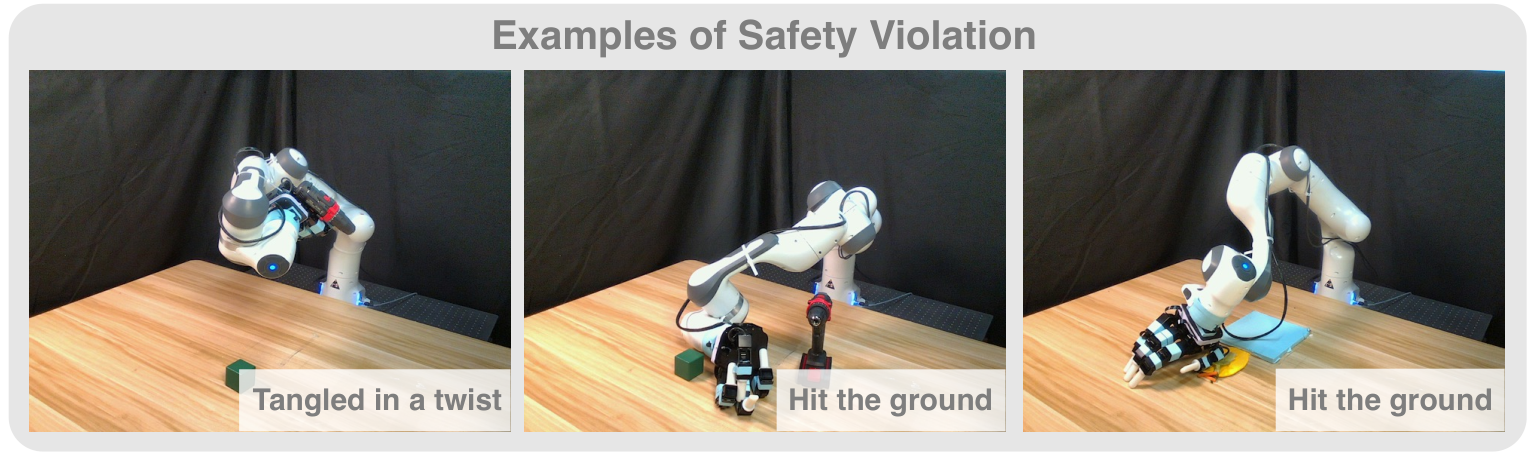
ENIn our real-world experiments, we observe that image-based and depth-based diffusion policies often deliver unpredictable behaviors in real-world experiments, which necessitates human termination to ensure robot safety. We define this situation as safety violation and compute the safety violation rate in our main real-world experiments, shown in Table XIV . Interestingly and surprisingly, we find that DP3 rarely violates the safety, showing that DP3 is a practical and hardware-friendly method for real robot learning. An intuitive explanation is that since the robots operate in 3D space, directly observing 3D information helps avoid collision. It is important to note that our assessment of safety is primarily qualitative. We intend to explore a more theoretical understanding of this observation in our future work.
中真实实验中,图像、深度图扩散策略常出现不可预测行为,需要人工终止以保护机器人。我们将此定义为安全违规,统计主要真实实验中的比例(表 XIV)。令人意外的是,DP3 很少违规,显示其实用、对硬件友好。直观解释是机器人在三维中行动,直接观测三维信息有助避免碰撞。安全评估主要是定性的,更理论化的理解留待未来。
SOURCE p.10 · S5.T14
Original table: 原表全部数值和英文专名按下方表保留;表头、通用动作描述提供中文对照。
Original caption: TABLE XIV: Safety violation rate. While conducting the main real-world experiments, we also count the times of safety violation and compute the rate.
中表 XIV:安全违规率。在主要真实实验同时记录违规次数并计算比例。
SOURCE p.10 · S6
VI 结论
SOURCE p.10 · S6.p1
ENIn this work, we introduce 3D Diffusion Policy (DP3), an efficient visual imitation learning algorithm, adept at managing a wide range of robotic tasks in both simulated and real-world environments with only a small set of demonstrations. The essence of DP3 lies in its integration of carefully designed 3D representations with the expressiveness of diffusion policies. Across 72 simulated tasks, DP3 outperforms its 2D counterpart by a relative margin of
24.2% . In real-world scenarios, DP3 shows high accuracy in executing complex manipulations of deformable objects using the Allegro hand. More importantly, we demonstrate that DP3 possesses robust generalization capabilities across various aspects and causes fewer safety violations in real-world scenarios.
中DP3 是高效视觉模仿算法,只需少量示范即可应对广泛仿真与真实任务。核心是精心设计的三维表示与扩散策略表达性相结合。72 项仿真中相对二维版本提升
24.2%;真实场景中,Allegro 手高精度执行复杂可变形物体操作。更重要的是,多方面泛化稳健,真实安全违规更少。
SOURCE p.10 · S6.p2
ENLimitations. Though we have developed an efficient architecture, the optimal 3D representation for control is still yet discovered. Besides, this work does not delve into tasks with extremely long horizons, which remains for future exploration.
中局限。尽管架构高效,最优控制三维表示仍待发现;本文也未深入研究极长时域任务,留待未来探索。
SOURCE p.10 · Sx1
致谢
SOURCE p.10 · Sx1.p1
ENWe would like to thank Zhecheng Yuan, Chen Wang, Cheng Lu, and Jianfei Chen for their helpful discussions. This work is supported by National Key R&D Program of China (2022ZD0161700).
中感谢 Zhecheng Yuan、Chen Wang、Cheng Lu、Jianfei Chen 的有益讨论。本工作受国家重点研发计划 2022ZD0161700 支持。
SOURCE p.10 · bib
参考文献(保留英文原书目)
SOURCE p.10 · bib.bib1
English bibliography: [1] Ananye Agarwal, Shagun Uppal, Kenneth Shaw, and Deepak Pathak. Dexterous functional grasping. In CoRL , 2023.
SOURCE p.10 · bib.bib2
English bibliography: [2] Anurag Ajay, Yilun Du, Abhi Gupta, Joshua Tenenbaum, Tommi Jaakkola, and Pulkit Agrawal. Is conditional generative modeling all you need for decision-making? arXiv preprint arXiv:2211.15657 , 2022.
SOURCE p.10 · bib.bib3
English bibliography: [3] Sridhar Pandian Arunachalam, Sneha Silwal, Ben Evans, and Lerrel Pinto. Dexterous imitation made easy: A learning-based framework for efficient dexterous manipulation. In ICRA , 2023.
SOURCE p.10 · bib.bib4
English bibliography: [4] Jimmy Lei Ba, Jamie Ryan Kiros, and Geoffrey E Hinton. Layer normalization. arXiv , 2016.
SOURCE p.10 · bib.bib5
English bibliography: [5] Chen Bao, Helin Xu, Yuzhe Qin, and Xiaolong Wang. Dexart: Benchmarking generalizable dexterous manipulation with articulated objects. In CVPR , 2023.
SOURCE p.11 · bib.bib6
English bibliography: [6] Tao Chen, Jie Xu, and Pulkit Agrawal. A system for general in-hand object re-orientation. In CoRL , 2022a.
SOURCE p.11 · bib.bib7
English bibliography: [7] Tao Chen, Megha Tippur, Siyang Wu, Vikash Kumar, Edward Adelson, and Pulkit Agrawal. Visual dexterity: In-hand reorientation of novel and complex object shapes. Science Robotics , 8(84):eadc9244, 2023a. doi: 10.1126/scirobotics.adc9244 .
SOURCE p.11 · bib.bib8
English bibliography: [8] Yuanpei Chen, Tianhao Wu, Shengjie Wang, Xidong Feng, Jiechuan Jiang, Zongqing Lu, Stephen McAleer, Hao Dong, Song-Chun Zhu, and Yaodong Yang. Towards human-level bimanual dexterous manipulation with reinforcement learning. NeurIPS , 2022b.
SOURCE p.11 · bib.bib9
English bibliography: [9] Yuanpei Chen, Chen Wang, Li Fei-Fei, and C Karen Liu. Sequential dexterity: Chaining dexterous policies for long-horizon manipulation. CoRL , 2023b.
SOURCE p.11 · bib.bib10
English bibliography: [10] Cheng Chi, Siyuan Feng, Yilun Du, Zhenjia Xu, Eric Cousineau, Benjamin Burchfiel, and Shuran Song. Diffusion policy: Visuomotor policy learning via action diffusion. RSS , 2023.
SOURCE p.11 · bib.bib11
English bibliography: [11] Pete Florence, Corey Lynch, Andy Zeng, Oscar A Ramirez, Ayzaan Wahid, Laura Downs, Adrian Wong, Johnny Lee, Igor Mordatch, and Jonathan Tompson. Implicit behavioral cloning. In CoRL , 2022.
SOURCE p.11 · bib.bib12
English bibliography: [12] Zipeng Fu, Tony Z. Zhao, and Chelsea Finn. Mobile aloha: Learning bimanual mobile manipulation with low-cost whole-body teleoperation. In arXiv , 2024.
SOURCE p.11 · bib.bib13
English bibliography: [13] Theophile Gervet, Zhou Xian, Nikolaos Gkanatsios, and Katerina Fragkiadaki. Act3d: Infinite resolution action detection transformer for robotic manipulation. arXiv preprint arXiv:2306.17817 , 2023.
SOURCE p.11 · bib.bib14
English bibliography: [14] Ankit Goyal, Jie Xu, Yijie Guo, Valts Blukis, Yu-Wei Chao, and Dieter Fox. Rvt: Robotic view transformer for 3d object manipulation. arXiv , 2023.
SOURCE p.11 · bib.bib15
English bibliography: [15] Huy Ha, Pete Florence, and Shuran Song. Scaling up and distilling down: Language-guided robot skill acquisition. In Conference on Robot Learning . PMLR, 2023.
SOURCE p.11 · bib.bib16
English bibliography: [16] Siddhant Haldar, Jyothish Pari, Anant Rai, and Lerrel Pinto. Teach a robot to fish: Versatile imitation from one minute of demonstrations. RSS , 2023.
SOURCE p.11 · bib.bib17
English bibliography: [17] Ankur Handa, Karl Van Wyk, Wei Yang, Jacky Liang, Yu-Wei Chao, Qian Wan, Stan Birchfield, Nathan Ratliff, and Dieter Fox. Dexpilot: Vision-based teleoperation of dexterous robotic hand-arm system. In 2020 IEEE International Conference on Robotics and Automation (ICRA) . IEEE, 2020.
SOURCE p.11 · bib.bib18
English bibliography: [18] Ankur Handa, Arthur Allshire, Viktor Makoviychuk, Aleksei Petrenko, Ritvik Singh, Jingzhou Liu, Denys Makoviichuk, Karl Van Wyk, Alexander Zhurkevich, Balakumar Sundaralingam, et al. Dextreme: Transfer of agile in-hand manipulation from simulation to reality. In ICRA , 2023.
SOURCE p.11 · bib.bib19
English bibliography: [19] Nicklas Hansen, Hao Su, and Xiaolong Wang. Stabilizing deep q-learning with convnets and vision transformers under data augmentation. Advances in neural information processing systems , 2021.
SOURCE p.11 · bib.bib20
English bibliography: [20] Nicklas Hansen, Zhecheng Yuan, Yanjie Ze, Tongzhou Mu, Aravind Rajeswaran, Hao Su, Huazhe Xu, and Xiaolong Wang. On pre-training for visuo-motor control: Revisiting a learning-from-scratch baseline. In International Conference on Machine Learning (ICML) , 2022.
SOURCE p.11 · bib.bib21
English bibliography: [21] Nicklas Hansen, Yixin Lin, Hao Su, Xiaolong Wang, Vikash Kumar, and Aravind Rajeswaran. Modem: Accelerating visual model-based reinforcement learning with demonstrations. In ICLR , 2023a.
SOURCE p.11 · bib.bib22
English bibliography: [22] Nicklas Hansen, Hao Su, and Xiaolong Wang. Td-mpc2: Scalable, robust world models for continuous control. arXiv , 2023b.
SOURCE p.11 · bib.bib23
English bibliography: [23] Jonathan Ho, Ajay Jain, and Pieter Abbeel. Denoising diffusion probabilistic models. NeurIPS , 2020.
SOURCE p.11 · bib.bib24
English bibliography: [24] Binghao Huang, Yuanpei Chen, Tianyu Wang, Yuzhe Qin, Yaodong Yang, Nikolay Atanasov, and Xiaolong Wang. Dynamic handover: Throw and catch with bimanual hands. CoRL , 2023a.
SOURCE p.11 · bib.bib25
English bibliography: [25] Tao Huang, Guangqi Jiang, Yanjie Ze, and Huazhe Xu. Diffusion reward: Learning rewards via conditional video diffusion. arXiv , 2023b.
SOURCE p.11 · bib.bib26
English bibliography: [26] Zhiao Huang, Yuanming Hu, Tao Du, Siyuan Zhou, Hao Su, Joshua B Tenenbaum, and Chuang Gan. Plasticinelab: A soft-body manipulation benchmark with differentiable physics. arXiv , 2021.
SOURCE p.11 · bib.bib27
English bibliography: [27] Michael Janner, Yilun Du, Joshua B Tenenbaum, and Sergey Levine. Planning with diffusion for flexible behavior synthesis. arXiv , 2022.
SOURCE p.11 · bib.bib28
English bibliography: [28] Tsung-Wei Ke, Nikolaos Gkanatsios, and Katerina Fragkiadaki. 3d diffuser actor: Policy diffusion with 3d scene representations. Arxiv , 2024.
SOURCE p.11 · bib.bib29
English bibliography: [29] Bernhard Kerbl, Georgios Kopanas, Thomas Leimkühler, and George Drettakis. 3d gaussian splatting for real-time radiance field rendering. ACM Transactions on Graphics , 2023.
SOURCE p.11 · bib.bib30
English bibliography: [30] Kun Lei, Zhengmao He, Chenhao Lu, Kaizhe Hu, Yang Gao, and Huazhe Xu. Uni-o4: Unifying online and offline deep reinforcement learning with multi-step on-policy optimization. arXiv , 2023.
SOURCE p.11 · bib.bib31
English bibliography: [31] Sizhe Li, Zhiao Huang, Tao Chen, Tao Du, Hao Su, Joshua B Tenenbaum, and Chuang Gan. Dexdeform: Dexterous deformable object manipulation with human demonstrations and differentiable physics. arXiv , 2023.
SOURCE p.11 · bib.bib32
English bibliography: [32] Cheng Lu, Yuhao Zhou, Fan Bao, Jianfei Chen, Chongxuan Li, and Jun Zhu. Dpm-solver++: Fast solver for guided sampling of diffusion probabilistic models. arXiv , 2022.
SOURCE p.11 · bib.bib33
English bibliography: [33] Yecheng Jason Ma, William Liang, Guanzhi Wang, De-An Huang, Osbert Bastani, Dinesh Jayaraman, Yuke Zhu, Linxi Fan, and Anima Anandkumar. Eureka: Human-level reward design via coding large language models. arXiv , 2023.
SOURCE p.11 · bib.bib34
English bibliography: [34] Viktor Makoviychuk, Lukasz Wawrzyniak, Yunrong Guo, Michelle Lu, Kier Storey, Miles Macklin, David Hoeller, Nikita Rudin, Arthur Allshire, Ankur Handa, et al. Isaac gym: High performance gpu-based physics simulation for robot learning. arXiv , 2021.
SOURCE p.12 · bib.bib35
English bibliography: [35] Ajay Mandlekar, Danfei Xu, Josiah Wong, Soroush Nasiriany, Chen Wang, Rohun Kulkarni, Li Fei-Fei, Silvio Savarese, Yuke Zhu, and Roberto Martín-Martín. What matters in learning from offline human demonstrations for robot manipulation. arXiv , 2021.
SOURCE p.12 · bib.bib36
English bibliography: [36] Ben Mildenhall, Pratul P Srinivasan, Matthew Tancik, Jonathan T Barron, Ravi Ramamoorthi, and Ren Ng. Nerf: Representing scenes as neural radiance fields for view synthesis. Communications of the ACM , 2021.
SOURCE p.12 · bib.bib37
English bibliography: [37] Felipe Nuti, Tim Franzmeyer, and João F Henriques. Extracting reward functions from diffusion models. arXiv preprint arXiv:2306.01804 , 2023.
SOURCE p.12 · bib.bib38
English bibliography: [38] Jyothish Pari, Nur Muhammad Shafiullah, Sridhar Pandian Arunachalam, and Lerrel Pinto. The surprising effectiveness of representation learning for visual imitation. arXiv preprint arXiv:2112.01511 , 2021.
SOURCE p.12 · bib.bib39
English bibliography: [39] Tim Pearce, Tabish Rashid, Anssi Kanervisto, Dave Bignell, Mingfei Sun, Raluca Georgescu, Sergio Valcarcel Macua, Shan Zheng Tan, Ida Momennejad, Katja Hofmann, et al. Imitating human behaviour with diffusion models. ICLR , 2023.
SOURCE p.12 · bib.bib40
English bibliography: [40] Xue Bin Peng, Erwin Coumans, Tingnan Zhang, Tsang-Wei Lee, Jie Tan, and Sergey Levine. Learning agile robotic locomotion skills by imitating animals. arXiv , 2020.
SOURCE p.12 · bib.bib41
English bibliography: [41] Aaditya Prasad, Kevin Lin, Jimmy Wu, Linqi Zhou, and Jeannette Bohg. Consistency policy: Accelerated visuomotor policies via consistency distillation. In Robotics: Science and Systems , 2024.
SOURCE p.12 · bib.bib42
English bibliography: [42] Charles R Qi, Hao Su, Kaichun Mo, and Leonidas J Guibas. Pointnet: Deep learning on point sets for 3d classification and segmentation. In CVPR , 2017a.
SOURCE p.12 · bib.bib43
English bibliography: [43] Charles Ruizhongtai Qi, Li Yi, Hao Su, and Leonidas J Guibas. Pointnet++: Deep hierarchical feature learning on point sets in a metric space. NeurIPS , 2017b.
SOURCE p.12 · bib.bib44
English bibliography: [44] Haozhi Qi, Ashish Kumar, Roberto Calandra, Yi Ma, and Jitendra Malik. In-hand object rotation via rapid motor adaptation. In CoRL , 2023a.
SOURCE p.12 · bib.bib45
English bibliography: [45] Haozhi Qi, Brent Yi, Sudharshan Suresh, Mike Lambeta, Yi Ma, Roberto Calandra, and Jitendra Malik. General in-hand object rotation with vision and touch. In CoRL , 2023b.
SOURCE p.12 · bib.bib46
English bibliography: [46] Guocheng Qian, Yuchen Li, Houwen Peng, Jinjie Mai, Hasan Hammoud, Mohamed Elhoseiny, and Bernard Ghanem. Pointnext: Revisiting pointnet++ with improved training and scaling strategies. NeurIPS , 2022.
SOURCE p.12 · bib.bib47
English bibliography: [47] Yuzhe Qin, Yueh-Hua Wu, Shaowei Liu, Hanwen Jiang, Ruihan Yang, Yang Fu, and Xiaolong Wang. Dexmv: Imitation learning for dexterous manipulation from human videos. In ECCV , 2022.
SOURCE p.12 · bib.bib48
English bibliography: [48] Yuzhe Qin, Wei Yang, Binghao Huang, Karl Van Wyk, Hao Su, Xiaolong Wang, Yu-Wei Chao, and Dietor Fox. Anyteleop: A general vision-based dexterous robot arm-hand teleoperation system. arXiv preprint arXiv:2307.04577 , 2023.
SOURCE p.12 · bib.bib49
English bibliography: [49] Aravind Rajeswaran, Vikash Kumar, Abhishek Gupta, Giulia Vezzani, John Schulman, Emanuel Todorov, and Sergey Levine. Learning complex dexterous manipulation with deep reinforcement learning and demonstrations. arXiv , 2017.
SOURCE p.12 · bib.bib50
English bibliography: [50] Moritz Reuss, Maximilian Li, Xiaogang Jia, and Rudolf Lioutikov. Goal-conditioned imitation learning using score-based diffusion policies. arXiv preprint arXiv:2304.02532 , 2023.
SOURCE p.12 · bib.bib51
English bibliography: [51] Robin Rombach, Andreas Blattmann, Dominik Lorenz, Patrick Esser, and Björn Ommer. High-resolution image synthesis with latent diffusion models. In Proceedings of the IEEE/CVF conference on computer vision and pattern recognition , 2022.
SOURCE p.12 · bib.bib52
English bibliography: [52] Kallol Saha, Vishal Mandadi, Jayaram Reddy, Ajit Srikanth, Aditya Agarwal, Bipasha Sen, Arun Singh, and Madhava Krishna. Edmp: Ensemble-of-costs-guided diffusion for motion planning. arXiv , 2023.
SOURCE p.12 · bib.bib53
English bibliography: [53] John Schulman, Filip Wolski, Prafulla Dhariwal, Alec Radford, and Oleg Klimov. Proximal policy optimization algorithms. arXiv preprint arXiv:1707.06347 , 2017.
SOURCE p.12 · bib.bib54
English bibliography: [54] Mingyo Seo, Steve Han, Kyutae Sim, Seung Hyeon Bang, Carlos Gonzalez, Luis Sentis, and Yuke Zhu. Deep imitation learning for humanoid loco-manipulation through human teleoperation. Humanoids , 2023a.
SOURCE p.12 · bib.bib55
English bibliography: [55] Younggyo Seo, Danijar Hafner, Hao Liu, Fangchen Liu, Stephen James, Kimin Lee, and Pieter Abbeel. Masked world models for visual control. In CoRL , 2023b.
SOURCE p.12 · bib.bib56
English bibliography: [56] Nur Muhammad Shafiullah, Zichen Cui, Ariuntuya Arty Altanzaya, and Lerrel Pinto. Behavior transformers: Cloning k modes with one stone. Advances in neural information processing systems , 2022.
SOURCE p.12 · bib.bib57
English bibliography: [57] Nur Muhammad Mahi Shafiullah, Anant Rai, Haritheja Etukuru, Yiqian Liu, Ishan Misra, Soumith Chintala, and Lerrel Pinto. On bringing robots home. arXiv , 2023.
SOURCE p.12 · bib.bib58
English bibliography: [58] William Shen, Ge Yang, Alan Yu, Jansen Wong, Leslie Pack Kaelbling, and Phillip Isola. Distilled feature fields enable few-shot language-guided manipulation. arXiv preprint arXiv:2308.07931 , 2023.
SOURCE p.12 · bib.bib59
English bibliography: [59] Haochen Shi, Huazhe Xu, Samuel Clarke, Yunzhu Li, and Jiajun Wu. Robocook: Long-horizon elasto-plastic object manipulation with diverse tools. Proceedings of the 7th Conference on Robot Learning (CoRL) , 2023.
SOURCE p.12 · bib.bib60
English bibliography: [60] Mohit Shridhar, Lucas Manuelli, and Dieter Fox. Perceiver-actor: A multi-task transformer for robotic manipulation. In CoRL , 2023.
SOURCE p.12 · bib.bib61
English bibliography: [61] Anthony Simeonov, Ankit Goyal, Lucas Manuelli, Lin Yen-Chen, Alina Sarmiento, Alberto Rodriguez, Pulkit Agrawal, and Dieter Fox. Shelving, stacking, hanging: Relational pose diffusion for multi-modal rearrangement. arXiv preprint arXiv:2307.04751 , 2023.
SOURCE p.12 · bib.bib62
English bibliography: [62] Jiaming Song, Chenlin Meng, and Stefano Ermon. Denoising diffusion implicit models. ICLR , 2021a.
SOURCE p.12 · bib.bib63
English bibliography: [63] Yang Song, Jascha Sohl-Dickstein, Diederik P Kingma, Abhishek Kumar, Stefano Ermon, and Ben Poole. Score-based generative modeling through stochastic differential equations. ICLR , 2021b.
SOURCE p.13 · bib.bib64
English bibliography: [64] Kaustubh Sridhar, Souradeep Dutta, Dinesh Jayaraman, James Weimer, and Insup Lee. Memory-consistent neural networks for imitation learning. In The Twelfth International Conference on Learning Representations , 2024. URL https://openreview.net/forum?id=R3Tf7LDdX4 .
SOURCE p.13 · bib.bib65
English bibliography: [65] Emanuel Todorov, Tom Erez, and Yuval Tassa. Mujoco: A physics engine for model-based control. In IROS , 2012.
SOURCE p.13 · bib.bib66
English bibliography: [66] Julen Urain, Niklas Funk, Jan Peters, and Georgia Chalvatzaki. Se (3)-diffusionfields: Learning smooth cost functions for joint grasp and motion optimization through diffusion. In 2023 IEEE International Conference on Robotics and Automation (ICRA) . IEEE, 2023.
SOURCE p.13 · bib.bib67
English bibliography: [67] Che Wang, Xufang Luo, Keith Ross, and Dongsheng Li. Vrl3: A data-driven framework for visual deep reinforcement learning. Advances in Neural Information Processing Systems , 2022.
SOURCE p.13 · bib.bib68
English bibliography: [68] Chen Wang, Linxi Fan, Jiankai Sun, Ruohan Zhang, Li Fei-Fei, Danfei Xu, Yuke Zhu, and Anima Anandkumar. Mimicplay: Long-horizon imitation learning by watching human play. CoRL , 2023a.
SOURCE p.13 · bib.bib69
English bibliography: [69] Chen Wang, Haochen Shi, Weizhuo Wang, Ruohan Zhang, Li Fei-Fei, and C Karen Liu. Dexcap: Scalable and portable mocap data collection system for dexterous manipulation. arXiv preprint arXiv:2403.07788 , 2024.
SOURCE p.13 · bib.bib70
English bibliography: [70] Zhendong Wang, Jonathan J Hunt, and Mingyuan Zhou. Diffusion policies as an expressive policy class for offline reinforcement learning. ICLR , 2023b.
SOURCE p.13 · bib.bib71
English bibliography: [71] Tianhao Wu, Mingdong Wu, Jiyao Zhang, Yunchong Gan, and Hao Dong. Learning score-based grasping primitive for human-assisting dexterous grasping. In NeurIPS , 2023.
SOURCE p.13 · bib.bib72
English bibliography: [72] Zhou Xian, Nikolaos Gkanatsios, Theophile Gervet, Tsung-Wei Ke, and Katerina Fragkiadaki. Chaineddiffuser: Unifying trajectory diffusion and keypose prediction for robotic manipulation. In CoRL , 2023.
SOURCE p.13 · bib.bib73
English bibliography: [73] Fanbo Xiang, Yuzhe Qin, Kaichun Mo, Yikuan Xia, Hao Zhu, Fangchen Liu, Minghua Liu, Hanxiao Jiang, Yifu Yuan, He Wang, et al. Sapien: A simulated part-based interactive environment. In CVPR , 2020.
SOURCE p.13 · bib.bib74
English bibliography: [74] Ge Yan, Yueh-Hua Wu, and Xiaolong Wang. NeRFuser: Diffusion guided multi-task 3d policy learning, 2024. URL https://openreview.net/forum?id=8GmPLkO0oR .
SOURCE p.13 · bib.bib75
English bibliography: [75] Sizhe Yang, Yanjie Ze, and Huazhe Xu. Movie: Visual model-based policy adaptation for view generalization. Annual Conference on Neural Information Processing Systems (NeurIPS) , 2023.
SOURCE p.13 · bib.bib76
English bibliography: [76] Zhao-Heng Yin, Binghao Huang, Yuzhe Qin, Qifeng Chen, and Xiaolong Wang. Rotating without seeing: Towards in-hand dexterity through touch. RSS , 2023.
SOURCE p.13 · bib.bib77
English bibliography: [77] Tianhe Yu, Deirdre Quillen, Zhanpeng He, Ryan Julian, Karol Hausman, Chelsea Finn, and Sergey Levine. Meta-world: A benchmark and evaluation for multi-task and meta reinforcement learning. In CoRL , 2020.
SOURCE p.13 · bib.bib78
English bibliography: [78] Ying Yuan, Haichuan Che, Yuzhe Qin, Binghao Huang, Zhao-Heng Yin, Kang-Won Lee, Yi Wu, Soo-Chul Lim, and Xiaolong Wang. Robot synesthesia: In-hand manipulation with visuotactile sensing. arXiv , 2023.
SOURCE p.13 · bib.bib79
English bibliography: [79] Zhecheng Yuan, Zhengrong Xue, Bo Yuan, Xueqian Wang, Yi Wu, Yang Gao, and Huazhe Xu. Pre-trained image encoder for generalizable visual reinforcement learning. Advances in Neural Information Processing Systems , 2022.
SOURCE p.13 · bib.bib80
English bibliography: [80] Yanjie Ze, Nicklas Hansen, Yinbo Chen, Mohit Jain, and Xiaolong Wang. Visual reinforcement learning with self-supervised 3d representations. IEEE Robotics and Automation Letters , 2023a.
SOURCE p.13 · bib.bib81
English bibliography: [81] Yanjie Ze, Yuyao Liu, Ruizhe Shi, Jiaxin Qin, Zhecheng Yuan, Jiashun Wang, and Huazhe Xu. H-index: Visual reinforcement learning with hand-informed representations for dexterous manipulation. In Annual Conference on Neural Information Processing Systems (NeurIPS) , 2023b.
SOURCE p.13 · bib.bib82
English bibliography: [82] Yanjie Ze, Ge Yan, Yueh-Hua Wu, Annabella Macaluso, Yuying Ge, Jianglong Ye, Nicklas Hansen, Li Erran Li, and Xiaolong Wang. Gnfactor: Multi-task real robot learning with generalizable neural feature fields. Proceedings of the 7th Conference on Robot Learning (CoRL) , 2023c.
SOURCE p.13 · bib.bib83
English bibliography: [83] Gu Zhang, Hao-Shu Fang, Hongjie Fang, and Cewu Lu. Flexible handover with real-time robust dynamic grasp trajectory generation. In 2023 IEEE/RSJ International Conference on Intelligent Robots and Systems (IROS) , 2023.
SOURCE p.13 · bib.bib84
English bibliography: [84] Hengshuang Zhao, Li Jiang, Jiaya Jia, Philip HS Torr, and Vladlen Koltun. Point transformer. In ICCV , 2021.
SOURCE p.13 · bib.bib85
English bibliography: [85] Yuke Zhu, Josiah Wong, Ajay Mandlekar, Roberto Martín-Martín, Abhishek Joshi, Soroush Nasiriany, and Yifeng Zhu. robosuite: A modular simulation framework and benchmark for robot learning. arXiv preprint arXiv:2009.12293 , 2020.
SOURCE p.14 · A0.SS1
附录 A 实现细节
EN-A Implementation Details
SOURCE p.14 · A0.SS1.p1
SOURCE p.14 · A0.SS1.p2
ENPerception. The input of DP3 includes the visual observation and the robot pose. The visual observation is a point cloud without colors, downsampled from the raw point cloud using Farthest Point Sampling (FPS). We use 512 or 1024 in all the simulated and real-world tasks. DP3 encodes the point cloud into a compact representation with our designed DP3 Encoder. We provide a simple PyTorch implementation of our DP3 Encoder as follows: ⬇ class DP3Encoder ( nn . Module ): def init ( self , channels =3): # We only use xyz (channels=3) in this work # while our encoder also works for xyzrgb (channels=6) in our experiments self . mlp = nn . Sequential ( nn . Linear ( channels , 64), nn . LayerNorm (64), nn . ReLU (), nn . Linear (64, 128), nn . LayerNorm (128), nn . ReLU (), nn . Linear (128, 256), nn . LayerNorm (256), nn . ReLU ()) self . projection = nn . Sequential ( nn . Linear (256, 64), nn . LayerNorm (64)) def forward ( self , x ): # x: B, N, 3 x = self . mlp ( x ) # B, N, 256 x = torch . max ( x , 1)[0] # B, 256 x = self . projection ( x ) # B, 64 return x The robot poses are also processed by an MLP network described as follows: ⬇ # DimRobo is the dimension of the robot poses. Sequential ( (0): Linear ( in_features = DimRobo , out_features =64, bias = True ) (1): ReLU () (2): Linear ( in_features =64, out_features =64, bias = True )) The representations encoded from point clouds and robot poses are concatenated into one representation of dimension 128. Afterward, the decision backbone generates actions conditioning on this representation.
中感知。输入含视觉观测与机器人位姿。观测为不含颜色的点云,用最远点采样从原始点云下采样;所有仿真与真实任务取 512 或 1024 点。DP3 Encoder 将其编码为紧凑表示。下面保留原 PyTorch 代码并逐行对照:channels=3 表示只用 xyz;同一编码器也可接收 channels=6 的 xyzrgb。逐点线性层依次 3→64→128→256,每层接 LayerNorm、ReLU;输入 B×N×3 经 MLP 得 B×N×256,沿点维取 max 得 B×256,再经 256→64 投影与 LayerNorm 得 B×64。机器人位姿另用 DimRobo→64→64 MLP,中间 ReLU。点云 64 维和位姿 64 维拼为 128 维,作为动作决策骨干条件。
⬇
class DP3Encoder(nn.Module):
def __init__(self, channels=3):
self.mlp = nn.Sequential(
nn.Linear(channels, 64), nn.LayerNorm(64), nn.ReLU(),
nn.Linear(64, 128), nn.LayerNorm(128), nn.ReLU(),
nn.Linear(128, 256), nn.LayerNorm(256), nn.ReLU())
self.projection = nn.Sequential(nn.Linear(256, 64), nn.LayerNorm(64))
def forward(self, x):
x = self.mlp(x)
x = torch.max(x, 1)[0]
x = self.projection(x)
return x
⬇
Sequential(
(0): Linear(in_features=DimRobo, out_features=64, bias=True)
(1): ReLU()
(2): Linear(in_features=64, out_features=64, bias=True))
SOURCE p.14 · A0.SS1.p3
ENDecision. The decision backbone is a convolutional network-based diffusion policy, which transforms random Gaussian noise into a coherent sequence of actions. For implementation, we utilize the official PyTorch framework available from [ 10 ] . In practice, the model is designed to predict a series of
H actions based on
Nobs observed timesteps, but it will only execute the last
Nact actions during inference. We set
H=4,Nobs=2,Nact=3 for DP3 and diffusion-based baselines.
中决策。卷积扩散策略将高斯噪声变为连贯动作序列,基于 [10] 官方 PyTorch 实现。以
Nobs 个观测时间步预测
H 个动作,推理仅执行最后
Nact 个动作。DP3 及扩散基线均设
H=4,Nobs=2,Nact=3。
SOURCE p.14 · A0.SS1.p4
ENThe original Diffusion Policy typically employs a longer horizon, primarily due to the denser nature of the timesteps in their tasks. In Table XV , we show that there is no significant difference between a short horizon and a long horizon for our tasks. Moreover, considering the potential for sudden disruptions in real-world robotic operations, we choose to employ a shorter horizon.
中原 Diffusion Policy 通常采用更长时域,主要因其任务时间步更稠密。表 XV 显示本文任务长短时域无显著差别。考虑真实操作可能突然受干扰,我们采用较短时域。
SOURCE p.14 · A0.SS1.p5
ENNormalization. We scale the min and max of each action dimension and each observation dimension to
[−1,1] independently. Normalizing the actions to
[−1,1] is a must for the prediction of DDPM and DDIM since they would clip the prediction to
[−1,1] for stability.
中归一化。各动作维与观测维的最小最大值分别缩放至
[−1,1]。DDPM、DDIM 预测时必须把动作归一化为
[−1,1],因为它们为稳定会将预测裁剪到
[−1,1]。
SOURCE p.14 · A0.SS2
附录 B 任务套件
SOURCE p.14 · A0.SS2.p1
ENSimulated tasks. We collect diverse simulated tasks to systematically evaluate imitation learning algorithms. Our collected tasks mainly focus on robotic manipulation, including Adroit [ 49 ] , Bi-DexHands [ 8 ] , DexArt [ 5 ] , DexDeform [ 31 ] , DexMV [ 47 ] , HORA [ 44 ] , and MetaWorld [ 77 ] . The full task names could be seen in Table XVIII . We add the support for 3D modality in these tasks when the 3D modality is not available originally.
中仿真任务。收集多样操作任务系统评估模仿算法,包括 Adroit [49]、Bi-DexHands [8]、DexArt [5]、DexDeform [31]、DexMV [47]、HORA [44]、MetaWorld [77]。完整名称见表 XVIII;原本不支持三维模态的环境,我们增加三维观测支持。
SOURCE p.14 · A0.SS2.p2
ENReal-world tasks. The episode length for our real-world tasks is not fixed. Average episode lengths for demonstrations of each task are listed as follows: (1) 79.9 for Roll-Up; (2) 113.5 for Dumpling; (3) 71.4 for Drill; and (4) 83.6 for Pour. During the evaluation of the policy, we stop the robot when we find (1) the policy finishes the task; (2) the policy can not successfully handle the task; and (3) the policy makes behaviors that are harmful to the hardware. Our real-world setup and everyday objects used in our tasks are shown in Figure 8 . The randomization in each task is shown in Figure 9 . For Roll-Up and Dumpling, the plasticine’s shape and the appearance of the objects placed upon the plasticine are randomized. For Drill and Pour, the variations come from the random positions of the cube, drill, and bowl.
中真实任务。回合长度不固定,示范平均长度为:卷起 79.9、包饺子 113.5、电钻 71.4、倾倒 83.6。评估时发现任务完成、策略已无法成功、或动作可能损害硬件,均停止机器人。配置物体见图 8,随机化见图 9。卷起、包饺子改变橡皮泥形状及上方物体外观;电钻、倾倒改变方块、电钻、碗位置。
SOURCE p.15 · A0.SS3
附录 C 更多仿真实验
EN-C More Simulation Experiments
SOURCE p.15 · A0.SS3.p1
ENSimulation results for each task. We give the simulation results for each task in Table XVIII , which is supplementary to Table I in our main paper. We report average success rates across 3 seeds. For HORA, we report the normalized returns since this task is doing in-hand rotation and is not measured by success rates.
中逐任务仿真结果。表 XVIII 补充正文表 I,报告 3 种子平均成功率。HORA 是手内旋转任务,以归一化回报衡量而非成功率。
SOURCE p.15 · A0.SS3.p2
ENSuccess rates for experts. In our simulated tasks, we apply Reinforcement Learning (RL)-trained agents to generate demonstrations. These expert policies are rigorously evaluated over 200 episodes, and their success rates are detailed in Table XIX . For MetaWorld tasks, we present results from scripted policies.
中专家成功率。强化学习智能体生成示范;每个专家严格评估 200 回合,成功率见表 XIX。MetaWorld 另报告脚本策略结果。
SOURCE p.15 · A0.SS3.p3
ENChoice of prediction horizon. DP3 applies a short action prediction and execution horizon
H=4,Nact=3 , and so does the baseline Diffusion Policy. This is mainly designed for the generality of DP3 in complex tasks and real robot tasks, where the environment would be changed by human intervention and the policy needs to switch action immediately. As shown in Table XV , a shortened prediction horizon is competitive with a longer one.
中预测时域选择。DP3 与 Diffusion Policy 基线均采用较短预测、执行时域
H=4,Nact=3,以适应复杂与真实任务:人工干预可能改变环境,策略需立即切换动作。表 XV 中短时域可与长时域竞争。
SOURCE p.15 · A0.T15
Original table: 原表全部数值和英文专名按下方表保留;表头、通用动作描述提供中文对照。
Original caption: TABLE XV: Ablation on prediction horizon. In this work, DP3 and Diffusion Policy uses a prediction horizon H=4,Nact=3 . We test H=16,Nact=8 originally used in [ 10 ] for both methods.
中表 XV:预测时域消融。本文 DP3 与 Diffusion Policy 使用
H=4,Nact=3,另测试 [10] 原用
H=16,Nact=8。
SOURCE p.15 · A0.SS4
附录 D Simple DP3
SOURCE p.15 · A0.SS4.fig1
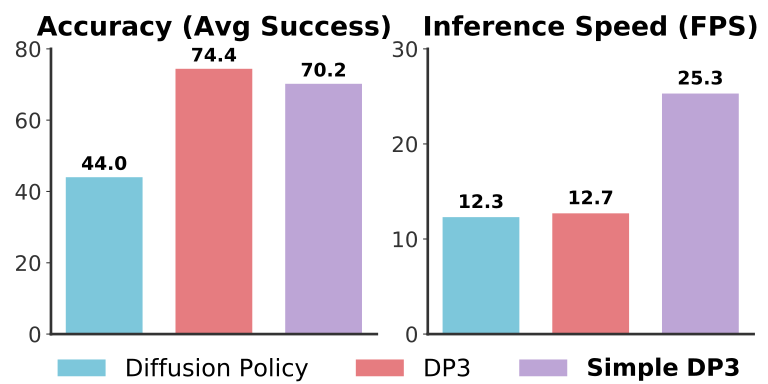
Original caption:
中无编号图:Simple DP3 简化 U-Net 冗余组件,以提高推理速度;原稿未单列图注。
SOURCE p.15 · A0.SS4.p1
ENTo enhance the applicability of DP3 in real-world robot learning, we simplify the policy backbone of DP3, which is identified as one critical factor that impacts inference speed. The refined version, dubbed Simple DP3 , offers 2x inference speed while maintaining high accuracy, as shown in Table XVI . The efficiency stems from removing the redundant components in the UNet backbone. The implementation of Simple DP3 is available on
https://github.com/YanjieZe/3D-Diffusion-Policy .
中为提高真实机器人适用性,我们简化了影响速度的策略骨干,称为 Simple DP3。表 XVI 显示,它在保持高精度的同时约提升 2 倍推理速度,主要来自移除 U-Net 冗余组件。实现同官方代码库。
SOURCE p.15 · A0.T16
Original table: 原表全部数值和英文专名按下方表保留;表头、通用动作描述提供中文对照。
Original caption: TABLE XVI: Results of Simple DP3. Compared to DP3, Simple DP3 achieves nearly 2x inference speed without losing much accuracy. Full evaluation results are given in Table XVII .
中表 XVI:Simple DP3 结果。相对 DP3,推理近快 2 倍、精度损失很小;完整结果见表 XVII。
SOURCE p.15 · A0.T17
Original table: 原表全部数值和英文专名按下方表保留;表头、通用动作描述提供中文对照。
Original caption: TABLE XVII: Full evaluation results of Simple DP3. We evaluate Simple DP3 on 10 tasks and compare it with DP3 and find that Simple DP3 could achieve results very competitive to DP3.
中表 XVII:Simple DP3 完整评估。在 10 项任务与 DP3 比较,性能相当。
SOURCE p.16 · A0.T18
Original table: 原表全部数值和英文专名按下方表保留;表头、通用动作描述提供中文对照。
Original caption: TABLE XVIII: Main results on 72 simulation tasks. Results for each task are provided in this table. A summary across domains is shown in Table I .
中表 XVIII:72 项仿真主要逐任务结果。领域汇总见表 I。
SOURCE p.17 · A0.T19
Original table: 原表全部数值和英文专名按下方表保留;表头、通用动作描述提供中文对照。
|
DexArt [5] |
DexDeform [31] |
DexMV [47] |
HORA [44] |
| Alg 任务 |
笔记本电脑 |
水龙头 |
马桶 |
桶 |
绳 |
包子 |
包饺子 |
包裹 |
翻转 |
折叠 |
倾倒 |
放入 |
旋转 |
| 专家 |
|
|
|
|
|
|
|
|
|
|
|
|
|
|
Meta-World (Easy) |
Meta-World (Medium) |
| Alg 任务 |
隔墙到达 |
关窗 |
开窗 |
侧拔销 |
投篮 |
箱中抓取 |
关盒 |
拉咖啡杯 |
推咖啡杯 |
| 专家 |
|
|
|
|
|
|
|
|
|
|
Meta-World (Hard) |
Meta-World (Very Hard) |
| Alg 任务 |
推 |
后推 |
放上架 |
拆卸 |
棍拉 |
棍推 |
隔墙抓放 |
| 专家 |
|
|
|
|
|
|
|
Original caption: TABLE XIX: Success rates of experts on 72 simulation tasks. We evaluate 200 episodes for each task. For MetaWorld tasks, we evaluate both BAC agents and the script policies provided officially in MetaWorld. For DexDeform tasks, the demonstrations are collected by human teleportation [ 31 ] and we record the success rates as 100%.
中表 XIX:72 项仿真专家成功率,每任务评估 200 回合。MetaWorld 同时评估 BAC 智能体与官方脚本;DexDeform 示范由人工遥操 [31] 采集,记为 100%。原文写 teleportation,此处按该数据集采集语境译为遥操。
读者校注与工程映射(本册原创)
三维表示的收益先于生成器选型
DP3 的关键不是增加复杂三维网络,而是将已标定深度转为度量点云、裁掉背景,再用小编码器保留控制相关几何。表 IV 中点云平均成功率 78.3,图像 40.7,深度图 32.0,RGB-D 34.7,体素 32.3;真值状态为 76.8。这组 6 任务消融测的是表示与相应编码器的组合,不应读成所有任务上“点云严格优于真值”。
从像素到 128 维条件的维度链
对像素齐次向量 x=(u,v,1)ᵀ,轴向深度 z,相机内参 K、相机到世界的刚体变换 (R,t),反投影为 p_w=R(zK⁻¹x)+t。深度单位与平移单位必须一致。裁剪与 FPS 后得到 B×N×3;逐点 MLP 为 3→64→128→256;沿 N 取最大值得 B×256;线性投影与 LayerNorm 得 B×64。机器人本体位姿经 DimRobo→64→64 MLP,形成另一 B×64,拼接为 B×128 条件。两步观测再按决策骨干接口组合,不应误把点数 N 当时间长度。
max-pooling 对点排列不变。原文正文称它为“order-equivariant”,而对输出的单一集合特征,更精确的术语是 permutation invariant。本文编码器没有由此获得 SE(3) 等变性;相机位姿、坐标系和数据覆盖仍影响控制。
损失和实际参数化需要同时核对
正文式(2)展示噪声预测 MSE,但实现段明确使用 sample prediction。前者回归加入的高斯噪声,后者回归干净动作;使用同一噪声调度并不能让两种监督的权重自动相同。复现应检查 scheduler.prediction_type、归一化范围和裁剪设置,而不是仅把论文公式抄成 epsilon loss。原文训练 100 步、DDIM 推理 10 步;这不是“单步策略”。
动作、观测逐维 min-max 归一化到 [−1,1]。这一约定与 DDPM/DDIM 的预测裁剪耦合;若动作单位或工作区改变却复用旧归一化器,裁剪可能把合法动作当越界值。推理应保存并复用训练集统计,而不在每个测试块重新估计 min/max。
有效结果与条件各在哪里
72 任务领域均值:DP3 74.4,二维 Diffusion Policy 59.8,相对改善按 (74.4−59.8)/59.8 计算约为 24.4%;原表标注 24.2%,差异可能来自未四舍五入的底层值。本册保留原表 24.2%,不以重算的舍入值替换作者结果。
真实任务平均 85% 来自 4 项任务各 10 次,逐任务为卷起 90%、包饺子 70%、电钻 80%、倾倒 100%。视角泛化仅每视角 1 次,且作者手动变换点云、调整裁剪区域;显著视角变化仍被明确列为困难。因此,3 次视角成功是小样本、带几何适配的证据,不是任意相机变化的保证。
安全违规采用人工终止判断,原文也将其称为主要定性观察。表 XIV 的 0% 是这批真实实验的观测频率;没有给出形式化碰撞安全约束。不要用它代替独立碰撞检测或执行器限幅。
本机 S9 对“相机泛化”作了什么补充
V:/embodied-3d-affordance-policy/DELIVERY_REPORT.md 中,45° 相机偏移下,世界系点云 Flow 与点云 DDIM 都为 59/64(92.2%),而图像 Flow 为 0/64,平均终端位置误差 224.39 mm。高成功率主要来自当前外参与可见表面配准;单独几何观察器的定位误差已约 1.57 mm / 0.41°。不带模板配准的点云 Flow 在 45° 虽比图像好,但仍为 0/64 成功。
这使映射关系更清楚:DP3 的点云表示支持几何泛化;S9 的高成功率是“已标定点云+学习形状配准+动作模型”的混合系统效果,不能反过来声称裸 DP3 编码器已达到该成绩。
同一 S9 检查点新增球障碍时,关闭 SDF 引导 64/64 碰撞,完整引导后 64/64 成功、0/64 碰撞;5 步中位推理从 40.37 ms 到 184.36 ms。组件消融显示,单独流梯度回拉仍有 64/64 碰撞,步内近端干净路径修正才清除碰撞。这提供一个清晰扩展接口:DP3 负责从观测提出动作块,独立几何模块负责测试期路径可行性,并把计算成本计入端到端延迟。
另外三条本机线如何影响迁移
S3(V:/lerobot-flow-matching-v2/DELIVERY_REPORT.md)中的 4,200 条配对回合说明,开环专家数据训练的快速生成器仍会在闭环失接触后漂移。DP3 的滚动动作块可缓解时序问题,但若失接触恢复状态根本不在数据中,换三维编码器或扩散采样器并不能凭空补齐行为。
S7(V:/rectified-flow-distill-bench/DELIVERY_REPORT.md)的低 NFE 数值分析提示:减少 DDIM 步数、改用连续流或单步蒸馏,应在同一观测器和同一闭环门禁下比较。DP3 原文的高低维 DPM-solver++ 消融已表明,低维采样优势不能直接迁移到高维动作。
S8(V:/event-neural-flow/DELIVERY_REPORT.md)的 1.213 ms 设备内 CUDA Graph 光流通路不含采集、磁盘、主机上传;它不能直接作为 DP3 全策略时延。若事件估计为三维策略补充运动条件,应先校准时钟、相机内外参、深度尺度,再评价遮挡与速度变化;二维光流不是三维物体速度。
原文内部差异与复现实务
正文 IV-B 称没有任务成功率低于 10%,但附录表 XVIII 的 MetaWorld Push Back 为 0±0;本册均保留。图 1 与附录 Simple DP3 的速度依赖具体硬件和观察设置;相关工作脚注给出的 CALVIN 公平对照中,DP3 为 581 ms 预测 4 步,3D Diffuser Actor 为 600 ms 预测 6 步,不能仅比较 FPS 就断言控制频率更高。
Terminology ledger
| English |
中文与约定 |
| point cloud |
点云,原文默认只用 xyz、不含颜色 |
| farthest point sampling, FPS |
最远点采样;区别于 frames per second 的帧率缩写 |
| sample prediction |
样本预测,即干净动作参数化 |
| epsilon prediction |
噪声预测 |
| proprioceptive state |
本体感知状态 |
| spatial / viewpoint generalization |
空间 / 视角泛化,分开统计 |
| deployment safety violation |
部署安全违规,按作者人工终止标准 |
| receding-horizon execution |
滚动时域执行 |
English engineering takeaway
DP3 benefits from calibrated metric geometry and a deliberately small point encoder. Its max-pooled feature is permutation invariant, not an SE(3)-equivariant policy. Preserve the sample-prediction implementation detail, normalization and camera transforms when reproducing the method. Local S9 controls isolate registration from action generation and show why SDF path correction is a separate inference-time component. Local S3 failures motivate explicit recovery data rather than assuming better perception solves contact drift.