2D Gaussian Splatting for Geometrically Accurate Radiance Fields
原作:Binbin Huang · Zehao Yu · Anpei Chen · Andreas Geiger · Shenghua Gao。2D Gaussian Splatting for Geometrically Accurate Radiance Fields,SIGGRAPH Conference Papers 2024。采用 arXiv:2403.17888v3 官方版本。arXiv页面的 view license 指向 Creative Commons Attribution 4.0 International(CC BY 4.0)。本中文译本为翻译与重新排版的演绎作品;原图、公式、表格及英文书目保留,中文译者为Codex辅助编译,2026-11-25。原作者未参与或背书本译本。许可:https://creativecommons.org/licenses/by/4.0/ 。
底本:https://arxiv.org/abs/2403.17888v3
章节导航
-
- 引言
-
- 相关工作
- 2.1. 新视角合成
- 2.2. 三维重建
- 2.3. 可微点图形学
- 2.4. 同期工作
-
- 三维高斯溅射
-
- 二维高斯溅射
- 4.1. 建模
- 4.2. 溅射
-
- 训练
-
- 实验
- 6.1. 实现
- 6.2. 比较
- 6.3. 消融
-
- 结论
- 致谢
- 参考文献(保留英文书目)
- 附录A 深度畸变细节
- 附录B 深度计算
- 附录C 额外基线
- 附录D 更多结果
SOURCE 英文PDF p.1 · HTML front · C001
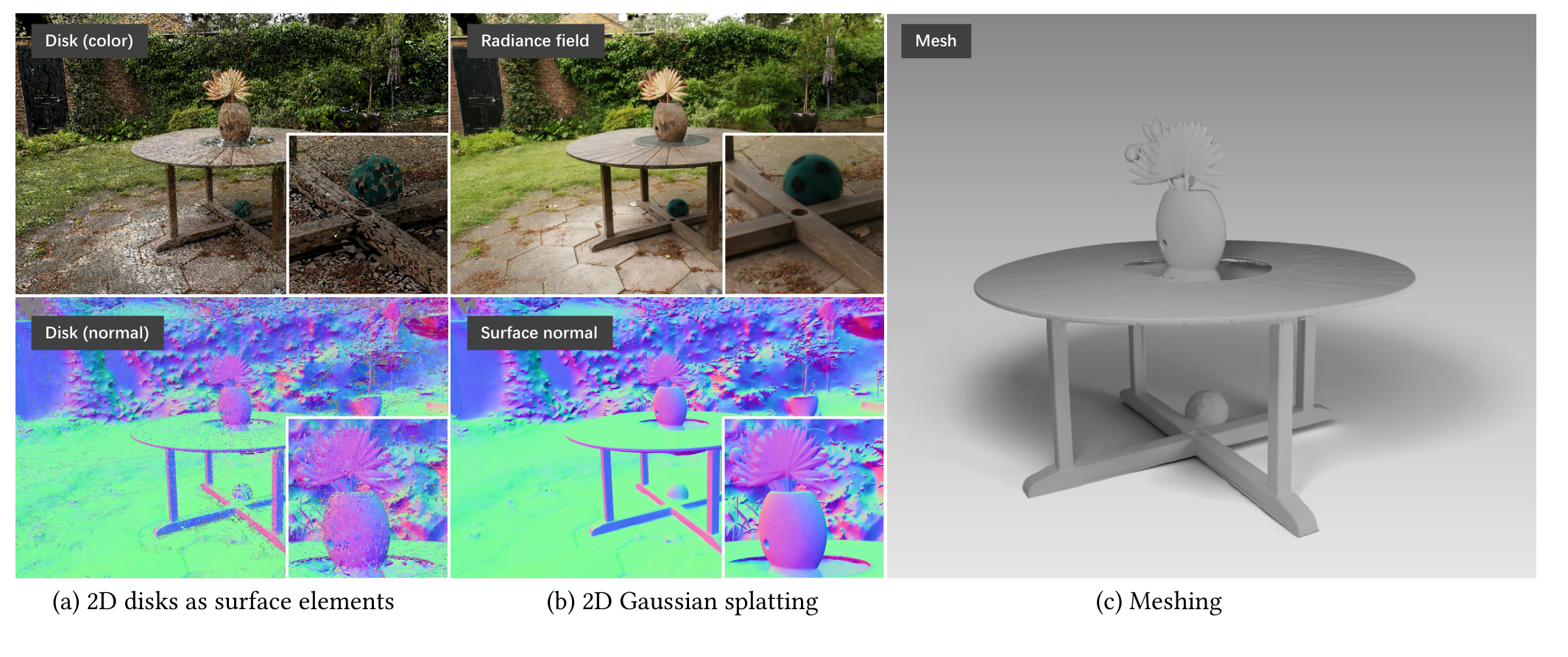
ENFigure 1 . Our method, 2DGS , (a) optimizes a set of 2D oriented disks to represent and reconstruct a complex real-world scene from multi-view RGB images. These optimized 2D disks are tightly aligned to the surfaces.
(b) With 2D Gaussian splatting, we allow real-time rendering of high quality novel view images with view consistent normals and depth maps. (c) Finally, our method provides detailed and noise-free triangle mesh reconstruction from the optimized 2D disks.
中图1. 2DGS:(a)从多视图RGB优化一组有朝向的二维盘,表示并重建复杂真实场景,优化后盘紧贴表面;(b)以二维高斯溅射实时渲染高质量新视角图像,同时提供视角一致的法线与深度;(c)最终从优化后的二维盘重建细致、无噪声的三角网格。
SOURCE 英文PDF p.1 · HTML abstract1.1 · S001
EN3D Gaussian Splatting (3DGS) has recently revolutionized radiance field reconstruction, achieving high quality novel view synthesis and fast rendering speed. However, 3DGS fails to accurately represent surfaces due to the multi-view inconsistent nature of 3D Gaussians. We present 2D Gaussian Splatting (2DGS), a novel approach to model and reconstruct geometrically accurate radiance fields from multi-view images. Our key idea is to collapse the 3D volume into a set of 2D oriented planar Gaussian disks. Unlike 3D Gaussians, 2D Gaussians provide view-consistent geometry while modeling surfaces intrinsically. To accurately recover thin surfaces and achieve stable optimization, we introduce a perspective-accurate 2D splatting process utilizing ray-splat intersection and rasterization. Additionally, we incorporate depth distortion and normal consistency terms to further enhance the quality of the reconstructions. We demonstrate that our differentiable renderer allows for noise-free and detailed geometry reconstruction while maintaining competitive appearance quality, fast training speed, and real-time rendering.
中三维高斯溅射(3DGS)近来革新了辐射场重建,实现高质量新视角合成与快速渲染。然而,三维高斯在多视图下不一致,因而无法准确表示表面。我们提出二维高斯溅射(2DGS),由多视图图像建模并重建几何准确的辐射场。关键思想是把三维体积压缩为一组具有朝向的二维平面高斯盘。不同于三维高斯,二维高斯内在地建模表面,并提供视角一致的几何。为准确恢复薄表面、稳定优化,引入利用射线–溅射求交和光栅化的透视准确二维溅射流程;另加入深度畸变与法线一致性项,进一步提高重建质量。可微渲染器在保持有竞争力的外观质量、快速训练和实时渲染的同时,实现无噪声而精细的几何重建。
1. 引言
SOURCE 英文PDF p.1 · HTML S1.p1 · S002
ENPhotorealistic novel view synthesis (NVS) and accurate geometry reconstruction stand as pivotal long-term objectives in computer graphics and vision. Recently, 3D Gaussian Splatting (3DGS) ( Kerbl et al., 2023 ) has emerged as an appealing alternative to implicit ( Mildenhall et al., 2020 ; Barron et al., 2022a ) and feature grid-based representations ( Barron et al., 2023 ; Müller et al., 2022 ) in NVS, due to its real-time photorealistic NVS results at high resolutions. Rapidly evolving, 3DGS has been quickly extended with respect to multiple domains, including anti-aliasing rendering ( Yu et al., 2024 ) , material modeling ( Shi et al., 2023 ; Jiang et al., 2023 ) , dynamic scene reconstruction ( Yan et al., 2023 ) , and animatable avatar creation ( Zielonka et al., 2023 ; Qian et al., 2023 ) . Nevertheless, it falls short in capturing intricate geometry since the volumetric 3D Gaussian, which models the complete angular radiance, conflicts with the thin nature of surfaces.
中照片级真实新视角合成(NVS)与准确几何重建,一直是图形学和视觉的重要长期目标。近期3DGS以高分辨率实时照片级NVS结果,成为隐式表示与特征网格表示之外很有吸引力的选择。它迅速扩展至抗混叠渲染、材质建模、动态场景重建与可动画化身创建等领域。然而,表示完整角度辐射的体三维高斯与表面的薄性质冲突,因此难以捕获精细几何。原段引文:( Kerbl et al., 2023 );( Mildenhall et al., 2020 ; Barron et al., 2022a );( Barron et al., 2023 ; Müller et al., 2022 );( Yu et al., 2024 );( Shi et al., 2023 ; Jiang et al., 2023 );( Yan et al., 2023 );( Zielonka et al., 2023 ; Qian et al., 2023 )
SOURCE 英文PDF p.2 · HTML S1.p2 · S003
ENOn the other hand, earlier works ( Pfister et al., 2000 ; Zwicker et al., 2001a ; Zwicker et al., 2001b ) have shown surfels (surface elements) to be an effective representation of complex geometry. Surfels approximate the object surface locally with shape and shade attributes and can be derived from known geometry. They are widely used in SLAM ( Whelan et al., 2016 ) and other robotics tasks ( Schöps et al., 2019 ) as an efficient geometry representation. Subsequent advancements ( Yifan et al., 2019 ) have incorporated surfels into a differentiable framework. However, these methods typically require ground truth (GT) geometry, depth sensor data, or operate under constrained scenarios with known lighting.
中另一方面,早期研究表明表面元(surfel)能有效表示复杂几何。表面元通过形状和着色属性局部近似物体表面,可由已知几何导出;作为高效几何表示,它广用于SLAM和其他机器人任务。后续工作将其纳入可微框架,但通常需要真值几何、深度传感器数据,或在已知光照等受限场景中运行。原段引文:( Pfister et al., 2000 ; Zwicker et al., 2001a ; Zwicker et al., 2001b );( Whelan et al., 2016 );( Schöps et al., 2019 );( Yifan et al., 2019 )
SOURCE 英文PDF p.2 · HTML S1.p3 · S004
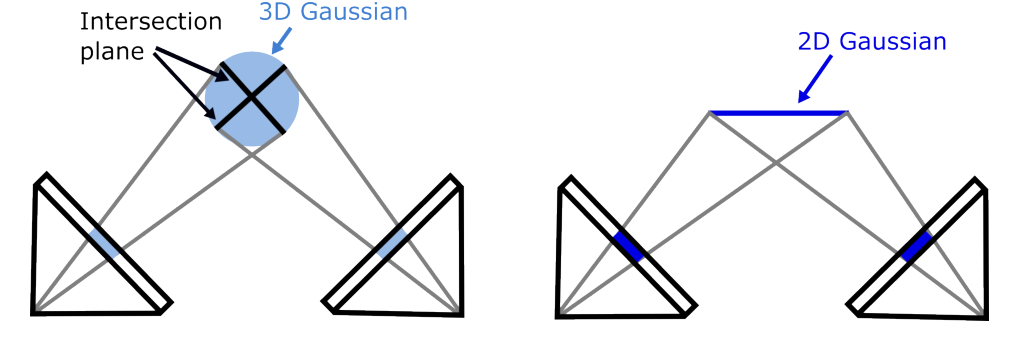
ENInspired by these works, we propose 2D Gaussian Splatting for 3D scene reconstruction and novel view synthesis that combines the benefits of both worlds, while overcoming their limitations. Unlike 3DGS, our approach represents a 3D scene with 2D Gaussian primitives, each defining an oriented elliptical disk. The significant advantage of 2D Gaussian over its 3D counterpart lies in the accurate geometry representation during rendering. Specifically, 3DGS evaluates a Gaussian’s value at the intersection between a pixel ray and a 3D Gaussian ( Keselman and Hebert, 2022 ; Keselman and Hebert, 2023 ) , which leads to inconsistency depth when rendered from different viewpoints. In contrast, our method utilizes explicit ray-splat intersection, resulting in a perspective correct splatting, as illustrated in Figure 2 , which in turn significantly improves reconstruction quality. Furthermore, the inherent surface normals in 2D Gaussian primitives enable direct surface regularization through normal constraints. In contrast with surfels-based models ( Pfister et al., 2000 ; Zwicker et al., 2001a ; Yifan et al., 2019 ) , our 2D Gaussians can be recovered from unknown geometry with gradient-based optimization.
中受这些工作启发,我们提出用于三维场景重建与NVS的二维高斯溅射,结合两类表示的优势并克服其限制。不同于3DGS,场景由二维高斯图元表示,每个图元是一片带朝向的椭圆盘。优势在于渲染中能准确表示几何:3DGS在像素射线与三维高斯的交会处求高斯值,从不同视点渲染会导致深度不一致;我们显式计算射线–溅射交点,实现透视正确溅射(图2),显著提高重建质量。二维图元内在包含表面法线,可直接施加法线约束。不同于既有表面元模型,我们能从未知几何出发,以基于梯度的优化恢复二维高斯。原段引文:( Keselman and Hebert, 2022 ; Keselman and Hebert, 2023 );( Pfister et al., 2000 ; Zwicker et al., 2001a ; Yifan et al., 2019 )
SOURCE 英文PDF p.2 · HTML S1.p4 · S005
ENWhile our 2D Gaussian approach excels in geometric modeling, optimizing solely with photometric losses can lead to noisy reconstructions, due to the inherently unconstrained nature of 3D reconstruction tasks, as noted in ( Barron et al., 2022b ; Zhang et al., 2020 ; Yu et al., 2022b ) . To enhance reconstructions and achieve smoother surfaces, we introduce two regularization terms: depth distortion and normal consistency. The depth distortion term concentrates 2D primitives distributed within a tight range along the ray, addressing the rendering process’s limitation where the distance between Gaussians is ignored. The normal consistency term minimizes discrepancies between the rendered normal map and the gradient of the rendered depth, ensuring alignment between the geometries defined by depth and normals.
Employing these regularizations in combination with our 2D Gaussian model enables us to extract highly accurate surface meshes, as demonstrated in Figure 1 .
中尽管二维高斯擅长几何建模,但三维重建本身约束不足,仅优化光度损失仍会产生带噪重建。为提升重建并得到更光滑表面,引入深度畸变与法线一致性两项正则。深度畸变使沿射线分布的二维图元集中在狭小范围,补偿渲染忽略高斯间距离的缺陷;法线一致性最小化渲染法线图与渲染深度梯度之间的差异,使深度与法线定义的几何对齐。结合二维高斯模型,这些正则使我们能提取高精度表面网格(图1)。原段引文:( Barron et al., 2022b ; Zhang et al., 2020 ; Yu et al., 2022b )
Original: In summary, we make the following contributions:
SOURCE 英文PDF p.2 · HTML S1.I1.i1.p1 · S006
ENWe present a highly efficient differentiable 2D Gaussian renderer, enabling perspective-correct splatting by leveraging 2D surface modeling, ray-splat intersection, and volumetric integration.
中提出高效可微二维高斯渲染器,利用二维表面建模、射线–溅射求交与体积分,实现透视正确溅射。
SOURCE 英文PDF p.2 · HTML S1.I1.i2.p1 · S007
ENWe introduce two regularization losses for improved and noise-free surface reconstruction.
中引入两种正则化损失,提高表面重建质量并去除噪声。
SOURCE 英文PDF p.2 · HTML S1.I1.i3.p1 · S008
ENOur approach achieves state-of-the-art geometry reconstruction and NVS results compared to other explicit representations.
中相较其他显式表示,本方法获得SOTA几何重建与NVS结果。
SOURCE 英文PDF p.2 · HTML S1 · C002
ENFigure 2 . Comparison of 3DGS and 2DGS. 3DGS utilizes different intersection planes for value evaluation when viewing from different viewpoints, resulting in inconsistency. Our 2DGS provides multi-view consistent value evaluations.
中图2. 3DGS与2DGS比较。3DGS从不同视点采用不同交平面求值,造成不一致;2DGS提供多视图一致求值。
2.1. 新视角合成
SOURCE 英文PDF p.2 · HTML S2.SS1.p1 · S009
ENSignificant advancements have been achieved in NVS, particularly since the introduction of Neural Radiance Fields (NeRF) ( Mildenhall et al., 2021 ) . NeRF employs a multi-layer perceptron (MLP) to represent geometry and view-dependent appearance, optimized via volume rendering to deliver exceptional rendering quality. Post-NeRF developments have further enhanced its capabilities. For instance, Mip-NeRF ( Barron et al., 2021 ) and subsequent works ( Barron et al., 2022a ; Barron et al., 2023 ; Hu et al., 2023 ) tackle NeRF’s aliasing issues. Additionally, the rendering efficiency of NeRF has seen substantial improvements through techniques such as distillation ( Reiser et al., 2021 ; Yu et al., 2021 ) and baking ( Reiser et al., 2023 ; Hedman et al., 2021 ; Yariv et al., 2023 ; Chen et al., 2023a ) . Moreover, the training and representational power of NeRF have been enhanced using feature-grid based scene representations ( Chen et al., 2022 ; Müller et al., 2022 ; Liu et al., 2020 ; Sun et al., 2022a ; Chen et al., 2023c ; Fridovich-Keil et al., 2022 ) .
中自NeRF提出以来,NVS进展显著。NeRF以MLP表示几何及视角相关外观,通过体渲染优化,获得卓越渲染质量。后续工作继续增强能力:Mip-NeRF及其后续解决混叠,蒸馏与烘焙大幅提高渲染效率,基于特征网格的场景表示则增强训练效率与表达能力。原段引文:( Mildenhall et al., 2021 );( Barron et al., 2021 );( Barron et al., 2022a ; Barron et al., 2023 ; Hu et al., 2023 );( Reiser et al., 2021 ; Yu et al., 2021 );( Reiser et al., 2023 ; Hedman et al., 2021 ; Yariv et al., 2023 ; Chen et al., 2023a );( Chen et al., 2022 ; Müller et al., 2022 ; Liu et al., 2020 ; Sun et al., 2022a ; Chen et al., 2023c ; Fridovich-Keil et al., 2022 )
SOURCE 英文PDF p.2 · HTML S2.SS1.p2 · S010
ENRecently, 3D Gaussian Splatting (3DGS) ( Kerbl et al., 2023 ) has emerged, demonstrating impressive real-time NVS results. This method has been quickly extended to multiple domains ( Yu et al., 2024 ; Yan et al., 2023 ; Zielonka et al., 2023 ; Xie et al., 2023 ) . In this work, we propose to “flatten” 3D Gaussians to 2D Gaussian primitives to better align their shape with the object surface. Combined with two novel regularization losses, our approach reconstructs surfaces more accurately than 3DGS while preserving its high-quality and real-time rendering capabilities.
中近期3DGS展示了令人印象深刻的实时NVS,并迅速扩展至多个领域。我们将三维高斯“压平”为二维图元,让形状更贴合物体表面;结合两种新正则,在保留高质量实时渲染的同时,比3DGS更准确地重建表面。原段引文:( Kerbl et al., 2023 );( Yu et al., 2024 ; Yan et al., 2023 ; Zielonka et al., 2023 ; Xie et al., 2023 )
2.2. 三维重建
SOURCE 英文PDF p.2 · HTML S2.SS2.p1 · S011
EN3D Reconstruction from multi-view images has been a long-standing goal in computer vision. Multi-view stereo based methods ( Schönberger et al., 2016 ; Yao et al., 2018 ; Yu and Gao, 2020 ) rely on a modular pipeline that involves feature matching, depth prediction, and fusion. In contrast, recent neural approaches ( Niemeyer et al., 2020 ; Yariv et al., 2020 ) represent surface implicitly via an MLP ( Park et al., 2019 ; Mescheder et al., 2019 ) , extracting surfaces post-training via the Marching Cube algorithm. Further advancements ( Oechsle et al., 2021 ; Wang et al., 2021 ; Yariv et al., 2021 ) integrated implicit surfaces with volume rendering, achieving detailed surface reconstructions from RGB images. These methods have been extended to large-scale reconstructions via additional regularization ( Yu et al., 2022b ; Li et al., 2023 ; Yu et al., 2022a ) , and efficient reconstruction for objects ( Wang et al., 2023 ) .
Despite these impressive developments, efficient large-scale scene reconstruction remains a challenge. For instance, Neuralangelo ( Li et al., 2023 ) requires 128 GPU hours for reconstructing a single scene from the Tanks and Temples Dataset ( Knapitsch et al., 2017 ) . In this work, we introduce 2D Gaussian splatting, a method that significantly accelerates the reconstruction process. It achieves similar or slightly better results compared to previous implicit neural surface representations, while being an order of magnitude faster.
中由多视图图像重建三维一直是计算机视觉目标。MVS方法依赖特征匹配、深度预测、融合组成的模块化管线;近期神经方法则通过MLP隐式表示表面,训练后以Marching Cubes提取表面。后续把隐式表面与体渲染结合,从RGB图像重建精细表面,并通过额外正则扩展到大规模重建或高效物体重建。尽管进展显著,高效大场景重建仍具挑战。例如Neuralangelo重建Tanks and Temples单个场景需要128 GPU小时。我们的二维高斯溅射大幅加速重建,在与此前隐式神经表面表示相近或略优的结果下,速度快一个数量级。原段引文:( Schönberger et al., 2016 ; Yao et al., 2018 ; Yu and Gao, 2020 );( Niemeyer et al., 2020 ; Yariv et al., 2020 );( Park et al., 2019 ; Mescheder et al., 2019 );( Oechsle et al., 2021 ; Wang et al., 2021 ; Yariv et al., 2021 );( Yu et al., 2022b ; Li et al., 2023 ; Yu et al., 2022a );( Wang et al., 2023 );( Li et al., 2023 );( Knapitsch et al., 2017 )
2.3. 可微点图形学
SOURCE 英文PDF p.3 · HTML S2.SS3.p1 · S012
ENDifferentiable point-based rendering ( Insafutdinov and Dosovitskiy, 2018 ; Yifan et al., 2019 ; Aliev et al., 2020 ; Wiles et al., 2020 ; Rückert et al., 2022 ) has been explored extensively due to its efficiency and flexibility in representing intricate structures. Notably, NPBG ( Aliev et al., 2020 ) rasterizes point cloud features onto an image plane, subsequently utilizing a convolutional neural network for RGB image prediction. DSS ( Yifan et al., 2019 ) focuses on optimizing oriented point clouds from multi-view images under known lighting conditions. Pulsar ( Lassner and Zollhofer, 2021 ) introduces a tile-based acceleration structure for more efficient rasterization. More recently, 3DGS ( Kerbl et al., 2023 ) optimizes anisotropic 3D Gaussian primitives, demonstrating real-time photorealistic NVS results. Despite these advances, using point-based representations from unconstrained multi-view images remains challenging. In this paper, we demonstrate detailed surface reconstruction using 2D Gaussian primitives. We also highlight the critical role of additional regularization losses in optimization, showcasing their significant impact on the quality of the reconstruction.
中由于表达复杂结构高效而灵活,可微点渲染已被广泛研究。NPBG把点云特征光栅化到像平面,再用CNN预测RGB;DSS在已知光照下从多视图优化有向点云;Pulsar引入分块加速结构以提高光栅化效率;3DGS优化各向异性三维高斯,实现实时照片级NVS。尽管如此,从无约束多视图图像使用点表示仍有挑战。本文展示用二维高斯图元重建精细表面,并强调额外正则化损失对优化和重建质量的重要影响。原段引文:( Insafutdinov and Dosovitskiy, 2018 ; Yifan et al., 2019 ; Aliev et al., 2020 ; Wiles et al., 2020 ; Rückert et al., 2022 );( Aliev et al., 2020 );( Yifan et al., 2019 );( Lassner and Zollhofer, 2021 );( Kerbl et al., 2023 )
2.4. 同期工作
SOURCE 英文PDF p.3 · HTML S2.SS4.p1 · S013
ENSince 3DGS ( Kerbl et al., 2023 ) was introduced, it has been rapidly adapted across multiple domains. We now review the closest work in inverse rendering. These work ( Liang et al., 2023 ; Gao et al., 2023 ; Jiang et al., 2023 ; Shi et al., 2023 ) extend 3DGS by modeling normals as additional attributes of 3D Gaussian primitives.
Our approach, in contrast, inherently defines normals by representing the tangent space of the 3D surface using 2D Gaussian primitives, aligning them more closely with the underlying geometry. Additionally, the aforementioned works predominantly focus on estimating the material properties of the scene and evaluating their results for relighting tasks. Notably, none of these works specifically target surface reconstruction, the primary focus of our work.
中3DGS提出后迅速应用于多个领域。最相关的逆渲染工作为三维高斯增加法线属性;我们则用二维高斯表示三维表面切空间,内在定义法线,因此更贴合底层几何。上述工作主要估计场景材质并以重光照评估,并不专门针对本文关注的表面重建。原段引文:( Kerbl et al., 2023 );( Liang et al., 2023 ; Gao et al., 2023 ; Jiang et al., 2023 ; Shi et al., 2023 )
SOURCE 英文PDF p.3 · HTML S2.SS4.p2 · S014
ENWe also highlight the distinctions between our method and concurrent works SuGaR ( Guédon and Lepetit, 2023 ) and NeuSG ( Chen et al., 2023b ) . Unlike SuGaR, which approximates 2D Gaussians with 3D Gaussians, our method directly employs 2D Gaussians, simplifying the process and enhancing the resulting geometry without additional mesh refinement. NeuSG optimizes 3D Gaussian primitives and an implicit SDF network jointly and extracts the surface from the SDF network, while our approach leverages 2D Gaussian primitives for surface approximation, offering a faster and conceptually simpler solution.
中与同期SuGaR和NeuSG也存在区别。SuGaR用三维高斯近似二维高斯,我们直接采用二维高斯,使流程简化,且无需额外网格细化便提高几何质量。NeuSG联合优化三维高斯和隐式SDF网络,再从SDF网络提取表面;我们直接用二维高斯近似表面,速度更快、概念更简单。原段引文:( Guédon and Lepetit, 2023 );( Chen et al., 2023b )
3. 三维高斯溅射
SOURCE 英文PDF p.3 · HTML S3.p1 · S015
ENKerbl et al. ( Kerbl et al., 2023 ) propose to represent 3D scenes with 3D Gaussian primitives and render images using differentiable volume splatting.
Specifically, 3DGS explicitly parameterizes Gaussian primitives via 3D covariance matrix and their location : (1) where the covariance matrix is factorized into a scaling matrix and a rotation matrix .
To render an image, the 3D Gaussian is transformed into the camera coordinates with world-to-camera transform matrix and projected to image plane via a local affine transformation ( Zwicker et al., 2001a ) : (2) By skipping the third row and column of , we obtain a 2D Gaussian with covariance matrix . Next, 3DGS ( Kerbl et al., 2023 ) employs volumetric alpha blending to integrate alpha-weighted appearance from front to back: (3) where is the index of the Gaussian primitives, denotes the alpha values and is the view-dependent appearance. The attributes of 3D Gaussian primitives are optimized using a photometric loss.
中Kerbl等以三维高斯表示场景,并用可微体溅射渲染。具体以协方差和位置显式参数化图元:(1),其中分解为缩放与旋转。渲染时,通过世界到相机变换将高斯转换至相机坐标,再用局部仿射变换投影到像平面:(2)。删去第三行和第三列,得到协方差为的二维高斯。然后以体alpha混合从前向后积分alpha加权外观:(3),其中是图元索引,是alpha值,为视角相关外观;用光度损失优化各项属性。原段引文:( Kerbl et al., 2023 );( Zwicker et al., 2001a )
表面重建面临的挑战
SOURCE 英文PDF p.3 · HTML S3.SS0.SSS0.Px1.p1 · S016
ENReconstructing surfaces using 3D Gaussian modeling and splatting faces several challenges. First, the volumetric radiance representation of 3D Gaussians conflicts with the thin nature of surfaces. Second, 3DGS does not natively model surface normals, essential for high-quality surface reconstruction. Third, the rasterization process in 3DGS lacks multi-view consistency, leading to varied 2D intersection planes for different viewpoints ( Keselman and Hebert, 2023 ) , as illustrated in Figure 2 (a). Additionally, using an affine matrix for transforming a 3D Gaussian into ray space only yields accurate projections near the center, compromising on perspective accuracy around surrounding regions ( Zwicker et al., 2004 ) . Therefore, it often results in noisy reconstructions, as shown in Figure 5 .
中用三维高斯建模与溅射重建表面存在多个困难。第一,体辐射表示与表面薄性质冲突;第二,3DGS不原生建模高质量表面重建所需法线;第三,光栅化缺乏多视图一致性,不同视点采用不同二维求交平面(图2a)。此外,仿射矩阵把三维高斯转至射线空间时,只在中心附近投影准确,周边透视准确性下降,因此常产生噪声重建(图5)。原段引文:( Keselman and Hebert, 2023 );( Zwicker et al., 2004 )
4. 二维高斯溅射
SOURCE 英文PDF p.3 · HTML S4.p1 · S017
ENTo accurately reconstruct geometry while maintaining high-quality novel view synthesis, we present differentiable 2D Gaussian splatting (2DGS).
中为同时获得准确几何与高质量NVS,我们提出可微二维高斯溅射(2DGS)。
4.1. 建模
SOURCE 英文PDF p.4 · HTML S4.SS1.p1 · S018
ENUnlike 3DGS ( Kerbl et al., 2023 ) , which models the entire angular radiance in a blob, we simplify the 3-dimensional modeling by adopting “flat” 2D Gaussians embedded in 3D space.
With 2D Gaussian modeling, the primitive distributes densities within a planar disk, defining the normal as the direction of the steepest change of density.
This feature enables better alignment with thin surfaces. While previous methods ( Kopanas et al., 2021 ; Yifan et al., 2019 ) also utilize 2D Gaussians for geometry reconstruction, they require a dense point cloud or ground-truth normals as input. By contrast, we simultaneously reconstruct the appearance and geometry given only a sparse calibration point cloud and photometric supervision.
中3DGS用一个体团建模完整角度辐射,我们则采用嵌入三维空间的“平坦”二维高斯简化建模。图元密度分布在平面盘中,法线定义为密度变化最快方向,因而更易与薄表面对齐。此前也有二维高斯几何重建方法,但要求密集点云或真值法线;我们仅需稀疏标定点云与光度监督,即可同时重建外观和几何。原段引文:( Kerbl et al., 2023 );( Kopanas et al., 2021 ; Yifan et al., 2019 )
SOURCE 英文PDF p.4 · HTML S4.SS1.p2 · S019
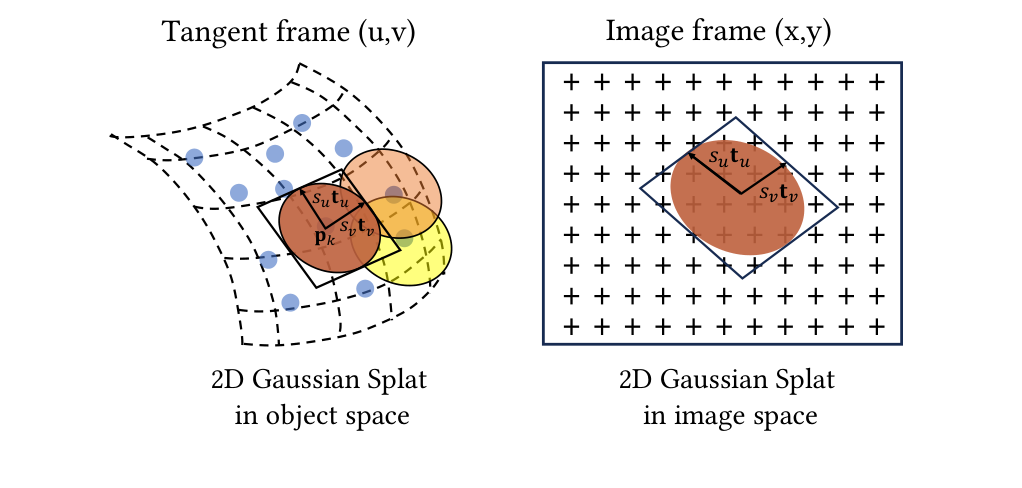
ENAs illustrated in Figure 3 , our 2D splat is characterized by its central point , two principal tangential vectors and , and a scaling vector that controls the variances of the 2D Gaussian. Notice that the primitive normal is defined by two orthogonal tangential vectors . We can arrange the orientation into a rotation matrix and the scaling factors into a diagonal matrix whose last entry is zero.
中图3中,二维溅射由中心、两个主切向量和、以及控制方差的缩放向量描述。图元法线由两个正交切向量定义:。可把朝向排为旋转矩阵,缩放排为最后一项为零的对角矩阵。
SOURCE 英文PDF p.4 · HTML S4.SS1.p3 · S020
ENA 2D Gaussian is therefore defined in a local tangent plane in world space, which is parameterized: (4) (5) where is a homogeneous transformation matrix representing the geometry of the 2D Gaussian. For the point in space, its 2D Gaussian value can then be evaluated by standard Gaussian (6) The center , scaling , and the rotation are learnable parameters. Following 3DGS ( Kerbl et al., 2023 ) , each 2D Gaussian primitive has opacity and view-dependent appearance parameterized with spherical harmonics.
中因此,二维高斯定义在世界空间的局部切平面上,参数化为:(4),(5)。为描述二维高斯几何的齐次变换矩阵。对空间中的点,以标准高斯求值:(6)。中心、缩放与旋转均可学习。沿用3DGS,每个图元另有不透明度及用球谐参数化的视角相关外观。原段引文:( Kerbl et al., 2023 )
SOURCE 英文PDF p.4 · HTML S4.SS1 · C003
ENFigure 3 . Illustration of 2D Gaussian Splatting. 2D Gaussian Splats are elliptical disks characterized by a center point , tangential vectors and , and two scaling factors ( and ) control the variance. Their elliptical projections are sampled through the ray-splat intersection ( Section 4.2 ) and accumulated via alpha-blending in image space. 2DGS reconstructs surface attributes such as colors, depths, and normals through gradient descent.
中图3. 二维高斯溅射示意。椭圆盘由中心、切向量和、以及控制方差的两个缩放因子与描述。椭圆投影通过射线–溅射求交采样(4.2节),在像空间alpha混合。2DGS通过梯度下降重建颜色、深度、法线等表面属性。
4.2. 溅射
SOURCE 英文PDF p.4 · HTML S4.SS2.p1 · S021
ENOne common strategy for rendering 2D Gaussians is to project the 2D Gaussian primitives onto the image space using the affine approximation of the perspective projection ( Zwicker et al., 2001b ; Zwicker et al., 2001a ) .
However, as noted in ( Zwicker et al., 2004 ) , this projection is only accurate at the center of the Gaussian and has increasing approximation error with increased distance to the center. To address this issue, Zwicker et al. proposed a formulation based on homogeneous coordinates. Specifically, projecting the 2D splat onto an image plane can be described by a general 2D-to-2D mapping in homogeneous coordinates. Let be the combined transformation matrix from world space to screen space. The screen space points are hence obtained by (7) where represents a homogeneous ray emitted from the camera and passing through pixel and intersecting the splat at depth .
To rasterize a 2D Gaussian, Zwicker et al. proposed to project its conic into the screen space with an implicit method using .
However, the inverse transformation introduces numerical instability, especially when the splat degenerates into a line segment (i.e. , if it is viewed from the side). To address this issue, previous surface splatting rendering methods discard such
ill-conditioned transformations using a predefined threshold ( Zwicker et al., 2004 ) . However, such a scheme poses challenges within a differentiable rendering framework, as thresholding can lead to unstable optimization. To address this problem, we utilize an explicit ray-splat intersection inspired by ( Sigg et al., 2006 ) .
中常见二维高斯渲染策略,是用透视投影的仿射近似把图元投至像空间。但该投影仅在高斯中心准确,离中心越远误差越大。为此,Zwicker等提出齐次坐标公式,把投影描述为一般的二维到二维映射。令为世界至屏幕的组合变换,屏幕点满足:(7),其中表示从相机出发、经过像素并在深度与溅射相交的齐次射线。Zwicker等通过把二次曲线隐式投影至屏幕进行光栅化。但求逆会导致数值不稳定,尤其侧视溅射退化为线段时。此前表面溅射以预设阈值丢弃这些病态变换,却会在可微渲染中导致优化不稳。我们因此采用受Sigg等启发的显式射线–溅射求交。原段引文:( Zwicker et al., 2001b ; Zwicker et al., 2001a );( Zwicker et al., 2004 );( Sigg et al., 2006 )
射线–溅射求交
SOURCE 英文PDF p.4 · HTML S4.SS2.SSS0.Px1.p1 · S022
ENWe efficiently locate the ray-splat intersections by finding the intersection of three non-parallel planes, a method originally designed for specialized hardware ( Weyrich et al., 2007 ) . Given an image coordinate , we parameterize the ray of a pixel in the projective space as the intersection of two orthogonal planes: the x-plane and the y-plane.
Specifically, the x-plane is defined by a normal vector and an offset . The x-plane can be represented as a 4D homogeneous plane . Similarly, the y-plane is . Thus, the ray is determined by the intersection of the two planes.
中通过三个非平行平面求交高效定位射线–溅射交点,这一方法最初为专用硬件设计。给定图像坐标,把投影空间中的像素射线参数化为两个正交平面——x平面与y平面——的交线。x平面法向量、偏移,可写为四维齐次平面;同理y平面为。射线由二者交线确定。原段引文:( Weyrich et al., 2007 )
SOURCE 英文PDF p.4 · HTML S4.SS2.SSS0.Px1.p2 · S023
ENNext, we transform both planes into the local coordinates of the 2D Gaussian primitives, the -coordinate system. Note that transforming points on a plane using a transformation matrix is equivalent to transforming homogeneous plane parameters using the inverse transpose ( Blinn, 1977 ) . Therefore, applying is equivalent to , eliminating explicit matrix inversion and yielding: (8)
中再把两个平面变换至二维高斯的局部坐标系。用矩阵变换平面上的点,等价于以逆转置变换齐次平面参数。因此应用等价于,无需显式求逆,得到:(8)。原段引文:( Blinn, 1977 )
SOURCE 英文PDF p.4 · HTML S4.SS2.SSS0.Px1.p3 · S024
ENAs introduced in Section 4.1 , points on the 2D Gaussian plane are represented as . At the same time, the intersection point should fall in the transformed -plane and -plane. Thus, (9) This leads to an efficient solution for the intersection point : (10) where are the -th parameter of the 4D plane. Note that and are always zero according to Eq. 5 .
Once we obtain the local coordinates , we can calculate the depth of the intersected points using Eq. 7 and evaluate the Gaussian value with Eq. 6 .
中如4.1节,二维高斯平面上的点写为。交点还需同时位于变换后的平面和平面,于是:(9)。由此高效求得交点:(10),其中为四维平面的第个参数。依式(5),与始终为零。得到局部坐标后,可用式(7)计算交点深度,再用式(6)计算高斯值。
退化情形
SOURCE 英文PDF p.5 · HTML S4.SS2.SSS0.Px2.p1 · S025
ENWhen a 2D Gaussian is observed from a slanted viewpoint, it degenerates to a line in screen space. Therefore, it might be missed during rasterization. To deal with these cases and stabilize optimization, we employ the object-space low-pass filter introduced in ( Botsch et al., 2005 ) : (11) where is given by Eq. 10 and is the projection of center . Intuitively, is lower-bounded by a fixed screen-space Gaussian low-pass filter with center and radius . In our experiments, we set to ensure sufficient pixels are used during rendering.
中斜视二维高斯时,它在屏幕上退化为线,可能在光栅化中漏掉。为处理这类情况并稳定优化,采用Botsch等提出的物体空间低通滤波:(11)。其中由式(10)给出,为中心的投影。直观上,以中心、半径的固定屏幕空间高斯低通滤波器为下界。实验设,保证渲染涉及足够像素。原段引文:( Botsch et al., 2005 )
光栅化
SOURCE 英文PDF p.5 · HTML S4.SS2.SSS0.Px3.p1 · S026
ENWe follow a similar rasterization process as in 3DGS ( Kerbl et al., 2023 ) . First, a screen space bounding box is computed for each Gaussian primitive. Then, 2D Gaussians are sorted based on the depth of their center and organized into tiles based on their bounding boxes. Finally, volumetric alpha blending is used to integrate alpha-weighted appearance from front to back: (12) The iterative process is terminated when the accumulated opacity reaches saturation.
中光栅化流程类似3DGS。先计算各图元的屏幕包围盒,再按中心深度排序,并依包围盒组织到块中;最后从前向后以体alpha混合积分加权外观:(12)。累计不透明度饱和时终止。原段引文:( Kerbl et al., 2023 )
SOURCE 英文PDF p.6 · HTML S4.SS2.SSS0.Px3 · C004
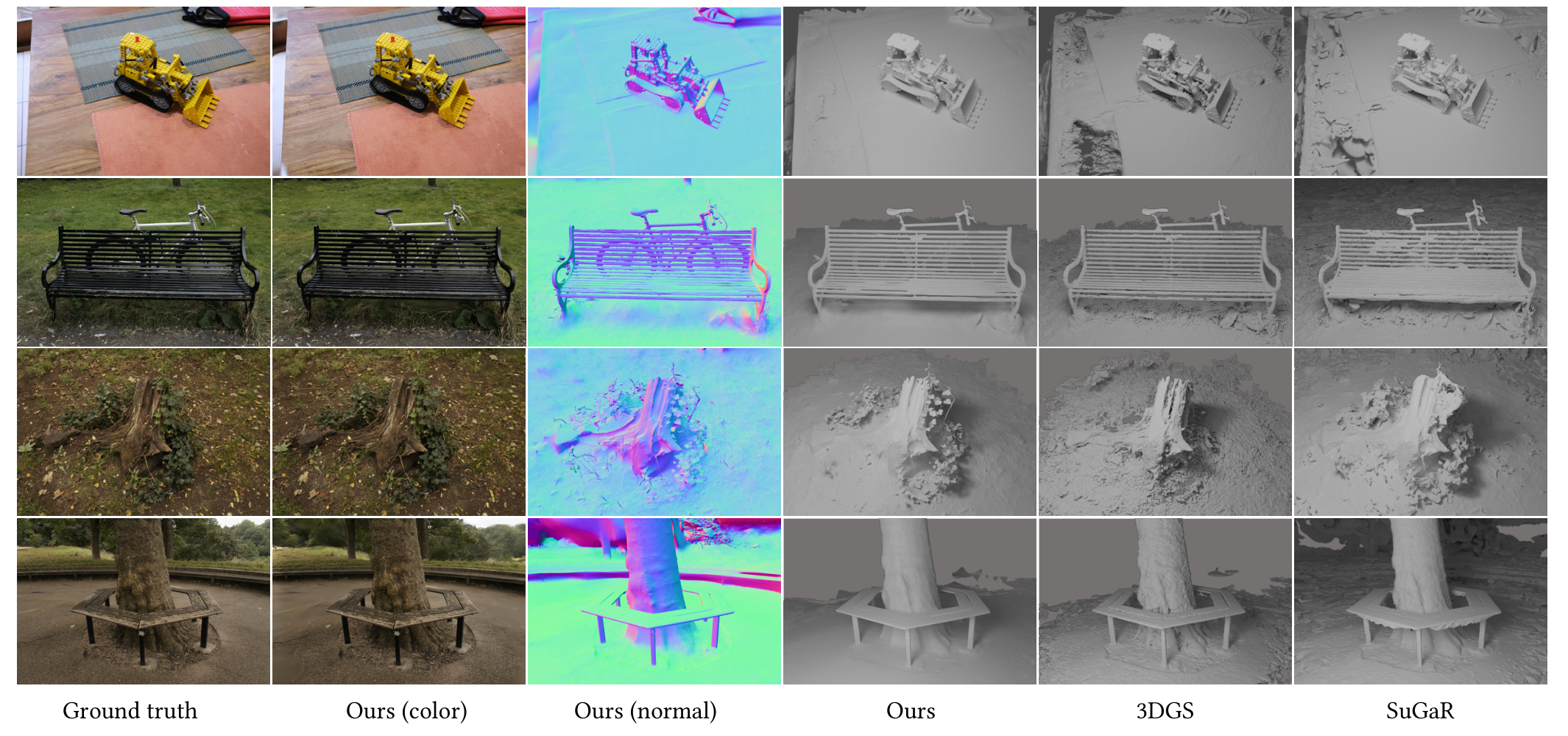
ENFigure 4 . Visual comparisons (test-set view) between our method, 3DGS ( Kerbl et al., 2023 ) , and SuGaR ( Guédon and Lepetit, 2023 ) using scenes from an real-world dataset ( Barron et al., 2022b ) .
Our method excels at synthesizing geometrically accurate radiance fields and surface reconstruction, outperforming 3DGS and SuGaR in capturing sharp edges and intricate details.
中图4. 真实数据集测试视图中,本方法与3DGS、SuGaR的视觉比较。本方法擅长几何准确的辐射场合成与表面重建,在锐利边缘及复杂细节方面优于两种对照。原段引文:( Kerbl et al., 2023 );( Guédon and Lepetit, 2023 );( Barron et al., 2022b )
5. 训练
SOURCE 英文PDF p.5 · HTML S5.p1 · S027
ENOur 2D Gaussian method, while effective in geometric modeling, can result in noisy reconstructions when optimized only with photometric losses, a challenge inherent to 3D reconstruction tasks ( Barron et al., 2022b ; Zhang et al., 2020 ; Yu et al., 2022b ) . To mitigate this issue and improve the geometry reconstruction, we introduce two regularization terms: depth distortion and normal consistency.
中二维高斯虽能有效建模几何,但仅以光度损失优化仍会出现噪声,这是三维重建固有挑战。为缓解问题并提高几何质量,我们引入深度畸变与法线一致性两项正则。原段引文:( Barron et al., 2022b ; Zhang et al., 2020 ; Yu et al., 2022b )
深度畸变
SOURCE 英文PDF p.5 · HTML S5.SS0.SSS0.Px1.p1 · S028
ENDifferent from NeRF, 3DGS’s volume rendering doesn’t consider the distance between intersected Gaussian primitives. Therefore, spreading out Gaussians might result in a similar color and depth rendering. This is different from surface rendering, where rays intersect the first visible surface exactly once. To mitigate this issue, we take inspiration from Mip-NeRF360 ( Barron et al., 2022a ) and propose a depth distortion loss to concentrate the weight distribution along the rays by minimizing the distance between the ray-splat intersections:
中与NeRF不同,3DGS体渲染不考虑相交高斯图元之间的距离,因此把高斯分散开也可能产生近似颜色和深度。表面渲染则不同,射线只与首个可见表面相交一次。受Mip-NeRF360启发,我们通过最小化射线–溅射交点间距离,提出深度畸变损失,使沿射线的权重分布集中:原段引文:( Barron et al., 2022a )
SOURCE 英文PDF p.5 · HTML S5.SS0.SSS0.Px1.p2 · S029
EN(13) where is the blending weight of the th intersection and is the depth of the intersection points. Unlike the distortion loss in Mip-NeRF360, where is the distance between sampled points and is not optimized, our approach directly encourages the concentration of the splats by adjusting the intersection depth . Note that we implement this regularization term efficiently with CUDA in a manner similar to ( Sun et al., 2022b ) .
中(13),其中为第个交点的混合权重,为交点深度。Mip-NeRF360畸变损失中的是采样点距离,不参与优化;我们则直接调整交点深度来使溅射集中。该正则项采用类似Sun等的方法,以CUDA高效实现。原段引文:( Sun et al., 2022b )
SOURCE 英文PDF p.6 · HTML S5.SS0.SSS0.Px1 · C005
ENTable 1 . Quantitative comparison on the DTU Dataset ( Jensen et al., 2014 ) . Our 2DGS achieves the highest reconstruction accuracy among other methods and provides speed up compared to the SDF based baselines.
中表1. DTU定量比较。2DGS在所比较方法中重建准确性最高,相较SDF基线加速。原段引文:( Jensen et al., 2014 )
|
24 |
37 |
40 |
55 |
63 |
65 |
69 |
83 |
97 |
105 |
106 |
110 |
114 |
118 |
122 |
|
Mean |
Time |
|
implicit
|
NeRF (Mildenhall et al., 2021) |
|
1.90 |
1.60 |
1.85 |
0.58 |
2.28 |
1.27 |
1.47 |
1.67 |
2.05 |
1.07 |
0.88 |
2.53 |
1.06 |
1.15 |
0.96 |
|
1.49 |
> 12h |
| VolSDF (Yariv et al., 2021) |
|
1.14 |
1.26 |
0.81 |
0.49 |
1.25 |
0.70 |
0.72 |
1.29 |
1.18 |
0.70 |
0.66 |
1.08 |
0.42 |
0.61 |
0.55 |
|
0.86 |
>12h |
| NeuS (Wang et al., 2021) |
|
1.00 |
1.37 |
0.93 |
0.43 |
1.10 |
0.65 |
0.57 |
1.48 |
1.09 |
0.83 |
0.52 |
1.20 |
0.35 |
0.49 |
0.54 |
|
0.84 |
>12h |
|
explicit
|
3DGS (Kerbl et al., 2023) |
|
2.14 |
1.53 |
2.08 |
1.68 |
3.49 |
2.21 |
1.43 |
2.07 |
2.22 |
1.75 |
1.79 |
2.55 |
1.53 |
1.52 |
1.50 |
|
1.96 |
11.2 m |
| SuGaR (Guédon and Lepetit, 2023) |
|
1.47 |
1.33 |
1.13 |
0.61 |
2.25 |
1.71 |
1.15 |
1.63 |
1.62 |
1.07 |
0.79 |
2.45 |
0.98 |
0.88 |
0.79 |
|
1.33 |
1h |
| 2DGS-15k (Ours) |
|
0.48 |
0.92 |
0.42 |
0.40 |
1.04 |
0.83 |
0.83 |
1.36 |
1.27 |
0.76 |
0.72 |
1.63 |
0.40 |
0.76 |
0.60 |
|
0.83 |
5.5 m |
|
2DGS-30k (Ours) |
|
0.48 |
0.91 |
0.39 |
0.39 |
1.01 |
0.83 |
0.81 |
1.36 |
1.27 |
0.76 |
0.70 |
1.40 |
0.40 |
0.76 |
0.52 |
|
0.80 |
10.9 m |
法线一致性
SOURCE 英文PDF p.5 · HTML S5.SS0.SSS0.Px2.p1 · S030
ENAs our representation is based on 2D Gaussian surface elements, we must ensure that all 2D splats are locally aligned with the actual surfaces. In the context of volume rendering where multiple semi-transparent surfels may exist along the ray, we consider the actual surface at the median point of intersection , where the accumulated opacity reaches 0.5. We then align the splats’ normal with the gradients of the depth maps as follows: (14) where indexes over intersected splats along the ray, denotes the blending weight of the intersection point, represents the normal of the splat that is oriented towards the camera, and is the normal estimated by the gradient of the depth map. Specifically, is computed with finite differences from nearby depth points as follows: (15) By aligning the splat normal with the estimated surface normal, we ensure that 2D splats locally approximate the actual object surface.
中表示基于二维高斯表面元,因此需保证所有溅射局部贴合真实表面。体渲染中,一条射线可能有多个半透明表面元;我们把累计不透明度达到0.5的中位交点当作真实表面,并让溅射法线与深度图梯度对齐:(14)。这里遍历射线上相交溅射,为交点混合权重,为朝向相机的溅射法线,为深度梯度估计法线。具体用相邻深度点有限差分计算:(15)。这样保证二维溅射局部近似真实物体表面。
最终损失
SOURCE 英文PDF p.5 · HTML S5.SS0.SSS0.Px3.p1 · S031
ENFinally, we optimize our model from an initial sparse point cloud using a set of posed images. We minimize the following loss function: (16) where is an RGB reconstruction loss combining with the D-SSIM term from ( Kerbl et al., 2023 ) , while and are regularization terms. We set for bounded scenes, for unbounded scenes, and for all scenes.
中最后,以稀疏初始点云和一组已知位姿图像优化模型,最小化:(16)。是RGB重建损失,由与3DGS的D-SSIM组合;和为正则项。有界场景设,无界场景设,所有场景均设。原段引文:( Kerbl et al., 2023 )
6. 实验
SOURCE 英文PDF p.5 · HTML S6.p1 · S032
ENWe now present evaluations of our 2D Gaussian Splatting reconstruction method, including appearance and geometry comparison with previous state-of-the-art implicit and explicit approaches. We then analyze the contribution of the proposed components.
中下面评估二维高斯溅射重建,与此前SOTA隐式及显式方法比较外观、几何,再分析各组件贡献。
6.1. 实现
SOURCE 英文PDF p.5 · HTML S6.SS1.p1 · S033
ENWe implement our 2D Gaussian Splatting with custom CUDA kernels, building upon the framework of 3DGS ( Kerbl et al., 2023 ) . We extend the renderer to output depth distortion maps, depth maps and normal maps for regularizations (See detailed computations in Appendices A and B of the supplemental material). During training, we increase the number of 2D Gaussian primitives following the adaptive control strategy in 3DGS. Since our method does not directly rely on the gradient of the projected 2D center, we hence project the gradient of 3D center onto the screen space as an approximation. Similarly, we employ a gradient threshold of and remove splats with opacity lower than every step. We conduct all the experiments on a single GTX RTX3090 GPU.
中基于3DGS框架,以自定义CUDA核实现2DGS,并扩展渲染器输出深度畸变图、深度图和法线图以作正则,计算细节见附录A、B。训练按3DGS自适应控制策略增加图元。由于本方法不直接依赖投影二维中心梯度,改将三维中心梯度投影到屏幕作为近似;同样采用梯度阈值,每步移除不透明度低于的溅射。所有实验在单张RTX3090 GPU上执行。原段引文:( Kerbl et al., 2023 )
网格提取
SOURCE 英文PDF p.5 · HTML S6.SS1.SSS0.Px1.p1 · S034
ENTo extract meshes from reconstructed 2D splats, we render depth maps of the training views using the depth value of the splats projected to the pixels and utilize truncated signed distance fusion (TSDF) to fuse the reconstruction depth maps, using Open3D ( Zhou et al., 2018 ) . We set the voxel size to and the truncated threshold to 0.02 during TSDF fusion. We also extend the original 3DGS to render depth and employ the same technique for surface reconstruction for a fair comparison.
中提取网格时,用投影到像素的溅射深度渲染训练视图深度图,再通过Open3D截断符号距离融合(TSDF)融合。体素大小设,截断阈值为0.02。为公平比较,也扩展原始3DGS输出深度,并采用同样表面重建技术。原段引文:( Zhou et al., 2018 )
SOURCE 英文PDF p.6 · HTML S6.SS1.SSS0.Px1 · C006
ENTable 2 . Quantitative results on the Tanks and Temples Dataset ( Knapitsch et al., 2017 ) . We report the F1 score and training time.
中表2. Tanks and Temples定量结果,报告F1和训练时间。原段引文:( Knapitsch et al., 2017 )
|
NeuS |
Geo-Neus |
Neurlangelo |
SuGaR |
3DGS |
Ours |
| Barn |
0.29 |
0.33 |
0.70 |
0.14 |
0.13 |
0.41 |
| Caterpillar |
0.29 |
0.26 |
0.36 |
0.16 |
0.08 |
0.23 |
| Courthouse |
0.17 |
0.12 |
0.28 |
0.08 |
0.09 |
0.16 |
| Ignatius |
0.83 |
0.72 |
0.89 |
0.33 |
0.04 |
0.51 |
| Meetingroom |
0.24 |
0.20 |
0.32 |
0.15 |
0.01 |
0.17 |
| Truck |
0.45 |
0.45 |
0.48 |
0.26 |
0.19 |
0.45 |
| Mean |
0.38 |
0.35 |
0.50 |
0.19 |
0.09 |
0.32 |
| Time |
>24h |
>24h |
>24h |
>1h |
14.3 m |
15.5 m |
SOURCE 英文PDF p.6 · HTML S6.SS1.SSS0.Px1 · C007
ENTable 3 . Performance comparison between 2DGS (ours), 3DGS and SuGaR on the DTU dataset ( Jensen et al., 2014 ) . We report the averaged chamfer distance, PSNR (training-set view), reconstruction time, and model size.
中表3. DTU上2DGS、3DGS、SuGaR比较:平均Chamfer距离、训练视图PSNR、重建时间与模型大小。原段引文:( Jensen et al., 2014 )
SOURCE 英文PDF p.7 · HTML S6.SS1.SSS0.Px1 · C008
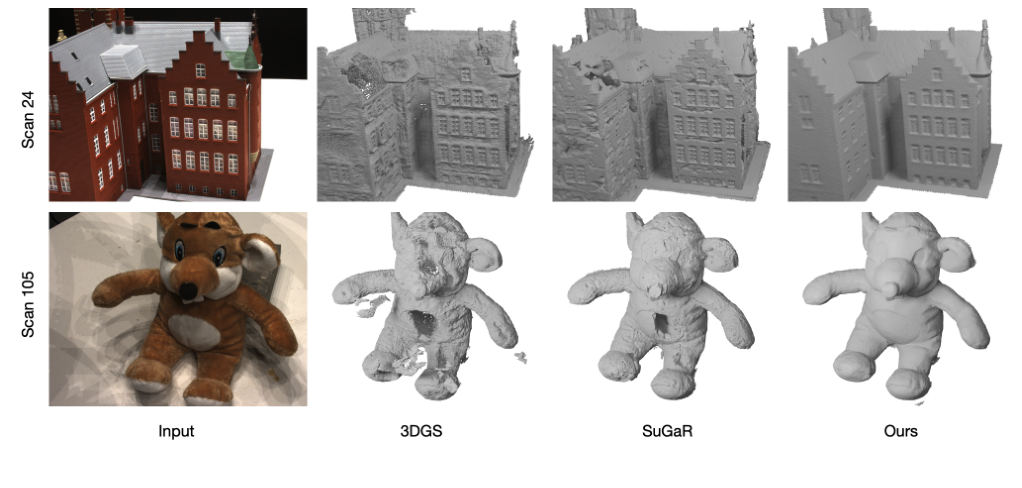
ENFigure 5 . Qualitative comparison on the DTU benchmark ( Jensen et al., 2014 ) . Our 2DGS produces detailed and noise-free surfaces.
中图5. DTU定性比较。2DGS产生细致、无噪声的表面。原段引文:( Jensen et al., 2014 )
SOURCE 英文PDF p.7 · HTML S6.SS1.SSS0.Px1 · C009
ENTable 4 . Quantitative results on Mip-NeRF 360 ( Barron et al., 2022a ) dataset. All scores of the baseline methods are directly taken from their papers whenever available. We report the performance of 3DGS, SuGaR and ours using iterations.
中表4. Mip-NeRF360定量结果。可得的基线分数直接取自原论文;3DGS、SuGaR与本方法采用次迭代。原段引文:( Barron et al., 2022a )
|
Outdoor Scene |
Indoor scene |
|
PSNR |
SSIM |
LIPPS |
PSNR |
SSIM |
LIPPS |
| NeRF |
21.46 |
0.458 |
0.515 |
26.84 |
0.790 |
0.370 |
| Deep Blending |
21.54 |
0.524 |
0.364 |
26.40 |
0.844 |
0.261 |
| Instant NGP |
22.90 |
0.566 |
0.371 |
29.15 |
0.880 |
0.216 |
| MERF |
23.19 |
0.616 |
0.343 |
27.80 |
0.855 |
0.271 |
| BakedSDF |
22.47 |
0.585 |
0.349 |
27.06 |
0.836 |
0.258 |
| MipNeRF360 |
24.47 |
0.691 |
0.283 |
31.72 |
0.917 |
0.180 |
| Mobile-NeRF |
21.95 |
0.470 |
0.470 |
- |
- |
- |
| SuGaR |
22.93 |
0.629 |
0.356 |
29.43 |
0.906 |
0.225 |
| 3DGS |
24.64 |
0.731 |
0.234 |
30.41 |
0.920 |
0.189 |
| 2DGS (Ours) |
24.34 |
0.717 |
0.246 |
30.40 |
0.916 |
0.195 |
数据集
SOURCE 英文PDF p.6 · HTML S6.SS2.SSS0.Px1.p1 · S035
ENWe evaluate the performance of our method on various datasets, including
DTU ( Jensen et al., 2014 ) , Tanks and Temples ( Knapitsch et al., 2017 ) , and Mip-NeRF360 ( Barron et al., 2022a ) . The DTU dataset comprises 15 scenes, each with 49 or 69 images of resolution . We use Colmap ( Schönberger and Frahm, 2016 ) to generate a sparse point cloud for each scene and down-sample the images into a resolution of for efficiency. We use the same training process for 3DGS ( Kerbl et al., 2023 ) and SuGaR ( Guédon and Lepetit, 2023 ) for a comparison.
中评估数据包括DTU、Tanks and Temples和Mip-NeRF360。DTU有15个场景,每场景49或69张图像。用COLMAP生成各场景稀疏点云,并为效率下采样至。3DGS与SuGaR采用相同训练流程作比较。原段引文:( Jensen et al., 2014 );( Knapitsch et al., 2017 );( Barron et al., 2022a );( Schönberger and Frahm, 2016 );( Kerbl et al., 2023 );( Guédon and Lepetit, 2023 )
几何重建
SOURCE 英文PDF p.6 · HTML S6.SS2.SSS0.Px2.p1 · S036
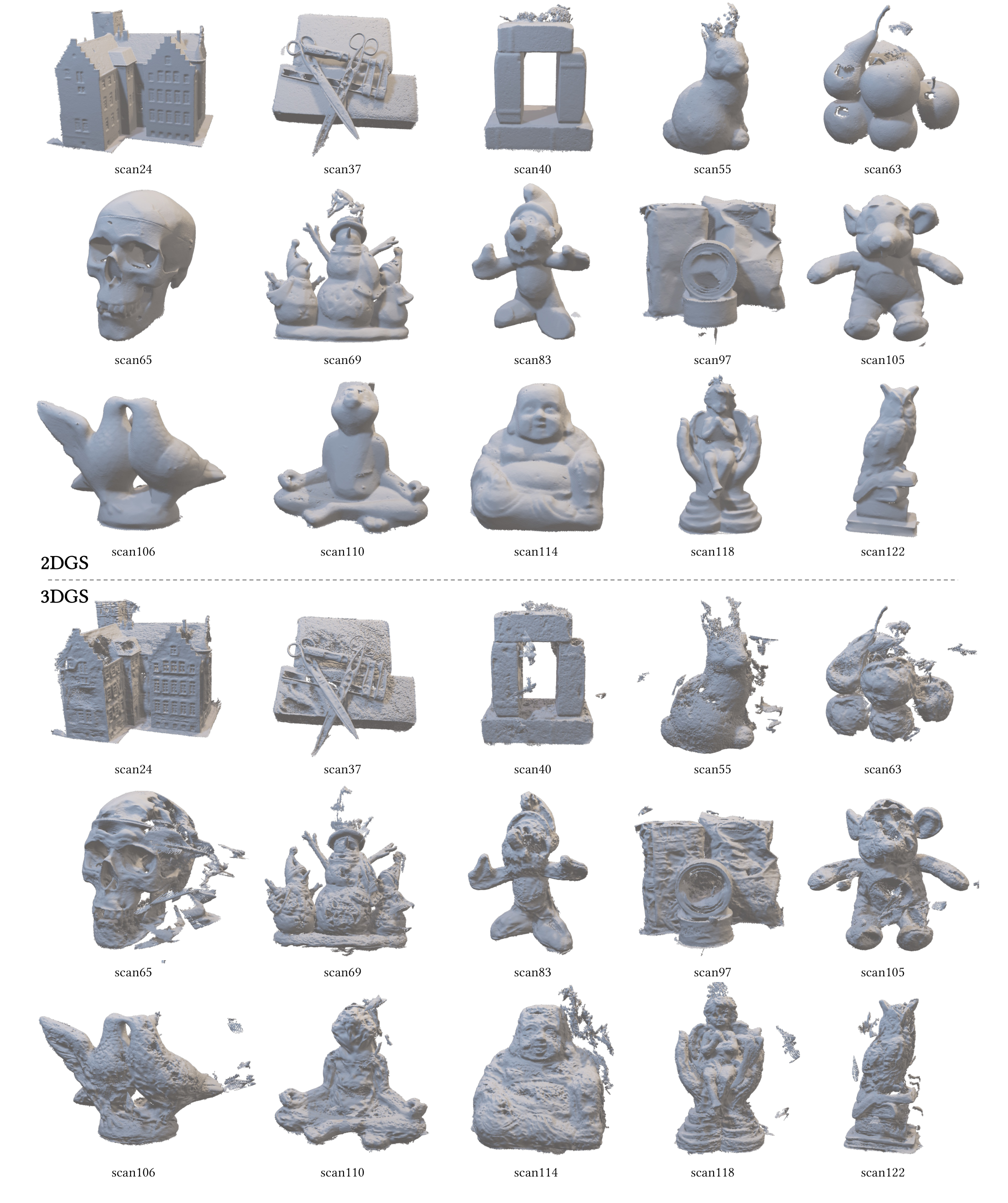
ENIn Table 1 and Table 3 , we compare our geometry reconstruction to SOTA implicit (i.e., NeRF ( Mildenhall et al., 2020 ) , VolSDF ( Yariv et al., 2021 ) , and NeuS ( Wang et al., 2021 ) ), explicit (i.e., 3DGS ( Kerbl et al., 2023 ) and concurrent work SuGaR ( Guédon and Lepetit, 2023 ) ) methods on Chamfer distance and training time using the DTU dataset. Our method outperforms all compared methods in terms of Chamfer distance. Moreover, as shown in Table 2 , 2DGS achieves competitive results with SDF models (i.e., NeuS ( Wang et al., 2021 ) and Geo-Neus ( Fu et al., 2022 ) ) on the TnT dataset, and significantly better reconstruction than explicit reconstruction methods (i.e., 3DGS and SuGaR). Notably, our model demonstrates exceptional efficiency, offering a reconstruction speed that is approximately 100 times faster compared to implicit reconstruction methods and more than 3 times faster than the concurrent work SuGaR. Our approach can also achieve qualitatively better reconstructions with more appearance and geometry details and fewer outliers, as shown in Figure 5 . Moreover, SDF-based reconstruction methods require predefining the spherical size for initialization, which plays a critical role in the success of SDF reconstruction. By contrast, our method leverages radiance field based geometry modeling and is less sensitive to initialization.
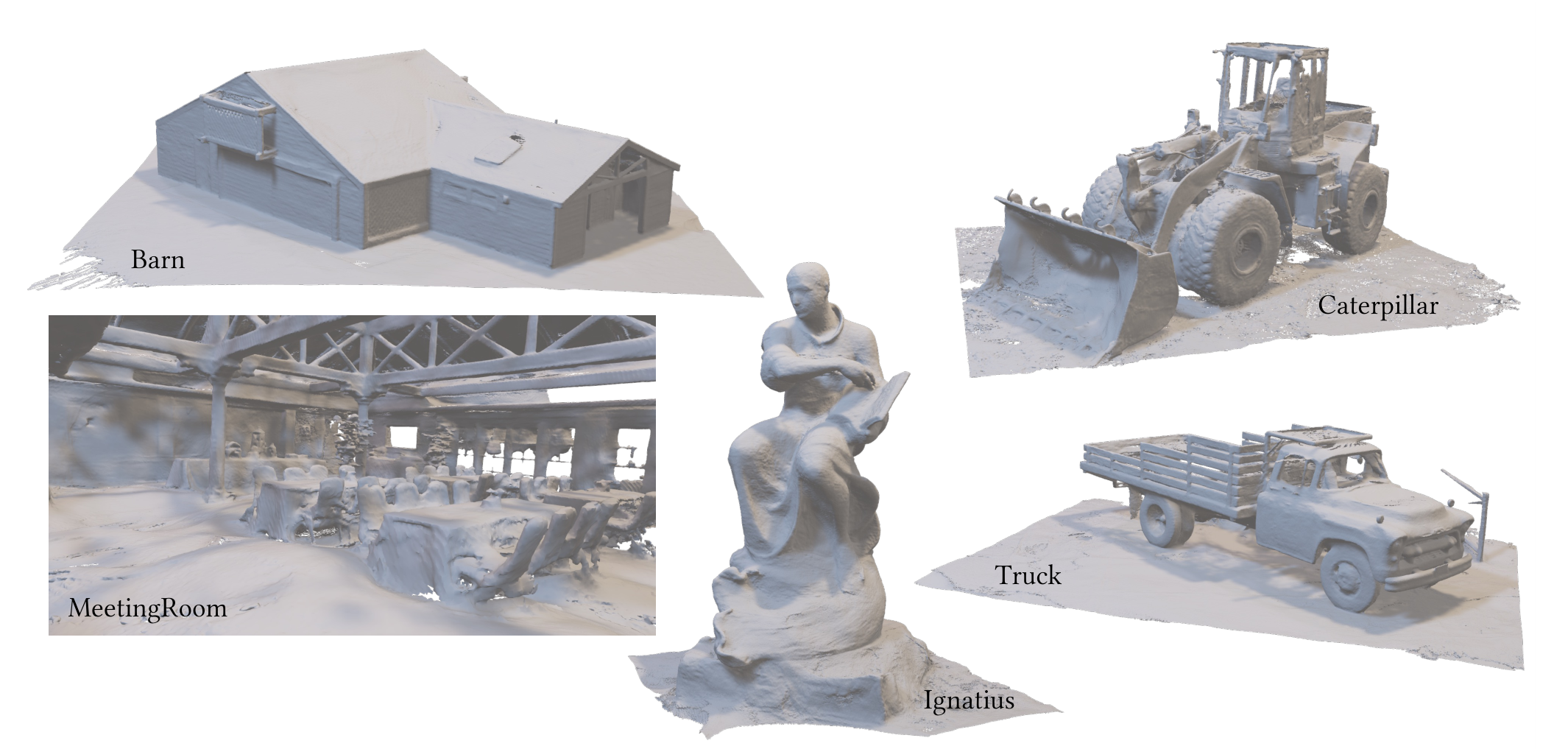
We include the full geometry reconstruction results for both DTU and TnT in Figure 9 and Figure 10 .
中表1、表3在DTU上以Chamfer距离与训练时间比较SOTA隐式方法NeRF、VolSDF、NeuS及显式3DGS、同期SuGaR。本方法Chamfer距离优于所有对照。表2显示,TnT上2DGS与NeuS、Geo-Neus等SDF模型相当,显著优于3DGS、SuGaR等显式重建。效率尤其突出:重建速度约为隐式重建的100倍,比SuGaR快逾3倍。图5中,外观与几何细节更多、离群点更少,定性结果更好。SDF重建还需预设初始化球大小,这对成功很关键;我们采用辐射场几何建模,对初始化较不敏感。DTU与TnT完整几何结果见图9、图10。原段引文:( Mildenhall et al., 2020 );( Yariv et al., 2021 );( Wang et al., 2021 );( Kerbl et al., 2023 );( Guédon and Lepetit, 2023 );( Fu et al., 2022 )
外观重建
SOURCE 英文PDF p.7 · HTML S6.SS2.SSS0.Px3.p1 · S037
ENOur method represents 3D scenes as radiance fields, providing high-quality novel view synthesis. In this section, we compare our novel view renderings using the Mip-NeRF360 dataset against baseline approaches, as shown in Table 4 and Figure 4 . Note that, since the ground truth geometry is not available in the Mip-NeRF360 dataset and we hence focus on quantitative comparison. Remarkably, our method consistently achieves competitive NVS results across state-of-the-art techniques while providing geometrically accurate surface reconstruction.
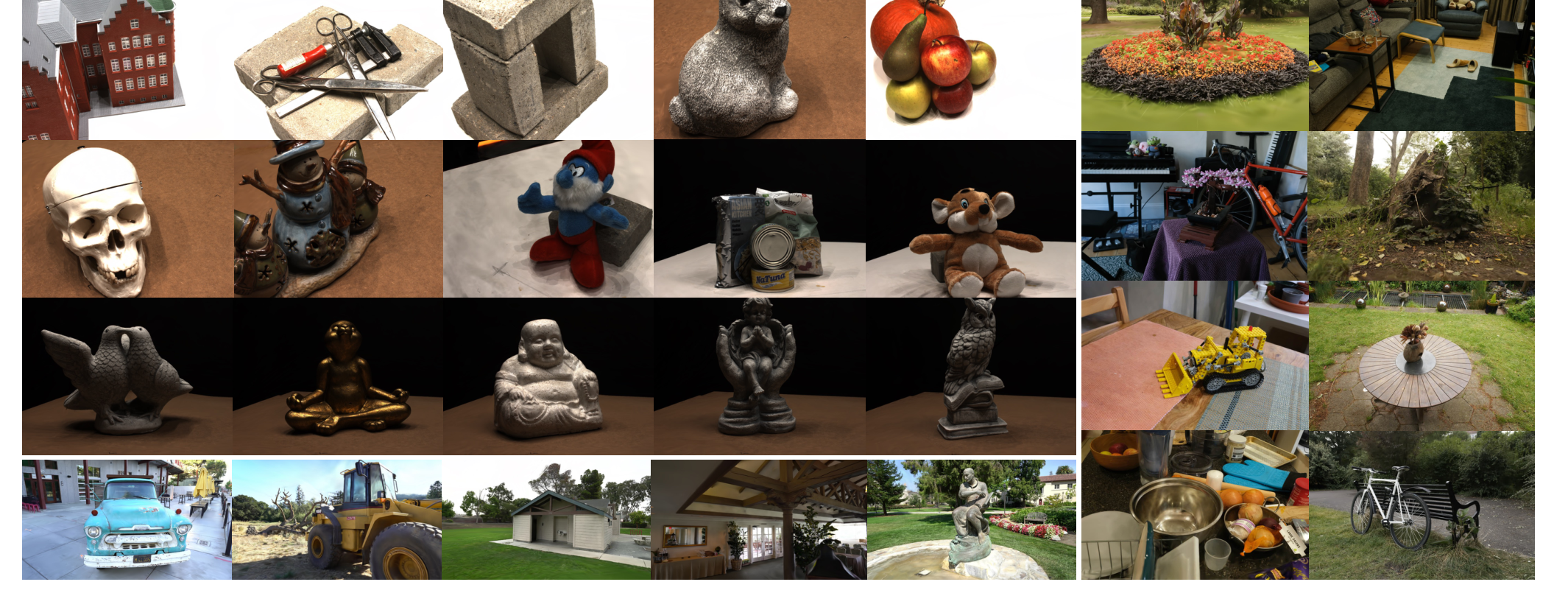
We include the appearance rendering results in Figure 11 .
中本方法以辐射场表示场景,支持高质量NVS。表4、图4在Mip-NeRF360上比较新视角渲染。原文指出该数据集没有真值几何,因此此处聚焦定量比较。与各SOTA技术相比,本方法持续获得有竞争力的NVS,并提供几何准确的表面重建。外观渲染见图11。
SOURCE 英文PDF p.7 · HTML S6.SS2.SSS0.Px3 · C010
ENTable 5 . Quantitative studies for the regularization terms and mesh extraction methods on the DTU dataset.
中表5. DTU上正则项与网格提取方法的定量研究。
|
Accuracy |
Completion |
Average |
| A. w/o normal consistency |
1.35 |
1.13 |
1.24 |
| B. w/o depth distortion |
0.89 |
0.87 |
0.88 |
| C. w / expected depth |
0.88 |
1.01 |
0.94 |
| D. w / SPSR |
1.25 |
0.89 |
1.07 |
| E. Full Model |
0.79 |
0.86 |
0.83 |
SOURCE 英文PDF p.7 · HTML S6.SS2.SSS0.Px3 · C011
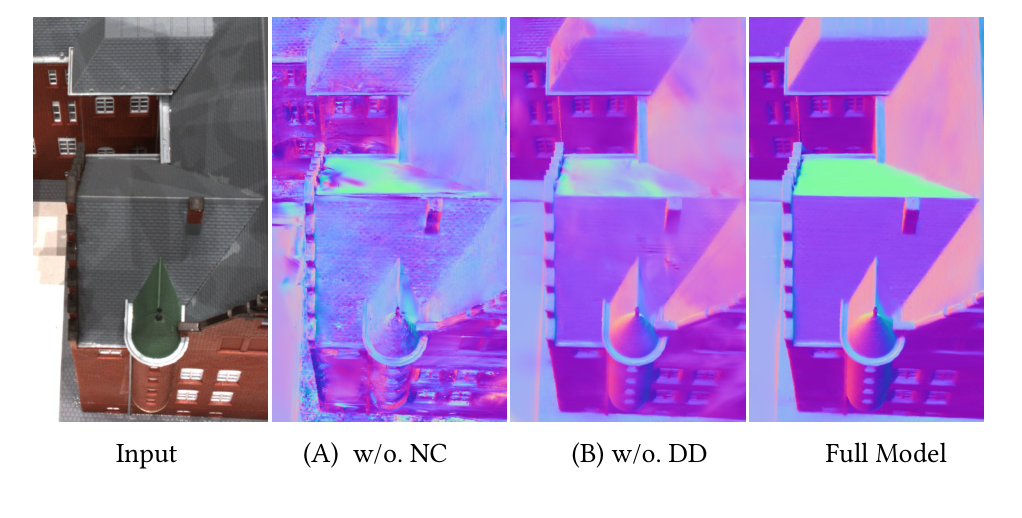
ENFigure 6 . Qualitative studies for the regularization effects. From left to right – input image, surface normals without normal consistency, without depth distortion, and our full model.
Disabling the normal consistency loss leads to noisy surface orientations; conversely, omitting depth distortion regularization results in blurred surface normals. The complete model, employing both regularizations, successfully captures sharp and flat features.
中图6. 正则效应定性研究。由左至右:输入、不使用法线一致性、不使用深度畸变、完整模型。禁用法线一致性会使表面朝向噪声化;去掉深度畸变会使表面法线模糊。两种正则共同使用,能捕获锐利和平坦特征。
6.3. 消融
SOURCE 英文PDF p.7 · HTML S6.SS3.p1 · S038
ENIn this section, we isolate the design choices and measure their effect on reconstruction quality, including regularization terms and mesh extraction.
We conduct experiments on the DTU dataset ( Jensen et al., 2014 ) with 15 iterations and report the reconstruction accuracy, completeness and average reconstruction quality.
The quantitative effect of the choices is reported in Table 5 . Additional baseline comparisons can be found in Appendix C of the supplemental material.
中隔离正则项、网格提取等设计,测量其对重建质量的影响。在DTU上训练15次迭代,报告准确性、完整性与平均重建质量;定量结果见表5,额外基线见附录C。原段引文:( Jensen et al., 2014 )
正则化
SOURCE 英文PDF p.7 · HTML S6.SS3.SSS0.Px1.p1 · S039
ENWe first examine the effects of the proposed normal consistency and depth distortion regularization terms. Our model (Table 5 E) provides the best performance when applying both regularization terms. We observe that disabling the normal consistency (Table 5 A) can lead to incorrect orientation, as shown in Figure 6 A. Additionally, the absence of depth distortion (Table 5 B) results in a noisy surface, as shown in Figure 6 B.
中先考察法线一致性与深度畸变。两项均使用时性能最佳(表5E)。禁用法线一致性(表5A)可能导致朝向错误(图6A);去掉深度畸变(表5B)则使表面带噪(图6B)。
网格提取
SOURCE 英文PDF p.7 · HTML S6.SS3.SSS0.Px2.p1 · S040
ENWe now analyze our choice for mesh extraction. Our full model (Table 5 E) utilizes TSDF fusion for mesh extraction with median depth. One alternative option is to use the expected depth instead of the median depth. However, it yields worse reconstructions as it is more sensitive to outliers, as shown in Table 5 C. Further, our approach surpasses screened Poisson surface reconstruction (SPSR)(Table 5 D) ( Kazhdan and Hoppe, 2013 ) using 2D Gaussians’ center and normal as inputs, due to SPSR’s inability to incorporate the opacity and the size of 2D Gaussian primitives.
中完整模型(表5E)以中位深度进行TSDF网格提取。换成期望深度会更敏感于离群点,重建更差(表5C)。本方法也优于以二维高斯中心与法线输入的筛选泊松表面重建(SPSR,表5D),原因是SPSR不能纳入图元不透明度与尺寸。原段引文:( Kazhdan and Hoppe, 2013 )
7. 结论
SOURCE 英文PDF p.8 · HTML S7.p1 · S041
ENWe presented 2D Gaussian splatting, a novel approach for geometrically accurate radiance field reconstruction. We utilized 2D Gaussian primitives for 3D scene representation, facilitating accurate and view consistent geometry modeling and rendering. We proposed two regularization techniques to further enhance the reconstructed geometry. Extensive experiments on several challenging datasets verify the effectiveness and efficiency of our method.
中本文提出几何准确辐射场重建的新方法二维高斯溅射。用二维高斯表示三维场景,使几何建模与渲染准确且视角一致;两种正则进一步改善几何。多个困难数据集的大量实验验证了有效性与效率。
局限
SOURCE 英文PDF p.8 · HTML S7.SS0.SSS0.Px1.p1 · S042
ENWhile our method successfully delivers accurate appearance and geometry reconstruction for a wide range of objects and scenes,
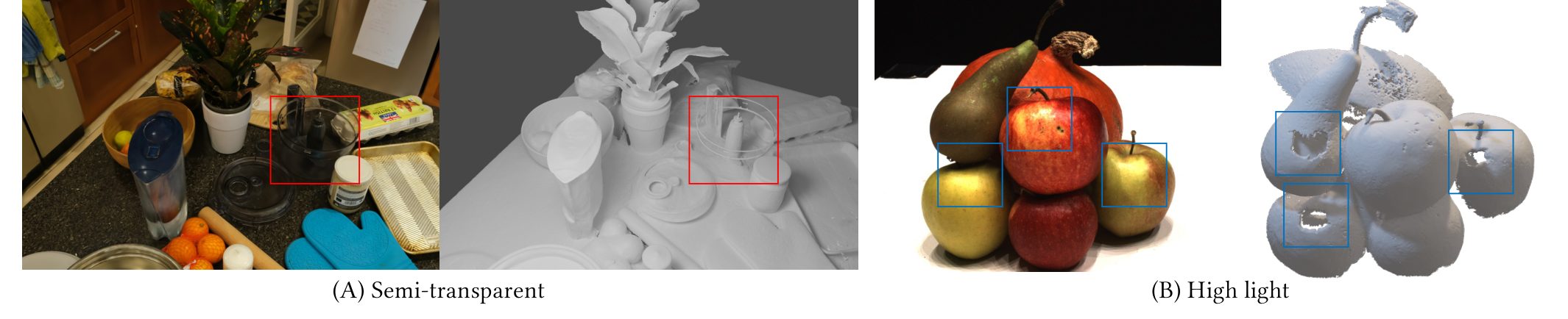
we also discuss its limitations: First, we assume surfaces with full opacity and extract meshes from multi-view depth maps. This can pose challenges in accurately handling semi-transparent surfaces, such as glass, due to their complex light transmission properties, as shown in Figure 12 . Secondly, our current densification strategy favors texture-rich over geometry-rich areas, occasionally leading to less accurate representations of fine geometric structures. A more effective densification strategy could mitigate this issue. Finally, our regularization often involves a trade-off between image quality and geometry, and can potentially lead to over-smoothing in certain regions.
中尽管本方法能为广泛物体与场景重建准确外观、几何,仍有局限。第一,假定表面完全不透明,并从多视图深度提取网格;玻璃等半透明表面的复杂透光性质会使准确重建困难(图12)。第二,当前增密偏向纹理丰富而非几何丰富区域,有时细结构不够准确,可通过更有效增密改进。第三,正则常需权衡图像质量与几何,部分区域可能过度平滑。
附录A 深度畸变细节
SOURCE 英文PDF p.9 · HTML A1.p1 · S043
ENWhile Barron et al. ( Barron et al., 2022b ) calculates the distortion loss with samples on the ray, we operate Gaussian primitives, where the intersected depth may not be ordered. To this end, we adopt an loss and transform the intersected depth to NDC space to down-weight distant Gaussian primitives, , with near and far plane empirically set to 0.2 and 1000. We implemented our depth distortion loss based on ( Sun et al., 2022b ) , also powered by tile-based rendering. Here we show that the nested algorithm can be implemented in a single forward pass: (17) where , and .
中Barron等在射线样本上计算畸变;我们操作高斯图元,交点深度未必有序。因此采用损失,并把交深变换到NDC:,以降低远高斯权重;近、远面经验设为0.2与1000。实现基于Sun等,同样采用分块渲染。嵌套算法可改为单次前向:(17),其中、、。原段引文:( Barron et al., 2022b );( Sun et al., 2022b )
SOURCE 英文PDF p.9 · HTML A1.p2 · S044
ENSpecifically, we let so that the distortion loss can be “rendered” as . Here, measures the depth distortion up to the -th Gaussian. During marching Gaussian front-to-back, we simultaneously accumulate , and , preparing for the next distortion computation . Similarly, the gradient of the depth distortion can be back-propagated to the primitives back-to-front. Different from implicit methods where are the pre-defined sampled depth and non-differentiable, we additionally back-propagate the gradient through the intersection , encouraging the Gaussians to move tightly together directly.
中具体令,畸变损失即可“渲染”为,表示直到第个高斯的深度畸变。从前向后步进时,同时累计、、,为下一次准备;梯度则由后向前反传。隐式方法中的为预定义、不可微采样深度;我们额外通过交点反传,直接推动高斯紧密聚集。
SOURCE 英文PDF p.10 · HTML A1 · C012
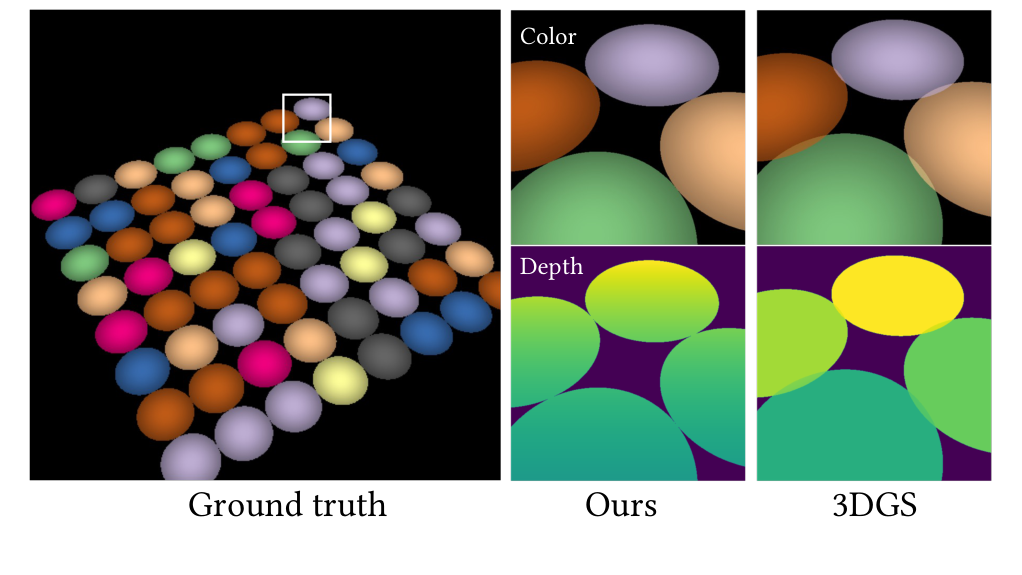
ENFigure 7 . Visualization of a plane tiled by 2D Gaussians. Affine approximation ( Zwicker et al., 2001b ) adopted in 3DGS ( Kerbl et al., 2023 ) causes perspective distortion and inaccurate depth, violating normal consistency.
中图7. 由二维高斯铺成的平面。3DGS采用的仿射近似产生透视畸变与不准深度,违反法线一致性。原段引文:( Zwicker et al., 2001b );( Kerbl et al., 2023 )
均值深度
SOURCE 英文PDF p.10 · HTML A2.SS0.SSS0.Px1.p1 · S045
ENThere are two optional depth computations used for our meshing process. The mean (expected) depth is calculated by weighting the intersected depth: (18) where is the weight contribution of the -th Gaussian and measures its visibility. It is important to normalize the depth with the accumulated alpha to ensure that a 2D Gaussian can be rendered as a planar 2D disk in the depth visualization.
中网格化可选择两种深度。均值/期望深度为交深加权:(18)。为第个高斯的权重贡献,度量可见性。需用累计alpha归一化,保证深度可视化中一个二维高斯呈平面盘。
中位深度
SOURCE 英文PDF p.10 · HTML A2.SS0.SSS0.Px2.p1 · S046
ENWe compute the median depth as the largest “visible” depth, considering as the pivot for surface and free space: (19) We find our median depth computation is more robust to ( Luiten et al., 2024 ) . When a ray’s accumulated alpha does not reach 0.5, while Luiten et al. sets a default value of 15, our computation selects the last Gaussian, which is more accurate and suitable for training.
中中位深度取最大的“可见”深度,以为表面与自由空间分界:(19)。相较Luiten等,我们的中位深度更稳健;射线累计alpha未到0.5时,Luiten等设默认值15,我们取最后一个高斯,更准确且适合训练。原段引文:( Luiten et al., 2024 )
SOURCE 英文PDF p.1 · HTML A2.SS0.SSS0.Px2 · C013
SOURCE 英文PDF p.11 · HTML A2.SS0.SSS0.Px2 · C014
EN(b) MipNeRF360 ( Barron et al., 2022b ) , SSIM=0.813
中(b)MipNeRF360,SSIM=0.813。原段引文:( Barron et al., 2022b )
SOURCE 英文PDF p.11 · HTML A2.SS0.SSS0.Px2 · C015
EN(c) 3DGS, normals from depth gradient
SOURCE 英文PDF p.11 · HTML A2.SS0.SSS0.Px2 · C016
EN(d) 3DGS ( Kerbl et al., 2023 ) , SSIM=0.834
中(d)3DGS,SSIM=0.834。原段引文:( Kerbl et al., 2023 )
SOURCE 英文PDF p.11 · HTML A2.SS0.SSS0.Px2 · C017
EN(e) Our model (2DGS), normals from depth gradient
SOURCE 英文PDF p.11 · HTML A2.SS0.SSS0.Px2 · C018
EN(f) Our model (2DGS), SSIM=0.845
SOURCE 英文PDF p.11 · HTML A2.SS0.SSS0.Px2 · C019
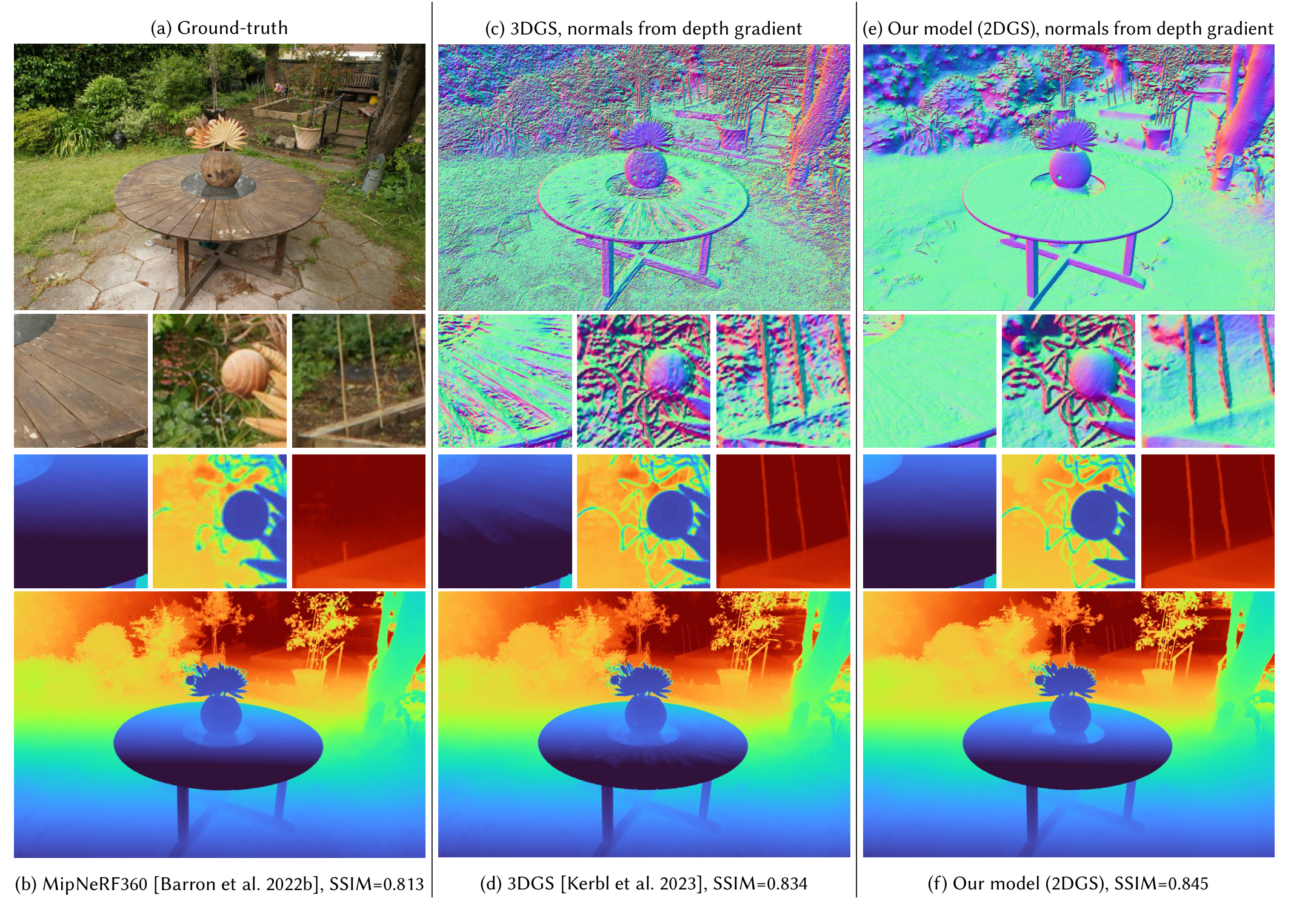
ENFigure 8 . We visualize the depth maps generated by MipNeRF360 ( Barron et al., 2022b ) , 3DGS ( Kerbl et al., 2023 ) , and our method. The depth maps for 3DGS (d) and 2DGS (f) are rendered using Eq. 18 and visualized following MipNeRF360. To highlight the surface smoothness, we further visualize the normal estimated from depth gradient using Eq. 15 for both 3DGS (c) and ours (e). While MipNeRF360 is capable of producing plausibly smooth depth maps, its sampling process may result in the loss of detailed structures. Both 3DGS and 2DGS excel at modeling thin structures; however, as illustrated in (c) and (e), the depth map of 3DGS exhibits significant noise. In contrast, our approach generates sampled depth points with normals consistent with the rendered normal map (refer to Figure 1 b), thereby enhancing depth fusion during the meshing process.
中图8. 比较MipNeRF360、3DGS与本方法的深度图。3DGS(d)和2DGS(f)采用式(18)渲染并按MipNeRF360方式可视化;另用式(15)展示3DGS(c)和本方法(e)深度梯度法线,以突出表面平滑度。MipNeRF360可产生合理平滑深度,但采样可能丢失细结构。3DGS与2DGS均擅长薄结构,但3DGS深度图有明显噪声。我们产生的深度样本法线则与渲染法线图一致(图1b),从而改进网格提取中的深度融合。原段引文:( Barron et al., 2022b );( Kerbl et al., 2023 )
附录C 额外基线
SOURCE 英文PDF p.10 · HTML A3.p1 · S047
ENIn this section, we present additional baselines to ablate the impact of our design choices, as summarized in Table 6 . Furthermore, we integrate our meshing approach into the comparison against these baselines for a comprehensive analysis. SuGaR extracts a mesh from depth points utilizing SPSR (Screen Poisson Surface Reconstruction) during the coarse stage, followed by refinement using a mesh renderer. To assess the effect of this meshing strategy, we substituted SPSR with TSDF using the depth maps, followed by an identical refinement stage. However, we found that the depth map generated from their flat Gaussian intersection is sparse and discontinuous. As a result, the adaptation of TSDF with its discontinuous depth map yields inferior results. For 3DGS, we leverage SPSR for mesh generation. Because the 3D Gaussian lacks a surface normal, we treat its normal as a trainable parameter ( Gao et al., 2023 ; Liang et al., 2023 ) distilled from the depth map, employing the normal consistency regularization. We then utilize all center points for SPSR, resulting in improved overall completion metrics compared to results obtained using TSDF.
中表6列出额外基线,用于消融设计影响,并把本方法网格提取整合进基线以全面分析。SuGaR粗阶段以SPSR从深度点提取网格,再用网格渲染器细化。我们把SPSR换成深度图TSDF,后续细化相同;但其平坦高斯求交所得深度稀疏、不连续,TSDF适配反而更差。对3DGS,则用SPSR生成网格;因三维高斯无法线,将法线作为可训练参数,以法线一致性从深度图蒸馏;再用全部中心点执行SPSR,比TSDF改善总体完整性指标。原段引文:( Gao et al., 2023 ; Liang et al., 2023 )
SOURCE 英文PDF p.10 · HTML A3.p2 · S048
ENFinally, we conduct ablation experiments on our 2DGS. Notably, 2DGS demonstrates enhanced performance by iteratively integrating components such as TSDF, perspective-correct rasterization, and median depth. For the affine approximation baseline, we utilize 3DGS’s rasterization method by configuring one scale of the 3D Gaussian to . While affine approximation already yields promising results, integrating the proposed ray-splat intersection scheme results in more accurate depth map generation under perspective projection, as depicted in Figure 7 , thus enhancing depth fusion performance.
中最后对2DGS消融,逐步加入TSDF、透视正确光栅化、中位深度可提升性能。仿射近似基线使用3DGS光栅化,把一个尺度设为。虽然仿射近似已有效,但加入所提射线–溅射求交后,透视下深度更准(图7),进而改善深度融合。
SOURCE 英文PDF p.10 · HTML A3 · C020
ENTable 6 . Additional baselines on DTU dataset. All the models are trained with 30 iterations.
中表6. DTU额外基线,全部模型训练30次迭代。
|
Accuracy |
Completion |
Average |
| SuGaR |
1.48 |
1.17 |
1.33 |
| SuGaR + TSDF |
2.47 |
1.90 |
2.18 |
| 3DGS + SPSR (center) |
2.05 |
1.25 |
1.65 |
| 3DGS + TSDF (mean) |
1.93 |
1.99 |
1.96 |
| 2DGS + SPSR (center) |
1.25 |
0.89 |
1.07 |
| 2DGS (affine approx) + TSDF (mean) |
0.96 |
1.20 |
1.08 |
| 2DGS (our rasterizer) + TSDF (mean) |
0.79 |
0.98 |
0.88 |
| 2DGS (our rasterizer) + TSDF (median) |
0.78 |
0.83 |
0.80 |
附录D 更多结果
SOURCE 英文PDF p.10 · HTML A4.p1 · S049
ENOur 2D Gaussian Splatting method achieves comparable performance even without the need for regularizations, as Table 7 shows.
We have included a detailed breakdown of per-scene metrics for the MipNeRF360 dataset ( Barron et al., 2022b ) in Table 9 . Additionally, we have provided a comparison of our rendered depth maps with those from 3DGS and MipNeRF360 in Figure 8 .
中表7表明,即使不使用正则,二维高斯溅射仍有相当性能。表9列出MipNeRF360逐场景指标;图8比较本方法、3DGS、MipNeRF360的渲染深度。原段引文:( Barron et al., 2022b )
SOURCE 英文PDF p.10 · HTML A4 · C021
ENTable 7 . PSNR scores for Synthetic NeRF dataset. Our model achieve comparable performance without using regularizations.
中表7. Synthetic NeRF的PSNR。无需正则,本模型仍有相当性能。
|
Mic |
Chair |
Ship |
Materials |
Lego |
Drums |
Ficus |
Hotdog |
Mean |
| Plenoxels |
33.26 |
33.98 |
29.62 |
29.14 |
34.10 |
25.35 |
31.83 |
36.81 |
31.76 |
| INGP-Base |
36.22 |
35.00 |
31.10 |
29.78 |
36.39 |
26.02 |
33.51 |
37.40 |
33.18 |
| Mip-NeRF |
36.51 |
35.14 |
30.41 |
30.71 |
35.70 |
25.48 |
33.29 |
37.48 |
33.09 |
| 3DGS |
35.36 |
35.83 |
30.80 |
30.00 |
35.78 |
26.15 |
34.87 |
37.72 |
33.32 |
| Ours |
35.09 |
35.05 |
30.60 |
29.74 |
35.10 |
26.05 |
35.57 |
37.36 |
33.07 |
SOURCE 英文PDF p.10 · HTML A4 · C022
ENTable 8 . PSNR scores for TnT dataset.
|
Barn |
Caterpillar |
Courthouse |
Ignatius |
Meetingroom |
Truck |
Mean |
| SuGaR |
28.63 |
23.27 |
23.33 |
20.72 |
25.47 |
24.40 |
24.16 |
| 3DGS |
27.99 |
24.82 |
23.33 |
23.95 |
26.89 |
25.01 |
25.33 |
| Ours |
28.79 |
24.23 |
23.51 |
23.82 |
26.15 |
26.85 |
25.56 |
SOURCE 英文PDF p.1 · HTML A4 · C023
ENTable 9 . PSNR , SSIM , LIPPS scores for MipNeRF360 dataset.
中表9. MipNeRF360的PSNR、SSIM与原文标作LIPPS的分数。
|
bicycle |
flowers |
garden |
stump |
treehill |
room |
counter |
kitchen |
bonsai |
mean |
| SugaR |
23.34 |
19.54 |
25.40 |
25.07 |
21.30 |
29.97 |
27.56 |
29.41 |
30.77 |
25.82 |
| 3DGS |
25.24 |
21.52 |
27.41 |
26.55 |
22.49 |
30.63 |
28.70 |
30.32 |
31.98 |
27.20 |
| Ours |
24.87 |
21.15 |
26.95 |
26.47 |
22.27 |
31.06 |
28.55 |
30.50 |
31.52 |
27.03 |
| SuGaR |
0.634 |
0.499 |
0.762 |
0.705 |
0.546 |
0.904 |
0.885 |
0.902 |
0.933 |
0.752 |
| 3DGS |
0.771 |
0.605 |
0.868 |
0.775 |
0.638 |
0.914 |
0.905 |
0.922 |
0.938 |
0.815 |
| Ours |
0.752 |
0.588 |
0.852 |
0.765 |
0.627 |
0.912 |
0.900 |
0.919 |
0.933 |
0.805 |
| SuGaR |
0.354 |
0.407 |
0.240 |
0.325 |
0.452 |
0.259 |
0.244 |
0.178 |
0.220 |
0.298 |
| 3DGS |
0.205 |
0.336 |
0.103 |
0.210 |
0.317 |
0.220 |
0.204 |
0.129 |
0.205 |
0.214 |
| Ours |
0.218 |
0.346 |
0.115 |
0.222 |
0.329 |
0.223 |
0.208 |
0.133 |
0.214 |
0.223 |
SOURCE 英文PDF p.12 · HTML A4 · C024
ENFigure 9 . Comparison of surface reconstruction using our 2DGS and 3DGS ( Kerbl et al., 2023 ) . Meshes are extracted by applying TSDF to the depth maps.
中图9. 2DGS与3DGS表面重建比较;网格均对深度图执行TSDF提取。原段引文:( Kerbl et al., 2023 )
SOURCE 英文PDF p.13 · HTML A4 · C025
ENFigure 10 . Qualitative studies for the Tanks and Temples dataset ( Knapitsch et al., 2017 ) .
中图10. Tanks and Temples定性研究。原段引文:( Knapitsch et al., 2017 )
SOURCE 英文PDF p.13 · HTML A4 · C026
ENFigure 11 . Appearance rendering results from reconstructed 2D Gaussian disks, including DTU, TnT, and Mip-NeRF360 datasets.
中图11. 重建二维高斯盘的外观渲染,包括DTU、TnT和Mip-NeRF360。
SOURCE 英文PDF p.13 · HTML A4 · C027
ENFigure 12 . Illustration of limitations: Our 2DGS struggles with the accurate reconstruction of semi-transparent surfaces, for example, the glass shown in example (A). Moreover, our method tends to create holes in areas with high light intensity, as shown in (B).
中图12. 局限示例:2DGS难以准确重建半透明表面,如(A)中玻璃;高光强区域还易出现孔洞,如(B)。
Source: 英文PDF p.8 · S7.SS0.SSS0.Px1.acknowledgements1
EN致谢 BH and SG are supported by NSFC #62172279, #61932020, Program of Shanghai Academic Research Leader. ZY, AC and AG are supported by the ERC Starting Grant LEGO-3D (850533) and DFG EXC number 2064/1 - project number 390727645.
中BH与SG获国家自然科学基金62172279、61932020和上海市学术研究带头人计划支持。ZY、AC与AG获ERC Starting Grant LEGO-3D(850533)及DFG EXC 2064/1项目390727645支持。
英文参考书目
Aliev et al . (2020) Kara-Ali Aliev, Artem Sevastopolsky, Maria Kolos, Dmitry Ulyanov, and Victor Lempitsky. 2020. Neural point-based graphics. In Computer Vision–ECCV 2020: 16th European Conference, Glasgow, UK, August 23–28, 2020, Proceedings, Part XXII 16 . Springer, 696–712.
Barron et al . (2021) Jonathan T. Barron, Ben Mildenhall, Matthew Tancik, Peter Hedman, Ricardo Martin-Brualla, and Pratul P. Srinivasan. 2021. Mip-NeRF: A Multiscale Representation for Anti-Aliasing Neural Radiance Fields. ICCV (2021).
Barron et al . (2022a) Jonathan T Barron, Ben Mildenhall, Dor Verbin, Pratul P Srinivasan, and Peter Hedman. 2022a. Mip-nerf 360: Unbounded anti-aliased neural radiance fields. In Proceedings of the IEEE/CVF Conference on Computer Vision and Pattern Recognition . 5470–5479.
Barron et al . (2022b) Jonathan T. Barron, Ben Mildenhall, Dor Verbin, Pratul P. Srinivasan, and Peter Hedman. 2022b. Mip-NeRF 360: Unbounded Anti-Aliased Neural Radiance Fields. CVPR (2022).
Barron et al . (2023) Jonathan T. Barron, Ben Mildenhall, Dor Verbin, Pratul P. Srinivasan, and Peter Hedman. 2023. Zip-NeRF: Anti-Aliased Grid-Based Neural Radiance Fields. ICCV (2023).
Blinn (1977) James F Blinn. 1977. A homogeneous formulation for lines in 3 space. In Proceedings of the 4th annual conference on Computer graphics and interactive techniques . 237–241.
Botsch et al . (2005) Mario Botsch, Alexander Hornung, Matthias Zwicker, and Leif Kobbelt. 2005. High-quality surface splatting on today’s GPUs. In Proceedings Eurographics/IEEE VGTC Symposium Point-Based Graphics, 2005. IEEE, 17–141.
Chen et al . (2022) Anpei Chen, Zexiang Xu, Andreas Geiger, Jingyi Yu, and Hao Su. 2022. TensoRF: Tensorial Radiance Fields. In European Conference on Computer Vision (ECCV) .
Chen et al . (2023b) Hanlin Chen, Chen Li, and Gim Hee Lee. 2023b. NeuSG: Neural Implicit Surface Reconstruction with 3D Gaussian Splatting Guidance. arXiv preprint arXiv:2312.00846 (2023).
Chen et al . (2023a) Zhiqin Chen, Thomas Funkhouser, Peter Hedman, and Andrea Tagliasacchi. 2023a. Mobilenerf: Exploiting the polygon rasterization pipeline for efficient neural field rendering on mobile architectures. In Proceedings of the IEEE/CVF Conference on Computer Vision and Pattern Recognition . 16569–16578.
Chen et al . (2023c) Zhang Chen, Zhong Li, Liangchen Song, Lele Chen, Jingyi Yu, Junsong Yuan, and Yi Xu. 2023c. NeuRBF: A Neural Fields Representation with Adaptive Radial Basis Functions. In Proceedings of the IEEE/CVF International Conference on Computer Vision . 4182–4194.
Fridovich-Keil et al . (2022) Sara Fridovich-Keil, Alex Yu, Matthew Tancik, Qinhong Chen, Benjamin Recht, and Angjoo Kanazawa. 2022. Plenoxels: Radiance Fields without Neural Networks. In CVPR .
Fu et al . (2022) Qiancheng Fu, Qingshan Xu, Yew-Soon Ong, and Wenbing Tao. 2022. Geo-Neus: Geometry-Consistent Neural Implicit Surfaces Learning for Multi-view Reconstruction. Advances in Neural Information Processing Systems (NeurIPS) (2022).
Gao et al . (2023) Jian Gao, Chun Gu, Youtian Lin, Hao Zhu, Xun Cao, Li Zhang, and Yao Yao. 2023. Relightable 3D Gaussian: Real-time Point Cloud Relighting with BRDF Decomposition and Ray Tracing. arXiv:2311.16043 (2023).
Guédon and Lepetit (2023) Antoine Guédon and Vincent Lepetit. 2023. SuGaR: Surface-Aligned Gaussian Splatting for Efficient 3D Mesh Reconstruction and High-Quality Mesh Rendering. arXiv preprint arXiv:2311.12775 (2023).
Hedman et al . (2021) Peter Hedman, Pratul P Srinivasan, Ben Mildenhall, Jonathan T Barron, and Paul Debevec. 2021. Baking neural radiance fields for real-time view synthesis. In Proceedings of the IEEE/CVF International Conference on Computer Vision . 5875–5884.
Hu et al . (2023) Wenbo Hu, Yuling Wang, Lin Ma, Bangbang Yang, Lin Gao, Xiao Liu, and Yuewen Ma. 2023. Tri-MipRF: Tri-Mip Representation for Efficient Anti-Aliasing Neural Radiance Fields. In ICCV .
Insafutdinov and Dosovitskiy (2018) Eldar Insafutdinov and Alexey Dosovitskiy. 2018. Unsupervised learning of shape and pose with differentiable point clouds. Advances in neural information processing systems 31 (2018).
Jensen et al . (2014) Rasmus Jensen, Anders Dahl, George Vogiatzis, Engin Tola, and Henrik Aanæs. 2014. Large scale multi-view stereopsis evaluation. In Proceedings of the IEEE conference on computer vision and pattern recognition . 406–413.
Jiang et al . (2023) Yingwenqi Jiang, Jiadong Tu, Yuan Liu, Xifeng Gao, Xiaoxiao Long, Wenping Wang, and Yuexin Ma. 2023. GaussianShader: 3D Gaussian Splatting with Shading Functions for Reflective Surfaces. arXiv preprint arXiv:2311.17977 (2023).
Kazhdan and Hoppe (2013) Michael Kazhdan and Hugues Hoppe. 2013. Screened poisson surface reconstruction. ACM Transactions on Graphics (ToG) 32, 3 (2013), 1–13.
Kerbl et al . (2023) Bernhard Kerbl, Georgios Kopanas, Thomas Leimkühler, and George Drettakis. 2023. 3D Gaussian Splatting for Real-Time Radiance Field Rendering. ACM Transactions on Graphics 42, 4 (July 2023). https://repo-sam.inria.fr/fungraph/3d-gaussian-splatting/
Keselman and Hebert (2022) Leonid Keselman and Martial Hebert. 2022. Approximate differentiable rendering with algebraic surfaces. In European Conference on Computer Vision . Springer, 596–614.
Keselman and Hebert (2023) Leonid Keselman and Martial Hebert. 2023. Flexible techniques for differentiable rendering with 3d gaussians. arXiv preprint arXiv:2308.14737 (2023).
Knapitsch et al . (2017) Arno Knapitsch, Jaesik Park, Qian-Yi Zhou, and Vladlen Koltun. 2017. Tanks and Temples: Benchmarking Large-Scale Scene Reconstruction. ACM Transactions on Graphics 36, 4 (2017).
Kopanas et al . (2021) Georgios Kopanas, Julien Philip, Thomas Leimkühler, and George Drettakis. 2021. Point-Based Neural Rendering with Per-View Optimization. In Computer Graphics Forum , Vol. 40. Wiley Online Library, 29–43.
Lassner and Zollhofer (2021) Christoph Lassner and Michael Zollhofer. 2021. Pulsar: Efficient sphere-based neural rendering. In Proceedings of the IEEE/CVF Conference on Computer Vision and Pattern Recognition . 1440–1449.
Li et al . (2023) Zhaoshuo Li, Thomas Müller, Alex Evans, Russell H Taylor, Mathias Unberath, Ming-Yu Liu, and Chen-Hsuan Lin. 2023. Neuralangelo: High-Fidelity Neural Surface Reconstruction. In IEEE Conference on Computer Vision and Pattern Recognition (CVPR) .
Liang et al . (2023) Zhihao Liang, Qi Zhang, Ying Feng, Ying Shan, and Kui Jia. 2023. GS-IR: 3D Gaussian Splatting for Inverse Rendering. arXiv preprint arXiv:2311.16473 (2023).
Liu et al . (2020) Lingjie Liu, Jiatao Gu, Kyaw Zaw Lin, Tat-Seng Chua, and Christian Theobalt. 2020. Neural Sparse Voxel Fields. NeurIPS (2020).
Luiten et al . (2024) Jonathon Luiten, Georgios Kopanas, Bastian Leibe, and Deva Ramanan. 2024. Dynamic 3D Gaussians: Tracking by Persistent Dynamic View Synthesis. In 3DV .
Mescheder et al . (2019) Lars Mescheder, Michael Oechsle, Michael Niemeyer, Sebastian Nowozin, and Andreas Geiger. 2019. Occupancy Networks: Learning 3D Reconstruction in Function Space. In Conference on Computer Vision and Pattern Recognition (CVPR) .
Mildenhall et al . (2020) Ben Mildenhall, Pratul P. Srinivasan, Matthew Tancik, Jonathan T. Barron, Ravi Ramamoorthi, and Ren Ng. 2020. NeRF: Representing Scenes as Neural Radiance Fields for View Synthesis. In ECCV .
Mildenhall et al . (2021) Ben Mildenhall, Pratul P Srinivasan, Matthew Tancik, Jonathan T Barron, Ravi Ramamoorthi, and Ren Ng. 2021. Nerf: Representing scenes as neural radiance fields for view synthesis. Commun. ACM 65, 1 (2021), 99–106.
Müller et al . (2022) Thomas Müller, Alex Evans, Christoph Schied, and Alexander Keller. 2022. Instant Neural Graphics Primitives with a Multiresolution Hash Encoding. ACM Trans. Graph. 41, 4, Article 102 (July 2022), 15 pages.
Niemeyer et al . (2020) Michael Niemeyer, Lars Mescheder, Michael Oechsle, and Andreas Geiger. 2020. Differentiable Volumetric Rendering: Learning Implicit 3D Representations without 3D Supervision. In Conference on Computer Vision and Pattern Recognition (CVPR) .
Oechsle et al . (2021) Michael Oechsle, Songyou Peng, and Andreas Geiger. 2021. UNISURF: Unifying Neural Implicit Surfaces and Radiance Fields for Multi-View Reconstruction. In International Conference on Computer Vision (ICCV) .
Park et al . (2019) Jeong Joon Park, Peter Florence, Julian Straub, Richard Newcombe, and Steven Lovegrove. 2019. DeepSDF: Learning Continuous Signed Distance Functions for Shape Representation. In The IEEE Conference on Computer Vision and Pattern Recognition (CVPR) .
Pfister et al . (2000) Hanspeter Pfister, Matthias Zwicker, Jeroen Van Baar, and Markus Gross. 2000. Surfels: Surface elements as rendering primitives. In Proceedings of the 27th annual conference on Computer graphics and interactive techniques . 335–342.
Qian et al . (2023) Shenhan Qian, Tobias Kirschstein, Liam Schoneveld, Davide Davoli, Simon Giebenhain, and Matthias Nießner. 2023. GaussianAvatars: Photorealistic Head Avatars with Rigged 3D Gaussians. arXiv preprint arXiv:2312.02069 (2023).
Reiser et al . (2021) Christian Reiser, Songyou Peng, Yiyi Liao, and Andreas Geiger. 2021. KiloNeRF: Speeding up Neural Radiance Fields with Thousands of Tiny MLPs. In International Conference on Computer Vision (ICCV) .
Reiser et al . (2023) Christian Reiser, Rick Szeliski, Dor Verbin, Pratul Srinivasan, Ben Mildenhall, Andreas Geiger, Jon Barron, and Peter Hedman. 2023. Merf: Memory-efficient radiance fields for real-time view synthesis in unbounded scenes. ACM Transactions on Graphics (TOG) 42, 4 (2023), 1–12.
Rückert et al . (2022) Darius Rückert, Linus Franke, and Marc Stamminger. 2022. Adop: Approximate differentiable one-pixel point rendering. ACM Transactions on Graphics (ToG) 41, 4 (2022), 1–14.
Schönberger and Frahm (2016) Johannes Lutz Schönberger and Jan-Michael Frahm. 2016. Structure-from-Motion Revisited. In Conference on Computer Vision and Pattern Recognition (CVPR) .
Schönberger et al . (2016) Johannes Lutz Schönberger, Enliang Zheng, Marc Pollefeys, and Jan-Michael Frahm. 2016. Pixelwise View Selection for Unstructured Multi-View Stereo. In European Conference on Computer Vision (ECCV) .
Schöps et al . (2019) Thomas Schöps, Torsten Sattler, and Marc Pollefeys. 2019. Surfelmeshing: Online surfel-based mesh reconstruction. IEEE transactions on pattern analysis and machine intelligence 42, 10 (2019), 2494–2507.
Shi et al . (2023) Yahao Shi, Yanmin Wu, Chenming Wu, Xing Liu, Chen Zhao, Haocheng Feng, Jingtuo Liu, Liangjun Zhang, Jian Zhang, Bin Zhou, Errui Ding, and Jingdong Wang. 2023. GIR: 3D Gaussian Inverse Rendering for Relightable Scene Factorization. Arxiv (2023). arXiv:2312.05133
Sigg et al . (2006) Christian Sigg, Tim Weyrich, Mario Botsch, and Markus H Gross. 2006. GPU-based ray-casting of quadratic surfaces.. In PBG@ SIGGRAPH . 59–65.
Sun et al . (2022a) Cheng Sun, Min Sun, and Hwann-Tzong Chen. 2022a. Direct Voxel Grid Optimization: Super-fast Convergence for Radiance Fields Reconstruction. In CVPR .
Sun et al . (2022b) Cheng Sun, Min Sun, and Hwann-Tzong Chen. 2022b. Improved Direct Voxel Grid Optimization for Radiance Fields Reconstruction. arxiv cs.GR 2206.05085 (2022).
Wang et al . (2021) Peng Wang, Lingjie Liu, Yuan Liu, Christian Theobalt, Taku Komura, and Wenping Wang. 2021. NeuS: Learning Neural Implicit Surfaces by Volume Rendering for Multi-view Reconstruction. Advances in Neural Information Processing Systems 34 (2021), 27171–27183.
Wang et al . (2023) Yiming Wang, Qin Han, Marc Habermann, Kostas Daniilidis, Christian Theobalt, and Lingjie Liu. 2023. NeuS2: Fast Learning of Neural Implicit Surfaces for Multi-view Reconstruction. In Proceedings of the IEEE/CVF International Conference on Computer Vision (ICCV) .
Weyrich et al . (2007) Tim Weyrich, Simon Heinzle, Timo Aila, Daniel B Fasnacht, Stephan Oetiker, Mario Botsch, Cyril Flaig, Simon Mall, Kaspar Rohrer, Norbert Felber, et al . 2007. A hardware architecture for surface splatting. ACM Transactions on Graphics (TOG) 26, 3 (2007), 90–es.
Whelan et al . (2016) Thomas Whelan, Renato F Salas-Moreno, Ben Glocker, Andrew J Davison, and Stefan Leutenegger. 2016. ElasticFusion: Real-time dense SLAM and light source estimation. The International Journal of Robotics Research 35, 14 (2016), 1697–1716.
Wiles et al . (2020) Olivia Wiles, Georgia Gkioxari, Richard Szeliski, and Justin Johnson. 2020. SynSin: End-to-end View Synthesis from a Single Image. In Proceedings of the IEEE/CVF Conference on Computer Vision and Pattern Recognition (CVPR) .
Xie et al . (2023) Tianyi Xie, Zeshun Zong, Yuxing Qiu, Xuan Li, Yutao Feng, Yin Yang, and Chenfanfu Jiang. 2023. PhysGaussian: Physics-Integrated 3D Gaussians for Generative Dynamics. arXiv preprint arXiv:2311.12198 (2023).
Yan et al . (2023) Yunzhi Yan, Haotong Lin, Chenxu Zhou, Weijie Wang, Haiyang Sun, Kun Zhan, Xianpeng Lang, Xiaowei Zhou, and Sida Peng. 2023. Street Gaussians for Modeling Dynamic Urban Scenes. (2023).
Yao et al . (2018) Yao Yao, Zixin Luo, Shiwei Li, Tian Fang, and Long Quan. 2018. MVSNet: Depth Inference for Unstructured Multi-view Stereo. European Conference on Computer Vision (ECCV) (2018).
Yariv et al . (2021) Lior Yariv, Jiatao Gu, Yoni Kasten, and Yaron Lipman. 2021. Volume rendering of neural implicit surfaces. Advances in Neural Information Processing Systems 34 (2021), 4805–4815.
Yariv et al . (2023) Lior Yariv, Peter Hedman, Christian Reiser, Dor Verbin, Pratul P. Srinivasan, Richard Szeliski, Jonathan T. Barron, and Ben Mildenhall. 2023. BakedSDF: Meshing Neural SDFs for Real-Time View Synthesis. arXiv (2023).
Yariv et al . (2020) Lior Yariv, Yoni Kasten, Dror Moran, Meirav Galun, Matan Atzmon, Basri Ronen, and Yaron Lipman. 2020. Multiview Neural Surface Reconstruction by Disentangling Geometry and Appearance. Advances in Neural Information Processing Systems 33 (2020).
Yifan et al . (2019) Wang Yifan, Felice Serena, Shihao Wu, Cengiz Öztireli, and Olga Sorkine-Hornung. 2019. Differentiable surface splatting for point-based geometry processing. ACM Transactions on Graphics (TOG) 38, 6 (2019), 1–14.
Yu et al . (2021) Alex Yu, Ruilong Li, Matthew Tancik, Hao Li, Ren Ng, and Angjoo Kanazawa. 2021. PlenOctrees for Real-time Rendering of Neural Radiance Fields. In ICCV .
Yu et al . (2022a) Zehao Yu, Anpei Chen, Bozidar Antic, Songyou Peng, Apratim Bhattacharyya, Michael Niemeyer, Siyu Tang, Torsten Sattler, and Andreas Geiger. 2022a. SDFStudio: A Unified Framework for Surface Reconstruction. https://github.com/autonomousvision/sdfstudio
Yu et al . (2024) Zehao Yu, Anpei Chen, Binbin Huang, Torsten Sattler, and Andreas Geiger. 2024. Mip-Splatting: Alias-free 3D Gaussian Splatting. Conference on Computer Vision and Pattern Recognition (CVPR) (2024).
Yu and Gao (2020) Zehao Yu and Shenghua Gao. 2020. Fast-MVSNet: Sparse-to-Dense Multi-View Stereo With Learned Propagation and Gauss-Newton Refinement. In Conference on Computer Vision and Pattern Recognition (CVPR) .
Yu et al . (2022b) Zehao Yu, Songyou Peng, Michael Niemeyer, Torsten Sattler, and Andreas Geiger. 2022b. MonoSDF: Exploring Monocular Geometric Cues for Neural Implicit Surface Reconstruction. Advances in Neural Information Processing Systems (NeurIPS) (2022).
Zhang et al . (2020) Kai Zhang, Gernot Riegler, Noah Snavely, and Vladlen Koltun. 2020. NeRF++: Analyzing and Improving Neural Radiance Fields. arXiv:2010.07492 (2020).
Zhou et al . (2018) Qian-Yi Zhou, Jaesik Park, and Vladlen Koltun. 2018. Open3D: A Modern Library for 3D Data Processing. arXiv:1801.09847 (2018).
Zielonka et al . (2023) Wojciech Zielonka, Timur Bagautdinov, Shunsuke Saito, Michael Zollhöfer, Justus Thies, and Javier Romero. 2023. Drivable 3D Gaussian Avatars. (2023). arXiv:2311.08581 [cs.CV]
Zwicker et al . (2001a) Matthias Zwicker, Hanspeter Pfister, Jeroen Van Baar, and Markus Gross. 2001a. EWA volume splatting. In Proceedings Visualization, 2001. VIS’01. IEEE, 29–538.
Zwicker et al . (2001b) Matthias Zwicker, Hanspeter Pfister, Jeroen Van Baar, and Markus Gross. 2001b. Surface splatting. In Proceedings of the 28th annual conference on Computer graphics and interactive techniques . 371–378.
Zwicker et al . (2004) Matthias Zwicker, Jussi Rasanen, Mario Botsch, Carsten Dachsbacher, and Mark Pauly. 2004. Perspective accurate splatting. In Proceedings-Graphics Interface . 247–254.
致谢中译
BH与SG获国家自然科学基金62172279、61932020和上海市学术研究带头人计划支持。ZY、AC与AG获ERC Starting Grant LEGO-3D(850533)及DFG EXC 2064/1项目390727645支持。
统一术语
| English |
中文 |
| Gaussian splatting |
高斯溅射 |
| radiance field |
辐射场 |
| Structure-from-Motion / SfM |
运动恢复结构 |
| spherical harmonics / SH |
球谐 |
| covariance |
协方差 |
| alpha blending |
alpha混合 |
| ray-splat intersection |
射线–溅射求交 |
| normal consistency |
法线一致性 |
| depth distortion |
深度畸变 |
本机工程映射
本机工程映射(译后独立阅读札记) 三维高斯是场景重建与渲染表示,不等于闭环动力学模型或动作策略。S9中45°视角变化后的59/64成功来自已标定、已配准的世界系点云与插槽几何;不能据此推出仅重建高PSNR高斯便获得SE(3)鲁棒性。2DGS深度/法线一致性可改善表面点和SDF构建的输入,但仍需误差标定、碰撞裕量与动态更新。 S7的单步生成质量与S3的闭环接触恢复问题,分别属于生成积分误差和分布偏移;3DGS实时光栅化只解决观测表示及渲染成本。S8的824.5 FPS计时从显存原始事件开始,不包含采集与主机上传;事件体素、光流和涡量不能直接替换静态RGB多视图重建假设。工程衔接应分别报告重建误差、标定误差、推理延迟与闭环成功率。 依据:V:/_astra_sprint_hub/logs/S3、S7、S8、S9/final_message.md(2026-11-25只读核对)。