E-RAFT:基于循环全对相关体的事件相机稠密光流
将体素网格事件表征引入全像素对 4D 相关金字塔与 ConvGRU 迭代更新,大幅刷新 DSEC 光流精度。
E-RAFT: Dense Optical Flow from Event Cameras
Mathias Gehrig*,Mario Millhäusler*,Daniel Gehrig,Davide Scaramuzza(*共同第一作者) · 3DV 2021
对照 arXiv:2108.10552v3,逐段翻译摘要、正文 §1–7、图表注及公式。读图批注与正文分列。原文十页,页码均从 PDF 首页起算。
摘要 · 1 引言 · 2 相关工作:2.1 基于图像的学习方法 · 3 方法 · 4 DSEC-Flow 数据集 · 5 实验 · 6 结论 · 7 致谢
摘要
来源: 英文 PDF p.1 · S001
Original:
We propose to incorporate feature correlation and sequential processing into dense optical flow estimation from event cameras. Modern frame-based optical flow methods heavily rely on matching costs computed from feature correlation. In contrast, there exists no optical flow method for event cameras that explicitly computes matching costs. Instead, learning-based approaches using events usually resort to the U-Net architecture to estimate optical flow sparsely. Our key finding is that the introduction of correlation features significantly improves results compared to previous methods that solely rely on convolution layers. Compared to the state-of-the-art, our proposed approach computes dense optical flow and reduces the end-point error by 23% on MVSEC. Furthermore, we show that all existing optical flow methods developed so far for event cameras have been evaluated on datasets with very small displacement fields with maximum flow magnitude of 10 pixels. Based on this observation, we introduce a new real-world dataset that exhibits displacement fields with magnitudes up to 210 pixels and 3 times higher camera resolution. Our proposed approach reduces the end-point error on this dataset by 66%.
中文: 我们将特征相关性和序列处理引入事件相机的稠密光流估计。现代帧式方法通常用特征相关性计算匹配代价;相比之下,当时的事件光流方法尚未显式计算这一代价,学习方法多以 U-Net 估计稀疏光流。实验的主要发现是:与只使用卷积层的既有方法相比,引入相关特征能明显提高精度。本方法输出稠密光流,在 MVSEC 上将端点误差降低 23%。我们还发现,以往事件光流方法所用数据集的位移很小,流幅值最大仅约 10 像素。因此,我们构建了一个真实场景数据集,将最大位移扩展至 210 像素,相机像素数约为原来的三倍。在这个数据集上,本方法将端点误差降低了 66%。
1 引言
来源: 英文 PDF p.1 · S002
Original:
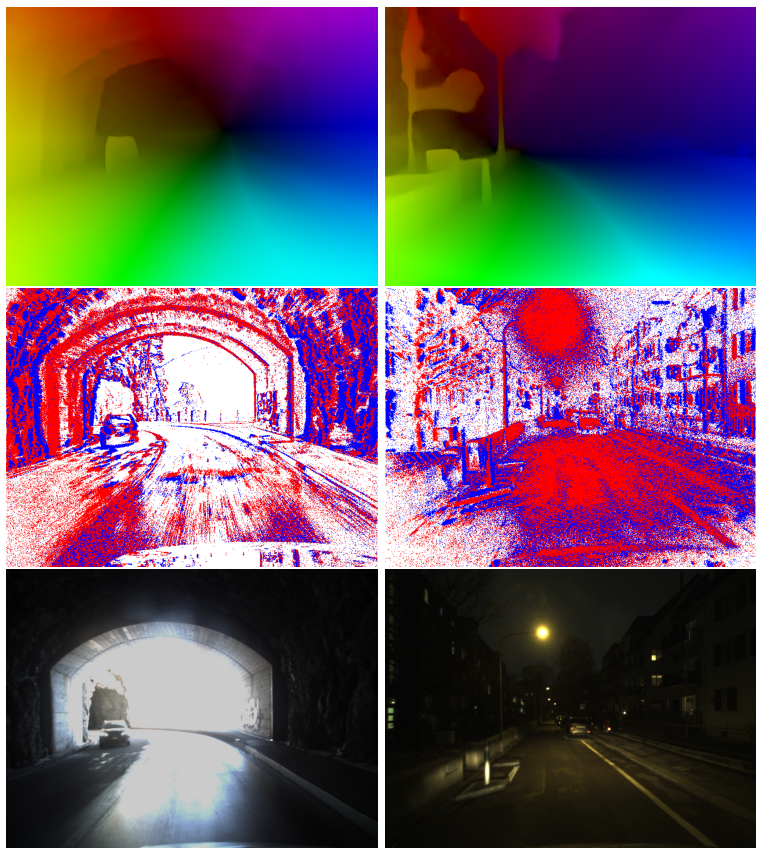
Optical flow predictions from our proposed approach trained on our novel optical flow dataset for event-based vision. The second and third row visualize input event data and images of the same scene respectively.
中文: 图 1|用本文提出的新事件光流数据集训练模型后所得的预测。第二行是输入事件的可视化,第三行是同一场景的图像。
编者读图: 三行共享场景坐标。第三行供人辨认街景,而非网络的另一条 RGB 输入;比较暗处的事件边缘与上方稠密颜色分布。
来源: 英文 PDF p.1 · S003
Original:
Optical flow estimation is a fundamental computer vision task that informs about movement in image space. It serves as a fundamental building block for visual odometry [28] for robotics and AR/VR, autonomous driving [16], action recognition [31], high dynamic range (HDR) imaging [18], and computational videography [25]. Traditionally, this problem is formulated as finding pixel correspondences between two images.
中文: 光流估计描述运动如何投影到图像平面,是计算机视觉的基本任务。机器人及 AR/VR 中的视觉里程计 [28]、自动驾驶 [16]、动作识别 [31]、高动态范围成像 [18] 和计算摄像 [25] 都以它为基础。传统问题表述是:找出两幅图像之间彼此对应的像素。
来源: 英文 PDF p.1 · S004
Original:
While earlier top-performing methods were mostly based on energy minimization techniques [13], current state of the art is dominated by neural network-based approaches [34].
中文: 早期精度最高的方法大多采用能量最小化 [13];如今,神经网络方法 [34] 已占主导地位。
来源: 英文 PDF p.1 · S005
Original:
Decades of research on image-based optical flow estimation have resulted in impressive results on public benchmarks [23]. However, image-based methods struggle in presence of motion blur [6] or over-saturated image regions due to limited dynamic range of image sensors. A promising sensor for optical flow estimation is the event camera.
中文: 经过数十年发展,基于图像的光流估计已在公开基准 [23] 上取得优异结果。然而,运动模糊 [6] 或传感器动态范围有限造成的过曝区域都会使这些方法失效。事件相机为光流估计提供了另一种有前景的传感器。
来源: 英文 PDF p.1–2 · S006
Original:
Event cameras drastically differ from image-based sensors in their way of acquiring data. In contrast to frame-based cameras, which capture images at regular intervals, event cameras report per-pixel brightness changes as a stream of asynchronous events. For a detailed survey on event cameras, we refer to [9]. The distinct advantages of event cameras are high temporal resolution (microseconds), high dynamic range ( dB), and no motion blur. All three aspects are essential for high-quality optical flow estimation in real-world applications. However, these advantages are tied to the fundamentally different data format resulting from event cameras.
中文: 事件相机的采集机制与帧式传感器截然不同:它不按固定间隔拍摄图像,而以异步事件流报告各像素的亮度变化。详细综述见 [9]。其优势在于微秒量级的时间分辨率、超过 120 dB 的动态范围以及没有帧曝光引起的运动模糊。三者对真实场景的高质量光流估计都很重要,同时也意味着必须处理一种完全不同的数据格式。
来源: 英文 PDF p.2 · S007
Original:
Effectively extracting motion from an asynchronous event stream is a non-trivial task. Unlike images, which can be directly used as input to convolutional neural networks, event data is sparse, irregular, and asynchronous in nature. Prior work on optical flow estimation from events proposed spatio-temporal plane-fitting [3], variational optimization based on discretized spatio-temporal volumes [2] and, more recently, convolutional architectures on preprocessed event data [40, 41, 38]. Similarly to image-based optical flow, the current state of the art is based on data-driven neural network approaches. These data-driven methods have in common that they are only evaluated for sparse optical flow prediction while relying on a U-Net architecture [29] to extract motion features from events converted into a tensor representation.
中文: 从异步事件流中有效提取运动并不容易。图像可以直接送入卷积网络,事件却在时空上稀疏、不规则且不同步。既有研究包括时空平面拟合、对离散化时空体做变分优化,以及在预处理事件上使用卷积网络。与帧式光流类似,当前领先方法主要由数据驱动。这些方法把事件转换为张量,用 U-Net 提取运动特征,并且只在稀疏位置评估光流。 [3, 2, 40, 41, 38, 29]
来源: 英文 PDF p.2 · S008
Original:
In contrast to event-based optical flow methods, modern image-based optical flow approaches make use of cost volumes to extract discriminant features [35, 32, 36, 34]. Typically, a neural network computes image features at a lower resolution, which are then used to compute feature correlations between the source and the target descriptors. The feature correlations are summarized in a cost volume that is processed with CNN layers [32, 36]. Teed et al. [34] chose instead to extract features from the cost volume via an iterative update scheme.
中文: 现代图像光流方法不同于上述事件方法,会借助代价体提取有判别力的特征。网络一般先在较低分辨率上计算图像描述子,再求源、目标描述子之间的相关性。相关值汇集为代价体,可以交给卷积层处理;Teed 等 [34] 则采用迭代更新,从代价体中逐步提取光流。 [35, 32, 36]
来源: 英文 PDF p.2 · S009
Original:
In contrast to prior work, we focus on dense optical flow estimation for event cameras and utilize cost volumes instead of using the U-Net architecture. First, we show that a state-of-the-art method designed for images can be adopted to work exceptionally well on event-data, outperforming all previously proposed methods consistently. Then, we exploit the fact that event data is sequential and propose a differentiable warm-starting technique that initializes the flow estimate for the next time step. Differently from previous work [34], we perform backprogagation through time via the differentiable warm-starting module. Our experiments suggest that incorporating this warm-starting technique in the training pipeline improves the performance on sequential event data further. More importantly, our proposed approach can be directly used for fine-tuning our non-recurrent model for sequential data because it does not introduce any additional parameters.
中文: 我们研究的是事件相机的稠密光流,用代价体代替 U-Net。首先,我们表明:把先进的图像光流方法用于事件数据,可以持续取得优于先前方法的性能。接着利用事件数据的顺序性,设计可微的热启动,用上一时刻的预测初始化下一时刻。不同于 [34],梯度经可微热启动模块沿时间反向传播。序列事件实验表明,训练时引入热启动还能提高精度。该模块不增加参数,因此可直接加入训练好的非循环模型,面向序列数据继续微调。
来源: 英文 PDF p.2 · S010
Original:
Until now, data driven optical flow methods on events have solely been evaluated on the MVSEC dataset [40]. Our analysis suggests that the difficulty of this dataset is very limited. For example, 95% of ground truth flow on the outdoor evaluation sequence [40] has a magnitude of less than 3 pixels (see figure 3). Based on this observation, we extend a recently proposed real-world driving dataset [11] with optical flow ground truth. This dataset features a maximum flow magnitude of up to 210 pixels and an event camera resolution that is three times higher than MVSEC. We train and evaluate a state-of-the-art event-based method on this dataset and show that our proposed approach outperforms existing approaches that have so far only been tested on MVSEC by 23% EPE (0.27 vs 0.35) and by 66% EPE (0.79 vs 2.32) on our proposed dataset.
中文: 此前,数据驱动的事件光流方法只在 MVSEC [40] 上评测。我们的分析表明,该数据集的难度有限:例如,室外评测序列中,95% 的真值位移小于 3 像素(图 3)。为此,我们为一套真实驾驶数据增加光流真值,新数据集的最大位移可达 210 像素,事件相机像素数约为 MVSEC 的三倍。我们重新训练并评测了已有的先进事件方法。与这类过去只在 MVSEC 上测试的方法相比,我们的方法在 MVSEC 上把 EPE 从 0.35 降至 0.27,降幅约 23%;在新数据集上则从 2.32 降至 0.79,降幅约 66%。 [11]
来源: 英文 PDF p.2 · S011
Original:
In summary, our contributions are
中文: 本文的贡献如下:
来源: 英文 PDF p.2 · S012
Original:
The first optical flow approach for event cameras that is designed and evaluated for dense optical flow estimation.
中文: 首次针对事件相机的稠密光流估计设计方法,并按稠密预测进行评估。
来源: 英文 PDF p.2 · S013
Original:
The first optical flow method for event cameras, which utilizes cost volumes and introduces recurrency to incorporate temporal priors. Previous event-based optical flow methods rely on plane fitting, variational optimization or pure CNN layers to estimate optical flow.
中文: 首次在事件光流方法中使用代价体,并引入循环结构以利用时间先验。以往方法主要通过平面拟合、变分优化或纯卷积层估计光流。
来源: 英文 PDF p.2 · S014
Original:
A novel real-world optical flow dataset for event-based vision with significantly larger pixel displacements, higher resolution than current datasets, and higher ground truth quality.
中文: 提出新的真实事件光流数据集。与当时已有数据集相比,它包含更大的像素位移、更高的空间分辨率和质量更好的真值。
来源: 英文 PDF p.2 · S015
Original:
Controlled experiments and evaluation on both MVSEC and our proposed dataset that suggest that both cost volumes and temporal recurrency are powerful concepts for event-based optical flow estimation outperforming purely convolutional architectures.
中文: 在 MVSEC 与新数据集上进行了受控对照实验。结果表明,代价体和跨时间的循环对事件光流估计均有效,优于纯卷积结构。
2 相关工作:2.1 基于图像的学习方法
来源: 英文 PDF p.2–3 · S016
Original:
Data-driven approaches for optical flow estimation has been pioneered by FlowNet [8]. In the following years, optical flow estimation has witnessed great progress through principled neural network design [39, 14, 15, 21, 32, 33, 36, 34]. As a result a few core ingredients for high performance optical flow estimation have emerged: (i) coarse-to-fine processing, (ii) the use of feature correlation volumes, and (iii) feature warping [39, 14, 15, 21, 32, 33, 36]. Teed et al. [34] builds on these ideas and extends them by constructing correlation volumes at multiple scales and introducing an iterative approach to extract optical flow from them, reaching state-of-the-art results on the Sintel[6] and KITTI[12] benchmarks.
中文: FlowNet [8] 开创了数据驱动的图像光流估计。随后,结构设计上的进展大幅提高了精度。高性能方法逐渐形成三类共同要素:从粗到细的处理、特征相关体,以及特征变形。Teed 等 [34] 进一步建立多尺度相关体,并迭代提取光流,在 Sintel 和 KITTI 基准上取得了当时领先的结果。 [39, 14, 15, 21, 32, 33, 36, 6, 12]
来源: 英文 PDF p.3 · S017
Original:
While these methods work well in standard conditions, their performance is intricately tied to the quality of the images used. These algorithms are thus not able to cope with image degradations, that occurr in challenging scenarios, such as in HDR scenes and during high-speed motion.
中文: 这些方法在常规条件下表现良好,精度却与输入图像质量紧密相连。因此,高动态范围场景和高速运动造成的图像退化,会超出它们的应对能力。
来源: 英文 PDF p.3 · S018
Original:
In this work, we seek to address this intrinsic limitation of current approaches, by proposing the use of event cameras [20] which do not suffer from motion blur or limited dynamic range.
中文: 为了克服这一内在限制,我们采用事件相机 [20],利用其不受常规帧式运动模糊影响、动态范围宽的特点。
2.2 事件光流估计
来源: 英文 PDF p.3 · S019
Original:
Algorithmic methods for event-based optical flow estimation can be summarized in three categories. First, iterative asynchronous methods inspired by [4, 10] by the well-known Lucas-Kanade algorithm [22]. The latter also leverages image data for photometric feature tracking. Second, plane fitting methods [5, 24] that exploit the local plane-like shape of spatio-temporal event streams. Third, variational optimization based approaches [2, 26] that incorporate image data [26] or simultaneously estimate image intensity [2]. These methods directly work on event data and often incorporate strong assumptions, such as brightness constancy [2, 26], into their models. In contrast, our approach learns abstractions and priors from data and does not rely on such assumptions.
中文: 传统的事件光流算法可分为三类。第一类是受 Lucas–Kanade 方法启发的迭代异步算法,其中一种还利用图像做光度特征跟踪。第二类是平面拟合,利用事件流在局部时空邻域内近似成平面的几何性质。第三类是变分优化,可引入图像数据或同时估计图像强度。这些方法直接使用事件,通常还需亮度恒常等强假设。与之不同,我们从数据中学习抽象特征和先验,不以这些假设为前提。 [4, 10, 22, 5, 24, 2, 26]
来源: 英文 PDF p.3 · S020
Original:
Another line of research pursues learning-based approaches and exclusively adopts the self-supervised learning framework [41, 19, 37, 27, 40]. Supervision is either provided by images [40, 41, 19] or events only [37, 27]. However, these methods, except for [37], choose to mask their optical flow prediction for evaluation due to limiting accuracy in regions where no events are present. On the other hand, Ye et al. [37] assume that the scene is static and predict optical flow via depth and ego-motion. All aforementioned approaches have in common that they use the U-Net architecture to directly estimate and evaluate sparse optical flow from event representations. In contrast to above methods, we predict and evaluate dense optical flow, make explicit use of longer temporal history, and leverage correlation features from cost volumes to estimate pixel correspondences for large displacements. Finally, we depart from the common theme of using a U-Net architecture for event-based optical flow estimation while at the same time outperforming existing methods consistently on multiple datasets.
中文: 另一条路线采用自监督学习,以图像或纯事件构造监督信号。除 Ye 等的方法外,已有研究大多因为无事件处精度不足,而在评测时掩去这些位置;Ye 等则假定场景静止,由深度和相机自身运动推算光流。上述路线通常以 U-Net 处理事件表征,主要估计和评估稀疏光流。本文则预测并评估稠密光流,显式使用更长的历史,并利用代价体的相关特征在大位移下寻找像素对应。在多个数据集上,这一不同于 U-Net 的设计均优于已有方法。 [41, 19, 37, 27, 40]
2.3 用于事件光流的数据集
来源: 英文 PDF p.4 · S021

Original:
Comparison of existing event camera datasets for optical flow estimation.
中文: 表 1|现有事件相机光流数据集对照。
编者读图: 从左到右核对训练/测试划分、真值质量、像素数、是否含平移、是否室外。MVSEC 的括号叉记表示划分不统一,而不是没有可用测试数据。
来源: 英文 PDF p.3 · S022
Original:
To the best of our knowledge, there are currently only three event camera datasets that contain optical flow ground truth data. Table 1 summarizes and relates them to our novel proposed dataset.
中文: 据我们所知,当时只有三个事件相机数据集含光流真值。表 1 比较了它们与本文数据集的差异。
来源: 英文 PDF p.3 · S023
Original:
DVSFLOW16 [30] and DVSMOTION20 [1] are two small datasets designed for evaluating event-based optical flow algorithms for rotational camera motion in indoor scenes. Due to their small size and restricted camera motion, they are not well suited for training and evaluation of neural network based approaches.
中文: DVSFLOW16 [30] 和 DVSMOTION20 [1] 是两个小型数据集,用于考查室内场景中相机旋转时的事件光流算法。样本少且相机运动受限,因此不太适合训练和评价神经网络。
来源: 英文 PDF p.3 · S024
Original:
More closely related to our work is the MVSEC dataset [40]. It contains 5 driving sequences and 4 indoor sequences in the same environment. Groundtruth optical flow data is computed from lidar odometry and mapping for the outdoor scenes. However, there are three major limitations of this dataset. First, the ground truth quality is impaired by the lack of proper handling of occlusions and moving objects. Second, the resolution of the event cameras is low with only 0.1 Megapixels leading to small pixel displacements. We analyze this aspect in detail in section 4. Finally, MVSEC does not introduce a clear train and test split [40]. For example, the authors evaluate their proposed method on the outdoor day 1 sequence but also train on this sequence to evaluate on the indoor sequences. We address all these shortcomings by proposing a novel dataset free of ambiguities from occlusions and artifacts from moving objects, 3 times higher camera resolution, and a well-defined training and test split with established metrics to foster reproducibility.
中文: 更接近本文的是 MVSEC [40],它包含 5 段驾驶序列和在同一环境下采集的 4 段室内序列。室外光流真值来自激光里程计和建图,但有三个主要限制。第一,遮挡和运动物体处理不充分,损害了真值质量。第二,事件相机仅有约 0.1 百万像素,位移偏小(详见第 4 节)。第三,没有明确、固定的训练测试划分;例如,已有工作既在 outdoor day 1 上做评测,又在评测室内序列时用该序列训练。新数据集清除了遮挡含混和运动物体伪影,将像素数提高到约三倍,并设置明确的数据划分和评价指标以支持复现。
3 方法
来源: 英文 PDF p.3 · S025
Original:
Our approach takes inspiration from recent work on two-frame optical flow estimation [34]. However, instead of images, we use consecutive packets of events, which we convert to tensor-like event representations that are compatible with standard CNNs. Two CNN encoders with shared weights create a feature embedding to compute an all-pairs correlation volume at -th of the original resolution. The same encoder architecture, but with a different set of weights, is used to encode context features for further processing. Both outputs are used in an iteration scheme to extract per pixel flow, as proposed in [34]. We then extend this formulation to a temporally recurrent architecture, that processes sequences of event packets, by leveraging differentiable warmstarting of optical flow (Sec. 3.3).
中文: 方法受双帧光流 [34] 启发,但输入改为连续事件包,并转换成标准卷积网络能处理的张量。两个共享权重的卷积编码器生成特征嵌入,在原始宽、高各八分之一处建立全对相关体。另一个结构相同、权重独立的编码器提取上下文特征。两种输出共同进入迭代更新,求出逐像素光流。再通过可微热启动,将模型扩展为能够处理连续事件包序列的时间循环结构(第 3.3 节)。
3.1 问题定义
来源: 英文 PDF p.3 · S026
Original:
Dense optical flow estimation is commonly defined as the task of finding pixel correspondences between two images and [23, 6] denoted as flow . For event cameras, we are interested in the analog setting of finding pixel correspondence between two timestamps and given events in between both timestamps. In other words, our setting is strictly sequential in contrast to image-based optical flow estimation. For the sake of concise notation, the remaining text refers to as .
中文: 通常,稠密光流是寻找图像 与 的像素对应,记为 。在事件相机上,相应问题是:给定两时刻之间的事件,找出时刻 与 之间的像素对应 。与双图像设定不同,这里严格按时间顺序处理数据。下文把它简写为 。 [23, 6]
来源: 英文 PDF p.3–4 · S027
Original:
Different from frame-based cameras that acquire images at a specific rate, event cameras respond to brightness changes in the scene asynchronously and independently for each pixel. They do this by maintaining a per-pixel reference log intensity. As soon as a sufficient deviation from this memorized value is detected, an event is triggered and the memorized value is updated. An event is a tuple containing information about its pixel location , the exact trigger time as well as the 1-bit polarity that indicates whether the brightness change was positive or negative. We define a sequence of events between time and as .
中文: 帧式相机按一定频率成像,事件相机的每个像素独立、异步地响应亮度变化。像素保存对数强度参考值;一旦当前强度相对参考值的偏离足够大,就触发事件并更新参考值。每个事件 包含像素坐标、触发时刻及一位极性,后者说明亮度是增加还是降低。将两时刻间的有序事件写作 。
3.2 从事件包构建 RAFT
来源: 英文 PDF p.4 · S028
Original:
Previous approaches for event-based optical flow estimation with neural networks build an input representation given event data between and and directly regresses optical flow [40, 41, 27]. Instead, we propose to regress from two short consecutive event sequences and .
中文: 以往神经网络通常只用 到 的事件构造输入,直接回归 。我们使用两个连续短时事件包: 和 ,来回归同一目标位移。 [40, 41, 27]
来源: 英文 PDF p.4 · S029
Original:
Our baseline approach builds on the RAFT architecture [34]. We choose this architecture due to its extensibility to sequential data that we describe in detail in section 3.3 and visualize some components in figure 2. RAFT uses three feature embeddings to compute optical flow. First, two feature embeddings are created with a shared encoder to compute a cost volume, which is illustrated in blue in figure 2. Second, a context encoder with a different set of weights creates features, shown in green in figure 2, that are directly used by a GRU update block [7].
中文: 基线采用 RAFT [34],因为它容易扩展到第 3.3 节所述的序列设定(图 2)。RAFT 计算三份嵌入:共享编码器为两份输入分别提取特征,用于构建代价体(蓝色);不同权重的上下文编码器再给出第三份特征(绿色),直接送入 GRU 更新模块。 [7]
来源: 英文 PDF p.4 · S030
Original:
To adopt this idea for event data, we need to build an event representation that is compatible with CNN layers. Our idea is to split a short sequence of event data into two subsequences. More specifically, we select an event sequence where and a second event sequence . For each event sequence, we create a volumetric voxel grid representation of event data [41]. It discretizes the time dimension but is able to retain most of the temporal aspect of events through bilinear interpolation in time. The feature correlation encoder produces a feature embedding from and while the context encoder only receives the event representation of . The reason for this is that events between to contain more accurate contextual information for the prediction of than events before time .
中文: 为了使用卷积层,首先需要合适的事件表征。取前一包从 至 、后一包从 至 。对每包分别构建体素网格 [41],把时间轴离散化,并沿时间进行插值,因而能保留大部分时间信息。相关特征编码器分别处理前、后两个事件表征;上下文编码器只看后一包。原因在于,与 之前的事件相比,从 到 的事件更直接反映待估计流场所在时段的上下文。
来源: 英文 PDF p.5 · S031
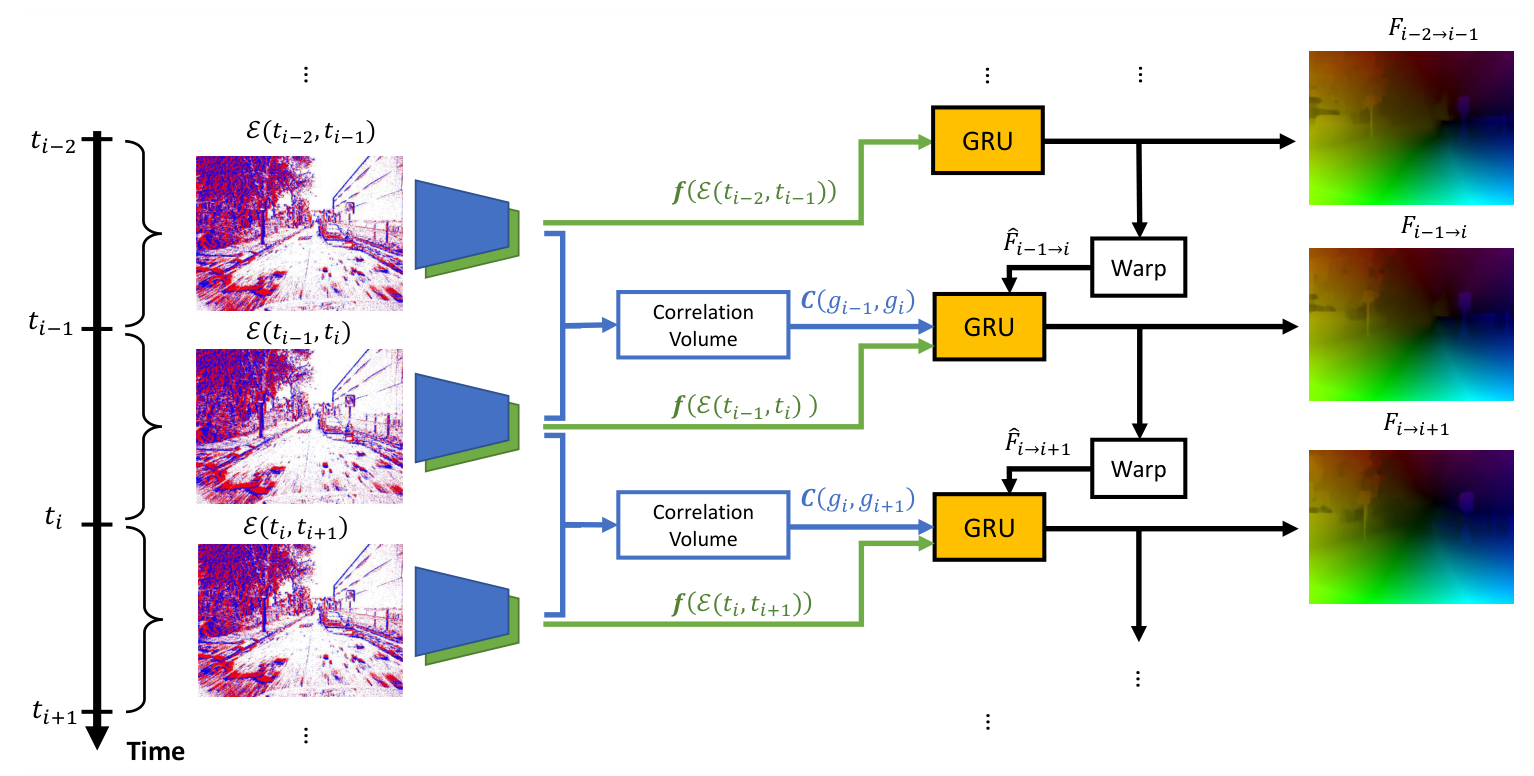
Original:
Our proposed recurrent approach for event-based optical flow estimation. The architecture computes a cost volume from two subsequent event representations. Another context encoder intializes the hidden state of the GRU update unit and provides additional semantic priors. Our proposed warping module fuses different timestamps together and facilitates propagation of information through time.
中文: 图 2|事件光流的循环估计。相邻两个事件表征用于构造代价体 ;上下文编码器 初始化 GRU 的隐状态,并提供额外语义先验。变形模块连接不同时间戳,使信息能够沿时间传播。
编者读图: 横向读一次更新:两包→相关体,后包→上下文。再纵向读相邻时刻:Warp 传递的是已经移到新坐标的流,不是把像素索引原样复制。
3.3 可微的光流热启动
来源: 英文 PDF p.4 · S032
Original:
This section elaborates on a method to incorporate flow priors from previous time steps not only in the evaluation but also in the training of the model.
中文: 本节讨论如何使前一时段的光流先验不仅在评测时生效,也参与模型训练。
来源: 英文 PDF p.4 · S033
Original:
By default, the RAFT architecture initializes the flow estimate with 0. Given sequential data, it is also possible to initialize the optical flow from the last prediction [34]. Different from prior work, we propose to implement this initialization step in a differentiable manner and incorporate the warm-starting module in the training. By doing this, the neural network can incorporate temporal priors and backpropagate gradients through time. The proposed warm-starting module does not introduce any additional parameters and can be added to already trained networks for further finetuning. The overall approach is visualized in figure 2.
中文: RAFT 默认把初始光流 设为零。数据成序列时,也可用上一次预测来初始化。我们把这一步写成可微运算并纳入训练,使网络既能使用时间先验,又能沿时间反向传播梯度。热启动不引入额外参数,可以加到已经训练好的网络上继续微调。整体结构见图 2。 [34]
来源: 英文 PDF p.4 · S034
Original:
Our goal is to reuse the previous flow prediction to initialize the iterative update module that eventually estimates . However, simply copying the previous flow estimate to initialize the current one would not take into account that the source pixel location changed according to the flow itself. Instead, the flow has to be forward warped to the next timestamp. We achieve this through forward warping of the flow predictions. In forward warping, multiple source pixels can map to the same target pixel leading to ambiguities, which is why we perform average splatting in the target pixel space. We do this by normalizing the warped flow with the weights derived from the bilinear kernel. In summary, the flow is initialized with the previous flow prediction in the following way:
中文: 我们想用 初始化最终求取 的迭代模块。但若直接照抄旧流场,就忽略了源像素位置已随光流移动。必须将旧流场向前变形到下一时间戳。多个源像素可能映射到同一个目标像素,为消除歧义,我们在目标网格上做加权平均散射:将投送的向量按双线性核的权重和归一化。因此,用前一预测初始化新流场可写为:
来源: 英文 PDF p.4 · S035
Original:
中文: 式(1–2)|先把源像素移到预测位置,再把到达同一目标邻域的前一时段位移向量按权重平均。
来源: 英文 PDF p.4 · S036
Original:
where
中文: 其中,权重为
来源: 英文 PDF p.4 · S037
Original:
中文: 式(3)|双线性插值核。
来源: 英文 PDF p.4 · S038
Original:
is the bilinear interpolation kernel. These operations are subdifferentiable and can directly be implemented in deep learning frameworks such as PyTorch.
中文: 该核沿两个坐标轴分别作线性插值,再取乘积。这些运算可取次梯度,能够直接用 PyTorch 等深度学习框架实现。
3.4 监督信号
来源: 英文 PDF p.5 · S039
Original:
We supervise all methods on the distance between optical flow prediction and groundtruth. The loss function for our method is defined as
中文: 所有方法均用预测光流与真值之间的 距离监督。本文方法的损失为:
来源: 英文 PDF p.5 · S040
Original:
中文: 式(4)|对序列内每一时段、每一次迭代的误差求和,越靠近最终预测的迭代,权重越大。
来源: 英文 PDF p.5 · S041
Original:
where is the sequence length, the number of iteration steps per timestep, the groundtruth for time , and the prediction at the th iteration at time . We set .
中文: 其中 是序列长度, 是每一时段的迭代次数; 为第 个时段的真值, 是同一时段第 次迭代的预测。本文取 。
4 DSEC-Flow 数据集
来源: 英文 PDF p.5 · S042
Original:
This section introduces our proposed optical flow dataset that overcomes the major shortcomings of the MVSEC optical flow dataset [40]. Our proposed dataset extends the publicly available DSEC dataset [11] which contains disparity ground truth obtained from a rotating Lidar. It features VGA resolution event cameras which have 3.4 times the number of pixels compared to the Davis346 used in the MVSEC dataset. Another advantage of the DSEC dataset is that the disparity maps are cleaned from occlusions, and Lidar points on moving objects have been removed with a stereo matching filtering technique. These aspects build a foundation for our extension of this dataset to optical flow ground truth.
中文: 我们扩展了公开的 DSEC 数据集,以弥补 MVSEC 的主要不足。原 DSEC 已提供由旋转式激光雷达取得的视差真值。其 VGA 事件相机的像素数是 MVSEC 所用 Davis346 的 3.4 倍。DSEC 的视差图还剔除了遮挡,用双目匹配筛选掉运动物体上的激光点。这些条件使进一步构造光流真值成为可能。 [40, 11]
来源: 英文 PDF p.5 · S043
Original:
We utilize the intrinsic and extrinsic calibration data for each sequence to reproject the disparity map into 3D. We then use the odometry ground truth from the dataset to estimate the forward and backward optical flow at 10 Hz assuming that the scene is static. However, we noticed that, even though most lidar points on dynamic objects have been removed via the proposed filtering technique [11], some points remain on the dynamic objects. To ensure accurate optical flow ground truth, we manually inspect the whole dataset and extract all parts of sequences that contain static environments. The resulting dataset contains 7800 training samples and 2100 test samples in 24 sequences at day and night. Figure 4 shows examples of optical flow predictions on this dataset.
中文: 对于每一段序列,我们使用相机内参和外参将视差重新投影到三维,再根据真值里程计,在场景静止的假设下,以 10 Hz 计算前向和后向光流。已有过滤虽去除了大多数动态物体上的激光点,却仍有残留。为保证真值精度,我们人工检查全部数据,只截取环境静止的区段。最终数据集含昼夜共 24 段序列,约 7,800 个训练样本和 2,100 个测试样本。图 4 给出了预测示例。 [11]
来源: 英文 PDF p.5 · S044
Original:
An important aspect that indicates the difficulty of an optical flow dataset is the distribution of pixel displacement magnitudes. Typically, smaller pixel displacements are easier to predict accurately, in absolute error, than large displacements [6]. On the other hand, estimating long-range correspondences has proven to be key for accurate, drift-free optical flow estimation for high-speed video [17]. Consequently, it is important to devise methods and datasets that address both small and large displacements.
中文: 像素位移幅值的分布是判断光流数据集难度的重要依据。若用绝对误差衡量,小位移通常比大位移容易估准;而高速视频若要获得准确、低漂移的光流,又必须建立长距离对应。因此,数据集和算法都要同时兼顾小位移与大位移。 [6, 17]
来源: 英文 PDF p.5–6 · S045
Original:
Figure 3 analyzes displacement distribution of our dataset and compares the ground truth flow magnitudes of DSEC-Flow with MVSEC. Optical flow ground truth for MVSEC is originally provided at 20 Hz. However, following initial evaluation of Zhu et al. [40], recent work also evaluates on temporally upsampled ground truth at frame rate [19, 41, 37] at approximately 45 Hz.
中文: 图 3 比较 DSEC-Flow 和 MVSEC 的真值位移分布。MVSEC 原生光流真值为 20 Hz;沿用 Zhu 等最初的评估方式,后续工作也将真值沿时间轴上采样至相机帧率,约为 45 Hz。 [40, 19, 41, 37]
来源: 英文 PDF p.6 · S046
Original:
Figure 3 also shows that our dataset consists of drastically higher displacement fields than MVSEC. 80 % of optical flow magnitudes on MVSEC are lower than 4 pixels. For the upsampled version this value decreases to mere 1.7 pixels. In stark contrast, DSEC-Flow reaches 22 pixel flow magnitude for the 80 % percentile.
中文: 新数据集的位移明显更大。MVSEC 上,80% 的位移小于 4 像素;上采样版本的这一阈值降至 1.7 像素。DSEC-Flow 的第 80 百分位则达到 22 像素。
来源: 英文 PDF p.6 · S047
Original:
For further analysis, we also normalize the flow magnitudes by the image width. The 80 % percentile for our dataset is 3.4 % while MVSEC reaches 1.3 % and 0.5 % respectively. This indicates that DSEC-Flow is more challenging even when normalized with respect to the resolution of the camera.
中文: 再按图像宽度归一化,DSEC-Flow 的第 80 百分位为 3.4%,MVSEC 原版和上采样版分别为 1.3% 与 0.5%。因此,即使剔除相机分辨率不同带来的影响,新数据集仍更难。
4.1 评价方法
来源: 英文 PDF p.6 · S048
Original:
Our test set consists of approximately 2100 ground truth flow maps in seven different sequences. We evaluate optical flow predictions based on the end-point-error (EPE) and also compute the -pixel errors (PE) that indicate the percentage of flow errors higher than pixels in magnitude. We compute PE for equals 3, 2 and 1 for coarse to fine analysis of flow outliers, but consider the EPE as the default metric since it provides the most accurate measure of flow accuracy.
中文: 测试集包含 7 段序列的约 2,100 张真值光流图。评价既使用端点误差 EPE,也报告误差幅值大于 像素的比例,即 PE。分别取阈值 3、2、1 像素,由粗到细分析大误差;默认指标采用 EPE,因为它对光流精度的刻画更细致。
来源: 英文 PDF p.6 · S049
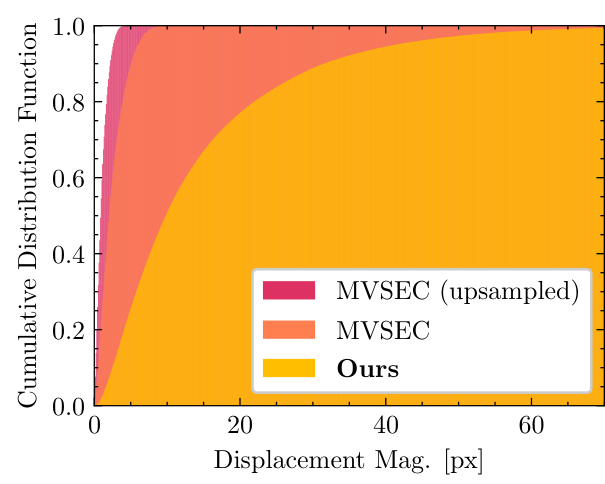
Original:
Cumulative Distribution of flow magnitudes normalized by the number of pixels in image width. Our dataset consists of significantly higher optical flow than the MVSEC variants. “upsampled” indicates that the dataset ground truth has been temporally upsampled according to Zhu et. al [40]
中文: 图 3|光流幅值的累积分布。原图注写作按图像宽度的像素数归一化;新数据集的位移显著大于 MVSEC 的两个版本。“Upsampled”指依 Zhu 等的方法在时间上对真值上采样。横轴实际单位见图旁译注。
编者读图: 在纵轴 0.8 处横向读,第 80 百分位为 1.7、约 4、22 px。图内横轴是 px;正文另报除以图宽后的 0.5%、1.3%、3.4%。
5 实验
来源: 英文 PDF p.6 · S050
Original:
We evaluate our method on MVSEC [40] and the proposed dataset DSEC-Flow. The published baselines are exclusively self-supervised methods that have been trained and evaluated on the MVSEC dataset. Since we are interested in understanding the full potential of existing approaches in comparison to our method, we retrain the EV-FlowNet [40, 41] architecture on both MVSEC and DSEC-Flow with direct supervision from scratch. Note that the EV-FlowNet architecture, which was also used in [41], achieved the lowest EPE of all baselines in the sparse evaluation summarized in table 2. (ECN [37] computes static optical flow only indirectly via depth and ego-motion. Therefore, the comparison is not fair.) We optimize the learning rate for each method separately and perform horizonal flipping and random cropping for data augmention on all datasets. We also set the number of iterations per timestep, in equation 4, to 12 for training and evaluation on both datasets.
中文: 我们在 MVSEC 和新提出的 DSEC-Flow 上评估方法。既有基线均为在 MVSEC 上训练和评估的自监督方法。为比较已有结构能达到的水平,我们用真值监督,从头在两个数据集上重训 EV-FlowNet。采用相同结构的工作在表 2 所列直接估计光流的基线中,稀疏 EPE 最低。脚注:ECN 只借助深度和相机运动间接计算静态场景光流,不宜直接相比。各方法分别调节学习率,均采用水平翻转、随机裁剪增强。两套数据在训练和评估时,每一时段均迭代 12 次。 [40, 41, 37]
5.1 MVSEC
来源: 英文 PDF p.7 · S051
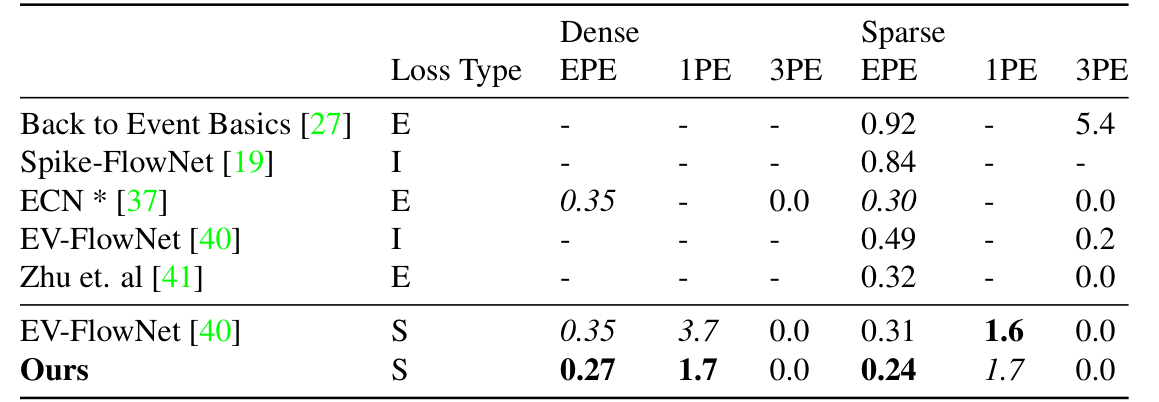
Original:
MVSEC results at temporally upsampled optical flow ground truth at around 45 Hz. Supervision type E refers to event-based loss, I to image-based (photometric) loss, and S to supervised learning. indicates that this method predicts optical flow via depth and ego-motion. Best performance in bold and second best in italic. We do not highlight the 3PE as it is zero for almost all methods.
中文: 表 2|MVSEC 上将光流真值沿时间上采样至约 45 Hz 的结果。监督类型 E 为事件损失,I 为图像光度损失,S 为有真值监督;星号表示由深度和相机自身运动间接求光流。最优值加粗,次优值用斜体。几乎所有方法的 3PE 都为零,因此该列不标优。
编者读图: 先选 Dense 或 Sparse 再比较。监督版 EV-FlowNet 与本文方法在稠密掩膜口径分别为 0.35、0.27 px;稀疏列分别是 0.31、0.24 px。
来源: 英文 PDF p.7 · S052
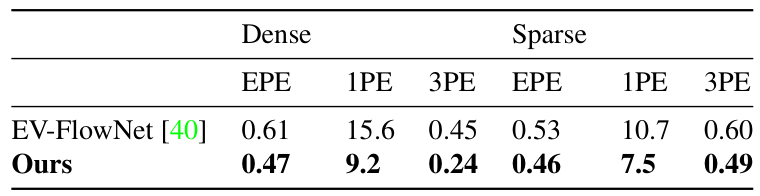
Original:
MVSEC results at original ground truth rate of 20 Hz. Best performance in bold.
中文: 表 3|MVSEC 原生 20 Hz 真值上的结果,粗体为最优值。
编者读图: 用 20 Hz 原生真值,稠密 EPE 由 0.61 降到 0.47 px;3PE 不再处处为零。时间窗改变了位移大小,不能横跨两张表比较百分比而忽略采样条件。
来源: 英文 PDF p.6 · S053
Original:
On MVSEC we train our approach with differentiable warm-starting from scratch with sequence length 2 on the outdoor day 2 sequence. After 10 epochs, we increase the sequence length to 5. We follow prior work and train, and evaluate on the temporally upsampled ground truth. The upsampled ground truth is post-processed to the frame-rate of the camera frames approximately at 45 Hz. Additionally, we also train, and evaluate EV-FlowNet and our method on the provided ground truth without any modifications to render the task more challenging.
中文: 在 outdoor day 2 序列上从头训练采用可微热启动的模型,起初序列长度为 2,10 个 epoch 后增至 5。与已有工作一致,先基于上采样到相机帧率(约 45 Hz)的真值训练并评估。另外还用未经修改的原生真值训练和评估 EV-FlowNet 与本方法,以提高任务难度。
来源: 英文 PDF p.6 · S054
Original:
Note that we also report 3-pixel errors on MVSEC to stay consistent with prior work in table 2, although 3PE is typically zero.
中文: 为与前人结果保持可比性,表 2 也给出 MVSEC 上的 3 像素误差比例,虽然它通常为零。
来源: 英文 PDF p.6 · S055
Original:
Sparse vs. Dense. Prior work often masks the optical flow predictions to the pixel locations where events triggered [40, 41, 19, 27]. Since not all methods are open source, we compare against our approaches and the supervised baseline at upsampled ground truth. Table 2 shows that the metrics are consistently lower when the evaluation is performed with masked ground truth. The sparse EPE is 11% lower compared to the dense EPE. Hence, dense optical flow prediction is a more difficult task on MVSEC. With a dense EPE of 0.27 and sparse EPE of 0.24, our approach outperforms the sparse and dense baselines and methods proposed in the literature.
中文: 稀疏与稠密。既有研究往往只评估触发事件的像素。由于并非所有方法都开源,我们用上采样真值比较本方法与有监督基线。表 2 表明,加事件掩膜后,各项指标普遍降低:本方法稀疏 EPE 比稠密 EPE 低约 11%。可见在 MVSEC 上,稠密预测更难。本方法的稠密、稀疏 EPE 分别为 0.27 和 0.24,优于稀疏及稠密评估里的基线与文献结果。 [40, 41, 19, 27]
来源: 英文 PDF p.6 · S056
Original:
Supervised vs. Self-Supervised. Our approach and the retrained EV-FlowNet baseline are the only supervised networks in the literature on this dataset. Regardeless of sparse or dense evaluation, supervised methods generally outperform self-supervised methods. The worse performing supervised baseline, EV-FlowNet, achieves a sparse EPE of 0.31 while Zhu et al. [41] reach 0.32 EPE. We hypothesize that the EPE error advantage of supervised learning methods would be significantly higher if MVSEC ground truth optical flow would be of higher quality.
中文: 有监督与自监督。在该数据集的已有比较中,只有本文模型和重训的 EV-FlowNet 使用真值监督。无论稀疏还是稠密评估,有监督方法总体优于自监督方法。较弱的有监督基线 EV-FlowNet 的稀疏 EPE 为 0.31,而 Zhu 等方法为 0.32。作者推测,若 MVSEC 光流真值质量更高,有监督学习的优势还会更大。 [41]
来源: 英文 PDF p.6–7 · S057
Original:
Temporally Upsampled vs Original Groundtruth Rate. Table 3 illustrates the performance of supervised EV-FlowNet and our method on MVSEC without ground truth upsampling. The direct comparison of our method and the supervised EV-FlowNet on both MVSEC versions reveils that the EPE of our approach is 23 % lower in both cases. Hence, the original (20 Hz) optical flow of MVSEC does not yet reveil additional insights with respect to the performance of estimating larger displacement fields. The experiments of the next section 5.2 addresses this challenge. Nonetheless, the 1-pixel error increases substantially for both methods. This is, of course, expected because the optical flow magnitudes increase due to the larger time windows.
中文: 时间上采样与原生频率。表 3 给出两种有监督方法在未上采样的 MVSEC 上的表现。本方法相对 EV-FlowNet 的 EPE 降幅,在两种真值频率下均约为 23%。因此,把 MVSEC 改用原生 20 Hz 真值,尚不足以揭示估计大位移时二者有何不同,下一节将专门考察这一点。但两种方法的 1 像素误差比例都明显增大,这是时间窗变长、位移随之增大的预期结果。
5.2 DSEC-Flow
来源: 英文 PDF p.7 · S058
Original:
On the DSEC-Flow dataset we perform horizontal flipping and random cropping to 288 pixels in height and 384 pixels in width. We train our non-recurrent approach with a learning rate of with Adam for 40 epochs until convergence. Then, we introduce the differentiable warm-starting with a sequence length of 3 and train for another 6 epochs with random cropping. Finally, we reduce the learning rate by a factor of 10 and fine-tune on the full resolution for evaluation. For a fair comparison, we apply the same fine-tuning schedule to the non-recurrent architecture as well as the baseline model.
中文: 在 DSEC-Flow 上,先作水平翻转并随机裁剪为高 288、宽 384 像素,用 Adam 和 的学习率训练非循环版本 40 个 epoch,直至收敛。随后加入可微热启动,使用长度为 3 的序列,继续随机裁剪并训练 6 个 epoch。最后将学习率降为原来的十分之一,在完整分辨率上微调后评估。为保证公平,非循环模型及基线也使用同样的微调安排。
来源: 英文 PDF p.7 · S059
Original:
Table 4 compares our approach against the baseline method. Our method achieves an EPE of 0.79 which is 2.9 times lower than EV-FlowNet with an EPE of 2.32. To our surprise, EV-FlowNet does not perform comparably in DSEC-Flow. This is different to the MVSEC experiments where the performance difference between our method and EV-FlowNet was in a comparable range. A possible explanation is that EV-FlowNet was designed on MVSEC to work for small pixel displacements.
中文: 表 4 中,本方法的 EPE 为 0.79,EV-FlowNet 为 2.32,后者约为前者的 2.9 倍。在 MVSEC 上,两种方法的误差尚属同一量级;在 DSEC-Flow 上,EV-FlowNet 却明显落后。作者提出的一种可能解释是:EV-FlowNet 是在 MVSEC 的小位移条件下设计的。
来源: 英文 PDF p.7 · S060
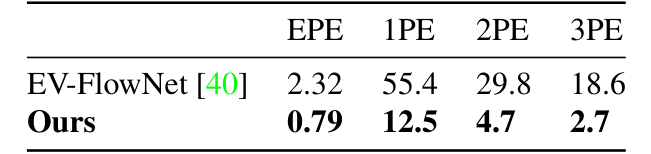
Original:
Evaluation on the DSEC-Flow dataset. Best performance in bold.
中文: 表 4|DSEC-Flow 数据集上的评估结果,最优值加粗。
编者读图: DSEC:EPE 以像素计,其余为百分比。本文 / 基线的 3PE 为 2.7% / 18.6%;看平均值之外,还应看长尾。
| DSEC 测试集 | EPE / px | 1PE / % | 2PE / % | 3PE / % |
|---|---|---|---|---|
| EV-FlowNet | 2.32 | 55.4 | 29.8 | 18.6 |
| E-RAFT | 0.79 | 12.5 | 4.7 | 2.7 |
来源: 英文 PDF p.8 · S061
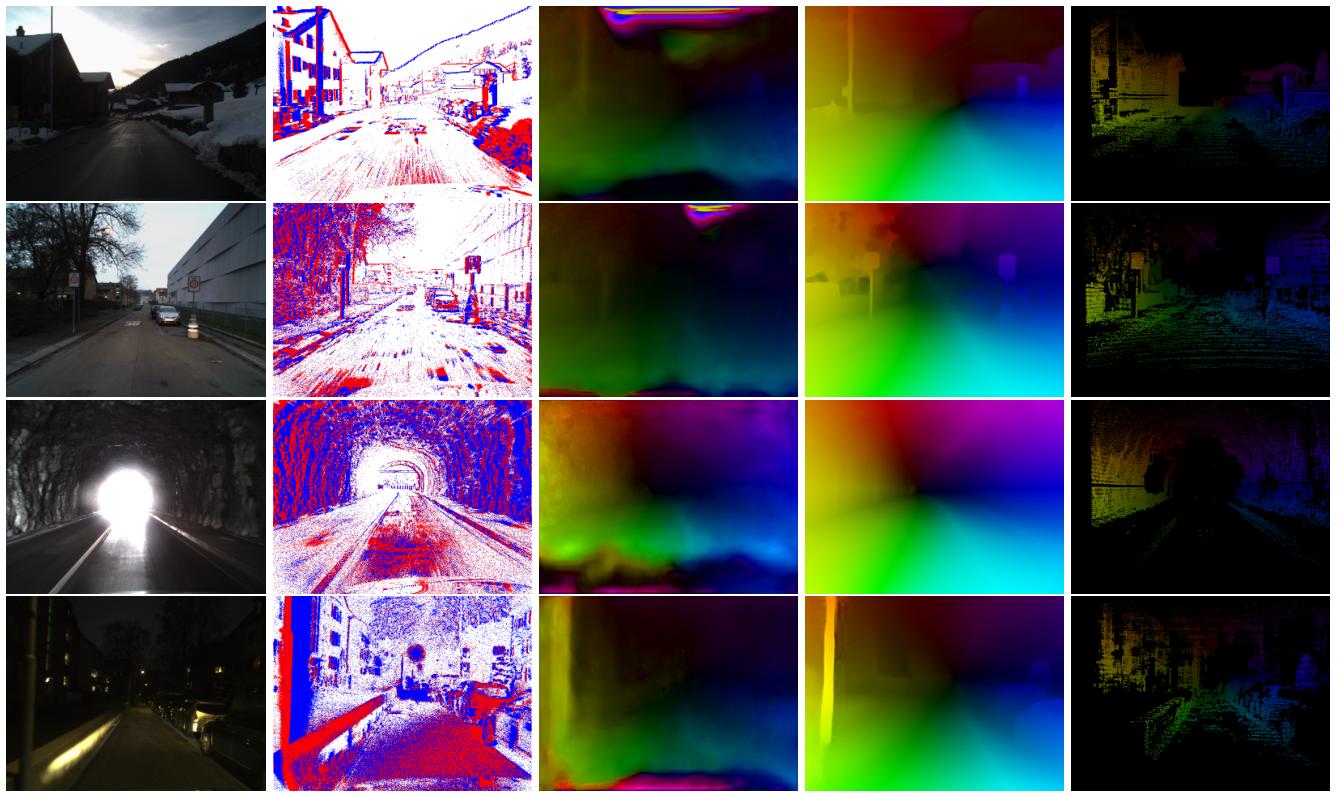
Original:
Qualitative examples of optical flow predictions on the DSEC-Flow test set. Best viewed in PDF format. From left to right: Image for visualization only, events visualized as image, EV-Flownet, our approach, and the ground truth. While EV-FlowNet does produce very noisy optical flow, our proposed approach is able to produce very sharp boundaries consistently.
中文: 图 4|DSEC-Flow 测试集的光流预测示例,建议放大 PDF 查看。从左至右依次为仅供观察的图像、事件可视化、EV-FlowNet、本文预测、真值。相比噪声明显的 EV-FlowNet,本文方法能较稳定地给出清晰的运动边界。
编者读图: 从左到右比较输入、估计和真值的有效覆盖。估计边缘更锐利并不等于没有激光真值的区域也已被定量验证。
5.3 消融实验
来源: 英文 PDF p.7 · S062
Original:
This section introduces the ablation studies that highlight the significance of different modules. We perform these ablation studies both on the DSEC-Flow dataset and on the MVSEC dataset. Table 5 summarizes the results of the ablation study that focuses on warm-starting strategies in combination with different evaluation and training combinations.
中文: 接下来用消融实验分析各模块的作用。两套数据集均进行消融;表 5 汇总不同热启动策略及训练、评测组合的结果。
来源: 英文 PDF p.8 · S063
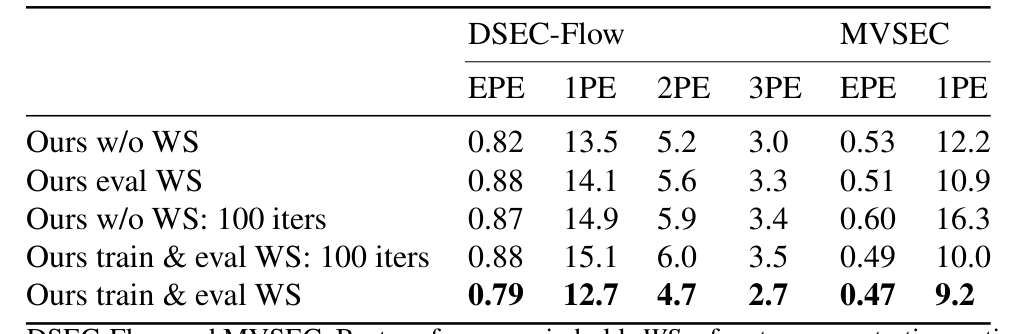
Original:
Ablation study on DSEC-Flow and MVSEC. Best performance in bold. WS refers to warm-starting optical flow from the previous estimated optical flow. eval WS means that warm-starting is only used at inference time without training with warm-starting beforehand.
中文: 表 5|DSEC-Flow 与 MVSEC 上的消融结果,最优值加粗。WS 指用前一预测初始化当前光流;eval WS 指训练时未用热启动,仅在推理时启用。
编者读图: 在 DSEC,训练不热启动、只在推理热启动使 EPE 从 0.82 恶化到 0.88;训练与推理都启用才到 0.79。表 5 的最终 1PE 为 12.7%,和表 4 的 12.5% 略异。
来源: 英文 PDF p.7 · S064
Original:
The baseline method (Ours w/o WS) is the proposed non-recurrent architecture applied to event data and does not incorporate any warm-starting in training or evaluation.
中文: “Ours w/o WS”是处理事件数据的非循环版本,训练和评估都不使用热启动。
来源: 英文 PDF p.7 · S065
Original:
DSEC-Flow Dataset. On the DSEC-Flow dataset, the baseline approach performs better compared to evaluating the same method with warm-starting. That is without incorporating warm-starting in the training. Surprisingly, it also outperforms both evaluation protocols that involve 100 iterations per timestep, regardless whether we train and evaluate with warm-starting or not. Our proposed approach, which incorporates warm-starting in the training and evaluation, outperforms the ablated methods with 4.0 % lower EPE of 0.79.
中文: DSEC-Flow。在训练时没有引入热启动的情况下,仅在评估时启用反而不如基线。不论是否在训练及评估中使用热启动,把迭代数增至每时段 100 次的两种设置也都不如基线。训练和评估均使用热启动的正式方法 EPE 为 0.79,作者报告相对消融方案降低约 4.0%。
来源: 英文 PDF p.7–8 · S066
Original:
MVSEC Dataset. The results on the MVSEC ablation similarly suggest that training and evaluating with warm-starting is superior to the aforementioned variations. However, differently from DSEC-Flow, purely evaluating with warm-starting (without training) leads to lower errors than not using warm-starting at all. Still, the model that also incorporates training with the warm-starting module achieves 4.2 % lower EPE than the closest ablated method (training + evaluation + 100 iterations).
中文: MVSEC。训练与评估都使用热启动同样最好。与 DSEC-Flow 不同,即使训练时不使用,只在评测时打开热启动也比完全不用的误差低。与最接近的消融配置(训练和评估均热启动、迭代 100 次)相比,完整方法的 EPE 又降低了 4.2%。
来源: 英文 PDF p.8 · S067
Original:
Overall, the effect of incorporating warm-starting into the fine-tuning procedure improves the performance consistently by a few percent on both datasets. Surprisingly, such gains are not consistent in our experiments if we only add warm-starting at inference time as reported in [34].
中文: 总体来看,在微调时就引入热启动,可在两个数据集上稳定获得几个百分点的改进。若像 [34] 那样仅在推理时加入,实验中则不能稳定复现这种收益。
6 结论
来源: 英文 PDF p.8 · S068
Original:
This work proposes an alternative approach to event-based optical flow estimation by adopting design choices from frame-based optical flow estimation and modifying the method to integrate with event-based input. We showed that the proposed method drastically outperforms baseline methods on two datasets, which suggests that the commonly used U-Net architecture in the event-based literature is a suboptimal choice for the task at hand. A key contribution of this work is a novel real-world optical flow dataset that addresses the major shortcomings of existing event-based datasets. We showed that training on this dataset leads to high-quality optical flow predictions that are unattainable with previous event-based vision datasets.
中文: 本文将帧式光流估计中的设计改造为可处理事件输入的方法。在两套数据集上,新方法都显著优于基线,说明事件视觉文献中常见的 U-Net 架构对这一任务并非最佳选择。另一项主要贡献是新的真实场景光流数据集,它针对已有事件数据集的主要不足作了改进。在此数据集上训练,得到的光流预测质量超过了既有事件数据集能够支持的水平。
7 致谢
来源: 英文 PDF p.8 · S069
Original:
This work was supported by the National Centre of Competence in Research (NCCR) Robotics through the Swiss National Science Foundation (SNSF) and by the European Research Council (ERC) under Grant Agreement 864042 (AGILEFLIGHT)
中文: 本工作获瑞士国家科学基金会(SNSF)支持的国家机器人研究能力中心(NCCR Robotics),以及欧洲研究理事会(ERC)资助,项目协议号 864042(AGILEFLIGHT)。
参考文献(英文原样编目)与多媒体
[1] Mohammed Almatrafi, Raymond Baldwin, Kiyoharu Aizawa, and Keigo Hirakawa. Distance surface for event-based optical flow. IEEE transactions on pattern analysis and machine intelligence, 2020.
[2] Patrick Bardow, Andrew J. Davison, and Stefan Leutenegger. Simultaneous optical flow and intensity estimation from an event camera. In IEEE Conf. Comput. Vis. Pattern Recog. (CVPR), pages 884–892, 2016.
[3] Ryad Benosman, Charles Clercq, Xavier Lagorce, Sio-Hoi Ieng, and Chiara Bartolozzi. Event-based visual flow. IEEE Trans. Neural Netw. Learn. Syst., 25(2):407–417, 2014.
[4] Ryad Benosman, Sio-Hoi Ieng, Charles Clercq, Chiara Bartolozzi, and Mandyam Srinivasan. Asynchronous frameless event-based optical flow. Neural Networks, 27:32–37, 2012.
[5] Tobias Brosch, Stephan Tschechne, and Heiko Neumann. On event-based optical flow detection. Frontiers in neuroscience, 9:137, 2015.
[6] D. J. Butler, J. Wulff, G. B. Stanley, and M. J. Black. A naturalistic open source movie for optical flow evaluation. In A. Fitzgibbon et al. (Eds.), editor, European Conf. on Computer Vision (ECCV), Part IV, LNCS 7577, pages 611–625. Springer-Verlag, Oct. 2012.
[7] Kyunghyun Cho, B van Merrienboer, Caglar Gulcehre, F Bougares, H Schwenk, and Yoshua Bengio. Learning phrase representations using rnn encoder-decoder for statistical machine translation. In Conference on Empirical Methods in Natural Language Processing (EMNLP 2014), 2014.
[8] Alexey Dosovitskiy, Philipp Fischer, Eddy Ilg, Philip Häusser, Caner Hazırbaş, Vladimir Golkov, Patrick van der Smagt, Daniel Cremers, and Thomas Brox. FlowNet: Learning optical flow with convolutional networks. In Int. Conf. Comput. Vis. (ICCV), pages 2758–2766, 2015.
[9] Guillermo Gallego, Tobi Delbruck, Garrick Orchard, Chiara Bartolozzi, Brian Taba, Andrea Censi, Stefan Leutenegger, Andrew Davison, Jörg Conradt, Kostas Daniilidis, and Davide Scaramuzza. Event-based vision: A survey. IEEE Trans. Pattern Anal. Mach. Intell., 2020.
[10] Daniel Gehrig, Henri Rebecq, Guillermo Gallego, and Davide Scaramuzza. EKLT: Asynchronous photometric feature tracking using events and frames. Int. J. Comput. Vis., 2019.
[11] Mathias Gehrig, Willem Aarents, Daniel Gehrig, and Davide Scaramuzza. Dsec: A stereo event camera dataset for driving scenarios. IEEE Robot. Autom. Lett., 2021.
[12] Andreas Geiger, Philip Lenz, Christoph Stiller, and Raquel Urtasun. Vision meets robotics: The KITTI dataset. Int. J. Robot. Research, 32(11):1231–1237, 2013.
[13] Berthold K.P. Horn and Brian G. Schunck. Determining optical flow. J. Artificial Intell., 17(1):185 – 203, 1981.
[14] Tak-Wai Hui, Xiaoou Tang, and Chen Change Loy. Liteflownet: A lightweight convolutional neural network for optical flow estimation. In IEEE Conf. Comput. Vis. Pattern Recog. (CVPR), 2018.
[15] Junhwa Hur and Stefan Roth. Iterative residual refinement for joint optical flow and occlusion estimation. In IEEE Conf. Comput. Vis. Pattern Recog. (CVPR), 2019.
[16] Joel Janai, Fatma Güney, Aseem Behl, Andreas Geiger, et al. Computer vision for autonomous vehicles: Problems, datasets and state of the art. Foundations and Trends® in Computer Graphics and Vision, 12(1–3):1–308, 2020.
[17] Joel Janai, Fatma Güney, Jonas Wulff, Michael Black, and Andreas Geiger. Slow flow: Exploiting high-speed cameras for accurate and diverse optical flow reference data. In CVPR, 2017.
[18] Nima Khademi Kalantari and Ravi Ramamoorthi. Deep high dynamic range imaging of dynamic scenes. ACM Trans. Graph., 36(4):144–1, 2017.
[19] Chankyu Lee, Adarsh Kumar Kosta, Alex Zihao Zhu, Kenneth Chaney, Kostas Daniilidis, and Kaushik Roy. Spike-flownet: event-based optical flow estimation with energy-efficient hybrid neural networks. In Eur. Conf. Comput. Vis. (ECCV), 2020.
[20] Patrick Lichtsteiner, Christoph Posch, and Tobi Delbruck. A 128×128s latency asynchronous temporal contrast vision sensor. IEEE J. Solid-State Circuits, 43(2):566–576, 2008.
[21] Pengpeng Liu, Michael Lyu, Irwin King, and Jia Xu. Selflow: Self-supervised learning of optical flow. In IEEE Conf. Comput. Vis. Pattern Recog. (CVPR), 2019.
[22] Bruce D. Lucas and Takeo Kanade. An iterative image registration technique with an application to stereo vision. In Int. Joint Conf. Artificial Intell. (IJCAI), pages 674–679, 1981.
[23] Moritz Menze and Andreas Geiger. Object scene flow for autonomous vehicles. In IEEE Conf. Comput. Vis. Pattern Recog. (CVPR), 2015.
[24] Elias Mueggler, Christian Forster, Nathan Baumli, Guillermo Gallego, and Davide Scaramuzza. Lifetime estimation of events from dynamic vision sensors. In IEEE Int. Conf. Robot. Autom. (ICRA), pages 4874–4881, 2015.
[25] Simon Niklaus and Feng Liu. Softmax splatting for video frame interpolation. In IEEE Conf. Comput. Vis. Pattern Recog. (CVPR), June 2020.
[26] Liyuan Pan, Miaomiao Liu, and Richard Hartley. Single image optical flow estimation with an event camera. IEEE Conf. Comput. Vis. Pattern Recog. (CVPR), 2020.
[27] Federico Paredes-Vallés and Guido CHE de Croon. Back to event basics: Self-supervised learning of image reconstruction for event cameras via photometric constancy. arXiv preprint arXiv:2009.08283, 2020.
[28] Tong Qin, Peiliang Li, and Shaojie Shen. Vins-mono: A robust and versatile monocular visual-inertial state estimator. IEEE Transactions on Robotics, 34(4):1004–1020, 2018.
[29] Olaf Ronneberger, Philipp Fischer, and Thomas Brox. U-net: Convolutional networks for biomedical image segmentation. In International Conference on Medical image computing and computer-assisted intervention, pages 234–241. Springer, 2015.
[30] Bodo Rueckauer and Tobi Delbruck. Evaluation of event-based algorithms for optical flow with ground-truth from inertial measurement sensor. Frontiers in neuroscience, 2016.
[31] Karen Simonyan and Andrew Zisserman. Two-stream convolutional networks for action recognition in videos. In Conf. Neural Inf. Process. Syst. (NeurIPS), 2014.
[32] Deqing Sun, Xiaodong Yang, Ming-Yu Liu, and Jan Kautz. PWC-Net: CNNs for optical flow using pyramid, warping, and cost volume. In IEEE Conf. Comput. Vis. Pattern Recog. (CVPR), 2018.
[33] Deqing Sun, Xiaodong Yang, Ming-Yu Liu, and Jan Kautz. Models matter, so does training: An empirical study of cnns for optical flow estimation. IEEE transactions on pattern analysis and machine intelligence, 2019.
[34] Zachary Teed and Jia Deng. Raft: Recurrent all-pairs field transforms for optical flow. In Eur. Conf. Comput. Vis. (ECCV), 2020.
[35] Jia Xu, Rene Ranftl, and Vladlen Koltun. Accurate optical flow via direct cost volume processing. In IEEE Conf. Comput. Vis. Pattern Recog. (CVPR), July 2017.
[36] Gengshan Yang and Deva Ramanan. Volumetric correspondence networks for optical flow. NeurIPS, 5:12, 2019.
[37] C. Ye, A. Mitrokhin, C. Fermüller, J. A. Yorke, and Y. Aloimonos. Unsupervised learning of dense optical flow, depth and egomotion with event-based sensors. In 2020 IEEE/RSJ International Conference on Intelligent Robots and Systems (IROS), 2020.
[38] Chengxi Ye, Anton Mitrokhin, Chethan Parameshwara, Cornelia Fermüller, James A. Yorke, and Yiannis Aloimonos. Unsupervised learning of dense optical flow and depth from sparse event data. arXiv e-prints, 2019.
[39] Shengyu Zhao, Yilun Sheng, Yue Dong, Eric I Chang, Yan Xu, et al. Maskflownet: Asymmetric feature matching with learnable occlusion mask. In IEEE Conf. Comput. Vis. Pattern Recog. (CVPR), 2020.
[40] Alex Zihao Zhu, Liangzhe Yuan, Kenneth Chaney, and Kostas Daniilidis. EV-FlowNet: Self-supervised optical flow estimation for event-based cameras. In Robotics: Science and Systems (RSS), 2018.
[41] Alex Zihao Zhu, Liangzhe Yuan, Kenneth Chaney, and Kostas Daniilidis. Unsupervised event-based learning of optical flow, depth, and egomotion. In IEEE Conf. Comput. Vis. Pattern Recog. (CVPR), 2019.
术语速查
- event packet:事件包,一个有限时段内的有序事件集合
- cost volume:代价体;本方法用特征相关性表示配对强弱
- warm-starting:热启动;在下一时刻的像素网格上初始化位移
- average splatting:加权平均散射;解决多对一前投
- end-point error:端点误差,单位像素
原作者保留署名及原稿 IEEE 出版标注。按 arXiv 本版本所列 CC BY-SA 4.0(https://creativecommons.org/licenses/by-sa/4.0/)制作并以相同许可分享此中文翻译、标注及排版改编。
展开术语校勘与原文笔误记录 (Translation & Notation Notes)
底本为 arXiv:2108.10552v3,2021-10-21 修订。任务清单的 2108.00552 实为 PSE-Match;本册保留目标论文而修正标识。英文据 arXiv 同版本源码整理:恢复数字引用、合并排版断行;图表截图依据 PDF 页坐标。§1–7、摘要、4 幅图、5 张表、式(1)–(4)、41 条英文书目及媒体入口均可查。
| 符号 | 含义及易混处 |
|---|---|
| Fᵢ→ⱼ | 从源网格映到目标时间的二维位移,单位 px,不是 px/s。将位移除以窗宽才得到平均表观速度。 |
| g、kᵦ | g 把源像素前投;双线性核给目标邻域分配权重。式(2)右边来自旧时段,左边是新的初值。无源点命中的位置不能拿 0/0 当测量值。 |
| EPE、NPE | 有效真值处的平均欧氏端点距离(px);后者是误差超过 N px 的比例(%)。网络稠密输出 ≠ 激光真值覆盖了每个像素。 |
| Nᵢ、Nₖ、γ | 训练序列长度、同窗迭代数与折扣;后一迭代的权重大。 |
原稿中的两处读数差异。 图 3 图注说按图宽归一化,但横轴印作 Displacement Magnitude [px],正文分开报告绝对与相对位移。表 4 和表 5 的 DSEC 最终模型 1PE 分别为 12.5% 和 12.7%,本册保持各自表值。3.3 的归一化权重不能解释为跨时间的速度恒定假设被验证。
与 EEPTV 的连接。 E-RAFT 可作为图像坐标系下的位移先验:先把事件起止时刻和帧时间映射到同一时钟,再在已知标定、近似平面且能观察到粒子的位置检验方向和幅值。记录真值覆盖率,以及活跃和非活跃区域的残差。网络在没有事件处给出的向量属于推断;单目道路表观光流不是流体质点速度,不能替代粒子身份、深度、标定或单位换算。此处为方法建议,非 EEPTV 实测。
许可与制作。 原文、图表及参考文献的署名与 arXiv 版本许可见 paper.md。中文译文、读图注和新的 A4 版式为本次改编。work/build.py 可从 source.tar.gz 复建;需要 PyMuPDF、Pillow、Node、KaTeX CommonJS 和 Edge。可用 KATEX_JS 指定 katex.js 的位置。