π₀: A Vision-Language-Action Flow Model for General Robot Control
Coupling a pretrained VLM backbone with a continuous flow-matching action expert for 50 Hz dexterity.
A reading of π₀: A Vision-Language-Action Flow Model for General Robot Control
原作:Kevin Black 等,Physical Intelligence · 初稿 2024,底本 arXiv:2410.24164v4(2026-01-08)
中英逐节深读。两种语言均为编者按原文证据重新撰写的解读;图号、试验条件与原版页码随段标注。适合与同目录英文论文一起读,不是逐段全文译本。
摘要与引言|机器人究竟在生成什么 · 模型|从观测到动作块 · 数学|两种时间,一个监督目标 · 数据|覆盖状态,再教学策略 · 实验|四种能力不能混为一项分数 · 局限与工程读法|50 Hz 不等于 20 ms 重规划
摘要与引言|机器人究竟在生成什么
来源: 英文 PDF p.1–2 · S001
English reading:
A cluttered table tests two competencies at once: choosing a destination for an object and controlling the wrist during contact. The policy conditions continuous trajectories on a shared perceptual and linguistic context. The training recipe asks a separate question: can broad experience improve a specialist's execution after fine-tuning?
中文: 同一台机器人既要判断盘子该放哪里,又要在抓取边缘时连续调节手腕。前一问关乎语义,后一问关乎可执行的动作轨迹。π₀ 用预训练视觉语言模型编码情境,再让动作专家在这一情境下产生整段连续控制量。论文同时考察一种训练顺序:先扩大机器人经验的覆盖面,再用精选示教教会它怎样把一件事做好。
来源: 英文 PDF p.2–4 · S002
English reading:
A narrow demonstration set leaves gaps around states where a robot must recover. Earlier generalists offer a semantic prior; specialist imitation policies model precise movement. Here the two representations share attention without serializing every joint coordinate into vocabulary symbols.
中文: 从一个平台、一个背景和一种成功策略获得的状态有限;示教之外的状态恰恰是部署中需要恢复的地方。通用 VLA 常以离散符号表示动作,专用模仿策略更擅长精细操作,却少有大规模预训练带来的语义先验。本文让文本与连续动作通过注意力交换信息,而不让语言模型逐个输出代表关节位置的离散编码。
模型|从观测到动作块
来源: 英文 PDF p.4 · S003
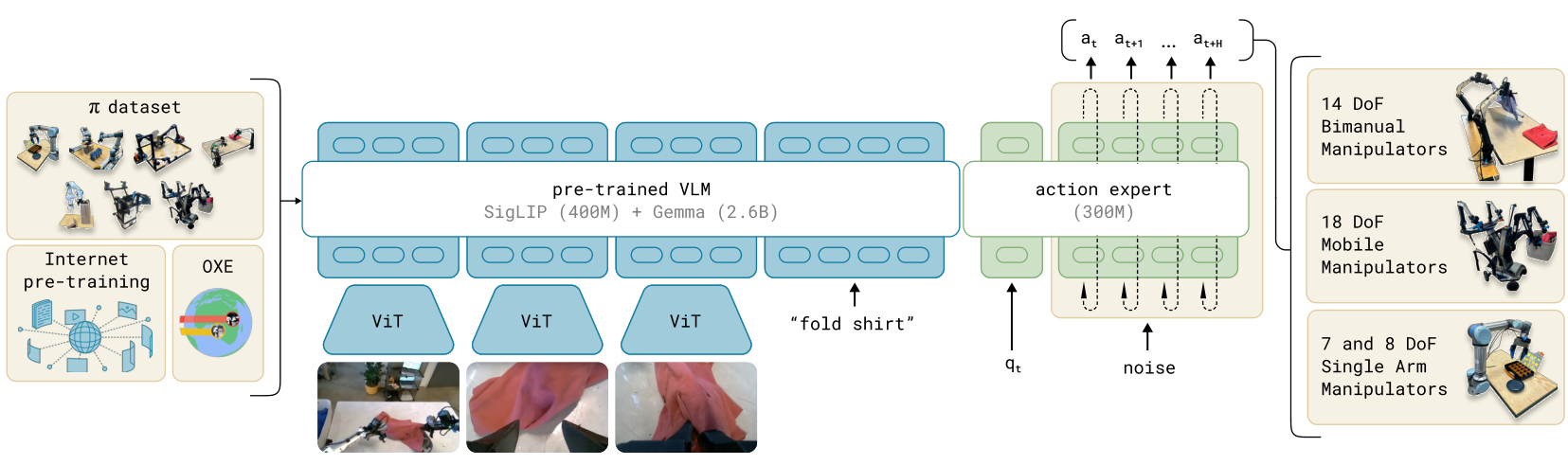
English reading:
Read the diagram twice: first trace the data mixture, then trace which transformer weights process each modality.
中文: 图 3|先看数据如何汇合,再看计算如何分工。共享注意力不等于视觉词元和动作词元共用每组权重。
编者读图: 左侧示教与开放数据共同参与机器人预训练。中部两条计算路径对应 VLM 主干与动作专家;右侧多机型输出不是未来相机画面。
来源: 英文 PDF p.4–5 · S004
English reading:
The target is a conditional distribution over fifty successive controls. Bidirectional attention lets the positions constrain one another before the first command reaches the robot. The repeated computation is refinement of the entire chunk, not autoregression through fifty physical time steps.
中文: 在机器人时刻 ,观测包含两或三路 RGB 图像、语言指令和关节状态。策略面向的是条件分布 :块中的 50 个动作对应未来 50 个物理时刻。块内位置能相互注意,无需逐维量化,也不需要自回归 50 次才见到整条轨迹。重复计算发生在整块的流场更新上。
数学|两种时间,一个监督目标
来源: 英文 PDF p.5 · S005
English reading:
Differentiating the interpolant gives a velocity label without a solver. Many endpoint pairs can explain the same intermediate input. Their conditional mean is the regression target seen by a model without access to those endpoints; straight training pairs do not imply a globally straight marginal ODE.
中文: 取一条示教动作块和同形的独立高斯噪声,以伪时间 作线性插值。给定两端点,对插值式求导便得到训练速度。一次训练样本只需中间位置和目标速度,不必先运行 ODE 求解器。直线属于给定端点的条件样本;模型只看到中间点和观测,最小二乘解是相容速度的条件均值,不保证实际积分轨迹都直。
来源: 英文 PDF p.5、16 · S006
English reading:
The ten Euler evaluations advance in artificial time. No new camera reading is implied by an integration step. A shifted beta training distribution emphasizes the noisy end of the path; this is distinct from the equally spaced Euler grid used at inference.
中文: 采样从纯噪声出发,模型执行十步前向欧拉,每步 0.1。 由机器人时钟决定, 只是合成一个动作块的积分变量;步长 0.1 不以秒为单位。附录 B 使用偏向较小 的移位 Beta 分布训练,此时输入噪声较大,动作预测更依赖观测。训练分布的上界取 0.999,而积分网格仍是均匀的。
来源: 英文 PDF p.5 · S007
English reading:
There is a variance discrepancy on page 5. Multiplying standard Gaussian noise by one minus tau squares the factor in the covariance. Use the stated interpolation and its derivative as a pair rather than splicing together the two variance conventions.
中文: 值得校勘的是,v4 同页把条件高斯的协方差写成 ,实际采样公式却把噪声乘以 。由后式计算,给定动作端点后的均值为 ,协方差应为 。复现时应让插值、速度标签和积分方向自洽。
来源: 英文 PDF p.15–16 · S008
English reading:
The mask is also a cache contract: changing the noisy suffix cannot change the observation keys or values. The action expert is narrower than the backbone to reduce work paid repeatedly. Since the small baseline changes both scale and architecture, it is not a single-variable ablation of VLM initialization.
中文: 注意力划分为图像与文本、机器人状态、噪声动作三个块。每块内部双向,后块可见前块,前块不看后块,所以同一次观测的键值可跨去噪步缓存。PaliGemma 主干约 30 亿参数,新动作专家约 3 亿,总计约 33 亿。小模型约 4.7 亿且结构也不同;两者的差距不能直接解释成 VLM 预训练的净收益。
数据|覆盖状态,再教学策略
来源: 英文 PDF p.5–6 · S009
English reading:
The private pool contains 903 million time steps spanning seven configurations and 68 task labels. A mixture weight is not a raw frame fraction. Sublinear weighting retains the importance of large task–robot pairs without letting them dominate in direct proportion to collection volume.
中文: 自采的 9.03 亿个时间步中,单臂占 1.06 亿,双臂占 7.97 亿,分布在 7 种配置、68 个任务。开放数据占训练混合权重的 9.1%,不能读成原始帧数的 9.1%。图 4 区别了样本量与采样权重。任务—机型组合按样本数 加权:样本多的组合仍较常出现,但不再按原始数量线性支配训练。
来源: 英文 PDF p.6 · S010
English reading:
Padding action and state vectors and masking absent views align tensor shapes, not joint semantics. Short language annotations provide finer temporal grounding than a task name alone. Data suitable for broad recovery and data suitable for teaching fluent execution need not have the same distribution.
中文: 跨机型先统一张量接口:关节状态和动作向量补至 18 维,不足三路的相机输入加掩膜。形状统一不代表不同关节的物理含义自动对齐。语言标注既可为任务名,也可指向约两秒的子任务片段。预训练重在覆盖状态,后训练重在示教动作的流畅和一致;只保留“漂亮”的成功片段,可能把部署时需要的恢复行为一并筛掉。
实验|四种能力不能混为一项分数
来源: 英文 PDF p.7–8 · S011
English reading:
The base-policy test measures out-of-box performance on tasks represented during pretraining. A shorter 160k-step run is useful beside the baseline schedules without making FLOPs, training time or architecture identical. Each task–method score averages ten physical episodes.
中文: 直接部署考察叠平铺 T 恤、两档清桌、装购物袋和从烤面包机取面包。这五项属于预训练覆盖范围,不是五项新任务的零样本泛化。完整版训练 70 万步;另有 16 万步 π₀ 与 16 万步 OpenVLA、32 万步 Octo 对照。完整版总体领先,短训练版也优于这两组基线。训练步数接近,不意味着每步算力、墙钟时间或表达能力相同。
来源: 英文 PDF p.8–9 · S012
English reading:
Flat prompting, human subcommands and high-level VLM subcommands place different demands on one low-level controller. Object selection, instruction following and contact execution can fail separately. Improvements with intermediate commands should be attributed to the composite system.
中文: 语言实验区分三种指令:全程只给总目标、人按进度给中间指令、由上层视觉语言策略给中间指令。清桌、摆桌和装购物袋都要求选对物体并按正确次序执行。“抓得住但拿错了”是语义失误;“拿对目标但掉落”则是运动失误。上层提示改善结果,并不说明底层动作专家独自学会了全任务的规划。
来源: 英文 PDF p.9–10 · S013
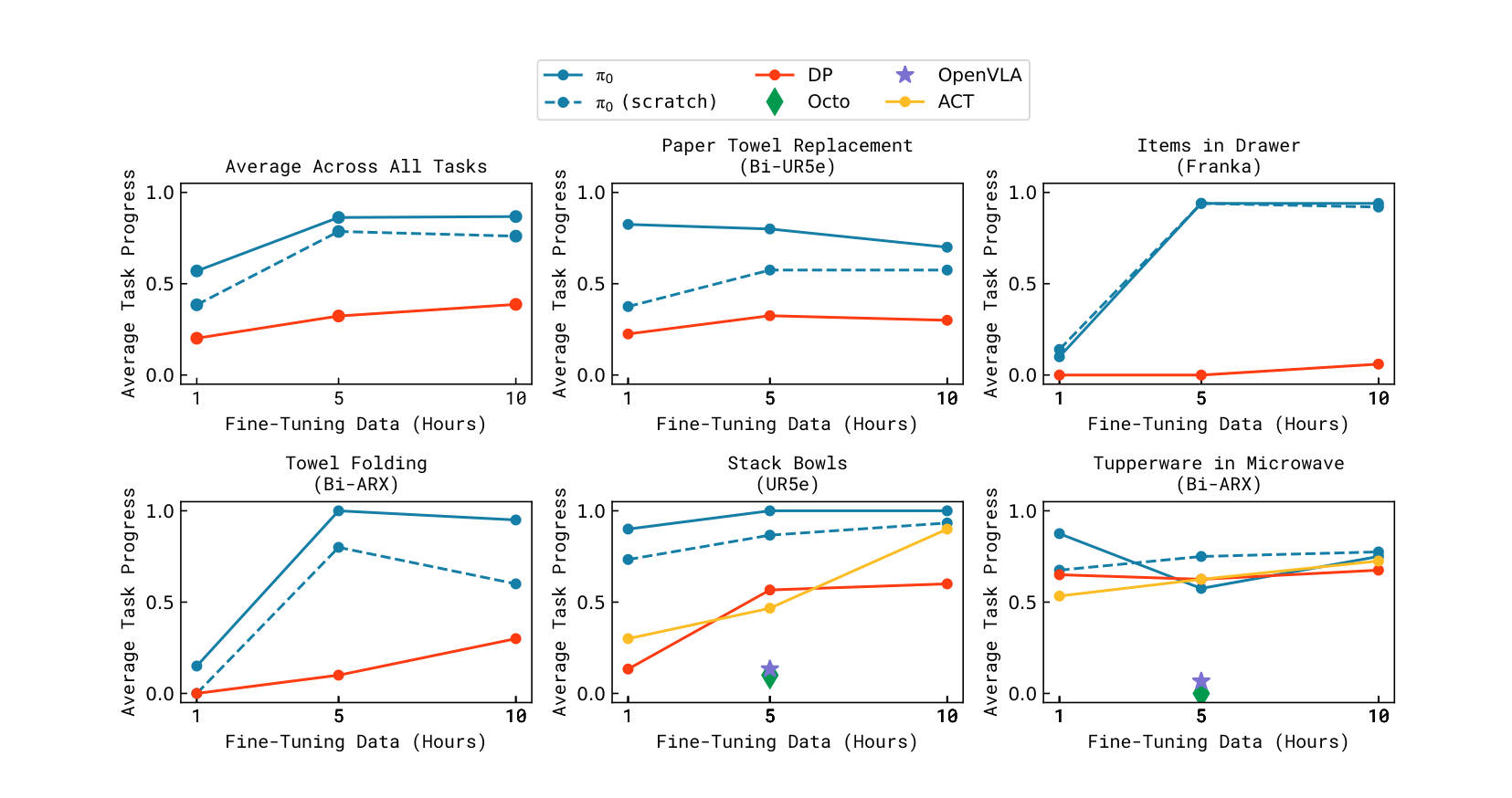
English reading:
The horizontal axis measures downstream data; the curves differ in earlier training and policy design. Compare like budgets within a task before comparing the shape of different panels.
中文: 图 11|横轴为特定任务的示教小时数,纵轴为按任务细则归一化的平均进度。应在相同小时数、相同任务的纵截面上比较曲线。
编者读图: 逐列读 1、5、10 小时;不是每种基线在每个预算上都有点。某任务在 1 小时上领先,不代表 5 小时上的相对差距会更大。
来源: 英文 PDF p.9–10 · S014
English reading:
Tasks vary in their distance from pretraining. Specialist baselines use target demonstrations; the other generalists begin with public checkpoints. The most informative comparison for robot pretraining is within the same policy family. Missing baseline points are not zero performance.
中文: 转移难度并不均匀:叠碗与叠毛巾接近源任务,微波炉引入新物体,抽屉收纳与换纸巾涉及新动作。ACT 和 Diffusion Policy 只用目标示教;Octo 和 OpenVLA 从开放预训练权重微调。同系列 π₀ 在有无机器人预训练时的比较,才更接近对机器人预训练效果的检验。有限次数的试验和不齐全的基线点不足以推导普适的样本效率定律。
来源: 英文 PDF p.11 · S015
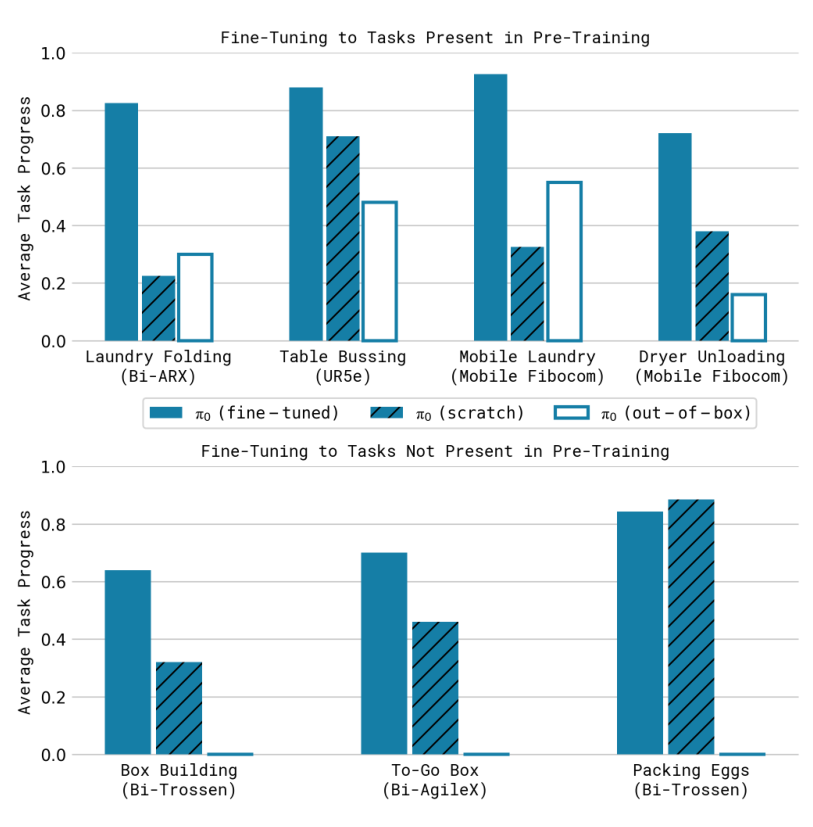
English reading:
Bars denote normalized task progress averaged across ten trials. More than half the available points is not the same as completing more than half the episodes.
中文: 图 13|复杂多阶段任务上的十次试验均分。完整模型在所有任务上均超过该任务最高可能得分的一半。
编者读图: 按同一任务比较 out-of-box、scratch 和完整方案。一次未完成的任务也可以取得部分分数,柱高不等于整任务成功率。
局限与工程读法|50 Hz 不等于 20 ms 重规划
来源: 英文 PDF p.10–12 · S016
English reading:
The long-horizon tests mix previously represented and new downstream tasks; some rely on a high-level policy. Their results do not determine a universal data mixture or a sample count for reliable completion. Transfer across tested manipulation platforms leaves transfer to distant control domains unresolved.
中文: 长任务包括叠衣、移动叠衣、从烘干机取衣、清理复杂餐桌和折盒,执行可持续 5–20 分钟。有些已见于预训练,另一些仅在后训练出现。两阶段训练对困难任务尤有帮助;但尚不能据此预测为达到近满分可靠性需要多少、何种示教。多种机械臂之间的迁移,也不能外推为对导航、自动驾驶或腿式运动的普适性。
来源: 英文 PDF p.16 · S017
English reading:
On a three-camera input the latency table describes an entire chunk, not one actuator tick. Playback can proceed at 50 Hz between policy calls. The authors executed chunk prefixes open loop; early trials with temporal ensembling hurt this policy.
中文: 在 RTX 4090 上对三相机观测生成一个动作块,耗时 73 ms:图像编码 14 ms、观测前缀 32 ms、十次动作前向合计 27 ms。远程再加 13 ms。50 Hz 平台每 0.5 s 重规划、执行 25 个动作;20 Hz 平台每 0.8 s 重规划、执行 16 个动作。系统能每 20 ms 发出一个已算好的动作,但并非每 20 ms 根据新观测决策一次。
| 预算对象 | 原文值 | 如何解释 |
|---|---|---|
| 图像 / 观测前缀 | 14 / 32 ms | 每次新观测各付一次 |
| 动作专家 ×10 | 共 27 ms | 不是每次 27 ms |
| 板上 / 远程 | 73 / 86 ms | 远程含 13 ms 网络开销 |
| 50 Hz 平台 | 25 / 50 = 0.5 s | 重规划间隔,不是模型延迟 |
来源: 英文 PDF p.17 · S018
English reading:
Appendix E gives the denominators behind the bars. Binary shirt-fold success and a fraction of correctly sorted items are different outcomes even at equal mean scores. In a deployment comparison, preserve the rubric and the time to the first new command alongside the aggregate.
中文: 再查附录 E 的分母:简单清桌有 7 件物品,困难版有 12 件;叠衬衫按成功或失败计,其他若干任务按动作阶段得分。均值同为 0.8,在不同任务中可能意味着完全不同的失误。评价自己的控制器时,宜同时保留整任务成功率、分步进度、从传感器到首个新动作的延迟以及实际执行前缀的长度。
术语速查
- action chunk:动作块,同时生成的未来命令序列
- action expert:处理机器人状态与动作词元的专属权重
- normalized progress:按评分细则归一化的任务进度,不总是成功率
- control rate:命令执行频率,须与新观测重规划频率分列
原文及所引图表署名 Physical Intelligence / Black 等。arXiv 页面列出的版本许可为非独占分发许可。
Show Translation & Notation Audit Notes
底本为 Black 等的 arXiv:2410.24164v4(2026-01-08),原稿 17 页。两种语言均为独立写作,覆盖摘要、§I–VII、附录 B–E 的模型/计时/评分;贡献声明与英文文献仍在原版 pp.12–15。资料映射到原版页码,而非深读版页码。
| 符号 | 解释 |
|---|---|
| t / τ | 机器人观测序号 / 合成动作的 ODE 伪时间。 |
| H、Aₜ | 预测块长 50、整块动作;实际执行的前缀常短于 H。 |
| ε、vθ | 与动作块同形的标准高斯噪声、以观测为条件的速度场。 |
| qₜ / q(·) | 关节状态 / 训练路径条件分布。 |
| prefix cache | 对同一次观测复用键值;新相机帧或新状态需重算。 |
底本校勘。 §III 概述与 §V、图 4 对 OXE 全集/子集的措辞并不完全一致。数据配方按 §V 的子集与混合权重理解,不把 OXE 多机型算入自采七配置。§IV 的协方差与实际插值式不一致,见 S007。S006 的 p.5 与 p.16 分别给出积分步及训练时间分布。
迁移至 lerobot-flow-matching。 固定观测与噪声,先做端点测试:τ=0 恢复噪声,τ=1 恢复示教动作。冻结前缀前后对照专家输出,再测缓存。每种 NFE 预算分别记录模型计算、相机等待、通信、首个新动作生效时间和实际执行的块前缀;离线 L2 不能替代闭环成功率。以上是实验建议,非本机实测。
与 EEPTV 的类比。 π₀ 的场定义在动作空间,沿伪时间积分;不能把它解释成图像坐标下的粒子位移或物理流体速度。
复建。 work/build.py 读取同目录 reading.txt 和原版 PDF,离线生成 MathML 并调用 Edge 打印。KATEX_JS 可指定 KaTeX CommonJS 文件。