Object Detection in 20 Years: A Survey · Zhengxia Zou、Keyan Chen、Zhenwei Shi、Yuhong Guo、Jieping Ye
版本:作者公开稿,22 页 · 英文原文 · 中文 PDF · 译校说明
章节:I. 引言 · II. 目标检测二十年 · III. 检测加速 · IV. 目标检测的近期进展 · V. 结论与未来方向 · 资助、作者单位与脚注 · 参考文献 · 术语表
原文页码:1 · 2 · 3 · 4 · 5 · 6 · 7 · 8 · 9 · 10 · 11 · 12 · 13 · 14 · 15 · 16 · 17 · 18 · 19 · 20 · 21 · 22
每个锚点对应原文的一个段落、标题、图注、脚注或公式;跨栏、跨页的段落按原文语义连续排布。参考文献保留英文原目。
Source: p.1 S001
ENObject Detection in 20 Years: A Survey
Source: p.1 S002
ENZhengxia Zou⋆, Keyan Chen, Zhenwei Shi, Member, IEEE, Yuhong Guo, and Jieping Ye⋆, Fellow, IEEE
中Zhengxia Zou⋆、Keyan Chen、Zhenwei Shi(IEEE 会员)、Yuhong Guo、Jieping Ye⋆(IEEE 会士)
Source: p.1 S003
ENAbstract—Object detection, as of one the most fundamental and challenging problems in computer vision, has received great attention in recent years. Over the past two decades, we have seen a rapid technological evolution of object detection and its profound impact on the entire computer vision field. If we consider today’s object detection technique as a revolution driven by deep learning, then back in the 1990s, we would see the ingenious thinking and long-term perspective design of early computer vision. This paper extensively reviews this fast-moving research field in the light of technical evolution, spanning over a quarter-century’s time (from the 1990s to 2022). A number of topics have been covered in this paper, including the milestone detectors in history, detection datasets, metrics, fundamental building blocks of the detection system, speed-up techniques, and the recent state-of-the-art detection methods.
中摘要——目标检测是计算机视觉中最基础、最具挑战性的问题之一,近年来备受关注。在过去二十年中,目标检测技术迅速演进,对整个计算机视觉领域产生了深远影响。如果说今天的目标检测技术经历了一场由深度学习驱动的变革,那么回看 20 世纪 90 年代,则能看到早期计算机视觉研究中巧妙的构思和有远见的设计。本文以技术演进为线索,广泛回顾这一快速发展的研究领域,时间跨度超过四分之一个世纪(从 20 世纪 90 年代到 2022 年)。文章涵盖历史上的里程碑检测器、检测数据集与评价指标、检测系统的基本模块、加速技术,以及近期达到领先水平的检测方法。
Source: p.1 S004
ENIndex Terms—Object detection, Computer vision, Deep learning, Convolutional neural networks, Technical evolution.
中关键词——目标检测,计算机视觉,深度学习,卷积神经网络,技术演进。
I. 引言
SOURCE p.1 S005
Source: p.1 S006
ENOBJECT detection is an important computer vision task that deals with detecting instances of visual objects of a certain class (such as humans, animals, or cars) in digital images. The goal of object detection is to develop computational models and techniques that provide one of the most basic pieces of knowledge needed by computer vision applications: What objects are where? The two most significant metrics for object detection are accuracy (including classification accuracy and localization accuracy) and speed.
中目标检测是计算机视觉中的一项重要任务,即从数字图像中找出某一类别的可见目标实例,如人、动物、汽车等。目标检测旨在开发计算模型和技术,回答计算机视觉应用所需的一个最基本的问题:有哪些目标,它们分别在哪里?衡量目标检测的两个最重要的指标是准确性(包括分类准确性与定位准确性)和速度。
Source: p.1 S007
ENObject detection serves as a basis for many other computer vision tasks, such as instance segmentation [1–4], image captioning [5–7], object tracking [8], etc. In recent years, the rapid development of deep learning techniques [9] has greatly promoted the progress of object detection, leading to remarkable breakthroughs and propelling it to a research hotspot with unprecedented attention. Object detection has now been widely used in many real-world applications, such as autonomous driving, robot vision, video surveillance, etc. Fig. 1 shows the growing number of publications that are associated with “object detection” over the past two decades.
中目标检测是许多其他计算机视觉任务的基础,如实例分割 [1–4]、图像描述生成 [5–7]、目标跟踪 [8] 等。近年来,深度学习技术 [9] 的迅速发展极大推动了目标检测的进步,带来显著突破,并使其成为受到空前关注的研究热点。如今,目标检测已广泛用于自动驾驶、机器人视觉、视频监控等实际场景。图 1 展示了过去二十年与“目标检测”相关的出版物数量的增长。
Fig. 1 · 目标检测出版物数量
Placed near: p.1 S007
Source: p.1 C001
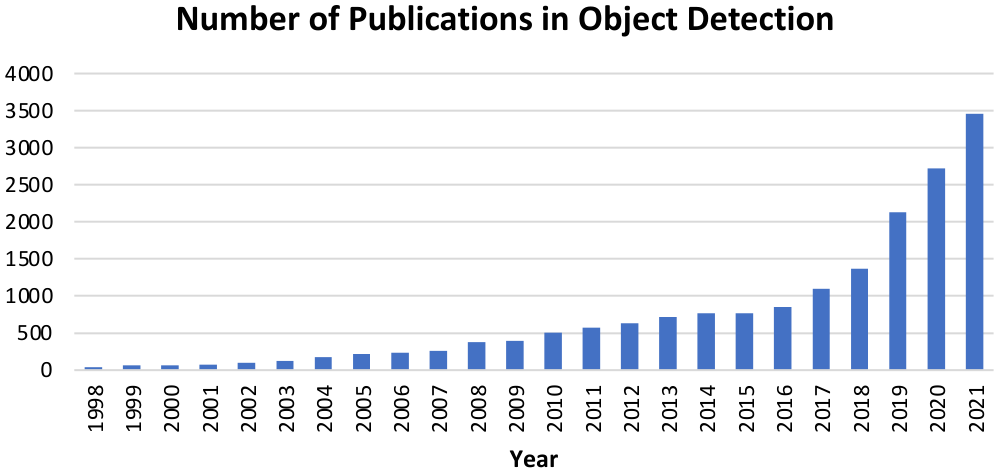
Original caption: Fig. 1: The increasing number of publications in object detection from 1998 to 2021. (Data from Google scholar advanced search: allintitle: “object detection” OR “detecting objects”.)
中图 1:1998 至 2021 年目标检测相关出版物数量的增长。(数据来自 Google 学术高级搜索:allintitle: “object detection” OR “detecting objects”。)
读图提示: 横轴为年份(Year),纵轴为相应检索条件下的出版物数量。
Source: p.1 S008
ENAs different detection tasks have totally different objectives and constraints, their difficulties may vary from each other. In addition to some common challenges in other computer vision tasks such as objects under different viewpoints, illuminations, and intraclass variations, the challenges in object detection include but are not limited to the following aspects: object rotation and scale changes (e.g., small objects), accurate object localization, dense and occluded object detection, speed up of detection, etc. In Sec. IV, we will give a more detailed analysis of these topics.
中不同检测任务的目标与约束可能截然不同,因而难度也不尽相同。除其他计算机视觉任务也会遇到的常见难题,如观测视角不同、光照不同及类内差异,目标检测的挑战还包括但不限于:目标旋转及尺度变化(如小目标)、精确定位、密集与遮挡目标的检测,以及检测加速等。第 IV 节将更详细地分析这些问题。
Source: p.1 S009
ENThis survey seeks to provide novices with a complete grasp of object detection technology from many viewpoints, with an emphasis on its evolution. The key features are three-folds: A comprehensive review in the light of technical evolutions, an in-depth exploration of the key technologies and the recent state of the arts, and a comprehensive analysis of detection speed-up techniques. The main clue focuses on the past, present, and future, complemented with some other necessary components in object detection, like datasets, metrics, and acceleration techniques. Standing on the technical highway, this survey aims to present the evolution of related technologies, allowing readers to grasp the essential concepts and find potential future directions, while neglecting their technical specifics.
中本综述希望帮助初学者从多个角度完整把握目标检测技术,重点着眼于它的演进。本文有三个特点:以技术演进为线索进行全面回顾,深入探讨关键技术和近期领先方法,并全面分析检测加速技术。全文以过去、现在和未来为主线,辅以数据集、评价指标和加速技术等目标检测的必要内容。本综述沿着这条技术主线呈现相关技术的演进,帮助读者在不纠缠于技术细节的情况下掌握核心概念,并找到潜在的未来方向。
Source: p.1 S010
ENThe rest of this paper is organized as follows. In Section II, we review the 20 years’ evolution of object detection. In Section III, we review the speed-up techniques in object detection. The state-of-the-art detection methods of the recent three years are reviewed in Section IV. In Section V, we conclude this paper and make a deep analysis of the further research directions.
中本文其余部分安排如下:第 II 节回顾目标检测二十年来的演进;第 III 节回顾目标检测的加速技术;第 IV 节介绍最近三年的领先检测方法;第 V 节总结全文,并深入分析进一步的研究方向。
II. 目标检测二十年
SOURCE p.1 S011
ENII. OBJECT DETECTION IN 20 YEARS
Source: p.1 S012
ENIn this section, we will review the history of object detection from multiple views, including milestone detectors, datasets, metrics and the evolution of key techniques.
中本节从多个角度回顾目标检测的历史,介绍里程碑检测器、数据集、评价指标以及关键技术的演进。
A. 目标检测发展路线图
SOURCE p.2 S013
ENA. A Road Map of Object Detection
Source: p.2 S014
ENIn the past two decades, it is widely accepted that the progress of object detection has generally gone through two historical periods: “traditional object detection period (before 2014)” and “deep learning based detection period (after 2014)”, as shown in Fig. 2. In the following, we will summarize the milestone detectors of this period, with the emergence time and performance serving as the main clue to highlight the behind driving technology, seeing Fig. 3.
中一般认为,过去二十年目标检测的发展大体经历了两个历史时期:“传统目标检测时期(2014 年以前)”和“基于深度学习的检测时期(2014 年以后)”,如图 2 所示。下文将以这些检测器的问世时间和性能为主要线索,总结这一时期的里程碑检测器,突出背后的推动性技术,参见图 3。
Fig. 2 · 目标检测发展路线图
Placed near: p.2 S014
Source: p.2 C002
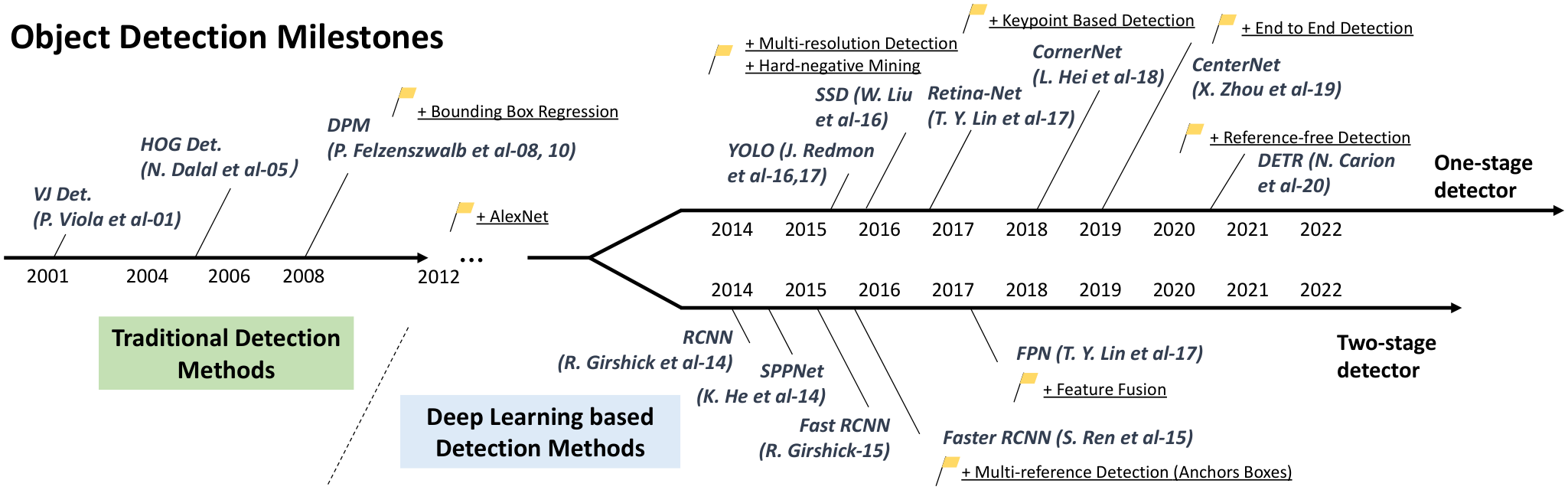
Original caption: Fig. 2: A road map of object detection. Milestone detectors in this figure: VJ Det. [10, 11], HOG Det. [12], DPM [13–15], RCNN [16], SPPNet [17], Fast RCNN [18], Faster RCNN [19], YOLO [20–22], SSD [23], FPN [24], Retina-Net [25], CornerNet [26], CenterNet [27], DETR [28].
中图 2:目标检测路线图。图中的里程碑检测器:VJ Det. [10, 11]、HOG Det. [12]、DPM [13–15]、RCNN [16]、SPPNet [17]、Fast RCNN [18]、Faster RCNN [19]、YOLO [20–22]、SSD [23]、FPN [24]、Retina-Net [25]、CornerNet [26]、CenterNet [27]、DETR [28]。
读图提示: 路线图区分传统与基于深度学习的检测方法,并按单阶段(one-stage)和双阶段(two-stage)分列深度学习方法。
Fig. 3 · 检测精度的历年变化
Placed near: p.2 S014
Source: p.3 C003
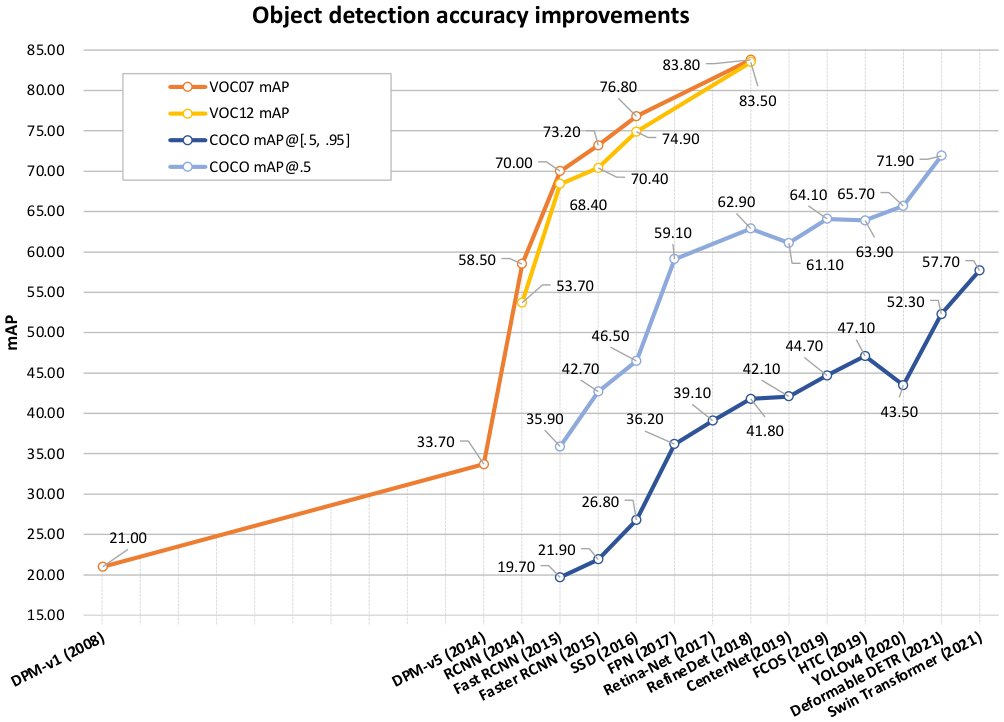
Original caption: Fig. 3: Accuracy improvement of object detection on VOC07, VOC12 and MS-COCO datasets. Detectors in this figure: DPM-v1 [13], DPM-v5 [37], RCNN [16], SPPNet [17], Fast RCNN [18], Faster RCNN [19], SSD [23], FPN [24], Retina-Net [25], RefineDet [38], TridentNet [39] CenterNet [40], FCOS [41], HTC [42], YOLOv4 [22], Deformable DETR [43], Swin Transformer [44].
中图 3:VOC07、VOC12 和 MS-COCO 数据集上目标检测精度的提升。图中的检测器:DPM-v1 [13]、DPM-v5 [37]、RCNN [16]、SPPNet [17]、Fast RCNN [18]、Faster RCNN [19]、SSD [23]、FPN [24]、Retina-Net [25]、RefineDet [38]、TridentNet [39]、CenterNet [40]、FCOS [41]、HTC [42]、YOLOv4 [22]、Deformable DETR [43]、Swin Transformer [44]。
读图提示: 纵轴为 mAP;VOC07、VOC12,及 COCO mAP@.5、mAP@[.5, .95] 使用不同曲线。
Source: p.2 S015
EN1) Milestones: Traditional Detectors: If we consider today’s object detection technique as a revolution driven by deep learning, then back in the 1990s, we would see the ingenious design and long-term perspective of early computer vision. Most of the early object detection algorithms were built based on handcrafted features. Due to the lack of effective image representation at that time, people have to design sophisticated feature representations and a variety of speed-up skills.
中**1) 里程碑:传统检测器:**如果说当今的目标检测技术经历了一场由深度学习驱动的变革,那么回到 20 世纪 90 年代,我们会看到早期计算机视觉技术设计得何其巧妙,又富有远见。多数早期目标检测算法建立在手工设计的特征之上。由于当时缺少有效的图像表征,研究人员不得不设计复杂的特征表示,并采用多种加速技巧。
Source: p.2 S016
ENViola Jones Detectors: In 2001, P. Viola and M. Jones achieved real-time detection of human faces for the first time without any constraints (e.g., skin color segmentation) [10, 11]. Running on a 700MHz Pentium III CPU, the detector was tens or even hundreds of times faster than other algorithms in its time under comparable detection accuracy. The VJ detector follows a most straightforward way of detection, i.e., sliding windows: to go through all possible locations and scales in an image to see if any window contains a human face. Although it seems to be a very simple process, the calculation behind it was far beyond the computer’s power of its time. The VJ detector has dramatically improved its detection speed by incorporating three important techniques: “integral image”, “feature selection”, and “detection cascades” (to be introduced in section III).
中**Viola–Jones 检测器:**2001 年,P. Viola 和 M. Jones 首次在不附加任何约束(如先做肤色分割)的条件下实现了实时人脸检测 [10, 11]。这款检测器运行在 700 MHz 的 Pentium III CPU 上,在准确度相当的情况下,比同时期的其他算法快几十倍,甚至上百倍。VJ 检测器采用最直接的检测方式——滑动窗口:遍历图像中所有可能的位置和尺度,检查各窗口内是否有人脸。这个过程看似简单,背后的计算量却远超当时计算机的能力。VJ 检测器通过结合三项关键技术大幅提升了检测速度:“积分图像”“特征选择”和“级联检测”(见第 III 节)。
Source: p.2 S017
ENHOG Detector: In 2005, N. Dalal and B. Triggs proposed Histogram of Oriented Gradients (HOG) feature descriptor [12]. HOG can be considered as an important improvement of the scale-invariant feature transform [29, 30] and shape contexts [31] of its time. To balance the feature invariance (including translation, scale, illumination, etc) and the nonlinearity, the HOG descriptor is designed to be computed on a dense grid of uniformly spaced cells and use overlapping local contrast normalization (on “blocks”). Although HOG can be used to detect a variety of object classes, it was motivated primarily by the problem of pedestrian detection. To detect objects of different sizes, the HOG detector rescales the input image for multiple times while keeping the size of a detection window unchanged. The HOG detector has been an important foundation of many object detectors [13, 14, 32] and a large variety of computer vision applications for many years.
中**HOG 检测器:**2005 年,N. Dalal 和 B. Triggs 提出了方向梯度直方图(Histogram of Oriented Gradients,HOG)特征描述符 [12]。HOG 可视为对当时尺度不变特征变换 [29, 30] 和形状上下文 [31] 的重要改进。为了在特征的不变性(包括对平移、尺度、光照等变化的不变性)与非线性之间取得平衡,HOG 在由等间距单元格构成的密集网格上计算描述符,并在相互重叠的“块”内做局部对比度归一化。HOG 可用于检测多类目标,但最初主要是为解决行人检测问题而提出的。为了检测不同大小的目标,HOG 检测器保持检测窗口的尺寸不变,对输入图像进行多次缩放。多年来,HOG 检测器一直是许多目标检测器 [13, 14, 32] 和多种计算机视觉应用的重要基础。
Source: p.2 S018
ENDeformable Part-based Model (DPM): DPM, as the winners of VOC-07, -08, and -09 detection challenges, was the epitome of the traditional object detection methods. DPM was originally proposed by P. Felzenszwalb [13] in 2008 as an extension of the HOG detector. It follows the detection philosophy of “divide and conquer”, where the training can be simply considered as the learning of a proper way of decomposing an object, and the inference can be considered as an ensemble of detections on different object parts. For example, the problem of detecting a “car” can be decomposed to the detection of its window, body, and wheels. This part of the work, a.k.a. “star-model”, was introduced by P. Felzenszwalb et al. [13]. Later on, R. Girshick has further extended the star model to the “mixture models” to deal with the objects in the real world under more significant variations and has made a series of other improvements [14, 15, 33, 34].
中**可变形部件模型(DPM):**DPM 赢得了 VOC-07、-08 和 -09 检测挑战赛,是传统目标检测方法的代表。P. Felzenszwalb 于 2008 年最早提出 DPM [13],作为对 HOG 检测器的扩展。DPM 采用“分而治之”的检测思想:训练可简单理解为学习怎样合理拆分目标,而推理可理解为汇集对该目标各部件的检测结果。例如,“汽车”检测可拆解为车窗、车身和车轮的检测。P. Felzenszwalb 等人将这项工作称为“星形模型” [13]。后来,R. Girshick 将星形模型进一步扩展为“混合模型”,以应对现实中变化更大的目标,并作了一系列其他改进 [14, 15, 33, 34]。
Source: p.2 S019
ENAlthough today’s object detectors have far surpassed DPM in detection accuracy, many of them are still deeply influenced by its valuable insights, e.g., mixture models, hard negative mining, bounding box regression, context priming, etc. In 2010, P. Felzenszwalb and R. Girshick were awarded the “lifetime achievement” by PASCAL VOC.
中尽管现在的目标检测器在检测精度上早已超过 DPM,其中许多仍深受其重要思想的影响,包括混合模型、难负样本挖掘、边界框回归和上下文引导等。2010 年,PASCAL VOC 授予 P. Felzenszwalb 和 R. Girshick“终身成就”奖。
Source: pp.2–3 S020
EN2) Milestones: CNN based Two-stage Detectors: As the performance of hand-crafted features became saturated, the research of object detection reached a plateau after 2010. In 2012, the world saw the rebirth of convolutional neural networks [35]. As a deep convolutional network is able to learn robust and high-level feature representations of an image, a natural question arises: can we introduce it to object detection? R. Girshick et al. took the lead to break the deadlocks in 2014 by proposing the Regions with CNN features (RCNN) [16, 36]. Since then, object detection started to evolve at an unprecedented speed. There are two groups of detectors in the deep learning era: “two-stage detectors” and “one-stage detectors”, where the former frames the detection as a “coarse-to-fine” process while the latter frames it as to “complete in one step”.
中**2) 里程碑:基于 CNN 的双阶段检测器:**手工特征的性能趋于饱和,目标检测研究在 2010 年后进入平台期。2012 年,卷积神经网络(CNN)重新崛起 [35]。深层卷积网络能够学习图像的稳健高层特征表示,由此自然产生一个问题:能否将它用于目标检测?2014 年,R. Girshick 等人率先打破僵局,提出了利用 CNN 特征的区域检测方法(Regions with CNN features,RCNN)[16, 36]。自此,目标检测以前所未有的速度演进。深度学习时代有两类检测器:“双阶段检测器”和“单阶段检测器”。前者把检测视为“由粗到细”的过程,后者则希望“一步完成”。
Source: p.3 S021
ENRCNN: The idea behind RCNN is simple: It starts with the extraction of a set of object proposals (object candidate boxes) by selective search [45]. Then each proposal is rescaled to a fixed size image and fed into a CNN model pretrained on ImageNet (say, AlexNet [35]) to extract features. Finally, linear SVM classifiers are used to predict the presence of an object within each region and to recognize object categories. RCNN yields a significant performance boost on VOC07, with a large improvement of mean Average Precision (mAP) from 33.7% (DPM-v5 [46]) to 58.5%. Although RCNN has made great progress, its drawbacks are obvious: the redundant feature computations on a large number of overlapped proposals (over 2000 boxes from one image) lead to an extremely slow detection speed (14s per image with GPU). Later in the same year, SPPNet [17] was proposed and has solved this problem.
中**RCNN:**RCNN 的思路很简单:首先用选择性搜索 [45] 提取一组候选区域(目标候选框);接着把每个候选区域缩放成固定大小的图像,送入在 ImageNet 上预训练的 CNN(如 AlexNet [35])以提取特征;最后用线性支持向量机(SVM)判断各区域是否包含目标,并识别其类别。RCNN 在 VOC07 上的表现明显提升,平均精度均值(mAP)从 DPM-v5 [46] 的 33.7% 大幅提高到 58.5%。尽管 RCNN 有很大进步,缺点也很明显:对大量重叠的候选区域(一张图像有 2,000 多个候选框)重复计算特征,导致检测非常慢(使用 GPU 时每张图像需 14 秒)。同年晚些时候提出的 SPPNet [17] 解决了这一问题。
Source: p.3 S022
ENSPPNet: In 2014, K. He et al. proposed Spatial Pyramid Pooling Networks (SPPNet) [17]. Previous CNN models require a fixed-size input, e.g., a 224x224 image for AlexNet [35]. The main contribution of SPPNet is the introduction of a Spatial Pyramid Pooling (SPP) layer, which enables a CNN to generate a fixed-length representation regardless of the size of the image/region of interest without rescaling it. When using SPPNet for object detection, the feature maps can be computed from the entire image only once, and then fixed-length representations of arbitrary regions can be generated for training the detectors, which avoids repeatedly computing the convolutional features. SPPNet is more than 20 times faster than R-CNN without sacrificing any detection accuracy (VOC07 mAP=59.2%). Although SPPNet has effectively improved the detection speed, it still has some drawbacks: first, the training is still multi-stage, second, SPPNet only fine-tunes its fully connected layers while simply ignoring all previous layers. Later in the next year, Fast RCNN [18] was proposed and solved these problems.
中**SPPNet:**2014 年,K. He 等人提出空间金字塔池化网络(SPPNet)[17]。此前的 CNN 要求输入尺寸固定,例如 AlexNet [35] 要求图像为 224×224。SPPNet 的主要贡献是引入空间金字塔池化(SPP)层,使 CNN 无须重新缩放图像或感兴趣区域,就能从任意尺寸的输入获得固定长度的表示。用 SPPNet 进行目标检测时,只需对整张图像计算一次特征图,随后可生成任意区域的定长表示来训练检测器,从而避免重复计算卷积特征。SPPNet 的速度是 R-CNN 的 20 倍以上,同时没有牺牲检测准确性(VOC07 mAP = 59.2%)。SPPNet 虽然有效加快了检测,但仍有两个缺点:一是训练仍需多个阶段,二是只微调全连接层,忽略此前各层。次年提出的 Fast RCNN [18] 解决了这些问题。
Source: p.3 S023
ENFast RCNN: In 2015, R. Girshick proposed Fast RCNN detector [18], which is a further improvement of R-CNN and SPPNet [16, 17]. Fast RCNN enables us to simultaneously train a detector and a bounding box regressor under the same network configurations. On VOC07 dataset, Fast RCNN increased the mAP from 58.5% (RCNN) to 70.0% while with a detection speed over 200 times faster than R-CNN. Although Fast-RCNN successfully integrates the advantages of R-CNN and SPPNet, its detection speed is still limited by the proposal detection (see Section II-C1 for more details). Then, a question naturally arises: “can we generate object proposals with a CNN model?” Later, Faster R-CNN [19] answered this question.
中**Fast RCNN:**2015 年,R. Girshick 提出了 Fast RCNN 检测器 [18],进一步改进了 R-CNN 和 SPPNet [16, 17]。Fast RCNN 允许在相同的网络配置下同时训练检测器和边界框回归器。在 VOC07 数据集上,Fast RCNN 将 mAP 从 RCNN 的 58.5% 提高至 70.0%,检测速度是 R-CNN 的 200 倍以上。Fast RCNN 成功结合了 R-CNN 和 SPPNet 的优势,但其检测速度仍受候选区域生成环节的限制(详见第 II-C1 节)。接下来的问题自然是:“我们能用 CNN 生成候选区域吗?”随后提出的 Faster R-CNN [19] 回答了这个问题。
Source: p.3 S024
ENFaster RCNN: In 2015, S. Ren et al. proposed Faster RCNN detector [19, 47] shortly after the Fast RCNN. Faster RCNN is the first near-realtime deep learning detector (COCO mAP@.5=42.7%, VOC07 mAP=73.2%, 17fps with ZF-Net [48]). The main contribution of Faster-RCNN is the introduction of Region Proposal Network (RPN) that enables nearly cost-free region proposals. From R-CNN to Faster RCNN, most individual blocks of an object detection system, e.g., proposal detection, feature extraction, bounding box regression, etc, have been gradually integrated into a unified, end-to-end learning framework. Although Faster RCNN breaks through the speed bottleneck of Fast RCNN, there is still computation redundancy at the subsequent detection stage. Later on, a variety of improvements have been proposed, including RFCN [49] and Light head RCNN [50]. (See more details in Section III.)
中**Faster RCNN:**2015 年,Fast RCNN 问世不久,S. Ren 等人提出了 Faster RCNN 检测器 [19, 47]。Faster RCNN 是首个接近实时的深度学习检测器(COCO mAP@.5 = 42.7%,VOC07 mAP = 73.2%,采用 ZF-Net [48] 时为 17 fps)。Faster RCNN 的主要贡献是引入候选区域网络(RPN),使生成候选区域的计算开销几乎可以忽略。从 R-CNN 到 Faster RCNN,目标检测系统的大多数独立模块——如候选区域生成、特征提取与边界框回归——逐步整合到统一的端到端学习框架中。Faster RCNN 虽然突破了 Fast RCNN 的速度瓶颈,之后的检测阶段仍有冗余计算。后来,研究者提出了 R-FCN [49] 和 Light-head RCNN [50] 等改进(详见第 III 节)。
Source: p.3 S025
ENFeature Pyramid Networks (FPN): In 2017, T.-Y. Lin et al. proposed FPN [24]. Before FPN, most of the deep learning based detectors run detection only on the feature maps of the networks’ top layer. Although the features in deeper layers of a CNN are beneficial for category recognition, it is not conducive to localizing objects. To this end, a top-down architecture with lateral connections is developed in FPN for building high-level semantics at all scales. Since a CNN naturally forms a feature pyramid through its forward propagation, the FPN shows great advances for detecting objects with a wide variety of scales. Using FPN in a basic Faster R-CNN system, it achieves state-of-the-art single model detection results on the COCO dataset without bells and whistles (COCO mAP@.5=59.1%). FPN has now become a basic building block of many latest detectors.
中**特征金字塔网络(FPN):**2017 年,T.-Y. Lin 等人提出了 FPN [24]。在此之前,大多数基于深度学习的检测器只在网络顶层的特征图上进行检测。CNN 中较深层的特征有利于类别识别,却不利于目标定位。为此,FPN 构建了带横向连接的自顶向下的架构,在所有尺度上生成高层语义特征。CNN 在前向传播时自然会形成一个特征金字塔,FPN 因而能更好地检测尺度差异很大的目标。只需把 FPN 用于基础版 Faster R-CNN,不加其他技巧,就能在 COCO 数据集上取得当时领先的单模型检测成绩(COCO mAP@.5 = 59.1%)。如今,FPN 已成为许多新检测器的基本模块。
Source: pp.3–4 S026
EN3) Milestones: CNN based One-stage Detectors: Most of the two-stage detectors follow a coarse-to-fine processing paradigm. The coarse strives to improve recall ability, while the fine refines the localization on the basis of the coarse detection, and places more emphasis on the discriminate ability. They can easily attain a high precision without any bells and whistles, but rarely employed in engineering due to the poor speed and enormous complexity. On the contrary, one-stage detectors can retrieve all objects in one-step inference. They are well-liked by mobile devices with real-time and easy-deployed features, but their performance suffers noticeably when detecting dense and small objects.
中**3) 里程碑:基于 CNN 的单阶段检测器:**多数双阶段检测器遵循由粗到细的处理方式。粗检力求提高召回能力,精检则在粗检的基础上完善定位,更重视辨别能力。这类检测器无须额外技巧就能达到较高精度,但速度较慢、复杂度很高,因而很少用于工程实践。相反,单阶段检测器只需一次推理就能检出所有目标。它们易于部署且可实时运行,因而很受移动端青睐,但在检测密集目标和小目标时,性能会明显下降。
Source: p.4 S027
ENYou Only Look Once (YOLO): YOLO was proposed by R. Joseph et al. in 2015. It was the first one-stage detector in the deep learning era [20]. YOLO is extremely fast: a fast version of YOLO runs at 155fps with VOC07 mAP=52.7%, while its enhanced version runs at 45fps with VOC07 mAP=63.4%. YOLO follows a totally different paradigm from two-stage detectors: to apply a single neural network to the full image. This network divides the image into regions and predicts bounding boxes and probabilities for each region simultaneously. In spite of its great improvement of detection speed, YOLO suffers from a drop of localization accuracy compared with two-stage detectors, especially for some small objects. YOLO’s subsequent versions [21, 22, 51] and the latter proposed SSD [23] has paid more attention to this problem. Recently, YOLOv7 [52], a follow-up work from YOLOv4 team, has been proposed. It outperforms most existing object detectors in terms of speed and accuracy (range from 5 FPS to 160 FPS) by introducing optimized structures like dynamic label assignment and model structure reparameterization.
中**You Only Look Once(YOLO):**R. Joseph 等人于 2015 年提出 YOLO,这是深度学习时代首个单阶段检测器 [20]。YOLO 速度极快:快速版的速度为 155 fps,VOC07 mAP 为 52.7%;增强版的速度为 45 fps,VOC07 mAP 为 63.4%。YOLO 采用与双阶段检测器截然不同的思路:用一个神经网络处理整张图像。该网络把图像划分为若干区域,同时预测各区域的边界框和概率。尽管检测速度大幅提高,YOLO 的定位准确性仍不及双阶段检测器,尤其是在部分小目标上。YOLO 的后续版本 [21, 22, 51] 和随后提出的 SSD [23] 更加重视这一问题。近期,YOLOv4 团队进一步提出 YOLOv7 [52];它引入动态标签分配与模型结构重参数化等优化设计,在速度和准确性上超越多数已有目标检测器(速度范围为 5 FPS 至 160 FPS)。
Source: p.4 S028
ENSingle Shot MultiBox Detector (SSD): SSD [23] was proposed by W. Liu et al. in 2015. The main contribution of SSD is the introduction of the multi-reference and multi-resolution detection techniques (to be introduced in Section II-C1), which significantly improves the detection accuracy of a one-stage detector, especially for some small objects. SSD has advantages in terms of both detection speed and accuracy (COCO mAP@.5=46.5%, a fast version runs at 59fps). The main difference between SSD and previous detectors is that SSD detects objects of different scales on different layers of the network, while the previous ones only run detection on their top layers.
中**单次多框检测器(SSD):**W. Liu 等人于 2015 年提出 SSD [23]。SSD 的主要贡献是引入多参考和多分辨率检测技术(见第 II-C1 节),显著提升单阶段检测器的检测精度,尤其是对部分小目标的检测。SSD 兼具速度和精度优势(COCO mAP@.5 = 46.5%,快速版可达 59 fps)。SSD 与先前检测器的主要区别在于,它在网络的不同层上检测不同尺度的目标,先前的检测器则只在顶层进行检测。
Source: p.4 S029
ENRetinaNet: Despite its high speed and simplicity, the one-stage detectors have trailed the accuracy of two-stage detectors for years. T.-Y. Lin et al. have explored the reasons behind and proposed RetinaNet in 2017 [25]. They found that the extreme foreground-background class imbalance encountered during the training of dense detectors is the central cause. To this end, a new loss function named “focal loss” has been introduced in RetinaNet by reshaping the standard cross entropy loss so that detector will put more focus on hard, misclassified examples during training. Focal Loss enables the one-stage detectors to achieve comparable accuracy of two-stage detectors while maintaining a very high detection speed (COCO mAP@.5=59.1%).
中**RetinaNet:**单阶段检测器虽然快速、简单,但多年来检测精度一直落后于双阶段检测器。T.-Y. Lin 等人探究了其中的原因,并于 2017 年提出 RetinaNet [25]。他们发现,密集检测器训练时极端的前景与背景类别不平衡是核心原因。为此,RetinaNet 改造了标准交叉熵损失,引入一种名为“焦点损失”的新损失函数,以使检测器在训练时更关注容易误判的困难样本。焦点损失使单阶段检测器在保持很高检测速度的同时,达到与双阶段检测器相当的精度(COCO mAP@.5 = 59.1%)。
Source: p.4 S030
ENCornerNet: Previous methods primarily used anchor boxes to provide classification and regression references. Objects frequently exhibit variation in terms of number, location, scale, ratio, etc. They have to follow the path of setting up a large number of reference boxes to better match ground truths in order to achieve high performance. However, the network would suffer from further category imbalance, lots of hand-designed hyper-parameters, and a long convergence time. To address these problems, H. Law et al [26] discard the previous detection paradigm, and view the task as a keypoint (corners of a box) prediction problem. After obtaining the key points, it will decouple and re-group the corner points using extra embedding information to form the bounding boxes. CornerNet outperforms most one-stage detectors at that time (COCO mAP@.5=57.8%).
中**CornerNet:**此前的方法主要用锚框作为分类和回归的参考。目标的数量、位置、尺度和宽高比等经常变化。这些方法为了获得较好的性能,不得不设置大量参考框,以更好地匹配真实标注。然而,这会加剧类别不平衡,引入大量手工设置的超参数,并延长网络收敛时间。为解决这些问题,H. Law 等人 [26] 放弃此前的检测范式,把任务视为对边界框角点的预测。得到关键点后,CornerNet 利用额外的嵌入信息将分开预测的角点重新配对,组成边界框。CornerNet 的表现优于当时大多数单阶段检测器(COCO mAP@.5 = 57.8%)。
Source: p.4 S031
ENCenterNet: X. Zhou et al proposed CenterNet [40] in 2019. It also follows a keypoint-based detection paradigm, but eliminates costly post-processes such as group-based keypoint assignment (in CornerNet [26], ExtremeNet [53], etc) and NMS, resulting in a fully end-to-end detection network. CenterNet considers an object to be a single point (the object’s center) and regresses all of its attributes (such as size, orientation, location, pose, etc) based on the reference center point. The model is simple and elegant, and it can integrate 3-D object detection, human pose estimation, optical flow learning, depth estimation, and other tasks into a single framework. Despite using such a concise detection concept, CenterNet can also achieve comparative detection results (COCO mAP@.5=61.1%).
中**CenterNet:**X. Zhou 等人于 2019 年提出 CenterNet [40]。它同样采用基于关键点的检测范式,但省去了开销较大的后处理,例如 CornerNet [26]、ExtremeNet [53] 等方法中的关键点分组分配,以及非极大值抑制(NMS),从而得到完全端到端的检测网络。CenterNet 把一个目标视为单点(目标中心),以中心点为参考回归该目标的各项属性,例如尺寸、方向、位置和姿态。该模型简洁,还能在同一框架内整合三维目标检测、人体姿态估计、光流学习、深度估计等任务。尽管检测思路如此简洁,CenterNet 的检测结果仍能达到相当水平(COCO mAP@.5 = 61.1%)。
Source: p.4 S032
ENDETR: In recent years, Transformers have deeply affected the entire field of deep learning, particularly the field of computer vision. Transformers discard the traditional convolution operator in favor of attention-alone calculation in order to overcome the limitations of CNNs and obtain a global-scale receptive field. In 2020, N. Carion et al proposed DETR [28], where they viewed object detection as a set prediction problem and proposed an end-to-end detection network with Transformers. So far, object detection has entered a new era in which objects can be detected without the use of anchor boxes or anchor points. Later, X. Zhu et al proposed Deformable DETR [43] to address the DETR’s long convergence time and limited performance on detecting small objects. It achieves state-of-the-art performance on MSCOCO dataset (COCO mAP@.5=71.9%).
中**DETR:**近年来,Transformer 对整个深度学习领域产生了深远影响,计算机视觉尤为如此。为克服 CNN 的局限并获得全局感受野,Transformer 放弃传统卷积算子,只使用注意力计算。2020 年,N. Carion 等人提出 DETR [28],将目标检测视为集合预测问题,并借助 Transformer 构建端到端的检测网络。至此,目标检测进入了无需锚框或锚点即可检测目标的新阶段。后来,X. Zhu 等人针对 DETR 收敛慢、小目标检测性能有限的问题,提出 Deformable DETR [43]。该方法在 MS-COCO 数据集上取得了当时的领先成绩(COCO mAP@.5 = 71.9%)。
B. 目标检测数据集和评价指标
SOURCE p.4 S033
ENB. Object Detection Datasets and Metrics
Source: p.4 S034
EN1) Datasets: Building larger datasets with less bias is essential for developing advanced detection algorithms. A number of well-known detection datasets have been released in the past 10 years, including the datasets of PASCAL VOC Challenges [54, 55] (e.g., VOC2007, VOC2012), ImageNet Large Scale Visual Recognition Challenge (e.g., ILSVRC2014) [56], MS-COCO Detection Challenge [57], Open Images Dataset [58, 59], Objects365 [60], etc. The statistics of these datasets are given in Table I. Fig. 4 shows some image examples of these datasets.
Fig. 3 shows the improvements of detection accuracy on VOC07, VOC12 and MS-COCO datasets from 2008 to 2021.
中**1) 数据集:**构建规模更大、偏差更小的数据集,对开发先进的检测算法至关重要。过去十年发布了多种知名检测数据集,包括 PASCAL VOC 挑战赛数据集 [54, 55](如 VOC2007、VOC2012)、ImageNet 大规模视觉识别挑战赛数据集(如 ILSVRC2014)[56]、MS-COCO 检测挑战赛数据集 [57]、Open Images 数据集 [58, 59]、Objects365 [60] 等。表 I 给出了这些数据集的统计数据。图 4 展示了其中一些示例图像。
图 3 显示了 2008 至 2021 年间目标检测在 VOC07、VOC12 和 MS-COCO 数据集上取得的精度提升。
Fig. 4 · 四个数据集的标注示例
Placed near: p.4 S034
Source: p.5 C004
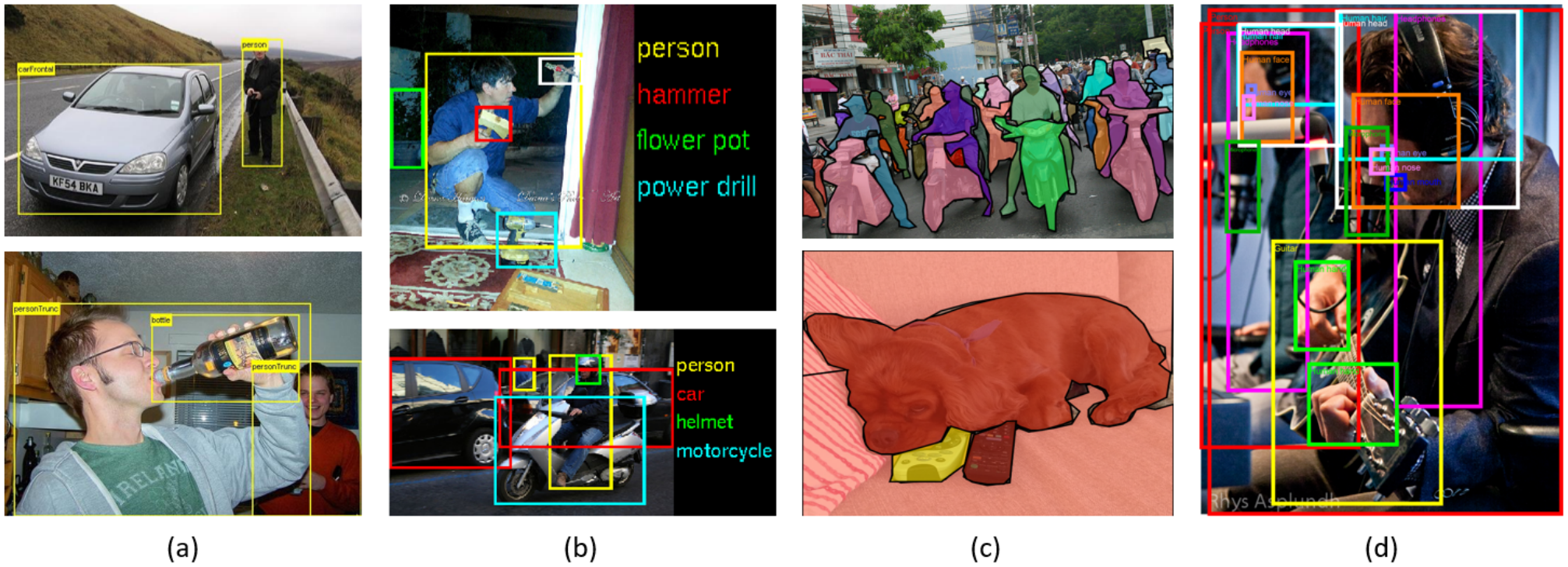
Original caption: Fig. 4: Some example images and annotations in (a) PASCAL-VOC07, (b) ILSVRC, (c) MS-COCO, and (d) Open Images.
中图 4:(a) PASCAL-VOC07、(b) ILSVRC、(c) MS-COCO 和 (d) Open Images 的示例图像及标注。
读图提示: 从左到右为 (a) 至 (d);图中保留各数据集的原始英文标注。
Table I · 常用数据集的统计
Placed near: p.4 S034
Source: p.5 C005
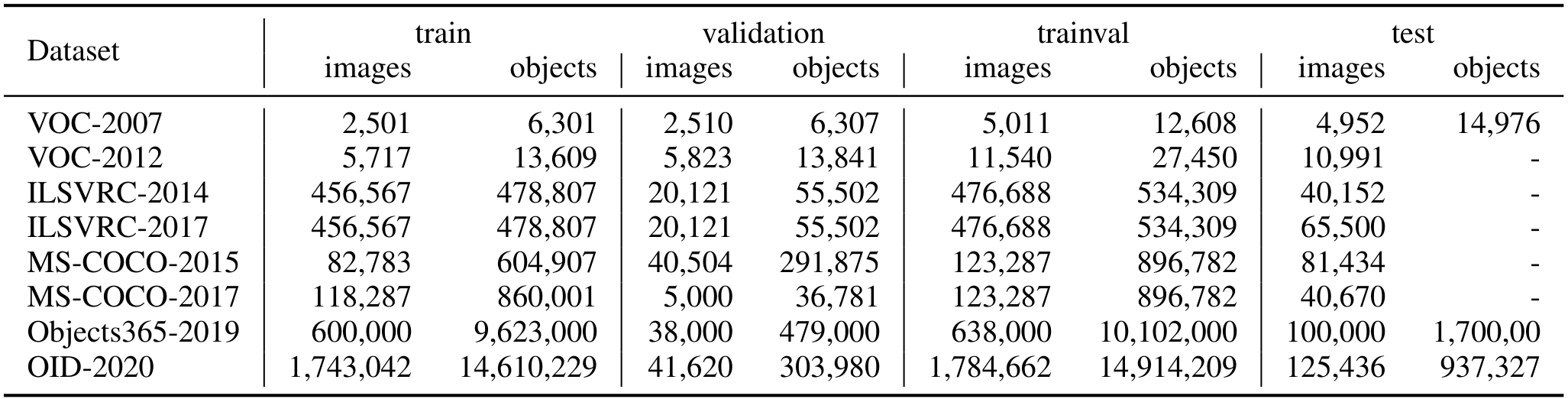
Original caption: TABLE I: Some well-known object detection datasets and their statistics.
读图提示: train = 训练集;validation = 验证集;trainval = 训练与验证合并集;test = 测试集;images / objects = 图像数 / 目标数。Objects365-2019 的测试目标数原表写作“1,700,00”。
Source: pp.4–5 S035
ENPascal VOC: The PASCAL Visual Object Classes (VOC) Challenges¹ (from 2005 to 2012) [54, 55] was one of the most important competitions in the early computer vision community. Two versions of Pascal-VOC are mostly used in object detection: VOC07 and VOC12, where the former consists of 5k tr. images + 12k annotated objects, and the latter consists of 11k tr. images + 27k annotated objects. 20 classes of objects that are common in life are annotated in these two datasets, e.g., “person”, “cat”, “bicycle”, “sofa”, etc.
中**Pascal VOC:**PASCAL 视觉目标类别(VOC)挑战赛¹(2005 至 2012 年)[54, 55] 是早期计算机视觉界最重要的竞赛之一。目标检测最常用的是 Pascal VOC 的两个版本:VOC07 和 VOC12。前者包含约 5,000 张训练图像和 12,000 个标注目标,后者包含约 11,000 张训练图像和 27,000 个标注目标。这两个数据集对日常生活中常见的 20 类目标进行了标注,如“人”“猫”“自行车”“沙发”等。
Source: p.5 S036
ENILSVRC: The ImageNet Large Scale Visual Recognition Challenge (ILSVRC)² [56] has pushed forward the state of the art in generic object detection. ILSVRC is organized each year from 2010 to 2017. It contains a detection challenge using ImageNet images [61]. The ILSVRC detection dataset contains 200 classes of visual objects. The number of its images/object instances is two orders of magnitude larger than VOC.
中**ILSVRC:**ImageNet 大规模视觉识别挑战赛(ILSVRC)² [56] 推动了通用目标检测的技术前沿。该比赛于 2010 至 2017 年每年举办一次,其中包括一项使用 ImageNet 图像 [61] 的检测挑战。ILSVRC 检测数据集包含 200 类视觉目标,其图像数量与目标实例数量均比 VOC 大两个数量级。
Source: p.5 S037
ENMS-COCO: MS-COCO³ [57] is one of the most challenging object detection dataset available today. The annual competition based on MS-COCO dataset has been held since 2015. It has less number of object categories than ILSVRC, but more object instances. For example, MS-COCO-17 contains 164k images and 897k annotated objects from 80 categories. Compared with VOC and ILSVRC, the biggest progress of MS-COCO is that apart from the bounding box annotations, each object is further labeled using per-instance segmentation to aid in precise localization. In addition, MS-COCO contains more small objects (whose area is smaller than 1% of the image) and more densely located objects. Just like ImageNet in its time, MS-COCO has become the de facto standard for the object detection community.
中**MS-COCO:**MS-COCO³ [57] 是当时最具挑战性的目标检测数据集之一。自 2015 年起,基于 MS-COCO 的竞赛每年举办。与 ILSVRC 相比,MS-COCO 的目标类别更少,但目标实例更多。例如,MS-COCO-17 包含约 164,000 张图像,在 80 个类别中标注了约 897,000 个目标。相比 VOC 和 ILSVRC,MS-COCO 最大的进步是:除边界框标注外,还对每个目标做逐实例的分割标注,以便精确定位。此外,MS-COCO 包含更多小目标(面积不足图像的 1%),目标排列也更密集。正如 ImageNet 当年一样,MS-COCO 已成为目标检测领域的事实标准。
Source: p.5 S038
ENOpen Images: The year of 2018 sees the introduction of the Open Images Detection (OID) challenge⁴ [62], following MS-COCO but at an unprecedented scale. There are two tasks in Open Images: 1) the standard object detection, and 2) the visual relationship detection which detects paired objects in particular relations. For the standard detection task, the dataset consists of 1,910k images with 15,440k annotated bounding boxes on 600 object categories.
中**Open Images:**2018 年推出的 Open Images 检测挑战赛(OID)⁴ [62] 继 MS-COCO 之后出现,且规模空前。Open Images 包含两项任务:1)标准目标检测;2)视觉关系检测,即检测具有特定关系的成对目标。用于标准检测任务的数据集包含约 1,910,000 张图像、约 15,440,000 个标注边界框,覆盖 600 个目标类别。
Source: p.5 S039
EN2) Metrics: How can we evaluate the accuracy of a detector? This question may have different answers at different times. In the early time’s detection research, there are no widely accepted evaluation metrics on detection accuracy. For example, in the early research of pedestrian detection [12], the “miss rate vs. false positives per window (FPPW)” was commonly used as the metric. However, the per-window measurement can be flawed and fails to predict full image performance [63]. In 2009, the Caltech pedestrian detection benchmark was introduced [63, 64] and since then, the evaluation metric has changed from FPPW to false positives per-image (FPPI).
中**2) 评价指标:**如何衡量检测器的准确性?不同时期的答案可能不同。目标检测研究早期,并无广泛认可的准确性评价指标。例如,早期行人检测研究 [12] 通常使用“漏检率与每窗口假阳性数(FPPW)的关系”作为评价指标。然而,按窗口度量存在缺陷,无法预测整幅图像上的表现 [63]。2009 年,Caltech 行人检测基准问世 [63, 64];此后,指标从 FPPW 改为每图像假阳性数(FPPI)。
Source: pp.5–6 S040
ENIn recent years, the most frequently used evaluation for detection is “Average Precision (AP)”, which was originally introduced in VOC2007. AP is defined as the average detection precision under different recalls, and is usually evaluated in a category-specific manner. The mean AP (mAP) averaged over all categories is usually used as the final metric of performance. To measure the object localization accuracy, the IoU between the predicted box and the ground truth is used to verify whether it is greater than a predefined threshold, say, 0.5. If yes, the object will be identified as “detected”, otherwise, “missed”. The 0.5-IoU mAP has then become the de facto metric for object detection.
中近些年最常用的检测评价指标是“平均精度(Average Precision,AP)”,它最初由 VOC2007 引入。论文将 AP 定义为不同召回率下检测精度的平均值,通常按类别分别计算。对所有类别的 AP 取均值,即平均精度均值(mAP),通常作为最终性能指标。为度量目标定位的准确性,要检验预测框与真实框的交并比(IoU)是否超过预设阈值,例如 0.5。超过则将目标判为“检出”,否则判为“漏检”。以 0.5 为 IoU 阈值的 mAP 随后成为目标检测的事实评价标准。
Source: p.6 S041
ENAfter 2014, due to the introduction of MS-COCO datasets, researchers started to pay more attention to the accuracy of object localization. Instead of using a fixed IoU threshold, MS-COCO AP is averaged over multiple IoU thresholds between 0.5 and 0.95, which encourages more accurate object localization and may be of great importance for some real-world applications (e.g., imagine there is a robot trying to grasp a spanner).
中2014 年后,随着 MS-COCO 数据集的引入,研究人员开始更重视目标定位的准确性。MS-COCO 的 AP 不采用单一固定的 IoU 阈值,而是在 0.5 至 0.95 之间的多个 IoU 阈值上取平均。这有助于推动更精确的目标定位,对一些实际应用可能很重要,例如机器人要抓取一把扳手。
C. 目标检测技术的演进
SOURCE p.6 S042
ENC. Technical Evolution in Object Detection
Source: p.6 S043
ENIn this section, we will introduce some important building blocks of a detection system and their technical evolutions. First, we describe the multi-scale and context priming on model designing, followed by the sample selection strategy and the design of the loss function in the training process, and lastly, the Non-Maximum Suppression in the inference. The time-stamp in the chart and text is supplied by the publication time of papers. The evolution order shown in the figures is primarily to assist readers in understanding and there may be temporal overlap.
中本节介绍检测系统的一些关键模块及其技术演进。先介绍模型设计中的多尺度检测与上下文引导,再介绍训练过程中的样本选择策略与损失函数设计,最后介绍推理中的非极大值抑制。图表和正文中的时间以论文发表时间为准。图中所示的演进顺序主要是为便于理解,各阶段在时间上可能重叠。
Source: p.6 S044
EN1) Technical Evolution of Multi-Scale Detection: Multi-scale detection of objects with “different sizes” and “different aspect ratios” is one of the main technical challenges in object detection. In the past 20 years, multi-scale detection has gone through multiple historical periods, as shown in Fig. 5.
中**1) 多尺度检测的技术演进:**对“不同尺寸”和“不同宽高比”的目标进行多尺度检测,是目标检测的主要技术挑战之一。过去二十年,多尺度检测经历了多个历史阶段,如图 5 所示。
Fig. 5 · 多尺度检测技术的演进
Placed near: p.6 S044
Source: p.6 C006
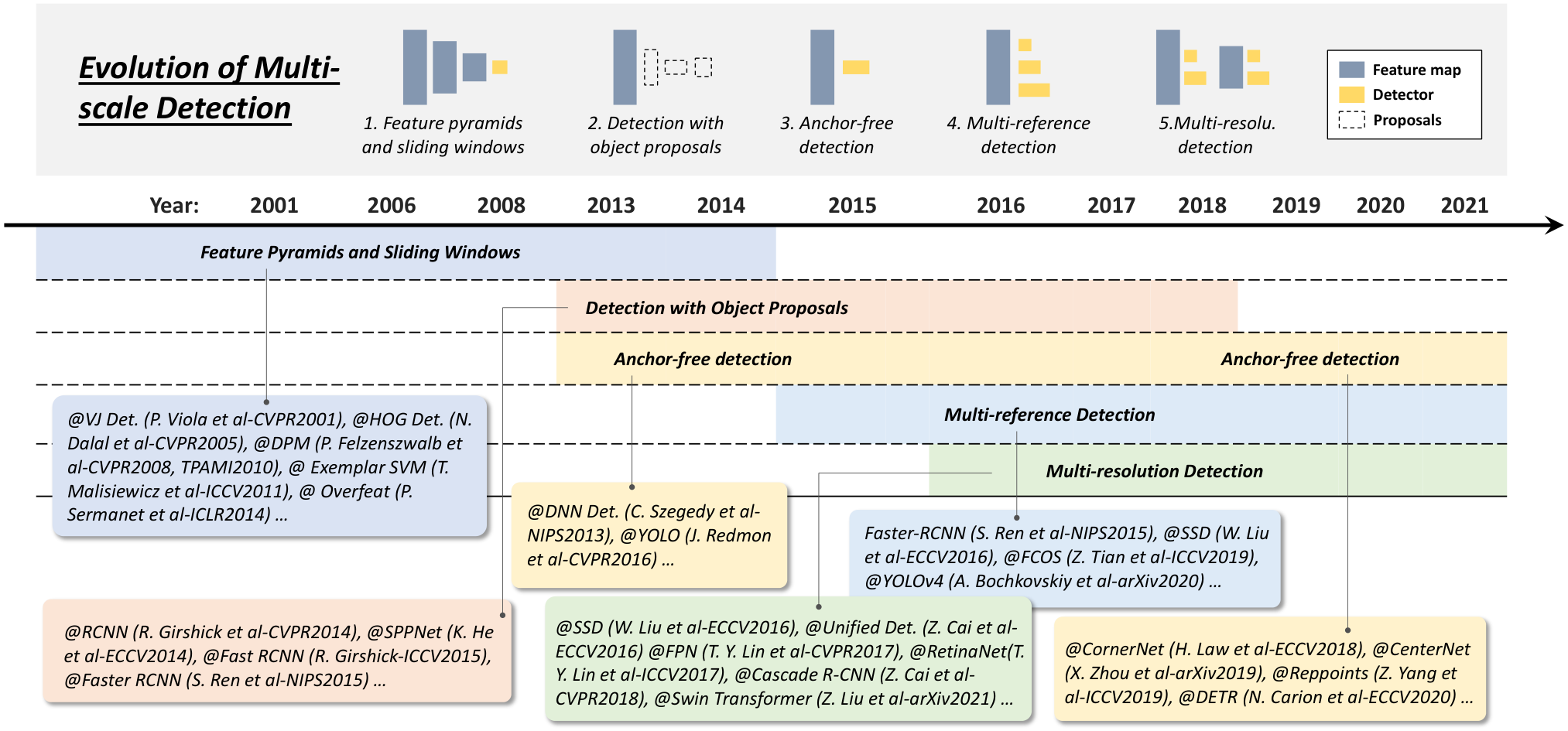
Original caption: Fig. 5: Evolution of multi-scale detection techniques in object detection. Detectors in this figure: VJ Det. [10], HOG Det. [12], DPM [13], Exemplar SVM [32], Overfeat [65], RCNN [16], SPPNet [17], Fast RCNN [18], Faster RCNN [19], DNN Det. [66], YOLO [20], SSD [23], Unified Det. [67], FPN [24], RetinaNet [25], RefineDet [38], Cascade R-CNN [68], Swin Transformer [44], FCOS [41], YOLOv4 [22], CornerNet [26], CenterNet [40], Reppoints [69], DETR [28].
中图 5:目标检测中多尺度检测技术的演进。图中的检测器:VJ Det. [10]、HOG Det. [12]、DPM [13]、Exemplar SVM [32]、Overfeat [65]、RCNN [16]、SPPNet [17]、Fast RCNN [18]、Faster RCNN [19]、DNN Det. [66]、YOLO [20]、SSD [23]、Unified Det. [67]、FPN [24]、RetinaNet [25]、RefineDet [38]、Cascade R-CNN [68]、Swin Transformer [44]、FCOS [41]、YOLOv4 [22]、CornerNet [26]、CenterNet [40]、Reppoints [69]、DETR [28]。
读图提示: 图上方依次为特征金字塔与滑动窗口、基于候选区域的检测、无锚框检测、多参考检测和多分辨率检测。
Source: p.6 S045
ENFeature pyramids + sliding windows: After the VJ detector, researchers started to pay more attention to a more intuitive way of detection, i.e. by building “feature pyramid + sliding windows”. From 2004, a number of milestone detectors were built based on this paradigm, including the HOG detector, DPM, etc. They frequently glide a fixed size detection window over the image, paying little attention to ”different aspect ratios”. To detect objects with a more complex appearance, R. Girshick et al. began to seek better solutions outside the feature pyramid. The “mixture model” [15] was a solution at that time, i.e. to train multiple detectors for objects of different aspect ratios. Apart from this, exemplar-based detection [32, 70] provided another solution by training individual models for every object instance (exemplar).
中**特征金字塔 + 滑动窗口:**VJ 检测器之后,研究者开始更重视一种更直观的检测方式,即构建“特征金字塔 + 滑动窗口”。从 2004 年起,多种里程碑检测器采用了这种范式,包括 HOG 检测器、DPM 等。这些方法通常在图像上滑动一个固定大小的检测窗口,不太考虑目标“宽高比不同”的问题。为检测外观更复杂的目标,R. Girshick 等人开始寻找特征金字塔之外的更好方案。一种当时的解法是“混合模型” [15],即训练多个检测器,分别检测不同宽高比的目标。此外,基于样例的检测 [32, 70] 提供了另一种解法:为每个目标实例(样例)分别训练模型。
Source: p.6 S046
ENDetection with object proposals: Object proposals refer to a group of class-agnostic reference boxes that are likely to contain any objects. Detection with object proposals helps to avoid the exhaustive sliding window search across an image. We refer readers to the following papers for a comprehensive review on this topic [71, 72]. Early time’s proposal detection methods followed a bottom-up detection philosophy [73, 74]. After 2014, with the popularity of deep CNN in visual recognition, the top-down, learning-based approaches began to show more advantages in this problem [19, 75, 76]. Now, the proposal detection gradually slipped out of sight after the rise of one-stage detectors.
中**基于候选区域的检测:**候选区域指一组不区分类别、可能包含目标的参考框。利用候选区域进行检测,可避免在图像上用滑动窗口穷举搜索。关于这一主题的完整综述,参见文献 [71, 72]。早期的候选区域生成方法采用自底向上的思路 [73, 74]。2014 年以后,随着深层 CNN 在视觉识别中的普及,自顶向上、基于学习的方法在这一问题上开始展现更多优势 [19, 75, 76]。单阶段检测器兴起后,候选区域生成逐渐淡出了研究视野。
Source: pp.6–7 S047
ENDeep regression and anchor-free detection: In recent years, with the increase of GPU’s computing power, multi-scale detection has become more and more straightforward and brute-force. The idea of using the deep regression to solve multi-scale problems becomes simple, i.e., to directly predict the coordinates of a bounding box based on the deep learning features [20, 66]. After 2018, researchers began to think about the object detection problem from the perspective of keypoint detection. These methods often follow two ideas: One is the group-based method which detects keypoints (corners, centers, or representative points) and then conducts object-wise grouping [26, 53, 69, 77]; the other is the group-free method which regards an object as one/many points and then regresses the object attributes (size, ratio, etc.) under the reference of the points [40, 41].
中**深度回归与无锚框检测:**近年来,随着 GPU 算力的提升,多尺度检测逐渐变得更直接,处理方式也更简单粗放。利用深度回归解决多尺度问题的思路很简单:直接根据深度学习特征预测边界框的坐标 [20, 66]。2018 年以后,研究人员开始从关键点检测的角度思考目标检测。这些方法通常遵循两种思路:一类依赖分组,先检测关键点(角点、中心点或代表点),再按目标将关键点分组 [26, 53, 69, 77];另一类无须分组,将目标视为一个或多个点,再以这些点为参照回归目标的属性(大小、宽高比等)[40, 41]。
Source: p.7 S048
ENMulti-reference/-resolution detection: Multi-reference detection is now the most used method for multi-scale detection [19, 22, 23, 41, 47, 51]. The main idea of multi-reference detection [19, 22, 23, 41, 47, 51] is to first define a set of references (a.k.a. anchors, including boxes and points) at every location of an image, and then predict the detection box based on these references. Another popular technique is multi-resolution detection [23, 24, 44, 67, 68], i.e. by detecting objects of different scales at different layers of the network. Multi-reference and multi-resolution detection have now become two basic building blocks in the state-of-the-art object detection systems.
中**多参考检测与多分辨率检测:**多参考检测是当时最常用的多尺度检测方法 [19, 22, 23, 41, 47, 51]。其主要思路 [19, 22, 23, 41, 47, 51] 是先在图像的每个位置定义一组参考(也称锚,包括锚框和锚点),然后基于这些参考预测检测框。另一种常用技术是多分辨率检测 [23, 24, 44, 67, 68],即在网络的不同层上检测不同尺度的目标。多参考检测与多分辨率检测已成为当时先进目标检测系统的两个基本模块。
Source: p.7 S049
EN2) Technical Evolution of Context Priming: Visual objects are usually embedded in a typical context with the surrounding environments. Our brain takes advantage of the associations among objects and environments to facilitate visual perception and cognition [96]. Context priming has long been used to improve detection. Fig. 6 shows the evolution of context priming in object detection.
中**2) 上下文引导的技术演进:**视觉目标通常处于由周围环境构成的典型上下文中。人脑利用目标与环境的关联来促进视觉感知与认知 [96]。目标检测也早已利用上下文引导来改善表现。图 6 展示了目标检测中上下文引导技术的演进。
Fig. 6 · 上下文引导技术的演进
Placed near: p.7 S049
Source: p.7 C007
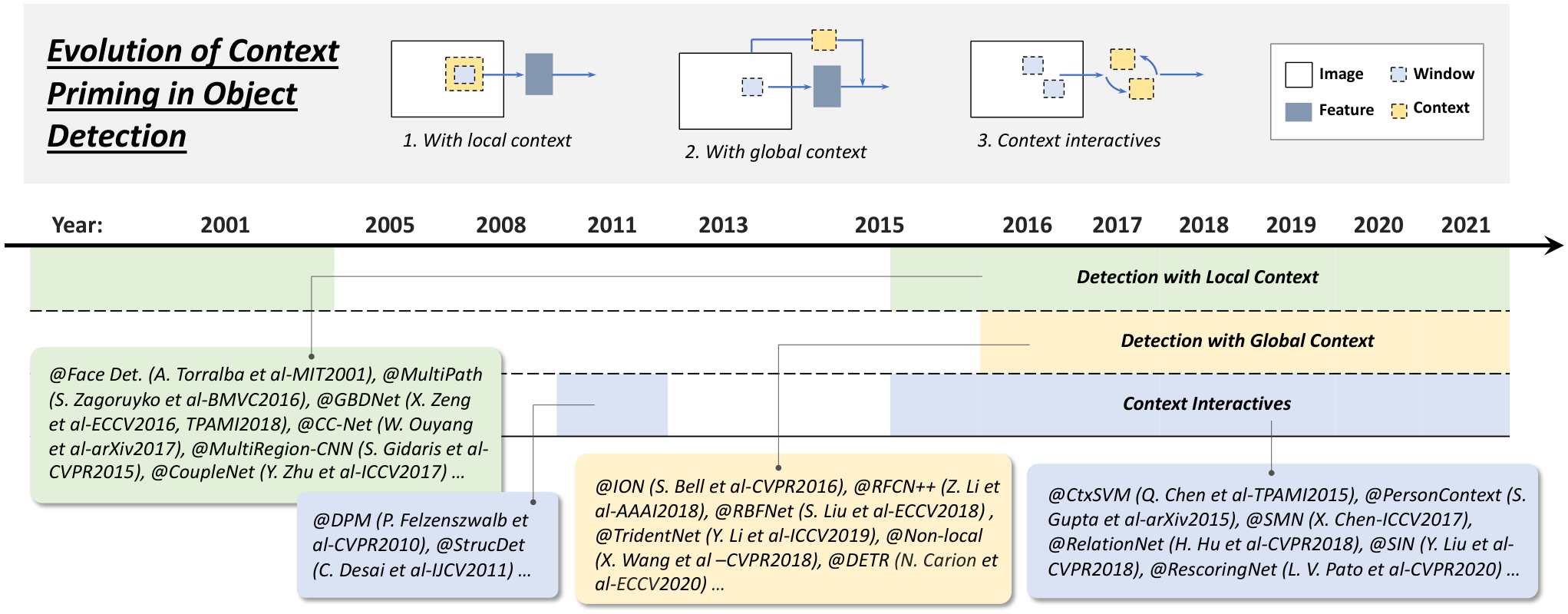
Original caption: Fig. 6: Evolution of context priming in object detection. Detectors in this figure: Face Det. [78], MultiPath [79], GBDNet [80, 81], CC-Net [82], MultiRegion-CNN [83], CoupleNet [84], DPM [14, 15], StructDet [85], ION [86], RFCN++ [87], RBFNet [88], TridentNet [39], Non-local [89], DETR [28], CtxSVM [90], PersonContext [91], SMN [92], RelationNet [93], SIN [94], RescoringNet [95].
中图 6:目标检测中上下文引导方法的演进。图中的检测器:Face Det. [78]、MultiPath [79]、GBDNet [80, 81]、CC-Net [82]、MultiRegion-CNN [83]、CoupleNet [84]、DPM [14, 15]、StructDet [85]、ION [86]、RFCN++ [87]、RBFNet [88]、TridentNet [39]、Non-local [89]、DETR [28]、CtxSVM [90]、PersonContext [91]、SMN [92]、RelationNet [93]、SIN [94]、RescoringNet [95]。
读图提示: 图区分局部上下文(local context)、全局上下文(global context)和上下文交互(context interactives)。
Source: p.7 S050
ENDetection with local context: Local context refers to the visual information in the area that surrounds the object to detect. It has long been acknowledged that local context helps improve object detection. In the early 2000s, Sinha and Torralba [78] found that the inclusion of local contextual regions such as the facial bounding contour substantially improves face detection performance. Dalal and Triggs also found that incorporating a small amount of background information improves the accuracy of pedestrian detection [12]. Recent deep learning based detectors can also be improved with local context by simply enlarging the networks’ receptive field or the size of object proposals [79–84, 97].
中**利用局部上下文进行检测:**局部上下文是指待检测目标周围区域的视觉信息。人们早已意识到,局部上下文有助于改进目标检测。21 世纪初,Sinha 和 Torralba [78] 发现,加入脸部外轮廓等局部上下文区域能够显著改善人脸检测表现。Dalal 和 Triggs 也发现,纳入少量背景信息可提高行人检测的精度 [12]。对近期基于深度学习的检测器,只要扩大网络的感受野或增大候选区域,也能利用局部上下文改善检测效果 [79–84, 97]。
Source: p.7 S051
ENDetection with global context: Global context exploits scene configuration as an additional source of information for object detection. For early time detectors, a common way of integrating global context is to integrate a statistical summary of the elements that comprise the scene, like Gist [96]. For recent detectors, there are two methods to integrate the global context. The first method is to take advantage of deep convolution, dilated convolution, deformable convolution, pooling operation [39, 87, 88] to receive a large receptive field (even larger than the input image). But now, researchers have explored the potential to apply attention based mechanisms (non-local, transformers, etc.) to achieve a full-image receptive field and have obtained great success [28, 89]. The second method is to think of the global context as a kind of sequential information and to learn it with the recurrent neural networks [86, 98].
中**利用全局上下文进行检测:**全局上下文方法将场景构成作为目标检测的额外信息来源。早期检测器通常通过整合场景组成元素的统计摘要来引入全局上下文,例如 Gist [96]。较新的检测器有两种整合全局上下文的方式。第一种是利用深层卷积、空洞卷积、可变形卷积和池化操作 [39, 87, 88] 获得更大的感受野(甚至超过输入图像)。后来,研究者尝试使用注意力机制(如非局部模块、Transformer 等)来获得覆盖整幅图像的感受野,并取得了很好的效果 [28, 89]。第二种方法是将全局上下文视为一种序列信息,用循环神经网络来学习 [86, 98]。
Source: p.7 S052
ENContext interactive: Context interactive refers to the constraints and dependencies that conveys between visual elements. Some recent researches suggested that modern detectors can be improved by considering context interactives. Some recent improvements can be grouped into two categories, where the first one is to explore the relationship between individual objects [15, 85, 90, 92, 93, 95], and the second one is to explore the dependencies between objects and scenes [91, 94].
中**上下文交互:**上下文交互指视觉元素之间的约束和依赖关系。近期研究表明,考虑上下文交互能够改进现代检测器。近期的一些改进可归为两类:一类探索各个目标之间的关系 [15, 85, 90, 92, 93, 95],另一类探索目标与场景之间的依赖关系 [91, 94]。
Source: p.8 S053
EN3) Technical Evolution of Hard Negative Mining: The training of a detector is essentially an imbalanced learning problem. In the case of sliding window based detectors, the imbalance between backgrounds and objects could be as extreme as 10⁷:1 [71]. In this case, using all backgrounds will be harmful to training as the vast number of easy negatives will overwhelm the learning process. Hard negative mining (HNM) aims to overcome this problem. The technical evolution of HNM is shown in Fig. 7.
中**3) 难负样本挖掘的技术演进:**训练检测器本质上是一个不平衡学习问题。对基于滑动窗口的检测器,背景与目标的比例甚至可能高达 10⁷:1 [71]。此时,使用全部背景样本反而会损害训练,因为海量易分类的负样本将淹没学习过程。难负样本挖掘(HNM)旨在解决这个问题。图 7 展示了 HNM 的技术演进。
Fig. 7 · 难负样本挖掘技术的演进
Placed near: p.8 S053
Source: p.8 C008
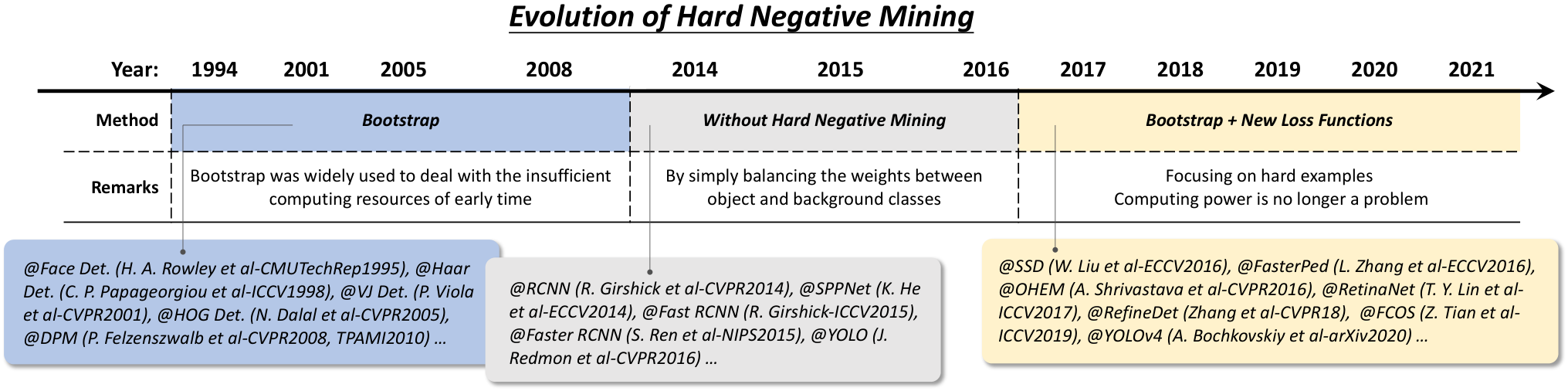
Original caption: Fig. 7: Evolution of hard negative mining techniques in object detection. Detectors in this figure: Face Det. [99], Haar Det. [100], VJ Det. [10], HOG Det. [12], DPM [13, 15], RCNN [16], SPPNet [17], Fast RCNN [18], Faster RCNN [19], YOLO [20], SSD [23], FasterPed [101], OHEM [102], RetinaNet [25], RefineDet [38], FCOS [41], YOLOv4 [22].
中图 7:目标检测中难负样本挖掘技术的演进。图中的检测器:Face Det. [99]、Haar Det. [100]、VJ Det. [10]、HOG Det. [12]、DPM [13, 15]、RCNN [16]、SPPNet [17]、Fast RCNN [18]、Faster RCNN [19]、YOLO [20]、SSD [23]、FasterPed [101]、OHEM [102]、RetinaNet [25]、RefineDet [38]、FCOS [41]、YOLOv4 [22]。
读图提示: 时间轴上的方法分组依次为自举、不使用难负样本挖掘、自举结合新损失函数。
Source: p.8 S054
ENBootstrap: Bootstrap in object detection refers to a group of training techniques in which the training starts with a small part of background samples and then iteratively adds new miss-classified samples. In early times detectors, bootstrap was commonly used with the purpose of reducing the training computations over millions of backgrounds [10, 99, 100]. Later it became a standard technique in DPM and HOG detectors [12, 13] for solving the data imbalance problem.
中**自举:**目标检测中的自举指一类训练技术:训练先从一小部分背景样本开始,再迭代加入新出现的误分类样本。早期检测器通常用自举来降低处理数百万背景样本的训练开销 [10, 99, 100]。后来,自举成为 DPM 和 HOG 检测器解决数据不平衡问题的标准技术 [12, 13]。
Source: p.8 S055
ENHNM in deep learning based detectors: In the deep learning era, due to the increase of computing power, bootstrap was shortly discarded in object detection during 2014-2016 [16–20]. To ease the data-imbalance problem during training, detectors like Faster RCNN and YOLO simply balance the weights between the positive and negative windows. However, researchers later noticed this cannot completely solve the imbalanced problem [25]. To this end, the bootstrap was reintroduced to object detection after 2016 [23, 38, 101, 102]. An alternative improvement is to design new loss functions [25] by reshaping the standard cross entropy loss so that it will put more focus on hard, misclassified examples [25].
中**基于深度学习的检测器中的难负样本挖掘:**在深度学习时代,由于算力提升,2014 至 2016 年间自举一度在目标检测中被弃用 [16–20]。为缓解训练中的数据不平衡,Faster RCNN、YOLO 等检测器仅对正、负窗口的权重进行平衡。后来研究人员发现,这无法彻底解决不平衡问题 [25]。为此,2016 年以后自举再次被引入目标检测 [23, 38, 101, 102]。另一种改进是设计新的损失函数 [25]:改造标准交叉熵损失,使其更关注被错误分类的困难样本 [25]。
Source: p.8 S056
EN4) Technical Evolution of Loss Function: The loss function measures how well the model matches the data (i.e., the deviation of the predictions from the true labels). Calculating the loss yields the gradients of the model weights, which can subsequently be updated by backpropagation to better suit the data. Classification loss and localization loss make up the supervision of the object detection problem, seeing Eq. 1. A general form of the loss function can be written as follows:
中**4) 损失函数的技术演进:**损失函数衡量模型与数据的吻合程度,即预测与真实标签之间的偏差。计算损失可以得到模型权重的梯度,随后用反向传播更新权重,使模型更好地拟合数据。分类损失和定位损失共同构成目标检测的监督信号,见式(1)。损失函数的一般形式可写为:
Source: p.8 E001
ENL(p,p*,t,t*) = L_cls.(p,p*) + βI(t)L_loc.(t,t*); I(t) = {1 if IoU{a,a*} > η; 0 else}. (1)
中L(p,p*,t,t*) = L_cls.(p,p*) + βI(t)L_loc.(t,t*);当 IoU{a,a*} > η 时,I(t) = 1,否则 I(t) = 0。(1)

Source: p.8 S057
ENwhere t and t∗ are the locations of predicted and ground-truth bounding boxes, p and p∗ are their category probabilities. IoU{a, a∗} is the IoU between the reference box/point a and its ground-truth a∗. η is an IoU threshold, say, 0.5. If an anchor box/point does not match any objects, its localization loss does not count in the final loss.
中其中,t 和 t∗ 分别为预测框和真实框的位置,p 和 p∗ 分别是其类别概率。IoU{a, a∗} 是参考框或参考点 a 与其真实标注 a∗ 之间的交并比。η 是 IoU 阈值,例如 0.5。如果某个锚框或锚点不匹配任何目标,其定位损失就不计入最终损失。
Source: p.8 S058
ENClassification loss: Classification loss is used to evaluate the divergence of the predicted category from the actual category, which was not thoroughly investigated in prevIoUs work such as YOLOv1 [20] and YOLOv2 [51] employing MSE/L2 loss (Mean Squared Error). Later, CE loss (Cross-Entropy) is typically used [21, 23, 47]. L2 loss is a measure in Euclidean space, whereas CE loss can measure distribution differences (termed as a form of likelihood). The prediction of classification is a probability, so CE loss is preferable to L2 loss with greater misclassification cost and lower gradient vanishing effect. For improving categorization efficiency, Label Smooth has been proposed to enhance the model generalization ability and solve the overconfidence problem on noise labels [103, 104], and Focal loss is designed to solve the problem of category imbalance and differences in classification difficulty [25].
中**分类损失:**分类损失用于衡量预测类别与真实类别之间的偏差。在采用 MSE/L2 损失(均方误差)的 YOLOv1 [20] 和 YOLOv2 [51] 等早期工作中,分类损失未得到充分研究。后来通常采用 CE 损失(交叉熵)[21, 23, 47]。L2 损失衡量欧氏空间中的差异,而 CE 损失可以衡量分布之间的差异(可视为一种似然形式)。由于分类的预测值是概率,CE 损失比 L2 损失更适合这一问题,因为它对误分类的惩罚更大,梯度消失的影响也更小。为改善分类效果,研究者提出标签平滑来增强模型泛化能力,缓解含噪标签造成的过度自信 [103, 104];焦点损失则旨在解决类别不平衡和分类难度不一的问题 [25]。
Source: p.8 S059
ENLocalization loss: Localization loss is used to optimize position and size deviation. L2 loss is prevalent in early research [16, 20, 51], but it is highly affected by outliers and prone to gradient explosion. Combining the benefits of L1 loss and L2 loss, the researchers propose Smooth L1 loss [18], as illustrated in the following formula,
中**定位损失:**定位损失用于优化位置和大小的偏差。L2 损失在早期工作中较为常见 [16, 20, 51],但它容易受异常值影响,并容易导致梯度爆炸。结合 L1 损失与 L2 损失的优点,研究者提出了平滑 L1 损失(Smooth L1)[18],如下式所示:
Source: p.8 E002
ENSmooth_L1(x) = {0.5x² if |x| < 1; |x| − 0.5 else}. (2)
中当 |x| < 1 时,Smooth_L1(x) = 0.5x²;否则 Smooth_L1(x) = |x| − 0.5。(2)

Source: p.8 S060
ENwhere x denotes the difference between the target and predicted values. When calculating the error, the above losses treat four numbers (x, y, w, h) representing a bounding box as independent variables, however, a correlation exists between them. Moreover, IoU is utilized to determine if the prediction box corresponds to the actual ground truth box in evaluation. Equal Smooth L1 values will have totally different IoU values, hence IoU loss [105] is introduced as follows:
中其中,x 表示目标值与预测值之差。计算误差时,上述损失将表示边界框的四个数值 (x, y, w, h) 视为独立变量,但它们之间实际存在相关性。此外,评价时用 IoU 判断预测框是否与真实框相匹配。相同的平滑 L1 损失值可能对应截然不同的 IoU 值,因此引入如下的 IoU 损失 [105]:
Source: p.8 E003
ENIoU loss = −log(IoU). (3)

Source: p.9 S061
ENFollowing that, several algorithms improved IoU loss. G-IoU (Generalized IoU) [106] improved the case when IoU loss could not optimize the non-overlapping bounding boxes, i.e., IoU = 0. According to Distance-IoU [107], a successful detection regression loss should meet three geometric metrics: overlap area, center point distance, and aspect ratio. So, based on IoU loss and G-IoU loss, DIoU (Distance IoU) is defined as the distance between the center point of the prediction and the ground truth, and CIoU (Complete IoU) [107] considered the aspect ratio difference on the basis of DIoU.
中此后,有多种算法改进了 IoU 损失。G-IoU(广义交并比)[106] 改善了在边界框不重叠(即 IoU = 0)时 IoU 损失无法优化的问题。根据 Distance-IoU [107],有效的检测回归损失应当考虑三个几何量:重叠面积、中心点距离和宽高比。因此,在 IoU 损失和 G-IoU 损失的基础上,DIoU(距离交并比)引入预测框与真实框中心点之间的距离;CIoU(完全交并比)[107] 则在 DIoU 的基础上考虑了宽高比的差异。
Source: p.9 S062
EN5) Technical Evolution of Non-Maximum Suppression: As the neighboring windows usually have similar detection scores, the non-maximum suppression is used as a post-processing step to remove the replicated bounding boxes and obtain the final detection result. At early times of object detection, NMS was not always integrated [121]. This is because the desired output of an object detection system was not entirely clear at that time. Fig. 8 shows the evolution of NMS in the past 20 years.
中**5) 非极大值抑制的技术演进:**由于相邻窗口的检测得分通常相近,非极大值抑制被用作后处理步骤,去除重复的边界框以获得最终检测结果。目标检测早期不一定包含 NMS [121],因为当时对目标检测系统应输出什么还没有完全明确的认识。图 8 展示了过去二十年间 NMS 的演进。
Fig. 8 · 非极大值抑制技术的演进
Placed near: p.9 S062
Source: p.9 C009
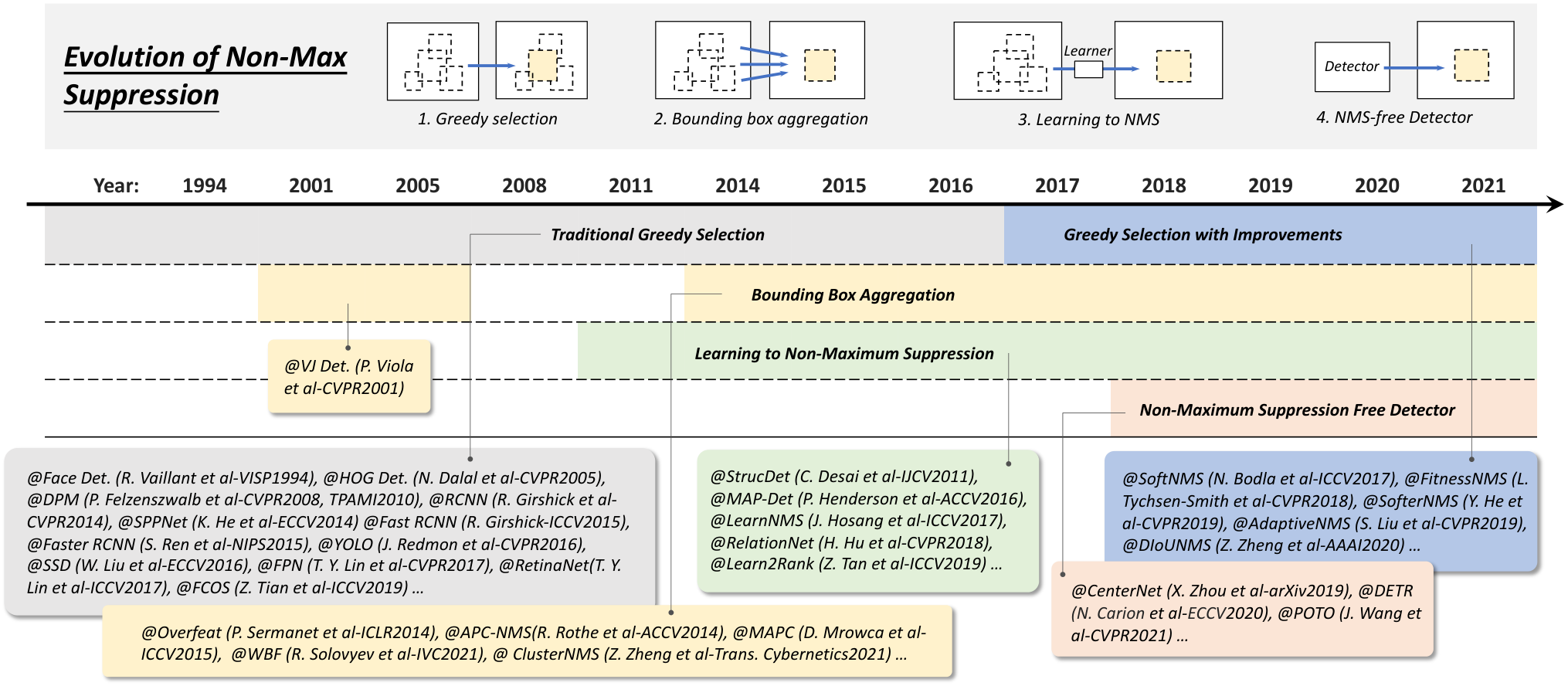
Original caption: Fig. 8: Evolution of non-max suppression (NMS) techniques in object detection from 1994 to 2021: 1) Greedy selection, 2) Bounding box aggregation, 3) Learning to NMS, and 4) NMS-free detection. Detectors in this figure: Face Det. [108], HOG Det. [12], DPM [13, 15], RCNN [16], SPPNet [17], Fast RCNN [18], Faster RCNN [19], YOLO [20], SSD [23], FPN [24], RetinaNet [25], FCOS [41], StrucDet [85], MAP-Det [109], LearnNMS [110], RelationNet [93], Learn2Rank [111], SoftNMS [112], FitnessNMS [113], SofterNMS [114], AdaptiveNMS [115], DIoUNMS [107], Overfeat [65], APC-NMS [116], MAPC [117], WBF [118], ClusterNMS [119], CenterNet [40], DETR [28], POTO [120].
中图 8:1994 至 2021 年间,目标检测中非极大值抑制(NMS)技术的演进:1)贪心选择;2)边界框聚合;3)基于学习的 NMS;4)无 NMS 检测。图中的检测器:Face Det. [108]、HOG Det. [12]、DPM [13, 15]、RCNN [16]、SPPNet [17]、Fast RCNN [18]、Faster RCNN [19]、YOLO [20]、SSD [23]、FPN [24]、RetinaNet [25]、FCOS [41]、StrucDet [85]、MAP-Det [109]、LearnNMS [110]、RelationNet [93]、Learn2Rank [111]、SoftNMS [112]、FitnessNMS [113]、SofterNMS [114]、AdaptiveNMS [115]、DIoUNMS [107]、Overfeat [65]、APC-NMS [116]、MAPC [117]、WBF [118]、ClusterNMS [119]、CenterNet [40]、DETR [28]、POTO [120]。
读图提示: 可沿时间轴对照图注中的四组方法及其代表检测器。
Source: p.9 S063
ENGreedy selection: Greedy selection is an old-fashioned but the most popular way to perform NMS. The idea behind it is simple and intuitive: for a set of overlapped detections, the bounding box with the maximum detection score is selected while its neighboring boxes are removed according to a predefined overlap threshold. Although greedy selection has now become the de facto method for NMS, it still has some space for improvement. First, the top-scoring box may not be the best fit. Second, it may suppress nearby objects. Finally, it does not suppress false positives [116]. Many works have been proposed to solve the problems mentioned above [107, 112, 114, 115].
中**贪心选择:**贪心选择是一种历史较早、但最常用的 NMS 方法。其思路简单直观:对一组重叠的检测结果,保留检测得分最高的边界框,再按预设的重叠阈值删除其相邻框。虽然贪心选择已成为 NMS 的事实标准方法,但仍有改进空间。首先,得分最高的框未必与目标最吻合;其次,它可能抑制临近的其他目标;最后,它不能抑制假阳性 [116]。针对上述问题,已有多项研究提出了解法 [107, 112, 114, 115]。
Source: p.9 S064
ENBounding Box aggregation: BB aggregation is another group of techniques for NMS [10, 65, 116, 117] with the idea of combining or clustering multiple overlapped bounding boxes into one final detection. The advantage of this type of method is that it takes full consideration of object relationships and their spatial layout [118, 119]. Some well-known detectors use this method, such as the VJ detector [10] and the Overfeat (winner of ILSVRC-13 localization task) [65].
中**边界框聚合:**边界框聚合是另一类 NMS 技术 [10, 65, 116, 117]。它将多个重叠的边界框合并或聚类为一个最终检测结果。这类方法的优点是充分考虑目标间的关系及其空间分布 [118, 119]。一些知名的检测器采用这一方法,如 VJ 检测器 [10] 和 Overfeat(ILSVRC-13 定位任务冠军)[65]。
Source: p.9 S065
ENLearning based NMS: A recent group of NMS improvements that have recently received much attention is learning based NMS [85, 93, 109–111, 122]. The main idea is to think of NMS as a filter to re-score all raw detections and to train the NMS as part of a network in an end-to-end fashion or train a net to imitate NMS’s behavior. These methods have shown promising results in improving occlusion and dense object detection over traditional hand-crafted NMS methods.
中**基于学习的 NMS:**近来,基于学习的 NMS 是备受关注的一类 NMS 改进 [85, 93, 109–111, 122]。其主要思路是把 NMS 当作一个为所有原始检测结果重新评分的过滤器,在网络中对其进行端到端训练,或另训练一个网络来模仿 NMS 的行为。与传统手工设计的 NMS 方法相比,这类方法在改善遮挡目标和密集目标的检测方面取得了有前景的结果。
Source: p.9 S066
ENNMS-free detector: To release from NMS and achieve a fully end-to-end object detection training network, researchers developed a series of methods to complete one-to-one label assignment (a.k.a. one object with just one prediction box) [28, 40, 120]. These methods frequently adhere to a rule that calls for the use of the highest-quality box for training in order to achieve free NMS. NMS-free detectors are more similar to the human visual perception system and are also a possible way to the future of object detection.
中**无 NMS 检测器:**为摆脱 NMS,获得可完全端到端训练的目标检测网络,研究人员开发了一系列方法来实现一对一标签分配(一个目标只对应一个预测框)[28, 40, 120]。这类方法通常遵循一个准则:使用质量最高的框来训练,从而实现无 NMS 检测。无 NMS 的检测器更接近人类视觉感知系统,也是目标检测未来的一个可能方向。
III. 检测加速
SOURCE p.9 S067
ENIII. SPEED-UP OF DETECTION
Source: pp.9–10 S068
ENThe acceleration of a detector has long been a challenging problem. The speed-up techniques in object detection can be divided into three levels of groups: speed up of “detection pipeline”, “detector backbone”, and “numerical computation”. , as shown in Fig. 9. Refer to [123] for a more detailed version.
中如何加速检测器,长期以来都是一个难题。图 9 将目标检测的加速技术分为三个层次:加速“检测流程”“检测器的骨干网络”以及“数值计算”。更详细的内容见文献 [123]。
Fig. 9 · 检测加速的三个层次
Placed near: pp.9–10 S068
Source: p.10 C010
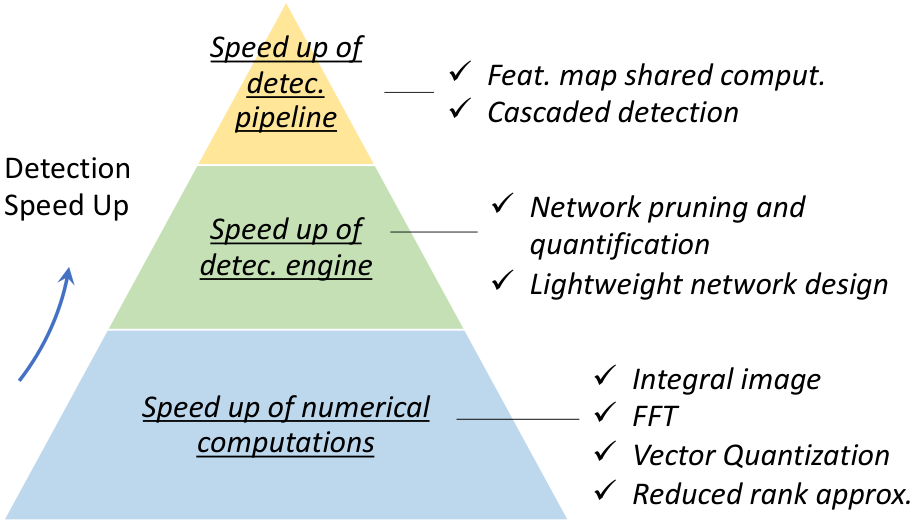
Original caption: Fig. 9: An overview of the speed-up techniques in object detection.
读图提示: 由上至下为检测流程、检测引擎和数值计算的加速;各自对应右侧的方法。
A. 特征图共享计算
SOURCE p.10 S069
ENA. Feature Map Shared Computation
Source: p.10 S070
ENAmong the different computational stages of a detector, feature extraction usually dominates the amount of computation. The most commonly used idea to reduce the feature computational redundancy is to compute the feature map of the whole image only once [18, 19, 124], which have achieved tens or even hundreds of times of acceleration.
中在检测器的各个计算环节中,特征提取通常占据大部分计算量。减少特征计算冗余最常用的办法,是对整张图像只计算一次特征图 [18, 19, 124],由此实现数十倍甚至数百倍的加速。
B. 级联检测
SOURCE p.10 S071
Source: p.10 S072
ENCascaded detection is a commonly used technique [10, 125]. It takes a coarse to fine detection philosophy: to filter out most of the simple background windows using simple calculations, then to process those more difficult windows with complex ones. In recent years, cascaded detection has been especially applied to those detection tasks of “small objects in large scenes”, e.g., face detection [126, 127], pedestrian detection [101, 124, 128], etc.
中级联检测是常用技术之一 [10, 125]。它采用由粗到细的检测思路:先用简单计算滤除大部分易判别的背景窗口,再用复杂计算处理较难判别的窗口。近些年,级联检测尤其常用于“大场景中的小目标”检测任务,如人脸检测 [126, 127]、行人检测 [101, 124, 128] 等。
C. 网络剪枝与量化
SOURCE p.10 S073
ENC. Network Pruning and Quantification
Source: p.10 S074
EN“Network pruning” and “network quantification” are two commonly used methods to speed up a CNN model. The former refers to pruning the network structure or weights and the latter refers to reducing their code length. The research of “network pruning” can be traced back to as early as the 1980s [129]. The recent network pruning methods usually take an iterative training and pruning process, i.e., to remove only a small group of unimportant weights after each stage of training, and to repeat those operations [130]. The recent works on network quantification mainly focus on network binarization, which aims to compress a network by quantifying its activations or weights to binary variables (say, 0/1) so that the floating-point operation is converted to logical operations.
中“网络剪枝”和“网络量化”是两种常见的 CNN 加速方法。前者剪去部分网络结构或权重,后者缩短编码长度。“网络剪枝”的研究最早可追溯至 20 世纪 80 年代 [129]。近期的网络剪枝通常交替进行训练和剪枝,即每个训练阶段后只去掉一小部分不重要的权重,然后重复这一过程 [130]。近期的网络量化工作主要关注网络二值化,即将激活值或权重量化为二进制变量(例如 0/1)来压缩网络,从而将浮点运算转换成逻辑运算。
D. 轻量化网络设计
SOURCE p.10 S075
END. Lightweight Network Design
Source: p.10 S076
ENThe last group of methods to speed up a CNN based detector is to directly design lightweight networks. In addition to some general designing principles like “fewer channels and more layers” [131], some other methods have been proposed in recent years [132–136].
中加速基于 CNN 的检测器的最后一类方法,是直接设计轻量化网络。除“更少的通道、更多的层”之类的一般设计原则 [131] 外,近年来还提出了其他方法 [132–136]。
Source: p.10 S077
EN1) Factorizing Convolutions: Factorizing convolutions is the most straightforward way to build a lightweight CNN model. There are two groups of factorizing methods. The first group is to factorize a large convolution filter into a set of small ones [50, 87, 137], as shown in Fig. 10 (b). For example, one can factorize a 7x7 filter into three 3x3 filters, where they share the same receptive field but the latter one is more efficient. The second group is to factorize convolutions in their channel dimension [138, 139], as shown in Fig. 10 (c).
中**1) 卷积分解:**卷积分解是构建轻量化 CNN 最直接的方式。分解方法有两类。第一类是将一个大卷积核分解为若干小卷积核 [50, 87, 137],如图 10(b) 所示。例如,可把一个 7×7 的卷积核分解为三个 3×3 的卷积核;两种方式的感受野相同,后者却更高效。第二类是在通道维度上分解卷积 [138, 139],见图 10(c)。
Fig. 10 · 卷积层的五种计算结构
Placed near: p.10 S077
Source: p.11 C011
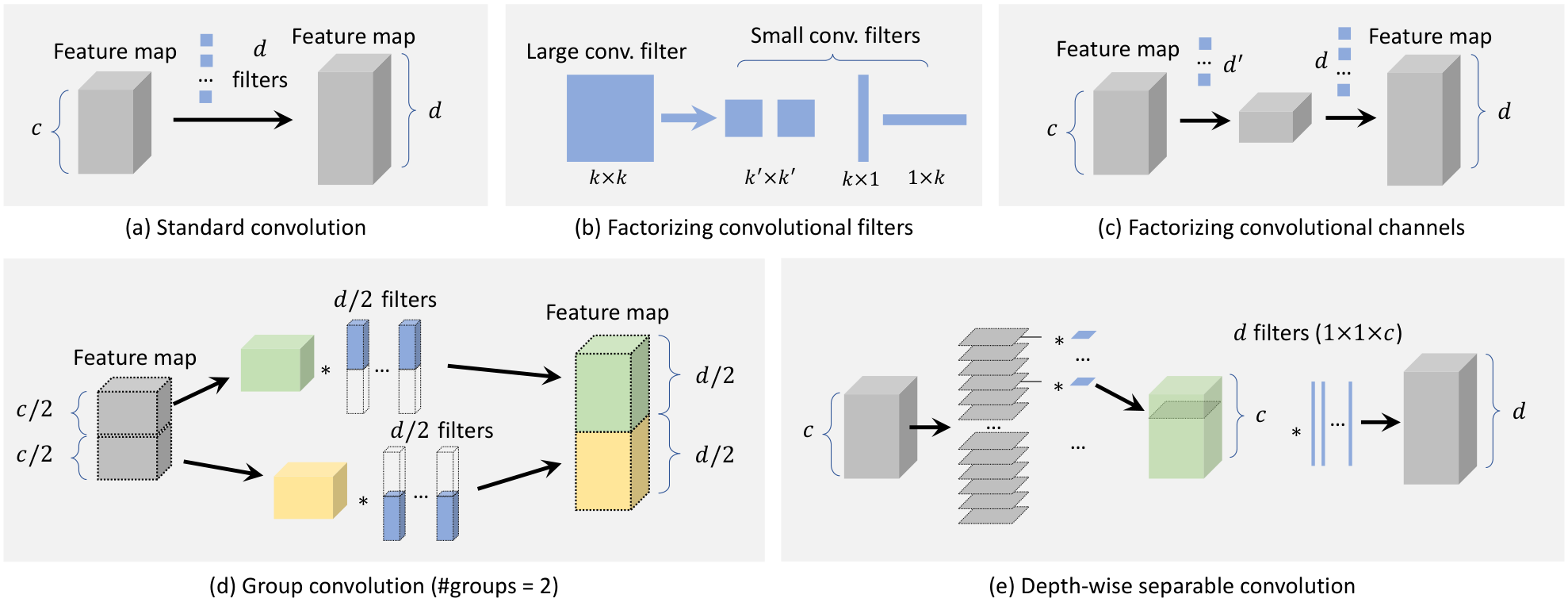
Original caption: Fig. 10: An overview of speed up methods of a CNN’s convolutional layer and the comparison of their computational complexity: (a) Standard convolution: 𝒪(dk²c). (b) Factoring convolutional filters (k×k → (k′×k′)² or 1×k, k×1): 𝒪(dk′²c) or 𝒪(dkc). (c) Factoring convolutional channels: 𝒪(d′k²c)+𝒪(dk²d′). (d) Group convolution (#groups=m): 𝒪(dk²c/m). (e) Depth-wise separable convolution: 𝒪(ck²)+𝒪(dc).
中图 10:CNN 卷积层加速方法及其计算复杂度比较。(a) 标准卷积:𝒪(dk²c);(b) 卷积核分解(k×k → (k′×k′)²,或 1×k、k×1):𝒪(dk′²c) 或 𝒪(dkc);(c) 卷积通道分解:𝒪(d′k²c)+𝒪(dk²d′);(d) 分组卷积(分组数 = m):𝒪(dk²c/m);(e) 深度可分离卷积:𝒪(ck²)+𝒪(dc)。
读图提示: 示意图中 c、d 分别表示输入、输出的通道数;(a)–(e) 对应图注中的五种计算结构。
Source: p.10 S078
EN2) Group Convolution: Group convolution aims to reduce the number of parameters in a convolution layer by dividing the feature channels into different groups, and then convolve on each group independently [140, 141], as shown in
Fig. 10 (d). If we evenly divide the features into m groups, without changing other configurations, the computation will be theoretically reduced to 1/m of that before.
中**2) 分组卷积:**分组卷积旨在减少卷积层的参数数量。它把特征通道分成若干组,然后分别对每组独立进行卷积 [140, 141],如
图 10(d) 所示。如果将特征均分为 m 组,且其他配置保持不变,计算量理论上会降至原来的 1/m。
Source: p.10 S079
EN3) Depth-wise Separable Convolution: Depth-wise separable convolution [142], as shown in
Fig. 10 (e) can be viewed as a special case of the group convolution when the number of groups is set equal to the number of channels. Usually, a number of 1x1 filters are used to make a dimension transform so that the final output will have the desired number of channels. By using depth-wise separable convolution, the computation can be reduced from O(dk²c) to O(ck²)+O(dc). This idea has been recently applied to object detection and fine-grain classification [143–145].
中**3) 深度可分离卷积:**如
图 10(e) 所示,深度可分离卷积 [142] 可视为分组卷积的一个特例,此时分组数等于通道数。通常再用若干 1×1 卷积核来变换维度,使最终输出具有所需的通道数。使用深度可分离卷积,可将计算量从 𝒪(dk²c) 降至 𝒪(ck²)+𝒪(dc)。近年来,这一思路已用于目标检测和细粒度分类 [143–145]。
Source: p.10 S080
EN4) Bottle-neck Design: A bottleneck layer in a neural network contains few nodes compared to the previous layers. In recent years, the bottle-neck design has been widely used for designing lightweight networks [50, 133, 146–148]. Among these methods, the input layer of a detector can be compressed to reduce the amount of computation from the very beginning of the detection [133, 146, 147]. One can also compress the feature map to make it thinner, so that to speed up subsequent detection [50, 148].
中**4) 瓶颈设计:**与前面的层相比,神经网络中的瓶颈层结点较少。近年来,瓶颈设计广泛用于设计轻量化网络 [50, 133, 146–148]。其中一种做法是压缩检测器的输入层,从检测一开始就减少计算量 [133, 146, 147]。也可以将特征图压缩得更薄,以加快后续检测 [50, 148]。
Source: p.10 S081
EN5) Detection with NAS: Deep learning-based detectors are becoming increasingly sophisticated, relying heavily on hand-crafted network architecture and training parameters. Neural architecture search (NAS) is primarily concerned with defining the proper space of candidate networks, improving strategies for searching quickly and accurately, and validating the searching results at a low cost. When designing a detection model, NAS can reduce the need for human intervention on the design of the network backbone and anchor boxes [149–155].
中**5) 采用 NAS 的检测:**基于深度学习的检测器日益复杂,高度依赖人工设计的网络架构和训练参数。神经架构搜索(NAS)主要关注如何定义合理的候选网络空间,如何快速、准确地搜索,以及如何以较低成本验证搜索结果。在设计检测模型时,NAS 可以减少在骨干网络和锚框设计中对人工干预的需求 [149–155]。
E. 数值计算加速
SOURCE p.10 S082
ENE. Numerical Acceleration
Source: p.10 S083
ENNumerical Acceleration aims to accelerate object detectors from the bottom of their implementations.
中数值计算加速旨在从实现的底层加快目标检测器的运行。
Source: p.10 S084
EN1) Speed Up with Integral Image: The integral image is an important method in image processing. It helps to rapidly calculate summations over image sub-regions. The essence of integral image is the integral-differential separability of convolution in signal processing:
中**1) 用积分图像加速:**积分图像是图像处理中的一种重要方法,可快速计算图像子区域内的求和。积分图像的原理是信号处理中卷积的积分与微分可分离性:
Source: p.10 E004
ENf(x) ∗ g(x) = (∫ f(x) dx) ∗ (dg(x)/dx), (4)
中f(x) ∗ g(x) = (∫ f(x) dx) ∗ (dg(x)/dx),(4)

Source: pp.10–11 S085
ENwhere if dg(x)/dx is a sparse signal, then the convolution can be accelerated by the right part of this equation [10, 156]. The integral image can also be used to speed up more general features in object detection, e.g., color histogram, gradient histogram [124, 157–159], etc. A typical example is to speed up HOG by computing integral HOG maps [124, 157], as shown in Fig. 11. Integral HOG map has been used in pedestrian detection and has achieved dozens of times’ acceleration without losing any accuracy [124].
中如果 dg(x)/dx 是稀疏信号,就可以用等式右侧的形式加速卷积 [10, 156]。积分图像还能加快目标检测中更一般的特征计算,例如颜色直方图、梯度直方图 [124, 157–159] 等。一个典型例子是通过计算积分 HOG 特征图来加速 HOG [124, 157],见图 11。积分 HOG 特征图已用于行人检测,并在准确性不受损的前提下实现了数十倍加速 [124]。
Fig. 11 · 积分 HOG 特征图的计算
Placed near: pp.10–11 S085
Source: p.11 C012
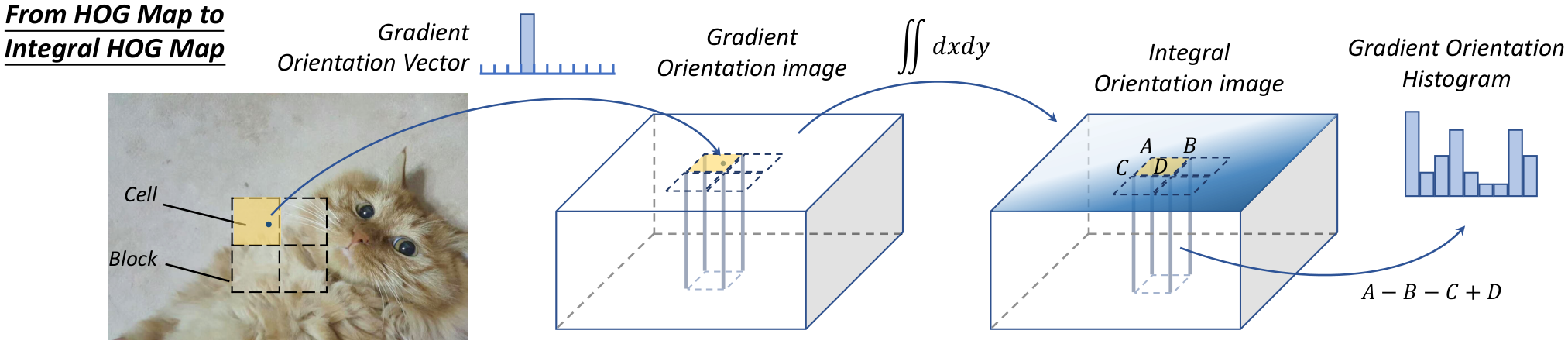
Original caption: Fig. 11: An illustration of how to compute the “Integral HOG Map” [124]. With integral image techniques, we can efficiently compute the histogram feature of any location and any size with constant computational complexity.
中图 11:“积分 HOG 特征图”的计算示意 [124]。借助积分图像技术,可以用常数计算复杂度高效计算任意位置、任意尺寸区域的直方图特征。
读图提示: cell = 单元格,block = 块。右侧示例用 A−B−C+D 从积分图计算区域直方图。
Source: p.11 S086
EN2) Speed Up in Frequency Domain: Convolution is an important type of numerical operation in object detection. As the detection of a linear detector can be viewed as the window-wise inner product between the feature map and detector’s weights, which can be implemented by convolutions. The Fourier transform is a very practical way to speed up convolutions, where the theoretical basis is the convolution theorem in signal processing, i.e. under suitable conditions, the Fourier transform F of a convolution of two signals I ∗ W is the point-wise product in their Fourier space:
中**2) 频域加速:**卷积是目标检测中的一类重要数值运算。线性检测器的检测可视为在每个窗口内对特征图和检测器权重做内积,而这可通过卷积实现。傅里叶变换是加快卷积的一种实用方法,其理论基础是信号处理中的卷积定理:在适当条件下,两个信号的卷积 I ∗ W 的傅里叶变换 F,等于它们在频域中的逐点乘积:
Source: p.11 E005
ENI ∗ W = F⁻¹(F(I) ⊙ F(W)). (5)
中I ∗ W = F⁻¹(F(I) ⊙ F(W))。(5)

Source: p.11 S087
ENwhere F is Fourier transform, F⁻¹ is Inverse Fourier transform, and ⊙ is the point-wise product. The above calculation can be accelerated by using the Fast Fourier Transform (FFT) and the Inverse FFT (IFFT) [160–163].
中其中 F 为傅里叶变换,F⁻¹ 为逆傅里叶变换,⊙ 为逐点乘积。上述计算可以用快速傅里叶变换(FFT)和逆快速傅里叶变换(IFFT)加速 [160–163]。
Source: p.11 S088
EN3) Vector Quantization: The Vector Quantization (VQ) is a classical quantization method in signal processing that aims to approximate the distribution of a large group of data by a small set of prototype vectors. It can be used for data compression and accelerating the inner product operation in object detection [164, 165].
中**3) 矢量量化:**矢量量化(VQ)是信号处理中的经典量化方法,旨在用一小组原型向量来近似大量数据的分布。它可用于数据压缩,也可加快目标检测中的内积运算 [164, 165]。
IV. 目标检测的近期进展
SOURCE p.11 S089
ENIV. RECENT ADVANCES IN OBJECT DETECTION
Source: p.11 S090
ENThe continual appearance of new technologies over the past two decades has a considerable influence on object detection, while its fundamental principles and underlying logic have remained unchanged. In the above sections, we introduced the evolution of technology over the past two decades in a large-scale time range to help readers comprehend object detection; in this section, we will focus more on state-of-the-art algorithms in recent years on a short time range to help readers understand object detection. Some are expansions of previously discussed techniques (e.g., Sec. IV-A – IV-E), while others are novel crossovers that mix concepts (e.g., Sec. IV-F – IV-H).
中过去二十年,不断涌现的新技术对目标检测产生了相当大的影响,但其基本原理和底层逻辑并未改变。前几节在较大的时间跨度上梳理了二十年来的技术演进,帮助读者把握目标检测;本节则在较短的时间范围内聚焦近年的先进算法,帮助读者深入理解目标检测。其中一部分是前述技术的延伸(如第 IV-A 至 IV-E 节),另一部分则是不同概念相结合的新方法(如第 IV-F 至 IV-H 节)。
A. 超越滑动窗口的检测
SOURCE p.12 S091
ENA. Beyond Sliding Window Detection
Source: p.12 S092
ENSince an object in an image can be uniquely determined by its upper left corner and lower right corner of the ground truth box, the detection task, therefore, can be equivalently framed as a pair-wise key points localization problem. One recent implementation of this idea is to predict a heat-map for the corners [26]. Some other methods follow the idea and utilize more key points (corner and center [77], extreme and center points [53], representative points [69] ) to obtain better performance. Another paradigm views an object as a point/points and directly predicts the object’s attributes (e.g. height and width) without grouping. The advantage of this approach is that it can be implemented under a semantic segmentation framework, and there is no need to design multi-scale anchor boxes. Furthermore, by viewing object detection as a set prediction, DETR [28, 43] completely liberates it in a reference-based framework.
中图像中的目标可由其真实边界框的左上角和右下角唯一确定,因此检测任务可等价表述为成对关键点的定位问题。近期实现这一思路的一种方式,是预测角点的热力图 [26]。还有一些方法沿用这一思路,使用更多关键点(角点和中心点 [77]、极值点和中心点 [53]、代表点 [69])来获得更好的性能。另一种范式将目标视为一个或多个点,无须分组,直接预测目标的属性(如高度和宽度)。这种做法的优点是可在语义分割框架下实现,而且无须设计多尺度锚框。进一步地,DETR [28, 43] 将目标检测视为集合预测,完全摆脱了基于预设参考的框架。
B. 对旋转和尺度变化具有鲁棒性的检测
SOURCE p.12 S093
ENB. Robust Detection of Rotation and Scale Changes
Source: p.12 S094
ENIn recent years, efforts have been made on robust detection of rotation and scale changes.
中近年来,研究者致力于使检测对旋转和尺度变化保持鲁棒。
Source: p.12 S095
EN1) Rotation Robust Detection: Object rotation is common to see in face detection, text detection, and remote sensing object detection. The most straightforward solution to this problem is to perform data augmentation so that an object in any orientation can be well covered by the augmented data distribution [166], or to train independent detectors separately for each orientation [167, 168]. Designing rotation invariant loss functions is a recent popular solution, where a constraint on the detection loss is added so that the feature of rotated objects keeps unchanged [169–171]. Another recent solution is to learn geometric transformations of the objects candidates [172–175]. In two-stage detectors, ROI pooling aims to extract a fixed-length feature representation for an object proposal with any location and size. Since the feature pooling usually is performed in Cartesian coordinates, it is not invariant to rotation transform. A recent improvement is to perform ROI pooling in polar coordinates so that the features can be robust to the rotation changes [167].
中**1) 旋转鲁棒检测:**在人脸检测、文本检测和遥感目标检测中,目标旋转很常见。最直接的办法是进行数据增强,使增强后的数据分布能覆盖目标的各种朝向 [166];也可以为每种朝向分别训练独立的检测器 [167, 168]。近期一种常用方法是设计旋转不变的损失函数:对检测损失加上约束,使目标旋转后特征保持不变 [169–171]。另一种近来的解法是学习候选目标的几何变换 [172–175]。在双阶段检测器中,感兴趣区域(ROI)池化旨在从任意位置、任意大小的候选区域提取定长特征。由于特征池化通常在笛卡尔坐标系中进行,因此不具备旋转不变性。一项近期改进是在极坐标系中进行 ROI 池化,使特征对旋转变化保持鲁棒 [167]。
Source: p.12 S096
EN2) Scale Robust Detection: Recent studies have been made for scale robust detection at both training and detection stages.
中**2) 尺度鲁棒检测:**近期研究从训练和检测两个阶段入手,提高检测对尺度变化的鲁棒性。
Source: p.12 S097
ENScale adaptive training: Modern detectors usually re-scale input images to a fixed size and back propagate the loss of the objects in all scales. A drawback of doing this is there will be a “scale imbalance” problem. Building an image pyramid during detection could alleviate this problem but not fundamentally [49, 178]. A recent improvement is Scale Normalization for Image Pyramids (SNIP) [176], which builds image pyramids at both training and detection stages and only backpropagates the loss of some selected scales, as shown in Fig. 12. Some researchers have further proposed a more efficient training strategy: SNIP with Efficient Resampling (SNIPER) [177], i.e. to crop and re-scale an image to a set of sub-regions so that to benefit from large batch training.
中**尺度自适应训练:**现代检测器通常将输入图像缩放到固定尺寸,并对所有尺度目标的损失进行反向传播。这会带来“尺度不平衡”问题。在检测阶段构建图像金字塔可以缓解问题,但无法从根本上解决 [49, 178]。一项近期改进是图像金字塔尺度归一化(Scale Normalization for Image Pyramids,SNIP)[176]。它在训练和检测阶段都构建图像金字塔,并且只对选定尺度上目标的损失进行反向传播,如图 12 所示。研究人员又提出了一种更高效的训练策略:结合高效重采样的 SNIP(SNIP with Efficient Resampling,SNIPER)[177],即从图像中裁出一组子区域并重新缩放,从而利用大批量训练的优势。
Fig. 12 · 对哪些尺度反向传播
Placed near: p.12 S097
Source: p.12 C013
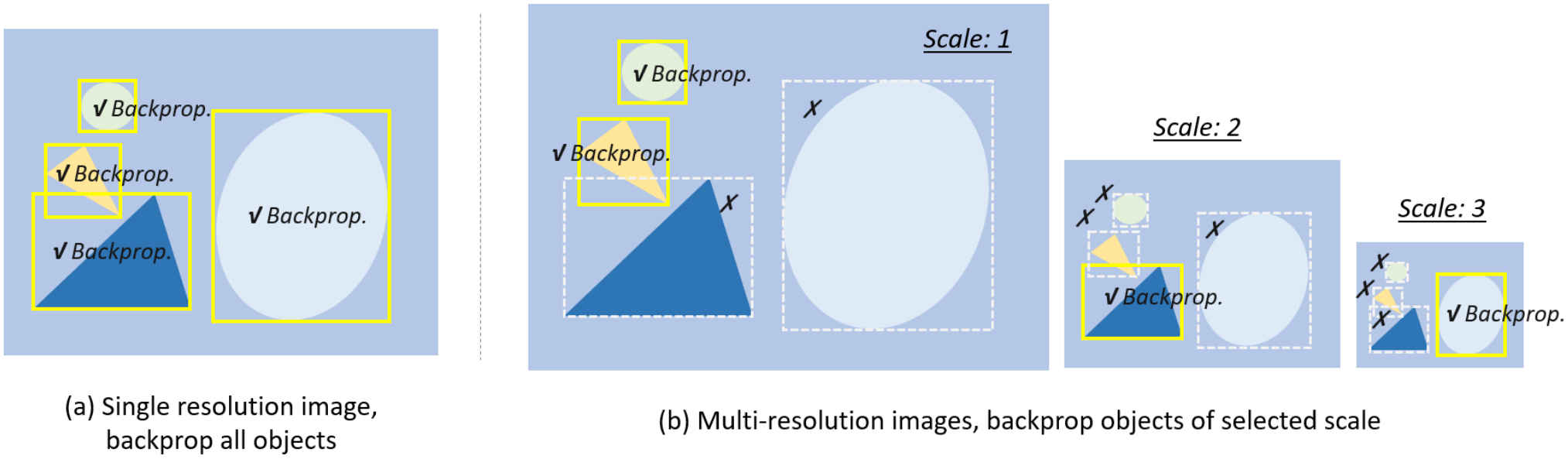
Original caption: Fig. 12: Different training strategies for multi-scale object detection: (a): Training on a single resolution image, back propagate objects of all scales [17–19, 23]. (b) Training on multi-resolution images (image pyramid), back propagate objects of selected scale. If an object is too large or too small, its gradient will be discarded [39, 176, 177].
中图 12:多尺度目标检测的两种训练策略。(a) 在单一分辨率图像上训练,对所有尺度目标的损失进行反向传播 [17–19, 23]。(b) 在多分辨率图像(图像金字塔)上训练,只对选定尺度的目标反向传播。若目标过大或过小,则丢弃其梯度 [39, 176, 177]。
读图提示: 带勾的 Backprop. 表示在当前分辨率下对该目标反向传播;叉号表示不对该目标反向传播。
Source: p.12 S098
ENScale adaptive detection: In CNN based detectors, the size of and aspect ratio of anchors are usually carefully designed. A drawback of doing this is the configurations cannot be adaptive to unexpected scale changes. To improve the detection of small objects, some “adaptive zoom-in” techniques are proposed in some recent detectors to adaptively enlarge the small objects into the “larger ones” [179, 180]. Another recent improvement is to predict the scale distribution of objects in an image, and then adaptively re-scaling the image according to it [181, 182].
中**尺度自适应检测:**基于 CNN 的检测器通常会仔细设计锚框的尺寸和宽高比,其缺点是这些配置无法适应意料之外的尺度变化。为改善小目标检测,一些近期检测器提出了“自适应放大”技术,按需将小目标放大为“较大的目标” [179, 180]。另一项近期改进,是先预测图像内目标的尺度分布,再据此对图像进行自适应缩放 [181, 182]。
C. 采用更好的骨干网络进行检测
SOURCE p.12 S099
ENC. Detection with Better Backbones
Source: pp.12–13 S100
ENThe accuracy/speed of a detector depends heavily on the feature extraction networks, a.k.a, backbones, e.g. the ResNet [178], CSPNet [183], Hourglass [184], and Swin Transformer [44]. For a detailed introduction of some important detection backbones in deep learning era, we refer readers to the following surveys [185]. Fig. 13 shows the detection accuracy of three well-known detection systems: Faster RCNN [19], R-FCN [49] and SSD [23] with different backbones [186]. Object detection has recently benefited from the powerful feature extraction capabilities of Transformers. On the COCO dataset, the top-10 detection methods are all transformer-based⁵. The performance gap between Transformers and CNNs have been gradually widened.
中检测器的准确性和速度在很大程度上取决于特征提取网络,也就是骨干网络,如 ResNet [178]、CSPNet [183]、Hourglass [184] 和 Swin Transformer [44]。关于深度学习时代一些重要检测骨干网络的详细介绍,可参阅综述 [185]。图 13 展示了三种知名检测系统——Faster RCNN [19]、R-FCN [49] 和 SSD [23]——搭配不同骨干网络时的检测精度 [186]。近来,目标检测受益于 Transformer 强大的特征提取能力。在作者引用的 COCO 数据集排行榜上,前十名的检测方法都基于 Transformer⁵。Transformer 与 CNN 的性能差距逐渐扩大。
Fig. 13 · 检测器搭配不同骨干网络的表现
Placed near: pp.12–13 S100
Source: p.13 C014
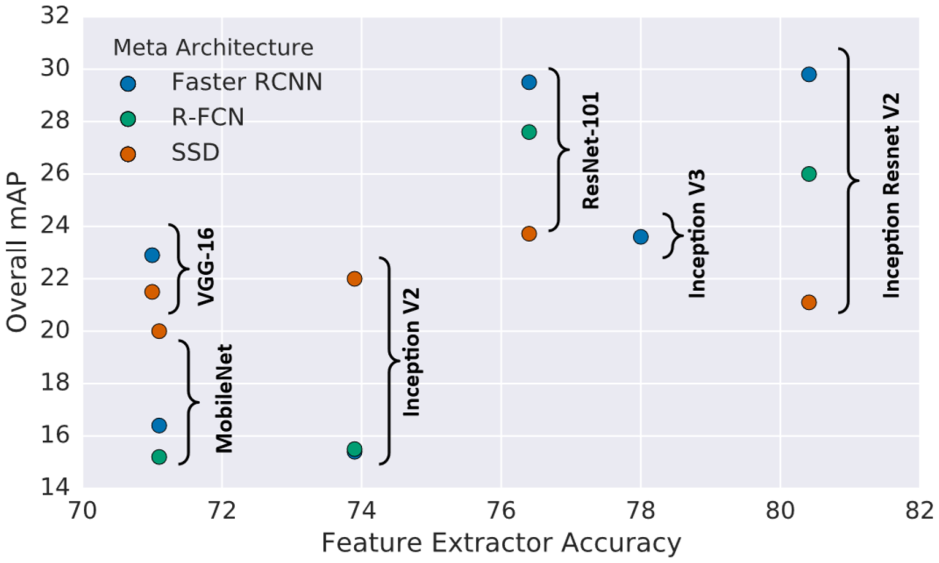
Original caption: Fig. 13: A comparison of detection accuracy of three detectors: Faster RCNN [19], R-FCN [49] and SSD [23] on MS-COCO dataset with different detection backbones. Image from J. Huang et al. CVPR 2017 [186].
中图 13:比较三种检测器在 MS-COCO 数据集上搭配不同检测骨干网络时的检测精度:Faster RCNN [19]、R-FCN [49] 和 SSD [23]。图片引自 J. Huang 等人的 CVPR 2017 论文 [186]。
读图提示: 横轴是特征提取网络自身的准确性,纵轴为整体检测 mAP;颜色区分三种检测框架。
D. 改进定位精度
SOURCE p.13 S101
END. Improvements of Localization
Source: p.13 S102
ENTo improve localization accuracy, there are two groups of methods in recent detectors: 1) bounding box refinement, and 2) new loss functions for accurate localization.
中近期检测器主要通过两类方法改善定位精度:1)边界框细化;2)面向精确定位的新损失函数。
Source: p.13 S103
EN1) Bounding Box Refinement: The most intuitive way to improve localization accuracy is bounding box refinement, which can be considered as a post-processing of the detection results. One recent method is to iteratively feed the detection results into a BB regressor until the prediction converges to a correct location and size [187–189]. However, some researchers also claimed that this method does not guarantee the monotonicity of localization accuracy [187] and may degenerate the localization if the refinement is applied for multiple times.
中**1) 边界框细化:**提高定位准确性最直观的方式是细化边界框,可视为对检测结果的后处理。近期一种做法是反复将检测结果输入边界框回归器,直到预测收敛到正确的位置和大小 [187–189]。不过,也有研究指出,这种方法无法保证定位准确性单调提高 [187];进行多次细化反而可能使定位变差。
Source: p.13 S104
EN2) New Loss Functions for Accurate Localization: In most modern detectors, object localization is considered as a coordinate regression problem. However, the drawbacks of this paradigm are obvious. First, the regression loss does not correspond to the final evaluation of localization, especially for some objects with very large aspect ratios. Second, the traditional BB regression method does not provide the confidence of localization. When there are multiple BB’s overlapping with each other, this may lead to failure in non-maximum suppression. The above problems can be alleviated by designing new loss functions. The most intuitive improvement is to directly use IoU as the localization loss [105–107, 190]. Besides, some researchers also tried to improve localization under a probabilistic inference framework [191]. Different from the previous methods that directly predict the box coordinates, this method predicts the probability distribution of a bounding box location.
中**2) 面向精确定位的新损失函数:**在大多数现代检测器中,目标定位被视为坐标回归问题,但这一范式的缺点很明显。首先,回归损失与最终的定位评价并不一致,尤其是某些宽高比很大的目标。其次,传统边界框回归不提供定位置信度。当多个边界框相互重叠时,这可能导致非极大值抑制失效。设计新的损失函数可缓解上述问题。最直观的改进是直接用 IoU 构造定位损失 [105–107, 190]。此外,一些研究者也尝试在概率推断框架下改进定位 [191]。与此前直接预测边界框坐标的方法不同,这种方法预测的是边界框位置的概率分布。
E. 利用分割损失学习
SOURCE p.13 S105
ENE. Learning with Segmentation Loss
Source: p.13 S106
ENObject detection and semantic segmentation are two fundamental tasks in computer vision. Recent researches suggest object detection can be improved by learning with semantic segmentation losses.
中目标检测与语义分割是计算机视觉中的两项基础任务。近期研究表明,利用语义分割损失来学习,可以改进目标检测。
Source: p.13 S107
ENTo improve detection with segmentation, the simplest way is to think of the segmentation network as a fixed feature extractor and to integrate it into a detector as auxiliary features [83, 192, 193]. The advantage of this approach is that it is easy to implement, while the disadvantage is that the segmentation network may bring additional computation.
中用分割改善检测,最简单的办法是把分割网络视为固定的特征提取器,将其输出作为辅助特征整合到检测器中 [83, 192, 193]。它的优点是容易实现,缺点是分割网络可能带来额外的计算开销。
Source: p.13 S108
ENAnother way is to introduce an additional segmentation branch on top of the original detector and to train this model with multi-task loss functions (seg. + det.) [4, 42, 192]. The advantage is the seg. brunch will be removed at the inference stage and the detection speed will not be affected. However, the disadvantage is that the training requires pixel-level image annotations.
中另一种办法是在原有检测器上增加分割分支,并用多任务损失(分割 + 检测)训练模型 [4, 42, 192]。优点是在推理阶段移除分割分支,因此不会影响检测速度。缺点是训练需要像素级图像标注。
F. 对抗训练
SOURCE p.13 S109
ENF. Adversarial Training
Source: p.13 S110
ENThe Generative Adversarial Networks (GAN) [194], introduced by A. Goodfellow et al. in 2014, has received great attention in many tasks such as image generation[194, 195], image style transfer [196], and image super-resolution [197].
中A. Goodfellow 等人于 2014 年提出生成对抗网络(GAN)[194]。这种网络在图像生成 [194, 195]、图像风格迁移 [196] 和图像超分辨率 [197] 等多种任务中受到广泛关注。
Source: p.13 S111
ENRecently, adversarial training has also been applied to object detection, especially for improving the detection of the small and occluded objects. For small object detection, GAN can be used to enhance the features of small objects by narrowing the representations between small and large ones [198, 199]. To improve the detection of occluded objects, one recent idea is to generate occlusion masks by using adversarial training [200]. Instead of generating examples in pixel space, the adversarial network directly modifies the features to mimic occlusion.
中近期,对抗训练也被用于目标检测,尤其是改善小目标及遮挡目标的检测。对于小目标,可用 GAN 缩小小目标与大目标的特征表示差距,增强小目标的特征 [198, 199]。为了改善遮挡目标检测,近期一种思路是用对抗训练生成遮挡掩码 [200]。对抗网络不是在像素空间中生成样本,而是直接修改特征以模拟遮挡。
G. 弱监督目标检测
SOURCE p.13 S112
ENG. Weakly Supervised Object Detection
Source: p.13 S113
ENTraining a deep learning based object detector usually requires a large amount of manually labeled data. Weakly Supervised Object Detection (WSOD) aims at easing the reliance on data annotation by training a detector with only image-level annotations instead of bounding boxes [201].
中训练基于深度学习的目标检测器,通常需要大量人工标注的数据。弱监督目标检测(WSOD)的目的是只用图像级标注而不用边界框来训练检测器,降低对数据标注的依赖 [201]。
Source: p.13 S114
ENMulti-instance learning is a group of supervised learning algorithms that has seen widespread application in WSOD [202–209]. Instead of learning with a set of instances which are individually labeled, a multi-instance learning model receives a set of labeled bags, each containing many instances. If we consider object candidates in an image as a bag and image-level annotation as the label, then the WSOD can be formulated as a multi-instance learning process.
中多实例学习是一类监督学习算法,在 WSOD 中得到广泛应用 [202–209]。多实例学习模型不从逐一标注的实例集学习,而是接收一组有标签的“包”,每个包包含多个实例。若将一张图像中的候选目标视为一个包,并将图像级标注作为包的标签,WSOD 就可以表述为一个多实例学习过程。
Source: p.13 S115
ENClass activation mapping is another recent group of methods for WSOD [210, 211]. The research on CNN visualization has shown that the convolutional layer of a CNN behaves as object detectors despite there is no supervision on the location of the object. Class activation mapping shed light on how to enable a CNN with localization capability despite being trained on image-level labels [212].
中类激活映射是另一类近期提出的 WSOD 方法 [210, 211]。关于 CNN 可视化的研究表明,即使没有对目标位置进行监督,CNN 的卷积层也会表现出类似目标检测器的行为。类激活映射让人们看到,如何使仅用图像级标签训练的 CNN 也具备定位能力 [212]。
Source: pp.13–14 S116
ENIn addition to the above approaches, some other researchers considered the WSOD as a proposal ranking process by selecting the most informative regions and then training these regions with image-level annotation [213]. Some other researchers proposed to mask out different parts of the image. If the detection score drops sharply, then the masked region may contain an object with high probability [214]. More recently, generative adversarial training has also been used for WSOD [215].
中除上述方法外,一些研究人员将 WSOD 视为候选区域排序过程:先选出信息量最大的区域,再用图像级标注对这些区域进行训练 [213]。另一些研究人员提出遮蔽图像的不同部分。如果检测得分急剧下降,被遮蔽的区域就很可能包含目标 [214]。再近一些的研究也将生成对抗训练用于 WSOD [215]。
H. 基于域适应的检测
SOURCE p.14 S117
ENH. Detection with Domain Adaptation
Source: p.14 S118
ENThe training process of most object detectors can be essentially viewed as a likelihood estimation process under the assumption of independent and identically distributed (i.i.d.) data. Object detection with non-i.i.d. data, especially for some real-world applications, still remains a challenge. Aside from collecting more data or applying proper data augmentation, domain adaptation offers the possibility of narrowing the gap between domains. To obtain domain-invariant feature representation, feature regularization and adversarial training based methods have been explored at the image, category, or object levels [216–221]. Cycle-consistent transformation [222] has also been applied to bridge the gap between source and target domain [223, 224]. Some other methods also incorporate both ideas [225] to acquire better performance.
中大多数目标检测器的训练过程,本质上可视为在数据独立同分布(i.i.d.)假设下进行似然估计。非独立同分布数据上的目标检测仍是一项挑战,某些实际应用尤其如此。除了收集更多数据或采用合适的数据增强,域适应还提供了缩小域间差距的可能。为获得域不变的特征表示,已有研究在图像级、类别级或目标级探索基于特征正则化与对抗训练的方法 [216–221]。循环一致变换 [222] 也被用于弥合源域与目标域的差距 [223, 224]。还有些方法同时采用两种思路 [225],以取得更好的性能。
V. 结论与未来方向
SOURCE p.14 S119
ENV. CONCLUSION AND FUTURE DIRECTIONS
Source: p.14 S120
ENRemarkable achievements have been made in object detection over the past 20 years. This paper extensively reviews some milestone detectors, key technologies, speed-up methods, datasets, and metrics in its 20 years of history. Some promising future directions may include but are not limited to the following aspects to help readers get more insights beyond the scheme mentioned above.
中过去二十年,目标检测取得了显著成就。本文广泛回顾了这一领域二十年间的一些里程碑检测器、关键技术、加速方法、数据集和评价指标。为帮助读者从上述框架之外获得更多启发,下面列出了一些有前景的未来方向,但不限于这些方向。
Source: p.14 S121
ENLightweight object detection: Lightweight object detection aims to speed up the detection inference to run on low-power edge devices. Some important applications include mobile augmented reality, automatic driving, smart city, smart cameras, face verification, etc. Although a great effort has been made in recent years, the speed gap between a machine and human eyes still remains large, especially for detecting some small objects or detecting with multi-source information [226, 227].
中**轻量化目标检测:**轻量化目标检测旨在加快检测推理,使其能在低功耗边缘设备上运行。重要应用包括移动增强现实、自动驾驶、智慧城市、智能摄像头和人脸核验等。尽管近些年已为此付出许多努力,机器与人眼之间仍有很大的速度差距,尤其是在检测某些小目标或利用多源信息进行检测时 [226, 227]。
Source: p.14 S122
ENEnd-to-End object detection: Although some methods have been developed to detect objects in a fully end-to-end manner (image to box in a network) using one-to-one label assignment training, the majority still use a one-to-many label assignment method where the non-maximum suppression operation is separately designed. Future research on this topic may focus on designing end-to-end pipelines that maintain both high detection accuracy and efficiency [228].
中**端到端目标检测:**尽管已有方法采用一对一标签分配进行训练,完全端到端地检测目标(由一个网络把图像直接转为边界框),多数方法仍采用一对多标签分配,将非极大值抑制操作另行设计。未来研究可着眼于设计兼具检测准确性与效率的端到端流程 [228]。
Source: p.14 S123
ENSmall object detection: Detecting small objects in large scenes has long been a challenge. Some potential application of this research direction includes counting the population of people in crowd or animals in the open air and detecting military targets from satellite images. Some further directions may include the integration of the visual attention mechanisms and the design of high resolution lightweight networks [229, 230].
中**小目标检测:**在大场景中检测小目标长期以来是一大难题。潜在应用包括统计人群中的人数或露天环境中的动物数量,以及从卫星图像中检测军事目标。可进一步探索的方向包括融合视觉注意力机制,以及设计高分辨率轻量化网络 [229, 230]。
Source: p.14 S124
EN3D object detection: Despite recent advances in 2-D object detection, applications like autonomous driving rely on access to the objects’ location and pose in a 3D world. The future of object detection will receive more attention in the 3D world and the utilization of multi-source and multi-view data (e.g., RGB images and 3D lidar points from multiple sensors) [231, 232].
中**三维目标检测:**尽管二维目标检测近来有所进展,自动驾驶等应用仍依赖于获取目标在三维世界中的位置与姿态。未来,三维目标检测及多源、多视角数据的利用将得到更多关注,例如利用多个传感器采集的 RGB 图像和三维激光雷达点 [231, 232]。
Source: p.14 S125
ENDetection in videos: Real-time object detection/tracking in HD videos is of great importance for video surveillance and autonomous driving. Traditional object detectors are usually designed under for image-wise detection, while simply ignores the correlations between videos frames. Improving detection by exploring the spatial and temporal correlation under the calculation limitation is an important research direction [233, 234].
中**视频中的检测:**在高清视频中实时检测和跟踪目标,对视频监控和自动驾驶十分重要。传统目标检测器通常按逐图像检测设计,忽略了视频帧之间的相关性。如何在计算资源有限的条件下利用时空相关性来改善检测,是一个重要的研究方向 [233, 234]。
Source: p.14 S126
ENCross-modality detection: Object detection with multiple sources/modalities of data, e.g., RGB-D image, lidar, flow, sound, text, video, etc, is of great importance for a more accurate detection system which performs like human-being’s perception. Some open questions include: how to immigrate well-trained detectors to different modalities of data, how to make information fusion to improve detection, etc [235, 236].
中**跨模态检测:**用多种来源或模态的数据进行目标检测,例如 RGB-D 图像、激光雷达、光流、声音、文本和视频等,对于建立更准确、接近人类感知方式的检测系统十分重要。尚待解决的问题包括:如何将训练良好的检测器迁移到不同模态的数据上,以及如何融合信息以提升检测效果等 [235, 236]。
Source: p.14 S127
ENTowards open-world detection: Out-of-domain generalization, zero-shot detection, and incremental detection are emerging topics in object detection. The majority of them devised ways to reduce catastrophic forgetting or utilized supplemental information. Humans have an instinct to discover objects of unknown categories in the environment. When the corresponding knowledge (label) is given, humans will learn new knowledge from it, and get to keep the patterns. However, it is difficult for current object detection algorithms to grasp the detection ability of unknown classes of objects. Object detection in the open world aims at discovering unknown categories of objects when supervision signals are not explicitly given or partially given, which holds great promise in applications such as robotics and autonomous driving [237, 238].
中**迈向开放世界检测:**域外泛化、零样本检测和增量检测是目标检测中的新兴主题。相关工作大多设法减轻灾难性遗忘,或者利用补充信息。人类能够本能地发现环境中类别未知的目标;一旦获得相应的知识(标签),又能从中学习新知识,记住所发现的模式。然而,现有目标检测算法很难具备检测未知类别目标的能力。开放世界目标检测旨在没有明确监督信号、或只提供部分监督信号时发现未知类别的目标,在机器人和自动驾驶等应用中很有前景 [237, 238]。
Source: p.14 S128
ENStanding on the highway of technical evolutions, we believe this paper will help readers to build a complete road map of object detection and to find future directions of this fast-moving research field.
中沿着技术演进的脉络回顾,我们相信,本文将帮助读者建立完整的目标检测路线图,并找到这个快速发展领域的未来方向。
资助、作者单位与脚注
Source: p.1 N001
ENThe work was supported by the National Natural Science Foundation of China under Grant 62125102, the National Key Research and Development Program of China (Titled “Brain-inspired General Vision Models and Applications”), and the Fundamental Research Funds for the Central Universities. (Corresponding Author: Zhengxia Zou (
zhengxiazou@buaa.edu.cn) and Jieping Ye (
jieping@gmail.com)).
Source: p.1 N002
ENZhengxia Zou is with the Department of Guidance, Navigation and Control, School of Astronautics, Beihang University, Beijing 100191, China, and also with Shanghai Artificial Intelligence Laboratory, Shanghai 200232, China.
中Zhengxia Zou 任职于北京航空航天大学宇航学院制导、导航与控制系(中国北京 100191),同时也任职于上海人工智能实验室(中国上海 200232)。
Source: p.1 N003
ENKeyan Chen and Zhenwei Shi are with the Image Processing Center, School of Astronautics, and with the Beijing Key Laboratory of Digital Media, and with the State Key Laboratory of Virtual Reality Technology and Systems, Beihang University, Beijing 100191, China, and also with the Shanghai Artificial Intelligence Laboratory, Shanghai 200232, China.
中Keyan Chen 与 Zhenwei Shi 任职于北京航空航天大学宇航学院图像处理中心、数字媒体北京市重点实验室、虚拟现实技术与系统国家重点实验室(中国北京 100191),同时也任职于上海人工智能实验室(中国上海 200232)。
Source: p.1 N004
ENYuhong Guo is with the School of Computer Science, Carleton University, Ottawa, Ontario, K1S 5B6, Canada.
中Yuhong Guo 任职于卡尔顿大学计算机科学学院(加拿大安大略省渥太华 K1S 5B6)。
Source: p.1 N005
ENJieping Ye is with the Alibaba Group, Hangzhou 310030, China.
中Jieping Ye 任职于阿里巴巴集团(中国杭州 310030)。
Source: p.4 N006
Source: p.5 N007
Source: p.5 N008
Source: p.5 N009
Source: p.12 N010
参考文献
SOURCE p.14 S129
下列参考文献保留原文著录与编号。
p.14 · [1] B. Hariharan, P. Arbeláez, R. Girshick, and J. Malik, “Simultaneous detection and segmentation,” in ECCV. Springer, 2014, pp. 297–312.
p.14 · [2] ——, “Hypercolumns for object segmentation and fine-grained localization,” in Proceedings of the IEEE conference on computer vision and pattern recognition, 2015, pp. 447–456.
p.14 · [3] J. Dai, K. He, and J. Sun, “Instance-aware semantic segmentation via multi-task network cascades,” in CVPR, 2016, pp. 3150–3158.
p.14 · [4] K. He, G. Gkioxari, P. Dollár, and R. Girshick, “Mask r-cnn,” in ICCV. IEEE, 2017, pp. 2980–2988.
p.14 · [5] A. Karpathy and L. Fei-Fei, “Deep visual-semantic alignments for generating image descriptions,” in CVPR, 2015, pp. 3128–3137.
p.14 · [6] K. Xu, J. Ba, R. Kiros, K. Cho, A. Courville, R. Salakhudinov, R. Zemel, and Y. Bengio, “Show, attend and tell: Neural image caption generation with visual attention,” in ICML, 2015, pp. 2048–2057.
pp.14–15 · [7] Q. Wu, C. Shen, P. Wang, A. Dick, and A. van den Hengel, “Image captioning and visual question answering based on attributes and external knowledge,” IEEE transactions on pattern analysis and machine intelligence, vol. 40, no. 6, pp. 1367–1381, 2018.
p.15 · [8] K. Kang, H. Li, J. Yan, X. Zeng, B. Yang, T. Xiao, C. Zhang, Z. Wang, R. Wang, X. Wang et al., “T-cnn: Tubelets with convolutional neural networks for object detection from videos,” IEEE Transactions on Circuits and Systems for Video Technology, vol. 28, no. 10, pp. 2896–2907, 2018.
p.15 · [9] Y. LeCun, Y. Bengio, and G. Hinton, “Deep learning,” nature, vol. 521, no. 7553, p. 436, 2015.
p.15 · [10] P. Viola and M. Jones, “Rapid object detection using a boosted cascade of simple features,” in CVPR, vol. 1. IEEE, 2001, pp. I–I.
p.15 · [11] P. Viola and M. J. Jones, “Robust real-time face detection,” International journal of computer vision, vol. 57, no. 2, pp. 137–154, 2004.
p.15 · [12] N. Dalal and B. Triggs, “Histograms of oriented gradients for human detection,” in CVPR, vol. 1. IEEE, 2005, pp. 886–893.
p.15 · [13] P. Felzenszwalb, D. McAllester, and D. Ramanan, “A discriminatively trained, multiscale, deformable part model,” in CVPR. IEEE, 2008, pp. 1–8.
p.15 · [14] P. F. Felzenszwalb, R. B. Girshick, and D. McAllester, “Cascade object detection with deformable part models,” in CVPR. IEEE, 2010, pp. 2241–2248.
p.15 · [15] P. F. Felzenszwalb, R. B. Girshick, D. McAllester, and D. Ramanan, “Object detection with discriminatively trained part-based models,” IEEE transactions on pattern analysis and machine intelligence, vol. 32, no. 9, pp. 1627–1645, 2010.
p.15 · [16] R. Girshick, J. Donahue, T. Darrell, and J. Malik, “Rich feature hierarchies for accurate object detection and semantic segmentation,” in CVPR, 2014, pp. 580–587.
p.15 · [17] K. He, X. Zhang, S. Ren, and J. Sun, “Spatial pyramid pooling in deep convolutional networks for visual recognition,” in ECCV. Springer, 2014, pp. 346–361.
p.15 · [18] R. Girshick, “Fast r-cnn,” in ICCV, 2015, pp. 1440–1448.
p.15 · [19] S. Ren, K. He, R. Girshick, and J. Sun, “Faster r-cnn: Towards real-time object detection with region proposal networks,” in Advances in neural information processing systems, 2015, pp. 91–99.
p.15 · [20] J. Redmon, S. Divvala, R. Girshick, and A. Farhadi, “You only look once: Unified, real-time object detection,” in CVPR, 2016, pp. 779–788.
p.15 · [21] J. Redmon and A. Farhadi, “Yolov3: An incremental improvement,” arXiv preprint arXiv:1804.02767, 2018.
p.15 · [22] A. Bochkovskiy, C.-Y. Wang, and H.-Y. M. Liao, “Yolov4: Optimal speed and accuracy of object detection,” arXiv preprint arXiv:2004.10934, 2020.
p.15 · [23] W. Liu, D. Anguelov, D. Erhan, C. Szegedy, S. Reed, C.-Y. Fu, and A. C. Berg, “Ssd: Single shot multibox detector,” in ECCV. Springer, 2016, pp. 21–37.
p.15 · [24] T.-Y. Lin, P. Dollár, R. B. Girshick, K. He, B. Hariharan, and S. J. Belongie, “Feature pyramid networks for object detection.” in CVPR, vol. 1, no. 2, 2017, p. 4.
p.15 · [25] T.-Y. Lin, P. Goyal, R. Girshick, K. He, and P. Dollár, “Focal loss for dense object detection,” IEEE transactions on pattern analysis and machine intelligence, 2018.
p.15 · [26] H. Law and J. Deng, “Cornernet: Detecting objects as paired keypoints,” in Proceedings of the European conference on computer vision (ECCV), 2018, pp. 734–750.
p.15 · [27] Z.-Q. Zhao, P. Zheng, S.-t. Xu, and X. Wu, “Object detection with deep learning: A review,” IEEE transactions on neural networks and learning systems, vol. 30, no. 11, pp. 3212–3232, 2019.
p.15 · [28] N. Carion, F. Massa, G. Synnaeve, N. Usunier, A. Kirillov, and S. Zagoruyko, “End-to-end object detection with transformers,” in European Conference on Computer Vision. Springer, 2020, pp. 213–229.
p.15 · [29] D. G. Lowe, “Object recognition from local scale-invariant features,” in ICCV, vol. 2. Ieee, 1999, pp. 1150–1157.
p.15 · [30] ——, “Distinctive image features from scale-invariant keypoints,” International journal of computer vision, vol. 60, no. 2, pp. 91–110, 2004.
p.15 · [31] S. Belongie, J. Malik, and J. Puzicha, “Shape matching and object recognition using shape contexts,” CALIFORNIA UNIV SAN DIEGO LA JOLLA DEPT OF COMPUTER SCIENCE AND ENGINEERING, Tech. Rep., 2002.
p.15 · [32] T. Malisiewicz, A. Gupta, and A. A. Efros, “Ensemble of exemplar-svms for object detection and beyond,” in ICCV. IEEE, 2011, pp. 89–96.
p.15 · [33] R. B. Girshick, P. F. Felzenszwalb, and D. A. Mcallester, “Object detection with grammar models,” in Advances in Neural Information Processing Systems, 2011, pp. 442–450.
p.15 · [34] R. B. Girshick, From rigid templates to grammars: Object detection with structured models. Citeseer, 2012.
p.15 · [35] A. Krizhevsky, I. Sutskever, and G. E. Hinton, “Imagenet classification with deep convolutional neural networks,” in Advances in neural information processing systems, 2012, pp. 1097–1105.
p.15 · [36] R. Girshick, J. Donahue, T. Darrell, and J. Malik, “Region-based convolutional networks for accurate object detection and segmentation,” IEEE transactions on pattern analysis and machine intelligence, vol. 38, no. 1, pp. 142–158, 2016.
p.15 · [37] M. A. Sadeghi and D. Forsyth, “30hz object detection with dpm v5,” in ECCV. Springer, 2014, pp. 65–79.
p.15 · [38] S. Zhang, L. Wen, X. Bian, Z. Lei, and S. Z. Li, “Single-shot refinement neural network for object detection,” in CVPR, 2018.
p.15 · [39] Y. Li, Y. Chen, N. Wang, and Z. Zhang, “Scale-aware trident networks for object detection,” arXiv preprint arXiv:1901.01892, 2019.
p.15 · [40] X. Zhou, D. Wang, and P. Krähenbühl, “Objects as points,” arXiv preprint arXiv:1904.07850, 2019.
pp.15–16 · [41] Z. Tian, C. Shen, H. Chen, and T. He, “Fcos: Fully convolutional one-stage object detection,” in Proceedings of the IEEE/CVF international conference on computer vision, 2019, pp. 9627–9636.
p.16 · [42] K. Chen, J. Pang, J. Wang, Y. Xiong, X. Li, S. Sun, W. Feng, Z. Liu, J. Shi, W. Ouyang et al., “Hybrid task cascade for instance segmentation,” in Proceedings of the IEEE/CVF Conference on Computer Vision and Pattern Recognition, 2019, pp. 4974–4983.
p.16 · [43] X. Zhu, W. Su, L. Lu, B. Li, X. Wang, and J. Dai, “Deformable detr: Deformable transformers for end-to-end object detection,” arXiv preprint arXiv:2010.04159, 2020.
p.16 · [44] Z. Liu, Y. Lin, Y. Cao, H. Hu, Y. Wei, Z. Zhang, S. Lin, and B. Guo, “Swin transformer: Hierarchical vision transformer using shifted windows,” arXiv preprint arXiv:2103.14030, 2021.
p.16 · [45] J. R. Uijlings, K. E. Van De Sande, T. Gevers, and A. W. Smeulders, “Selective search for object recognition,” International journal of computer vision, vol. 104, no. 2, pp. 154–171, 2013.
p.16 · [46] R. B. Girshick, P. F. Felzenszwalb, and D. McAllester, “Discriminatively trained deformable part models, release 5,” http://people.cs.uchicago.edu/ rbg/latentrelease5/.
p.16 · [47] S. Ren, K. He, R. Girshick, and J. Sun, “Faster r-cnn: towards real-time object detection with region proposal networks,” IEEE Transactions on Pattern Analysis & Machine Intelligence, no. 6, pp. 1137–1149, 2017.
p.16 · [48] M. D. Zeiler and R. Fergus, “Visualizing and understanding convolutional networks,” in ECCV. Springer, 2014, pp. 818–833.
p.16 · [49] J. Dai, Y. Li, K. He, and J. Sun, “R-fcn: Object detection via region-based fully convolutional networks,” in Advances in neural information processing systems, 2016, pp. 379–387.
p.16 · [50] Z. Li, C. Peng, G. Yu, X. Zhang, Y. Deng, and J. Sun, “Light-head r-cnn: In defense of two-stage object detector,” arXiv preprint arXiv:1711.07264, 2017.
p.16 · [51] J. Redmon and A. Farhadi, “Yolo9000: better, faster, stronger,” arXiv preprint, 2017.
p.16 · [52] C.-Y. Wang, A. Bochkovskiy, and H.-Y. M. Liao, “Yolov7: Trainable bag-of-freebies sets new state-of-the-art for real-time object detectors,” arXiv preprint arXiv:2207.02696, 2022.
p.16 · [53] X. Zhou, J. Zhuo, and P. Krahenbuhl, “Bottom-up object detection by grouping extreme and center points,” in Proceedings of the IEEE/CVF Conference on Computer Vision and Pattern Recognition, 2019, pp. 850–859.
p.16 · [54] M. Everingham, L. Van Gool, C. K. Williams, J. Winn, and A. Zisserman, “The pascal visual object classes (voc) challenge,” International journal of computer vision, vol. 88, no. 2, pp. 303–338, 2010.
p.16 · [55] M. Everingham, S. A. Eslami, L. Van Gool, C. K. Williams, J. Winn, and A. Zisserman, “The pascal visual object classes challenge: A retrospective,” International journal of computer vision, vol. 111, no. 1, pp. 98–136, 2015.
p.16 · [56] O. Russakovsky, J. Deng, H. Su, J. Krause, S. Satheesh, S. Ma, Z. Huang, A. Karpathy, A. Khosla, M. Bernstein et al., “Imagenet large scale visual recognition challenge,” International Journal of Computer Vision, vol. 115, no. 3, pp. 211–252, 2015.
p.16 · [57] T.-Y. Lin, M. Maire, S. Belongie, J. Hays, P. Perona, D. Ramanan, P. Dollár, and C. L. Zitnick, “Microsoft coco: Common objects in context,” in ECCV. Springer, 2014, pp. 740–755.
p.16 · [58] A. Kuznetsova, H. Rom, N. Alldrin, J. Uijlings, I. Krasin, J. Pont-Tuset, S. Kamali, S. Popov, M. Malloci, A. Kolesnikov, T. Duerig, and V. Ferrari, “The open images dataset v4: Unified image classification, object detection, and visual relationship detection at scale,” IJCV, 2020.
p.16 · [59] R. Benenson, S. Popov, and V. Ferrari, “Large-scale interactive object segmentation with human annotators,” in CVPR, 2019.
p.16 · [60] S. Shao, Z. Li, T. Zhang, C. Peng, G. Yu, X. Zhang, J. Li, and J. Sun, “Objects365: A large-scale, high-quality dataset for object detection,” in Proceedings of the IEEE/CVF International Conference on Computer Vision, 2019, pp. 8430–8439.
p.16 · [61] J. Deng, W. Dong, R. Socher, L.-J. Li, K. Li, and L. Fei-Fei, “Imagenet: A large-scale hierarchical image database,” in CVPR. Ieee, 2009, pp. 248–255.
p.16 · [62] I. Krasin and T. e. a. Duerig, “Openimages: A public dataset for large-scale multi-label and multi-class image classification.” Dataset available from https://storage.googleapis.com/openimages/web/index.html, 2017.
p.16 · [63] P. Dollár, C. Wojek, B. Schiele, and P. Perona, “Pedestrian detection: A benchmark,” in CVPR. IEEE, 2009, pp. 304–311.
p.16 · [64] P. Dollar, C. Wojek, B. Schiele, and P. Perona, “Pedestrian detection: An evaluation of the state of the art,” IEEE transactions on pattern analysis and machine intelligence, vol. 34, no. 4, pp. 743–761, 2012.
p.16 · [65] P. Sermanet, D. Eigen, X. Zhang, M. Mathieu, R. Fergus, and Y. LeCun, “Overfeat: Integrated recognition, localization and detection using convolutional networks,” arXiv preprint arXiv:1312.6229, 2013.
p.16 · [66] C. Szegedy, A. Toshev, and D. Erhan, “Deep neural networks for object detection,” in Advances in neural information processing systems, 2013, pp. 2553–2561.
p.16 · [67] Z. Cai, Q. Fan, R. S. Feris, and N. Vasconcelos, “A unified multi-scale deep convolutional neural network for fast object detection,” in ECCV. Springer, 2016, pp. 354–370.
p.16 · [68] Z. Cai and N. Vasconcelos, “Cascade r-cnn: Delving into high quality object detection,” in Proceedings of the IEEE conference on computer vision and pattern recognition, 2018, pp. 6154–6162.
p.16 · [69] Z. Yang, S. Liu, H. Hu, L. Wang, and S. Lin, “Reppoints: Point set representation for object detection,” in Proceedings of the IEEE/CVF International Conference on Computer Vision, 2019, pp. 9657–9666.
p.16 · [70] T. Malisiewicz, Exemplar-based representations for object detection, association and beyond. Carnegie Mellon University, 2011.
pp.16–17 · [71] J. Hosang, R. Benenson, P. Dollár, and B. Schiele, “What makes for effective detection proposals?” IEEE transactions on pattern analysis and machine intelligence, vol. 38, no. 4, pp. 814–830, 2016.
p.17 · [72] J. Hosang, R. Benenson, and B. Schiele, “How good are detection proposals, really?” arXiv preprint arXiv:1406.6962, 2014.
p.17 · [73] B. Alexe, T. Deselaers, and V. Ferrari, “What is an object?” in CVPR. IEEE, 2010, pp. 73–80.
p.17 · [74] ——, “Measuring the objectness of image windows,” IEEE transactions on pattern analysis and machine intelligence, vol. 34, no. 11, pp. 2189–2202, 2012.
p.17 · [75] M.-M. Cheng, Z. Zhang, W.-Y. Lin, and P. Torr, “Bing: Binarized normed gradients for objectness estimation at 300fps,” in CVPR, 2014, pp. 3286–3293.
p.17 · [76] D. Erhan, C. Szegedy, A. Toshev, and D. Anguelov, “Scalable object detection using deep neural networks,” in CVPR, 2014, pp. 2147–2154.
p.17 · [77] K. Duan, S. Bai, L. Xie, H. Qi, Q. Huang, and Q. Tian, “Centernet: Keypoint triplets for object detection,” in Proceedings of the IEEE/CVF International Conference on Computer Vision, 2019, pp. 6569–6578.
p.17 · [78] A. Torralba and P. Sinha, “Detecting faces in impoverished images,” MASSACHUSETTS INST OF TECH CAMBRIDGE ARTIFICIAL INTELLIGENCE LAB, Tech. Rep., 2001.
p.17 · [79] S. Zagoruyko, A. Lerer, T.-Y. Lin, P. O. Pinheiro, S. Gross, S. Chintala, and P. Dollár, “A multipath network for object detection,” arXiv preprint arXiv:1604.02135, 2016.
p.17 · [80] X. Zeng, W. Ouyang, B. Yang, J. Yan, and X. Wang, “Gated bi-directional cnn for object detection,” in ECCV. Springer, 2016, pp. 354–369.
p.17 · [81] X. Zeng, W. Ouyang, J. Yan, H. Li, T. Xiao, K. Wang, Y. Liu, Y. Zhou, B. Yang, Z. Wang et al., “Crafting gbdnet for object detection,” IEEE transactions on pattern analysis and machine intelligence, vol. 40, no. 9, pp. 2109–2123, 2018.
p.17 · [82] W. Ouyang, K. Wang, X. Zhu, and X. Wang, “Learning chained deep features and classifiers for cascade in object detection,” arXiv preprint arXiv:1702.07054, 2017.
p.17 · [83] S. Gidaris and N. Komodakis, “Object detection via a multi-region and semantic segmentation-aware cnn model,” in ICCV, 2015, pp. 1134–1142.
p.17 · [84] Y. Zhu, C. Zhao, J. Wang, X. Zhao, Y. Wu, H. Lu et al., “Couplenet: Coupling global structure with local parts for object detection,” in ICCV, vol. 2, 2017.
p.17 · [85] C. Desai, D. Ramanan, and C. C. Fowlkes, “Discriminative models for multi-class object layout,” International journal of computer vision, vol. 95, no. 1, pp. 1–12, 2011.
p.17 · [86] S. Bell, C. Lawrence Zitnick, K. Bala, and R. Girshick, “Inside-outside net: Detecting objects in context with skip pooling and recurrent neural networks,” in CVPR, 2016, pp. 2874–2883.
p.17 · [87] Z. Li, Y. Chen, G. Yu, and Y. Deng, “R-fcn++: Towards accurate region-based fully convolutional networks for object detection.” in AAAI, 2018.
p.17 · [88] S. Liu, D. Huang et al., “Receptive field block net for accurate and fast object detection,” in Proceedings of the European Conference on Computer Vision (ECCV), 2018, pp. 385–400.
p.17 · [89] X. Wang, R. Girshick, A. Gupta, and K. He, “Non-local neural networks,” in Proceedings of the IEEE conference on computer vision and pattern recognition, 2018, pp. 7794–7803.
p.17 · [90] Q. Chen, Z. Song, J. Dong, Z. Huang, Y. Hua, and S. Yan, “Contextualizing object detection and classification,” IEEE transactions on pattern analysis and machine intelligence, vol. 37, no. 1, pp. 13–27, 2015.
p.17 · [91] S. Gupta, B. Hariharan, and J. Malik, “Exploring person context and local scene context for object detection,” arXiv preprint arXiv:1511.08177, 2015.
p.17 · [92] X. Chen and A. Gupta, “Spatial memory for context reasoning in object detection,” in Proceedings of the IEEE international conference on computer vision, 2017, pp. 4086–4096.
p.17 · [93] H. Hu, J. Gu, Z. Zhang, J. Dai, and Y. Wei, “Relation networks for object detection,” in Proceedings of the IEEE conference on computer vision and pattern recognition, 2018, pp. 3588–3597.
p.17 · [94] Y. Liu, R. Wang, S. Shan, and X. Chen, “Structure inference net: Object detection using scene-level context and instance-level relationships,” in CVPR, 2018, pp. 6985–6994.
p.17 · [95] L. V. Pato, R. Negrinho, and P. M. Q. Aguiar, “Seeing without looking: Contextual rescoring of object detections for ap maximization,” in Proceedings of the IEEE/CVF Conference on Computer Vision and Pattern Recognition (CVPR), June 2020.
p.17 · [96] S. K. Divvala, D. Hoiem, J. H. Hays, A. A. Efros, and M. Hebert, “An empirical study of context in object detection,” in CVPR. IEEE, 2009, pp. 1271–1278.
p.17 · [97] C. Chen, M.-Y. Liu, O. Tuzel, and J. Xiao, “R-cnn for small object detection,” in Asian conference on computer vision. Springer, 2016, pp. 214–230.
p.17 · [98] J. Li, Y. Wei, X. Liang, J. Dong, T. Xu, J. Feng, and S. Yan, “Attentive contexts for object detection,” IEEE Transactions on Multimedia, vol. 19, no. 5, pp. 944–954, 2017.
p.17 · [99] H. A. Rowley, S. Baluja, and T. Kanade, “Human face detection in visual scenes,” in Advances in Neural Information Processing Systems, 1996, pp. 875–881.
p.17 · [100] C. P. Papageorgiou, M. Oren, and T. Poggio, “A general framework for object detection,” in ICCV. IEEE, 1998, pp. 555–562.
p.17 · [101] L. Zhang, L. Lin, X. Liang, and K. He, “Is faster r-cnn doing well for pedestrian detection?” in ECCV. Springer, 2016, pp. 443–457.
p.17 · [102] A. Shrivastava, A. Gupta, and R. Girshick, “Training region-based object detectors with online hard example mining,” in CVPR, 2016, pp. 761–769.
p.17 · [103] C. Szegedy, V. Vanhoucke, S. Ioffe, J. Shlens, and Z. Wojna, “Rethinking the inception architecture for computer vision,” in Proceedings of the IEEE conference on computer vision and pattern recognition, 2016, pp. 2818–2826.
p.18 · [104] R. Müller, S. Kornblith, and G. E. Hinton, “When does label smoothing help?” Advances in neural information processing systems, vol. 32, 2019.
p.18 · [105] J. Yu, Y. Jiang, Z. Wang, Z. Cao, and T. Huang, “Unitbox: An advanced object detection network,” in Proceedings of the 2016 ACM on Multimedia Conference. ACM, 2016, pp. 516–520.
p.18 · [106] H. Rezatofighi, N. Tsoi, J. Gwak, A. Sadeghian, I. Reid, and S. Savarese, “Generalized intersection over union: A metric and a loss for bounding box regression,” in Proceedings of the IEEE/CVF Conference on Computer Vision and Pattern Recognition, 2019, pp. 658–666.
p.18 · [107] Z. Zheng, P. Wang, W. Liu, J. Li, R. Ye, and D. Ren, “Distance-iou loss: Faster and better learning for bounding box regression,” in Proceedings of the AAAI Conference on Artificial Intelligence, vol. 34, no. 07, 2020, pp. 12 993–13 000.
p.18 · [108] R. Vaillant, C. Monrocq, and Y. Le Cun, “Original approach for the localisation of objects in images,” IEE Proceedings-Vision, Image and Signal Processing, vol. 141, no. 4, pp. 245–250, 1994.
p.18 · [109] P. Henderson and V. Ferrari, “End-to-end training of object class detectors for mean average precision,” in Asian Conference on Computer Vision. Springer, 2016, pp. 198–213.
p.18 · [110] J. H. Hosang, R. Benenson, and B. Schiele, “Learning non-maximum suppression.” in CVPR, 2017, pp. 6469–6477.
p.18 · [111] Z. Tan, X. Nie, Q. Qian, N. Li, and H. Li, “Learning to rank proposals for object detection,” in Proceedings of the IEEE/CVF International Conference on Computer Vision, 2019, pp. 8273–8281.
p.18 · [112] N. Bodla, B. Singh, R. Chellappa, and L. S. Davis, “Soft-nms—improving object detection with one line of code,” in ICCV. IEEE, 2017, pp. 5562–5570.
p.18 · [113] L. Tychsen-Smith and L. Petersson, “Improving object localization with fitness nms and bounded iou loss,” arXiv preprint arXiv:1711.00164, 2017.
p.18 · [114] Y. He, C. Zhu, J. Wang, M. Savvides, and X. Zhang, “Bounding box regression with uncertainty for accurate object detection,” in Proceedings of the IEEE/CVF Conference on Computer Vision and Pattern Recognition, 2019, pp. 2888–2897.
p.18 · [115] S. Liu, D. Huang, and Y. Wang, “Adaptive nms: Refining pedestrian detection in a crowd,” in Proceedings of the IEEE/CVF Conference on Computer Vision and Pattern Recognition, 2019, pp. 6459–6468.
p.18 · [116] R. Rothe, M. Guillaumin, and L. Van Gool, “Non-maximum suppression for object detection by passing messages between windows,” in Asian Conference on Computer Vision. Springer, 2014, pp. 290–306.
p.18 · [117] D. Mrowca, M. Rohrbach, J. Hoffman, R. Hu, K. Saenko, and T. Darrell, “Spatial semantic regularisation for large scale object detection,” in ICCV, 2015, pp. 2003–2011.
p.18 · [118] R. Solovyev, W. Wang, and T. Gabruseva, “Weighted boxes fusion: Ensembling boxes from different object detection models,” Image and Vision Computing, vol. 107, p. 104117, 2021.
p.18 · [119] Z. Zheng, P. Wang, D. Ren, W. Liu, R. Ye, Q. Hu, and W. Zuo, “Enhancing geometric factors in model learning and inference for object detection and instance segmentation,” IEEE Transactions on Cybernetics, 2021.
p.18 · [120] J. Wang, L. Song, Z. Li, H. Sun, J. Sun, and N. Zheng, “End-to-end object detection with fully convolutional network,” in Proceedings of the IEEE/CVF Conference on Computer Vision and Pattern Recognition, 2021, pp. 15 849–15 858.
p.18 · [121] C. Papageorgiou and T. Poggio, “A trainable system for object detection,” International journal of computer vision, vol. 38, no. 1, pp. 15–33, 2000.
p.18 · [122] L. Wan, D. Eigen, and R. Fergus, “End-to-end integration of a convolution network, deformable parts model and non-maximum suppression,” in CVPR, 2015, pp. 851–859.
p.18 · [123] Z. Zou, Z. Shi, Y. Guo, and J. Ye, “Object detection in 20 years: A survey,” arXiv preprint arXiv:1905.05055, 2019.
p.18 · [124] Q. Zhu, M.-C. Yeh, K.-T. Cheng, and S. Avidan, “Fast human detection using a cascade of histograms of oriented gradients,” in CVPR, vol. 2. IEEE, 2006, pp. 1491–1498.
p.18 · [125] F. Fleuret and D. Geman, “Coarse-to-fine face detection,” International Journal of computer vision, vol. 41, no. 1-2, pp. 85–107, 2001.
p.18 · [126] H. Li, Z. Lin, X. Shen, J. Brandt, and G. Hua, “A convolutional neural network cascade for face detection,” in CVPR, 2015, pp. 5325–5334.
p.18 · [127] K. Zhang, Z. Zhang, Z. Li, and Y. Qiao, “Joint face detection and alignment using multitask cascaded convolutional networks,” IEEE Signal Processing Letters, vol. 23, no. 10, pp. 1499–1503, 2016.
p.18 · [128] Z. Cai, M. Saberian, and N. Vasconcelos, “Learning complexity-aware cascades for deep pedestrian detection,” in ICCV, 2015, pp. 3361–3369.
p.18 · [129] Y. LeCun, J. S. Denker, and S. A. Solla, “Optimal brain damage,” in Advances in neural information processing systems, 1990, pp. 598–605.
p.18 · [130] S. Han, H. Mao, and W. J. Dally, “Deep compression: Compressing deep neural networks with pruning, trained quantization and huffman coding,” arXiv preprint arXiv:1510.00149, 2015.
p.18 · [131] K. He and J. Sun, “Convolutional neural networks at constrained time cost,” in CVPR, 2015, pp. 5353–5360.
p.18 · [132] Z. Qin, Z. Li, Z. Zhang, Y. Bao, G. Yu, Y. Peng, and J. Sun, “Thundernet: Towards real-time generic object detection on mobile devices,” in Proceedings of the IEEE/CVF International Conference on Computer Vision, 2019, pp. 6718–6727.
p.18 · [133] R. J. Wang, X. Li, and C. X. Ling, “Pelee: A real-time object detection system on mobile devices,” in Advances in Neural Information Processing Systems 31, S. Bengio, H. Wallach, H. Larochelle, K. Grauman, N. Cesa-Bianchi, and R. Garnett, Eds. Curran Associates, Inc., 2018, pp. 1967–1976.
pp.18–19 · [134] R. Huang, J. Pedoeem, and C. Chen, “Yolo-lite: a real-time object detection algorithm optimized for non-gpu computers,” in 2018 IEEE International Conference on Big Data (Big Data). IEEE, 2018, pp. 2503–2510.
p.19 · [135] H. Law, Y. Teng, O. Russakovsky, and J. Deng, “Cornernet-lite: Efficient keypoint based object detection,” arXiv preprint arXiv:1904.08900, 2019.
p.19 · [136] G. Yu, Q. Chang, W. Lv, C. Xu, C. Cui, W. Ji, Q. Dang, K. Deng, G. Wang, Y. Du et al., “Pp-picodet: A better real-time object detector on mobile devices,” arXiv preprint arXiv:2111.00902, 2021.
p.19 · [137] C. Szegedy, V. Vanhoucke, S. Ioffe, J. Shlens, and Z. Wojna, “Rethinking the inception architecture for computer vision,” in CVPR, 2016, pp. 2818–2826.
p.19 · [138] X. Zhang, J. Zou, X. Ming, K. He, and J. Sun, “Efficient and accurate approximations of nonlinear convolutional networks,” in CVPR, 2015, pp. 1984–1992.
p.19 · [139] X. Zhang, J. Zou, K. He, and J. Sun, “Accelerating very deep convolutional networks for classification and detection,” IEEE transactions on pattern analysis and machine intelligence, vol. 38, no. 10, pp. 1943–1955, 2016.
p.19 · [140] X. Zhang, X. Zhou, M. Lin, and J. Sun, “Shufflenet: An extremely efficient convolutional neural network for mobile devices,” 2017.
p.19 · [141] G. Huang, S. Liu, L. van der Maaten, and K. Q. Weinberger, “Condensenet: An efficient densenet using learned group convolutions,” group, vol. 3, no. 12, p. 11, 2017.
p.19 · [142] F. Chollet, “Xception: Deep learning with depthwise separable convolutions,” arXiv preprint, pp. 1610–02 357, 2017.
p.19 · [143] A. G. Howard, M. Zhu, B. Chen, D. Kalenichenko, W. Wang, T. Weyand, M. Andreetto, and H. Adam, “Mobilenets: Efficient convolutional neural networks for mobile vision applications,” arXiv preprint arXiv:1704.04861, 2017.
p.19 · [144] M. Sandler, A. Howard, M. Zhu, A. Zhmoginov, and L.-C. Chen, “Mobilenetv2: Inverted residuals and linear bottlenecks,” in CVPR. IEEE, 2018, pp. 4510–4520.
p.19 · [145] Y. Li, J. Li, W. Lin, and J. Li, “Tiny-dsod: Lightweight object detection for resource-restricted usages,” arXiv preprint arXiv:1807.11013, 2018.
p.19 · [146] F. N. Iandola, S. Han, M. W. Moskewicz, K. Ashraf, W. J. Dally, and K. Keutzer, “Squeezenet: Alexnet-level accuracy with 50x fewer parameters and¡ 0.5 mb model size,” arXiv preprint arXiv:1602.07360, 2016.
p.19 · [147] B. Wu, F. N. Iandola, P. H. Jin, and K. Keutzer, “Squeezedet: Unified, small, low power fully convolutional neural networks for real-time object detection for autonomous driving.” in CVPR Workshops, 2017, pp. 446–454.
p.19 · [148] T. Kong, A. Yao, Y. Chen, and F. Sun, “Hypernet: Towards accurate region proposal generation and joint object detection,” in CVPR, 2016, pp. 845–853.
p.19 · [149] Y. Chen, T. Yang, X. Zhang, G. Meng, C. Pan, and J. Sun, “Detnas: Neural architecture search on object detection,” arXiv preprint arXiv:1903.10979, 2019.
p.19 · [150] H. Xu, L. Yao, W. Zhang, X. Liang, and Z. Li, “Autofpn: Automatic network architecture adaptation for object detection beyond classification,” in Proceedings of the IEEE/CVF International Conference on Computer Vision, 2019, pp. 6649–6658.
p.19 · [151] G. Ghiasi, T.-Y. Lin, and Q. V. Le, “Nas-fpn: Learning scalable feature pyramid architecture for object detection,” in Proceedings of the IEEE/CVF Conference on Computer Vision and Pattern Recognition, 2019, pp. 7036–7045.
p.19 · [152] J. Guo, K. Han, Y. Wang, C. Zhang, Z. Yang, H. Wu, X. Chen, and C. Xu, “Hit-detector: Hierarchical trinity architecture search for object detection,” in Proceedings of the IEEE/CVF Conference on Computer Vision and Pattern Recognition, 2020, pp. 11 405–11 414.
p.19 · [153] N. Wang, Y. Gao, H. Chen, P. Wang, Z. Tian, C. Shen, and Y. Zhang, “Nas-fcos: Fast neural architecture search for object detection,” in Proceedings of the IEEE/CVF Conference on Computer Vision and Pattern Recognition, 2020, pp. 11 943–11 951.
p.19 · [154] L. Yao, H. Xu, W. Zhang, X. Liang, and Z. Li, “Smnas: structural-to-modular neural architecture search for object detection,” in Proceedings of the AAAI Conference on Artificial Intelligence, vol. 34, no. 07, 2020, pp. 12 661–12 668.
p.19 · [155] C. Jiang, H. Xu, W. Zhang, X. Liang, and Z. Li, “Sp-nas: Serial-to-parallel backbone search for object detection,” in Proceedings of the IEEE/CVF Conference on Computer Vision and Pattern Recognition, 2020, pp. 11 863–11 872.
p.19 · [156] P. Simard, L. Bottou, P. Haffner, and Y. LeCun, “Boxlets: a fast convolution algorithm for signal processing and neural networks,” in Advances in Neural Information Processing Systems, 1999, pp. 571–577.
p.19 · [157] X. Wang, T. X. Han, and S. Yan, “An hog-lbp human detector with partial occlusion handling,” in ICCV. IEEE, 2009, pp. 32–39.
p.19 · [158] F. Porikli, “Integral histogram: A fast way to extract histograms in cartesian spaces,” in CVPR, vol. 1. IEEE, 2005, pp. 829–836.
p.19 · [159] P. Dollár, Z. Tu, P. Perona, and S. Belongie, “Integral channel features,” 2009.
p.19 · [160] M. Mathieu, M. Henaff, and Y. LeCun, “Fast training of convolutional networks through ffts,” arXiv preprint arXiv:1312.5851, 2013.
p.19 · [161] H. Pratt, B. Williams, F. Coenen, and Y. Zheng, “Fcnn: Fourier convolutional neural networks,” in Joint European Conference on Machine Learning and Knowledge Discovery in Databases. Springer, 2017, pp. 786–798.
p.19 · [162] N. Vasilache, J. Johnson, M. Mathieu, S. Chintala, S. Piantino, and Y. LeCun, “Fast convolutional nets with fbfft: A gpu performance evaluation,” arXiv preprint arXiv:1412.7580, 2014.
p.19 · [163] O. Rippel, J. Snoek, and R. P. Adams, “Spectral representations for convolutional neural networks,” in Advances in neural information processing systems, 2015, pp. 2449–2457.
pp.19–20 · [164] M. A. Sadeghi and D. Forsyth, “Fast template evaluation with vector quantization,” in Advances in neural information processing systems, 2013, pp. 2949–2957.
p.20 · [165] I. Kokkinos, “Bounding part scores for rapid detection with deformable part models,” in ECCV. Springer, 2012, pp. 41–50.
p.20 · [166] H. Zhu, X. Chen, W. Dai, K. Fu, Q. Ye, and J. Jiao, “Orientation robust object detection in aerial images using deep convolutional neural network,” in ICIP. IEEE, 2015, pp. 3735–3739.
p.20 · [167] B. Cai, Z. Jiang, H. Zhang, Y. Yao, and S. Nie, “Online exemplar-based fully convolutional network for aircraft detection in remote sensing images,” IEEE Geoscience and Remote Sensing Letters, no. 99, pp. 1–5, 2018.
p.20 · [168] G. Cheng, J. Han, P. Zhou, and L. Guo, “Multi-class geospatial object detection and geographic image classification based on collection of part detectors,” ISPRS Journal of Photogrammetry and Remote Sensing, vol. 98, pp. 119–132, 2014.
p.20 · [169] G. Cheng, P. Zhou, and J. Han, “Rifd-cnn: Rotation-invariant and fisher discriminative convolutional neural networks for object detection,” in CVPR, 2016, pp. 2884–2893.
p.20 · [170] ——, “Learning rotation-invariant convolutional neural networks for object detection in vhr optical remote sensing images,” IEEE Transactions on Geoscience and Remote Sensing, vol. 54, no. 12, pp. 7405–7415, 2016.
p.20 · [171] G. Cheng, J. Han, P. Zhou, and D. Xu, “Learning rotation-invariant and fisher discriminative convolutional neural networks for object detection,” IEEE Transactions on Image Processing, vol. 28, no. 1, pp. 265–278, 2018.
p.20 · [172] X. Shi, S. Shan, M. Kan, S. Wu, and X. Chen, “Real-time rotation-invariant face detection with progressive calibration networks,” in CVPR, 2018, pp. 2295–2303.
p.20 · [173] M. Jaderberg, K. Simonyan, A. Zisserman et al., “Spatial transformer networks,” in Advances in neural information processing systems, 2015, pp. 2017–2025.
p.20 · [174] D. Chen, G. Hua, F. Wen, and J. Sun, “Supervised transformer network for efficient face detection,” in ECCV. Springer, 2016, pp. 122–138.
p.20 · [175] J. Ding, N. Xue, Y. Long, G.-S. Xia, and Q. Lu, “Learning roi transformer for oriented object detection in aerial images,” in Proceedings of the IEEE/CVF Conference on Computer Vision and Pattern Recognition, 2019, pp. 2849–2858.
p.20 · [176] B. Singh and L. S. Davis, “An analysis of scale invariance in object detection–snip,” in CVPR, 2018, pp. 3578–3587.
p.20 · [177] B. Singh, M. Najibi, and L. S. Davis, “Sniper: Efficient multi-scale training,” arXiv preprint arXiv:1805.09300, 2018.
p.20 · [178] K. He, X. Zhang, S. Ren, and J. Sun, “Deep residual learning for image recognition,” in CVPR, 2016, pp. 770–778.
p.20 · [179] M. Gao, R. Yu, A. Li, V. I. Morariu, and L. S. Davis, “Dynamic zoom-in network for fast object detection in large images,” in CVPR, 2018.
p.20 · [180] Y. Lu, T. Javidi, and S. Lazebnik, “Adaptive object detection using adjacency and zoom prediction,” in CVPR, 2016, pp. 2351–2359.
p.20 · [181] S. Qiao, W. Shen, W. Qiu, C. Liu, and A. L. Yuille, “Scalenet: Guiding object proposal generation in supermarkets and beyond.” in ICCV, 2017, pp. 1809–1818.
p.20 · [182] Z. Hao, Y. Liu, H. Qin, J. Yan, X. Li, and X. Hu, “Scale-aware face detection,” in CVPR, vol. 3, 2017.
p.20 · [183] C.-Y. Wang, H.-Y. M. Liao, Y.-H. Wu, P.-Y. Chen, J.-W. Hsieh, and I.-H. Yeh, “Cspnet: A new backbone that can enhance learning capability of cnn,” in Proceedings of the IEEE/CVF conference on computer vision and pattern recognition workshops, 2020, pp. 390–391.
p.20 · [184] A. Newell, K. Yang, and J. Deng, “Stacked hourglass networks for human pose estimation,” in European conference on computer vision. Springer, 2016, pp. 483–499.
p.20 · [185] J. Gu, Z. Wang, J. Kuen, L. Ma, A. Shahroudy, B. Shuai, T. Liu, X. Wang, L. Wang, G. Wang et al., “Recent advances in convolutional neural networks,” arXiv preprint arXiv:1512.07108, 2015.
p.20 · [186] J. Huang, V. Rathod, C. Sun, M. Zhu, A. Korattikara, A. Fathi, I. Fischer, Z. Wojna, Y. Song, S. Guadarrama et al., “Speed/accuracy trade-offs for modern convolutional object detectors,” in CVPR, vol. 4, 2017.
p.20 · [187] Z. Cai and N. Vasconcelos, “Cascade r-cnn: Delving into high quality object detection,” in CVPR, vol. 1, no. 2, 2018, p. 10.
p.20 · [188] R. N. Rajaram, E. Ohn-Bar, and M. M. Trivedi, “Refinenet: Iterative refinement for accurate object localization,” in ITSC. IEEE, 2016, pp. 1528–1533.
p.20 · [189] M.-C. Roh and J.-y. Lee, “Refining faster-rcnn for accurate object detection,” in Machine Vision Applications (MVA), 2017 Fifteenth IAPR International Conference on. IEEE, 2017, pp. 514–517.
p.20 · [190] B. Jiang, R. Luo, J. Mao, T. Xiao, and Y. Jiang, “Acquisition of localization confidence for accurate object detection,” in Proceedings of the ECCV, Munich, Germany, 2018, pp. 8–14.
p.20 · [191] S. Gidaris and N. Komodakis, “Locnet: Improving localization accuracy for object detection,” in CVPR, 2016, pp. 789–798.
p.20 · [192] S. Brahmbhatt, H. I. Christensen, and J. Hays, “Stuffnet: Using ‘stuff’to improve object detection,” in Applications of Computer Vision (WACV), 2017 IEEE Winter Conference on. IEEE, 2017, pp. 934–943.
p.20 · [193] A. Shrivastava and A. Gupta, “Contextual priming and feedback for faster r-cnn,” in ECCV. Springer, 2016, pp. 330–348.
p.20 · [194] I. Goodfellow, J. Pouget-Abadie, M. Mirza, B. Xu, D. Warde-Farley, S. Ozair, A. Courville, and Y. Bengio, “Generative adversarial nets,” in Advances in neural information processing systems, 2014, pp. 2672–2680.
p.20 · [195] A. Radford, L. Metz, and S. Chintala, “Unsupervised representation learning with deep convolutional generative adversarial networks,” arXiv preprint arXiv:1511.06434, 2015.
p.20 · [196] J.-Y. Zhu, T. Park, P. Isola, and A. A. Efros, “Unpaired image-to-image translation using cycle-consistent adversarial networks,” arXiv preprint, 2017.
p.21 · [197] C. Ledig, L. Theis, F. Huszár, J. Caballero, A. Cunningham, A. Acosta, A. P. Aitken, A. Tejani, J. Totz, Z. Wang et al., “Photo-realistic single image super-resolution using a generative adversarial network.” in CVPR, vol. 2, no. 3, 2017, p. 4.
p.21 · [198] J. Li, X. Liang, Y. Wei, T. Xu, J. Feng, and S. Yan, “Perceptual generative adversarial networks for small object detection,” in CVPR, 2017.
p.21 · [199] Y. Bai, Y. Zhang, M. Ding, and B. Ghanem, “Sodmtgan: Small object detection via multi-task generative adversarial network,” Computer Vision-ECCV, pp. 8–14, 2018.
p.21 · [200] X. Wang, A. Shrivastava, and A. Gupta, “A-fast-rcnn: Hard positive generation via adversary for object detection,” in CVPR, 2017.
p.21 · [201] D. Zhang, J. Han, G. Cheng, and M.-H. Yang, “Weakly supervised object localization and detection: A survey,” IEEE transactions on pattern analysis and machine intelligence, vol. 44, no. 9, pp. 5866–5885, 2021.
p.21 · [202] T. G. Dietterich, R. H. Lathrop, and T. Lozano-Pérez, “Solving the multiple instance problem with axisparallel rectangles,” Artificial intelligence, vol. 89, no. 1-2, pp. 31–71, 1997.
p.21 · [203] S. Andrews, I. Tsochantaridis, and T. Hofmann, “Support vector machines for multiple-instance learning,” in Advances in neural information processing systems, 2003, pp. 577–584.
p.21 · [204] R. G. Cinbis, J. Verbeek, and C. Schmid, “Weakly supervised object localization with multi-fold multiple instance learning,” IEEE transactions on pattern analysis and machine intelligence, vol. 39, no. 1, pp. 189–203, 2017.
p.21 · [205] D. P. Papadopoulos, J. R. Uijlings, F. Keller, and V. Ferrari, “We don’t need no bounding-boxes: Training object class detectors using only human verification,” in CVPR, 2016, pp. 854–863.
p.21 · [206] D. Zhang, W. Zeng, J. Yao, and J. Han, “Weakly supervised object detection using proposal-and semanticlevel relationships,” IEEE Transactions on Pattern Analysis and Machine Intelligence, 2020.
p.21 · [207] P. Tang, X. Wang, S. Bai, W. Shen, X. Bai, W. Liu, and A. Yuille, “Pcl: Proposal cluster learning for weakly supervised object detection,” IEEE transactions on pattern analysis and machine intelligence, vol. 42, no. 1, pp. 176–191, 2018.
p.21 · [208] E. Sangineto, M. Nabi, D. Culibrk, and N. Sebe, “Self paced deep learning for weakly supervised object detection,” IEEE transactions on pattern analysis and machine intelligence, vol. 41, no. 3, pp. 712–725, 2018.
p.21 · [209] D. Zhang, J. Han, L. Zhao, and D. Meng, “Leveraging prior-knowledge for weakly supervised object detection under a collaborative self-paced curriculum learning framework,” International Journal of Computer Vision, vol. 127, no. 4, pp. 363–380, 2019.
p.21 · [210] Y. Zhu, Y. Zhou, Q. Ye, Q. Qiu, and J. Jiao, “Soft proposal networks for weakly supervised object localization,” in ICCV, 2017, pp. 1841–1850.
p.21 · [211] A. Diba, V. Sharma, A. M. Pazandeh, H. Pirsiavash, and L. Van Gool, “Weakly supervised cascaded convolutional networks.” in CVPR, vol. 1, no. 2, 2017, p. 8.
p.21 · [212] B. Zhou, A. Khosla, A. Lapedriza, A. Oliva, and A. Torralba, “Learning deep features for discriminative localization,” in CVPR, 2016, pp. 2921–2929.
p.21 · [213] H. Bilen and A. Vedaldi, “Weakly supervised deep detection networks,” in CVPR, 2016, pp. 2846–2854.
p.21 · [214] L. Bazzani, A. Bergamo, D. Anguelov, and L. Torresani, “Self-taught object localization with deep networks,” in Applications of Computer Vision (WACV), 2016 IEEE Winter Conference on. IEEE, 2016, pp. 1–9.
p.21 · [215] Y. Shen, R. Ji, S. Zhang, W. Zuo, and Y. Wang, “Generative adversarial learning towards fast weakly supervised detection,” in CVPR, 2018, pp. 5764–5773.
p.21 · [216] Y. Chen, W. Li, C. Sakaridis, D. Dai, and L. Van Gool, “Domain adaptive faster r-cnn for object detection in the wild,” in Proceedings of the IEEE conference on computer vision and pattern recognition, 2018, pp. 3339–3348.
p.21 · [217] Y. Wang, R. Zhang, S. Zhang, M. Li, Y. Xia, X. Zhang, and S. Liu, “Domain-specific suppression for adaptive object detection,” in Proceedings of the IEEE/CVF Conference on Computer Vision and Pattern Recognition, 2021, pp. 9603–9612.
p.21 · [218] L. Hou, Y. Zhang, K. Fu, and J. Li, “Informative and consistent correspondence mining for cross-domain weakly supervised object detection,” in Proceedings of the IEEE/CVF Conference on Computer Vision and Pattern Recognition, 2021, pp. 9929–9938.
p.21 · [219] X. Zhu, J. Pang, C. Yang, J. Shi, and D. Lin, “Adapting object detectors via selective cross-domain alignment,” in Proceedings of the IEEE/CVF Conference on Computer Vision and Pattern Recognition, 2019, pp. 687–696.
p.21 · [220] K. Saito, Y. Ushiku, T. Harada, and K. Saenko, “Strongweak distribution alignment for adaptive object detection,” in Proceedings of the IEEE/CVF Conference on Computer Vision and Pattern Recognition, 2019, pp. 6956–6965.
p.21 · [221] C.-D. Xu, X.-R. Zhao, X. Jin, and X.-S. Wei, “Exploring categorical regularization for domain adaptive object detection,” in Proceedings of the IEEE/CVF Conference on Computer Vision and Pattern Recognition, 2020, pp. 11 724–11 733.
p.21 · [222] J.-Y. Zhu, T. Park, P. Isola, and A. A. Efros, “Unpaired image-to-image translation using cycle-consistent adversarial networks,” in Proceedings of the IEEE international conference on computer vision, 2017, pp. 2223–2232.
p.21 · [223] T. Kim, M. Jeong, S. Kim, S. Choi, and C. Kim, “Diversify and match: A domain adaptive representation learning paradigm for object detection,” in Proceedings of the IEEE/CVF Conference on Computer Vision and Pattern Recognition, 2019, pp. 12 456–12 465.
pp.21–22 · [224] N. Inoue, R. Furuta, T. Yamasaki, and K. Aizawa, “Cross-domain weakly-supervised object detection through progressive domain adaptation,” in Proceedings of the IEEE conference on computer vision and pattern recognition, 2018, pp. 5001–5009.
p.22 · [225] H.-K. Hsu, C.-H. Yao, Y.-H. Tsai, W.-C. Hung, H.-Y. Tseng, M. Singh, and M.-H. Yang, “Progressive domain adaptation for object detection,” in Proceedings of the IEEE/CVF Winter Conference on Applications of Computer Vision, 2020, pp. 749–757.
p.22 · [226] B. Bosquet, M. Mucientes, and V. M. Brea, “Stdnetst: Spatio-temporal convnet for small object detection,” Pattern Recognition, vol. 116, p. 107929, 2021.
p.22 · [227] C. Yang, Z. Huang, and N. Wang, “Querydet: Cascaded sparse query for accelerating high-resolution small object detection,” in Proceedings of the IEEE/CVF Conference on Computer Vision and Pattern Recognition, 2022, pp. 13 668–13 677.
p.22 · [228] P. Sun, Y. Jiang, E. Xie, W. Shao, Z. Yuan, C. Wang, and P. Luo, “What makes for end-to-end object detection?” in International Conference on Machine Learning. PMLR, 2021, pp. 9934–9944.
p.22 · [229] X. Zhou, X. Xu, W. Liang, Z. Zeng, S. Shimizu, L. T. Yang, and Q. Jin, “Intelligent small object detection for digital twin in smart manufacturing with industrial cyber-physical systems,” IEEE Transactions on Industrial Informatics, vol. 18, no. 2, pp. 1377–1386, 2021.
p.22 · [230] G. Cheng, X. Yuan, X. Yao, K. Yan, Q. Zeng, and J. Han, “Towards large-scale small object detection: Survey and benchmarks,” arXiv preprint arXiv:2207.14096, 2022.
p.22 · [231] Y. Wang, V. C. Guizilini, T. Zhang, Y. Wang, H. Zhao, and J. Solomon, “Detr3d: 3d object detection from multi-view images via 3d-to-2d queries,” in Conference on Robot Learning. PMLR, 2022, pp. 180–191.
p.22 · [232] Y. Wang, T. Ye, L. Cao, W. Huang, F. Sun, F. He, and D. Tao, “Bridged transformer for vision and point cloud 3d object detection,” in Proceedings of the IEEE/CVF Conference on Computer Vision and Pattern Recognition, 2022, pp. 12 114–12 123.
p.22 · [233] X. Cheng, H. Xiong, D.-P. Fan, Y. Zhong, M. Harandi, T. Drummond, and Z. Ge, “Implicit motion handling for video camouflaged object detection,” in Proceedings of the IEEE/CVF Conference on Computer Vision and Pattern Recognition, 2022, pp. 13 864–13 873.
p.22 · [234] Q. Zhou, X. Li, L. He, Y. Yang, G. Cheng, Y. Tong, L. Ma, and D. Tao, “Transvod: End-to-end video object detection with spatial-temporal transformers,” arXiv preprint arXiv:2201.05047, 2022.
p.22 · [235] R. Cong, Q. Lin, C. Zhang, C. Li, X. Cao, Q. Huang, and Y. Zhao, “Cir-net: Cross-modality interaction and refinement for rgb-d salient object detection,” IEEE Transactions on Image Processing, 2022.
p.22 · [236] Y. Wang, L. Zhu, S. Huang, T. Hui, X. Li, F. Wang, and S. Liu, “Cross-modality domain adaptation for freespace detection: A simple yet effective baseline,” in Proceedings of the 30th ACM International Conference on Multimedia, 2022, pp. 4031–4042.
p.22 · [237] C. Feng, Y. Zhong, Z. Jie, X. Chu, H. Ren, X. Wei, W. Xie, and L. Ma, “Promptdet: Expand your detector vocabulary with uncurated images,” arXiv preprint arXiv:2203.16513, 2022.
p.22 · [238] Y. Zhong, J. Yang, P. Zhang, C. Li, N. Codella, L. H. Li, L. Zhou, X. Dai, L. Yuan, Y. Li et al., “Regionclip: Region-based language-image pretraining,” in Proceedings of the IEEE/CVF Conference on Computer Vision and Pattern Recognition, 2022, pp. 16 793–16 803.
术语表
| 英文术语 |
本译本用语 |
用法 |
| object detection |
目标检测 |
|
| object detector |
目标检测器 |
|
| bounding box (BB) |
边界框 |
|
| bounding box regression |
边界框回归 |
|
| object proposal / region proposal |
候选区域 |
|
| Region Proposal Network (RPN) |
候选区域网络 |
|
| anchor / anchor box |
锚框 |
“anchor point” 单独译作“锚点”;两者并列时保留区别。 |
| anchor-free detection |
无锚框检测 |
|
| backbone |
骨干网络 |
|
| feature map |
特征图 |
|
| feature pyramid |
特征金字塔 |
|
| image pyramid |
图像金字塔 |
|
| receptive field |
感受野 |
|
| sliding window |
滑动窗口 |
|
| non-maximum suppression (NMS) |
非极大值抑制 |
涵盖原文 “non-max suppression”。 |
| IoU (intersection over union) |
交并比 |
用于衡量预测框与真实框的重叠程度。 |
| Average Precision (AP) |
平均精度 |
|
| mean Average Precision (mAP) |
平均精度均值 |
|
| precision / recall |
精度 / 召回率 |
|
| ground truth |
真实标注 |
位置为边界框时可简写为“真实框”。 |
| localization |
定位 |
|
| one-stage / two-stage detector |
单阶段 / 双阶段检测器 |
|
| multi-reference detection |
多参考检测 |
|
| multi-resolution detection |
多分辨率检测 |
|
| multi-scale detection |
多尺度检测 |
与多分辨率检测有区分;前者强调检测对象的尺度,后者强调分辨率。 |
| hard negative mining (HNM) |
难负样本挖掘 |
|
| bootstrap |
自举 |
此处是迭代加入误分类的负样本,不是统计学中的有放回重采样。 |
| context priming |
上下文引导 |
|
| context interactive(s) |
上下文交互 |
|
| keypoint |
关键点 |
|
| loss function |
损失函数 |
|
| cross-entropy loss (CE loss) |
交叉熵损失 |
|
| focal loss |
焦点损失 |
|
| label smoothing |
标签平滑 |
|
| convolutional neural network (CNN) |
卷积神经网络 |
|
| Histogram of Oriented Gradients (HOG) |
方向梯度直方图 |
|
| Deformable Part-based Model (DPM) |
可变形部件模型 |
|
| Spatial Pyramid Pooling (SPP) |
空间金字塔池化 |
|
| Feature Pyramid Network (FPN) |
特征金字塔网络 |
|
| region of interest (RoI/ROI) |
感兴趣区域 |
|
| integral image |
积分图像 |
|
| network quantification |
网络量化 |
原文此处使用 “quantification”,按上下文译作量化。 |
| depth-wise separable convolution |
深度可分离卷积 |
|
| neural architecture search (NAS) |
神经架构搜索 |
|
| fast Fourier transform (FFT) |
快速傅里叶变换 |
|
| vector quantization (VQ) |
矢量量化 |
|
| semantic segmentation |
语义分割 |
|
| generative adversarial network (GAN) |
生成对抗网络 |
|
| weakly supervised object detection (WSOD) |
弱监督目标检测 |
|
| multi-instance learning |
多实例学习 |
|
| class activation mapping |
类激活映射 |
|
| domain adaptation |
域适应 |
|
阅读提示
先用图 2 定位各检测范式,再用图 3 对照精度变化;比较模型数值时须区分 VOC、COCO,以及 COCO 下单一 IoU 阈值和多个 IoU 阈值的评价口径。第 II-C 节的图 5–8 按不同技术线索回顾设计取舍,第 IV 节承接这些线索讨论作者撰稿时的近期工作。